

Updated: June 23, 2026
OPRS may receive compensation when readers open an account through partner links on this page. Our analysis is based on independent research, BBB data, and IRS publications.
The U.S. Census Bureau reports that about 47% of married-couple households where both spouses are 55 to 64 have two earners. The Bureau of Labor Statistics shows median household retirement savings for that age band concentrated in employer-sponsored plans (401(k), 403(b), 457(b), TSP) rather than IRAs.
For a couple with seven figures spread across two workplace plans and one or two IRAs, the rollover sequencing question is rarely whether to move to a gold IRA. The real question is which account moves first, in which calendar year, and under whose name.
The sequencing matters because every IRS milestone that drives tax outcomes attaches to each spouse individually. Those milestones include 59½ under IRC §72(t), age 73 under IRC §401(a)(9), and the IRMAA bracket lookup under SSA POMS HI 01101.010.
Two spouses, two timelines, one joint tax return: the rollover plan has to coordinate all three.
Before either spouse signs the rollover paperwork
3 of 27+ gold IRA dealers reviewed by OPRS make the 2026 trusted list. Updated June 2026.
Why sequencing matters more for couples than for single filers
Three IRS rules drive most of the sequencing tax outcomes for a married couple. The first is the 59½ penalty waiver under IRC §72(t)(2)(A)(i), which attaches to each spouse individually. The older spouse can take penalty-free distributions from their own IRA earlier than the younger spouse.
The second is the required minimum distribution rule under IRC §401(a)(9), updated by SECURE 2.0 Act §107 (Public Law 117-328) to age 73 for individuals turning 72 after December 31, 2022. The older spouse’s first RMD year arrives first; the joint tax return absorbs that mandatory income while the younger spouse may still be working or contributing.
The third is the IRMAA Medicare premium surcharge. It uses modified adjusted gross income (MAGI) from two tax years prior to set Part B and Part D premium tiers. Each spouse enrolled in Medicare is evaluated separately.
Single filers manage one set of these milestones. Couples manage two parallel sets that intersect through the joint tax return and through the surviving-spouse election rules at death.
A rollover that pulls a large balance into the older spouse’s IRA in the same year the younger spouse takes a year-end bonus can push the household into a higher joint bracket. It can also raise both spouses’ IRMAA tier two years later. That combination can consume Roth conversion headroom the couple planned to use across the 59½-to-73 window.
The same rollover sequenced one calendar year apart, or split across spouse-by-spouse accounts, often produces a materially better after-tax outcome over a 15-year horizon.
The age gap between spouses is the variable that drives most of the sequencing arithmetic. A couple with both spouses born within 12 months of each other faces a simpler joint schedule than a couple with a 5-year age gap.
The 5-year-gap couple has two RMD start dates 5 years apart, two 59½ dates 5 years apart, and two Medicare enrollment dates 5 years apart. Most importantly for the surviving-spouse plan, the couple also has two materially different life-expectancy distributions for any inherited-IRA stretch calculation. Each of these gaps creates a planning window the rollover sequence should use, not collapse.
The four IRS milestones that anchor each spouse’s timeline
The four ages below define every spouse’s individual rollover and distribution schedule. Each milestone is keyed to the calendar year the spouse reaches that age, not to the day-of-birth itself, with one exception (the 59½ rule, which uses the actual half-birthday).
Age 59½ (IRC §72(t)(2)(A)(i)). The 10% additional tax on early distributions waives at age 59½. From this point forward, the spouse can pull from their own Traditional or Roth IRA without the §72(t) penalty. The waiver is per-spouse, not per-household. The older spouse hitting 59½ first does not unlock the younger spouse’s penalty-free access on the younger spouse’s accounts.
Age 63 (IRMAA two-year lookback). Modified adjusted gross income at age 63 sets the IRMAA Medicare premium tier at age 65, the year Medicare enrollment begins. Roth conversions, gold IRA rollovers that include taxable amounts, and large taxable IRA withdrawals in the year a spouse turns 63 raise that spouse’s Part B and Part D premiums two years later. The tier structure is documented in Medicare’s Part B costs page with the precise income brackets adjusted annually.
Age 65 (Medicare enrollment). Each spouse enrolls in Medicare Part A and (typically) Part B in the seven-month window around their 65th birthday. The younger spouse in a couple with a 3-year-plus age gap goes through a coverage bridge (employer plan, ACA marketplace, or COBRA) from the older spouse’s Medicare enrollment until their own.
That bridge is funded from somewhere; if it is funded from a Traditional IRA withdrawal, that withdrawal raises joint AGI and pulls forward IRMAA exposure for the older spouse.
Age 73 (IRC §401(a)(9) RMDs, post-SECURE 2.0). Required minimum distributions begin in the year the spouse turns 73. The required beginning date (RBD) is April 1 of the year after attainment of age 73. The first RMD can be deferred to that April 1, but doing so creates two RMDs in the same calendar year.
The Uniform Lifetime Table in Treasury Regulation §1.401(a)(9)-9 sets the divisor; for a 73-year-old it is 26.5, meaning the first RMD is about 3.77% of the prior-year-end balance. For couples where one spouse is more than 10 years younger than the other, the alternative Joint Life and Last Survivor Table applies and produces lower RMDs.
The “whose account rolls first” decision tree
The flowchart below maps the actual sequencing decision a dual-income couple faces between the day the older spouse separates from their employer (or hits 59½) and the day either rollover paperwork is signed. The branch points are entirely driven by age, by income from the still-working spouse, and by the couple’s view on whether to use the 59½-to-73 window for Roth conversions.
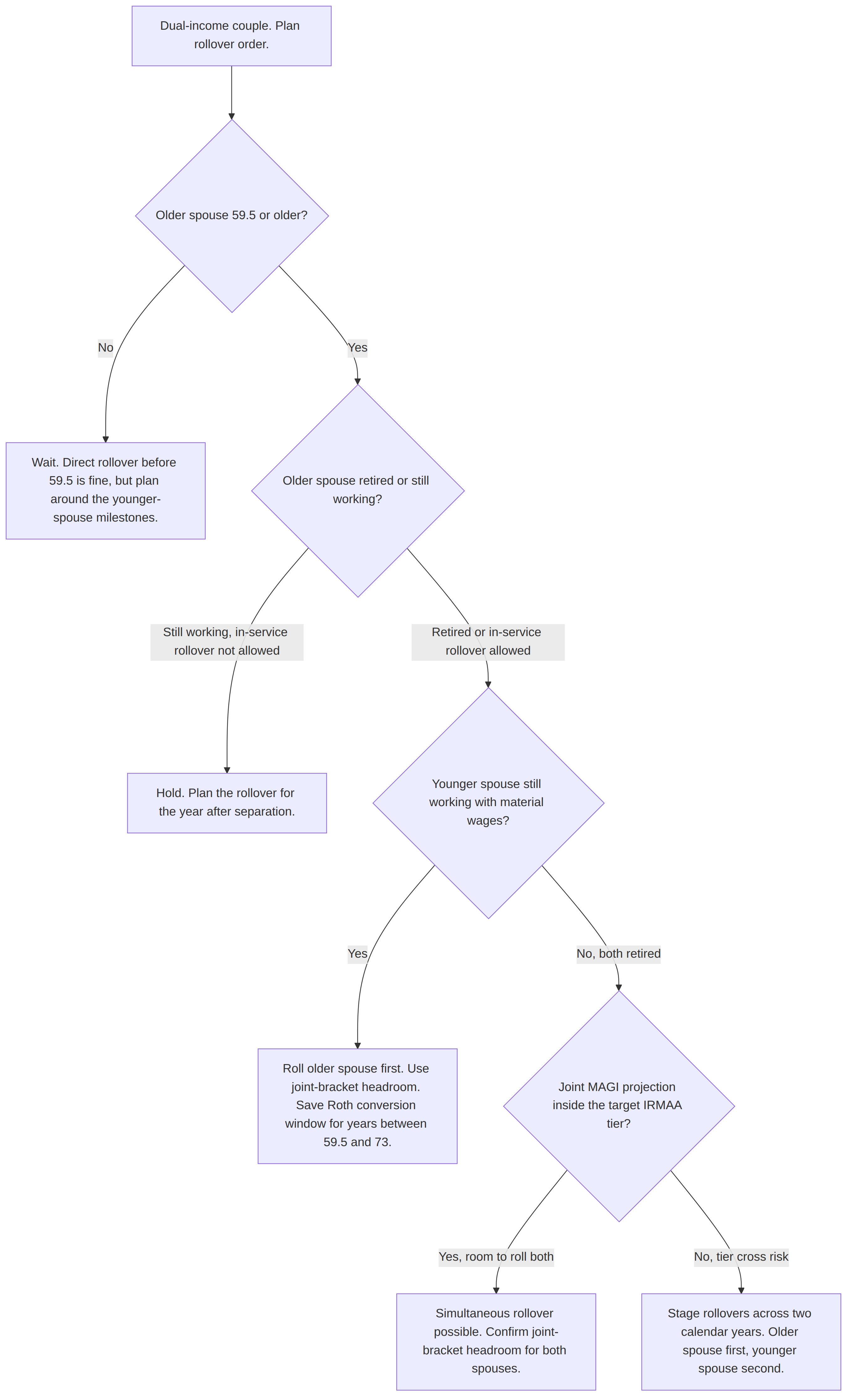
The Mermaid diagram is navigable as text for assistive technology. Couples with a 5-year-plus age gap and a still-working younger spouse exit through the older-spouse-first branch most often. In those years the joint return is dominated by the younger spouse’s wages, and the rollover plus a partial Roth conversion fits inside the existing bracket.
Couples with both spouses already retired, or both within a year of each other, can sometimes proceed on a simultaneous schedule. That works particularly when the planned rollover amount is small relative to baseline pension and Social Security income.
Couples where the older spouse is already past 73 and taking RMDs face a different calculus entirely; the rollover then has to accommodate the existing RMD schedule, which the next section covers.
Eight-step procedural sequence for a coordinated couples rollover
For a dual-income couple choosing the older-spouse-first path, the procedural sequence below covers eight discrete steps from the joint planning meeting to bullion arrival at the depository. The path means rolling the older spouse’s eligible workplace balance into a gold IRA while holding the younger spouse’s accounts for a later calendar year. Each step has a per-spouse paperwork trail and a specific failure mode if skipped or executed out of order.
- Build the joint timeline on a single sheet. Map both spouses’ 59½ dates, age-63 IRMAA lookback years, age-65 Medicare enrollment dates, and age-73 RMD start dates on one calendar. Mark the years where both spouses will be retired versus the years one is still working. This is the single document the rollover plan keys to.
- Confirm rollover eligibility for the older spouse’s workplace plan. Active employees often cannot roll out of an employer 401(k), 403(b), or 457(b) before separating; in-service rollovers are sometimes allowed at age 59½ per the plan’s summary plan description (SPD). Confirm the rule in writing from the plan administrator before assuming the rollover is available.
- Calculate the joint-bracket headroom for the rollover year. Project the couple’s joint taxable income for the planned rollover year (including the younger spouse’s wages, both spouses’ pension income, any investment income). Identify the dollar amount that fits inside the current marginal bracket without pushing into the next one. This is the maximum taxable amount the rollover plus any concurrent Roth conversion should produce.
- Execute a direct trustee-to-trustee rollover from the workplace plan to a Traditional IRA in the older spouse’s name. Use the plan’s direct-rollover election form; this produces an IRS Form 1099-R coded G (direct rollover, no withholding). Avoid the indirect rollover route, which subjects the distribution to mandatory 20% withholding under IRC §3405(c) and the once-per-12-month rule under Bobrow v. Commissioner (T.C. Memo. 2014-21).
- Open a self-directed IRA (SDIRA) at a gold-friendly custodian. Equity Trust, STRATA Trust, Madison Trust, and Kingdom Trust are the most common SDIRA custodians for precious-metals accounts. The SDIRA must be Traditional to receive a pre-tax governmental or private-sector workplace-plan rollover without triggering conversion tax.
- Initiate a trustee-to-trustee transfer from the Traditional IRA to the SDIRA. This is an IRA-to-IRA transfer, not a rollover, and is not subject to the Bobrow once-per-12-month indirect-rollover rule. Use the SDIRA custodian’s transfer form. Allow 2 to 4 weeks.
- Purchase IRS-eligible bullion through the SDIRA custodian. Eligible metals are defined in IRC §408(m)(3): gold of 99.5% purity, silver of 99.9%, platinum and palladium of 99.95%, plus a narrow list of legal-tender coins. The dealer invoices the SDIRA custodian, not the older spouse personally.
- Schedule the younger spouse’s parallel rollover for a later calendar year. Document the planned year and the planned joint-bracket headroom calculation for that year. Reassess in the year before execution: the younger spouse’s earned income, the older spouse’s Social Security claiming decision, and the joint return composition often change between the two rollover years and require a recalculation.
Dual RMD coordination after age 73
Once both spouses are 73 or older, each spouse’s IRAs (including the self-directed gold IRA) generate independent required minimum distributions calculated under IRC §401(a)(9). Each spouse’s RMD must be withdrawn from that spouse’s own accounts; one spouse cannot satisfy the other spouse’s RMD obligation, even though the couple files jointly.
The RMD aggregation rule under Treasury Regulation §1.408-8 allows a spouse with multiple IRAs to compute the total RMD across all of their own IRAs and take the full amount from any one of them. The aggregation does not cross to the other spouse.
For a self-directed gold IRA, the RMD must be funded with cash. That means either selling bullion in the SDIRA custodian’s account each year or holding a cash sleeve inside the SDIRA sufficient to cover the projected RMD.
The IRS allows in-kind RMDs, meaning you distribute the bullion itself rather than cash. The bullion’s fair market value at the date of distribution is the taxable amount. After distribution, the bullion is no longer inside the IRA wrapper.
Couples often pair the gold-IRA RMD with a Roth conversion. In years where the joint bracket has room, the older spouse takes the RMD and then converts an additional amount to Roth at the same marginal rate. That reduces the future RMD base over time.
The penalty for missing an RMD was 50% of the shortfall before SECURE 2.0 Act §302. The Act reduced it to 25%. It drops further to 10% if the shortfall is corrected within a correction window of two years.
The IRS will waive the penalty entirely on Form 5329 if the missed RMD is corrected and the couple provides a reasonable cause statement. None of these reductions change the planning imperative: missing an RMD is an avoidable error, and couples with two RMD obligations have twice the surface area.
Before either spouse picks a gold IRA custodian
The two most expensive couples-rollover mistakes both happen at the same point: when one spouse picks a precious-metals dealer before the joint timeline is drawn on a single page. Most dealers do not have a couples-coordination desk and will recommend identical paperwork for both spouses on the same call. The few that recognize the age-gap, RMD, and IRMAA interactions (and the BBB ratings, complaints, and dispute records behind them) sit on our 2026 shortlist.
IRMAA bracket management for both spouses
The IRMAA Medicare Part B and Part D premium surcharge uses each spouse’s MAGI from two tax years prior to determine the current year’s premium tier. For couples filing jointly, both spouses fall into the same MAGI tier because the lookup is on joint MAGI.
The result is that a rollover or Roth conversion in a single tax year can raise both spouses’ Medicare premiums two years later, even if the conversion was attributed to only one spouse’s account.
The bracket structure for 2026 runs from a base premium tier (joint MAGI under the first threshold) through five additional tiers. The highest tier adds several thousand dollars per spouse per year to Part B and Part D premiums.
The planning consequence is that gold IRA rollovers and concurrent Roth conversions should be sized to keep joint MAGI inside the target IRMAA tier. This is especially important in the years a spouse turns 63 and 64, which are the two-year-lookback years for Medicare enrollment at 65. The same discipline applies every year thereafter.
Couples sometimes accept a higher IRMAA tier in a single planning year to execute a larger conversion, then return to the base tier in subsequent years.
The math is fact-specific but the principle is uniform. A rollover that crosses an IRMAA threshold by a small dollar amount can cost the couple a four-figure annual premium surcharge for both spouses for one or more years. Splitting the rollover into two calendar years often eliminates the threshold cross.
Worked example: Bob (60) and Carol (58) with a $1.5 million combined balance
Consider a dual-income couple in Virginia: Bob at 60 (recently retired, $800,000 in a private-sector 401(k)) and Carol at 58 (still working, $50,000 wages, $700,000 in a 403(b) at her employer). The practical rollover question is when to move each balance. It also involves deciding how much of each to allocate to a self-directed gold IRA versus keeping in a mainstream Traditional IRA for liquidity.
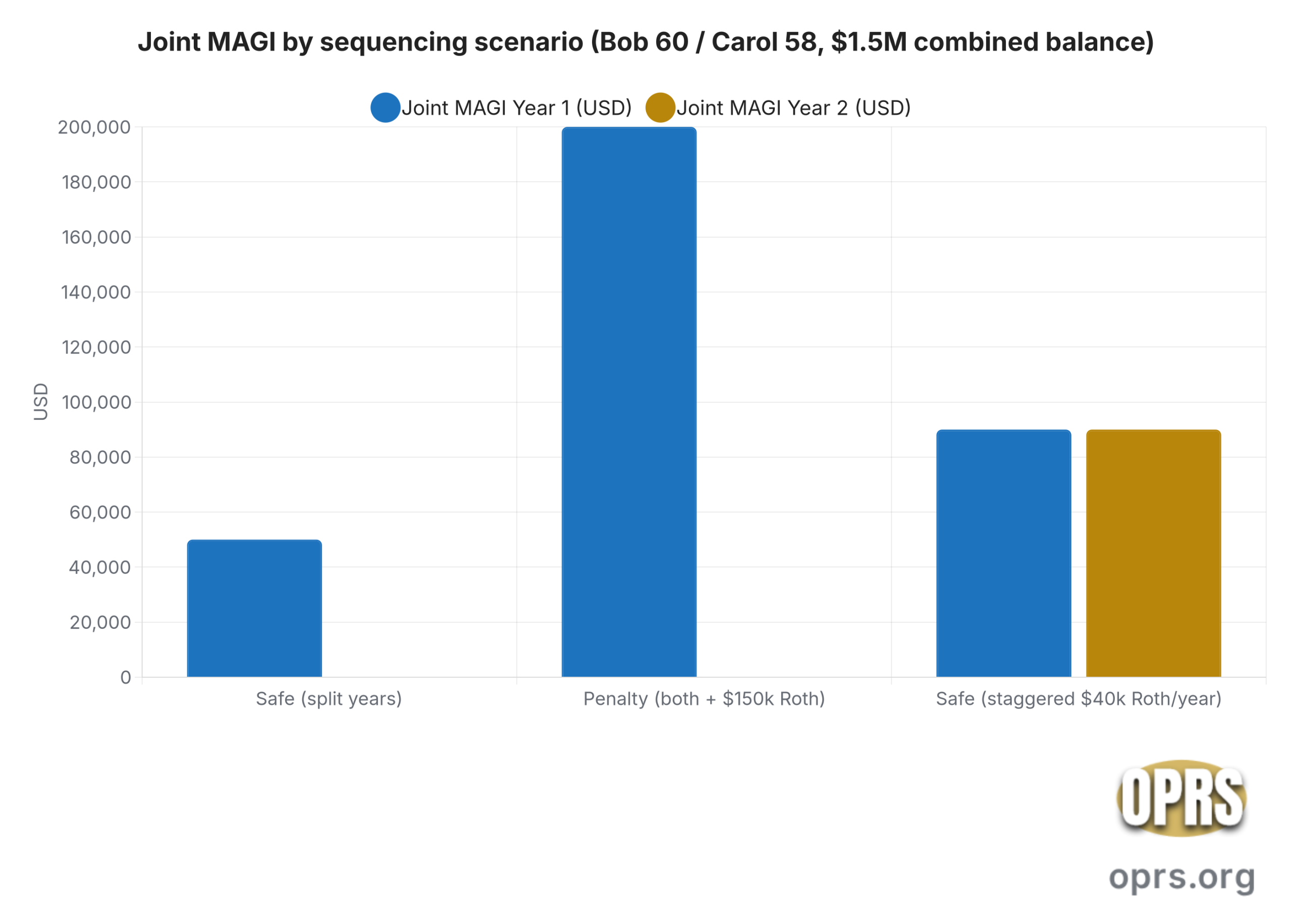
The table below compares three sequencing choices over a 5-year window. Tax assumptions use the 2026 joint-filing federal brackets at 22% marginal and ignore Virginia state tax. The IRMAA threshold assumed is the first-tier joint-MAGI cap.
| Sequencing choice | Joint MAGI in rollover year | IRMAA exposure for Bob at 65 | Roth conversion headroom preserved |
|---|---|---|---|
| (Safe) Year 1: Roll Bob’s $800K to Traditional IRA + $200K to gold SDIRA, no concurrent Roth conversion. Year 4: Roll Carol’s $700K after she retires. | ~$50K (Carol’s wages only; direct rollover not taxable) | Base tier (joint MAGI well under first threshold) | Full 59½-to-73 window preserved for staged Roth conversions in Years 2-13 |
| (Penalty) Year 1: Roll both spouses simultaneously + convert $150K of Bob’s IRA to Roth in same year. | ~$200K (Carol’s wages plus the $150K Roth conversion taxable income) | One or two tiers above base in 2 years (Bob’s IRMAA tier locks at age 65 based on age-63 MAGI) | Conversion executed in highest-bracket year; remaining headroom in Years 2-13 reduced by the Year 1 consumption |
| (Safe) Year 1: Roll Bob’s $800K to Traditional IRA + $200K to gold SDIRA + convert $40K to Roth (inside 22% bracket). Year 2: Convert $40K again. Year 4: Roll Carol’s $700K. | Year 1: ~$90K. Year 2: ~$90K. | Base tier maintained through the two-year IRMAA lookback for Bob’s age 65 | Conversions spread across 13 years at the lowest available joint bracket, with Carol’s rollover in Year 4 timed after her retirement to capture an even lower bracket |
The middle row is what happens when a dealer recommends a simultaneous rollover for both spouses and pairs it with an aggressive Roth conversion in the same calendar year.
The bottom row spreads the older spouse’s rollover and a measured Roth conversion across the first two years while delaying the younger spouse’s rollover until after she retires. That approach captures the joint-bracket headroom each year and avoids the IRMAA tier cross. The choice depends on the couple’s appetite for sequencing complexity and on the still-working spouse’s income trajectory.
For a couple where the younger spouse plans to keep working into the older spouse’s RMD years, the older-first split is almost always the lower-tax outcome.
Five mistakes that compound across two spouses
Each of the mistakes below has cost dual-income couples tax dollars they could have kept. The corrections are mechanical: the failure mode is always at the same coordination or timing step.
- Rolling both spouses on the same call to the same dealer in the same calendar year. The simultaneous schedule packs both rollovers into one tax year, often pushing joint MAGI through an IRMAA threshold and consuming the lower-bracket Roth conversion years that the staged schedule preserves. Correction: separate the rollover plans by calendar year and key each to the spouse-specific milestone (older spouse’s 59½, younger spouse’s separation date, joint-bracket headroom in the rollover year).
- Using an indirect rollover when a direct trustee-to-trustee rollover was available. The Tax Court’s Bobrow v. Commissioner decision and the IRS’s resulting one-per-12-month aggregate rule (Announcement 2014-15) treat all of a taxpayer’s IRAs as a single IRA for the indirect-rollover limit. A second indirect rollover within 12 months is fully taxable plus the 10% penalty if under 59½. Correction: always use the plan’s direct-rollover election form. Direct rollovers are unlimited and not subject to the 12-month rule.
- Storing precious metals at home after a successful rollover. The Tax Court’s McNulty v. Commissioner (157 T.C. No. 10, 2021) decision treats home storage of IRA-titled bullion as a deemed distribution of the entire IRA balance, plus the 10% §72(t) penalty if under 59½. The McNultys owed $322,302 in tax and $34,932 in penalties on a single account. For a couple with two SDIRAs, the exposure doubles. Correction: require written confirmation that the bullion is held at an IRS-approved third-party depository, with the depository receipt issued to the SDIRA custodian, for each spouse’s account.
- Failing to update beneficiary designations after the rollover. Both Traditional IRAs and SDIRAs require their own beneficiary designations independent of the workplace plan they were rolled out of. A surviving spouse who inherits an IRA without a designation in place may face probate, a less favorable distribution schedule, or both. Correction: file new primary and contingent beneficiary forms with the receiving Traditional IRA custodian and the SDIRA custodian within the same week as the rollover. Confirm the spouse is named as primary beneficiary on both accounts unless an estate-planning attorney has specifically recommended a trust as beneficiary.
- Forgetting that each spouse’s RMD is computed separately and must come from that spouse’s accounts. A couple where both spouses are 73 or older and one has an $800,000 gold SDIRA while the other has a $400,000 mainstream Traditional IRA cannot satisfy the larger spouse’s RMD by drawing from the smaller spouse’s account. Each spouse calculates and withdraws their own RMD. Correction: at the start of each RMD year, compute each spouse’s RMD separately. The aggregation rule under Treasury Reg. §1.408-8 allows a spouse to draw their entire RMD from any one of their own IRAs, but does not cross spousal lines.
Frequently asked dual-income couples rollover questions
If only one spouse has a workplace plan and the other has only an existing IRA, who rolls first?
The spouse with the workplace plan typically rolls first. The workplace plan is the source of the rollover, while the existing IRA does not need to roll anywhere. It can transfer directly to a self-directed IRA whenever the couple is ready.
The decision is driven by the workplace-plan spouse’s separation date, age relative to 59½, and the joint-bracket headroom in the rollover year. If the workplace-plan spouse is younger and still actively employed, the other spouse’s existing IRA often moves first as an SDIRA transfer for the gold-exposure portion. The workplace-plan rollover is then deferred until after separation.
The order is fact-specific and should be drawn on the joint timeline before either election is signed.
Does the 60-day indirect rollover rule apply per spouse or per household?
Per spouse, but with an important wrinkle. The 60-day window in IRC §408(d)(3)(A)(i) applies to each individual taxpayer’s distribution; one spouse’s 60-day clock does not affect the other spouse’s. However, the once-per-12-month limit established in Bobrow v. Commissioner and codified in Announcement 2014-15 aggregates all of one taxpayer’s IRAs but does not cross to the other spouse.
Each spouse can therefore execute one indirect rollover per 12 months independently. The far safer practice for couples is to use direct trustee-to-trustee rollovers for both spouses, which avoid both the 60-day window and the 12-month limit entirely.
If one spouse dies during the rollover process, can the surviving spouse complete the rollover?
The mechanics depend on where the funds are at the date of death. If the funds are still in the workplace plan, the surviving spouse can typically elect a spousal rollover under IRC §402(c)(9) and roll the inherited balance into the surviving spouse’s own IRA.
If the funds are mid-flight (already left the workplace plan but not yet in the IRA), the executor and the receiving custodian have to coordinate the completion.
If the funds are already in a Traditional IRA in the deceased spouse’s name, the surviving spouse can elect to treat the inherited IRA as their own under Treasury Reg. §1.408-8 Q&A 5, which is generally the most favorable post-death treatment.
Both the Traditional IRA and the SDIRA require independent beneficiary designations; the survivor’s election is exercised separately on each account.
Can the younger spouse use an inherited-IRA rule to delay RMDs after the older spouse’s death?
A surviving spouse who is the sole designated beneficiary has options that no other beneficiary has.
Under SECURE 2.0 Act §327, the surviving spouse can elect to be treated as the deceased spouse for RMD purposes. That allows the survivor to use the deceased spouse’s age and the more favorable Uniform Lifetime Table divisors at that age. The result is lower required distributions from the inherited account.
The alternative is the spousal rollover (treating the inherited IRA as the survivor’s own), which delays RMDs until the survivor’s own age-73 year. The choice depends on the age gap, the size of the inherited balance, and the survivor’s other income. Couples should walk through both scenarios on the joint timeline as part of the rollover plan.
Does the gold IRA itself create joint ownership, or is each spouse’s SDIRA single-owner?
Each spouse’s IRA, including the self-directed gold IRA, is single-owner by definition. The Internal Revenue Code does not allow joint-ownership IRAs. The couple’s coordinated rollover plan produces two separate SDIRAs, one in each spouse’s name, with the bullion in each held in a segregated or commingled (per the custodian’s account terms) sub-account at the IRS-approved depository.
The beneficiary designation on each SDIRA is what creates the survivorship link at death: typically each spouse names the other as primary beneficiary, with children or a trust as contingent beneficiaries.
The single-owner structure also means each spouse can make independent decisions about bullion allocation, custodian choice, and distribution timing within their own SDIRA, although couples almost always coordinate these decisions in practice.
More on OPRS
- Spousal inherited IRA: three election options compared. The post-death side of the coordination plan. What a surviving spouse can elect on the deceased spouse’s IRA or SDIRA, and how each election interacts with the surviving spouse’s own RMD schedule.
- Can I move my 401(k) to gold without penalty? The general-purpose primer on workplace-plan rollovers and the 59½ trigger, useful as background before reading this couples-specific page.
- QDRO divorce gold IRA rollover rules. The mirror-image coordination problem: how a workplace plan is divided between two spouses on dissolution rather than coordinated through retirement.
Sources cited
- IRC §72(t)(2)(A)(i): age-59½ early-withdrawal exception (Cornell Law)
- IRC §401(a)(9): Required Minimum Distribution rules (Cornell Law)
- IRC §402(c)(9): surviving-spouse rollover rights (Cornell Law)
- IRC §408(d)(3)(A)(i), §408(m)(3): IRA rollover rules and IRS-approved precious metals (Cornell Law)
- SECURE 2.0 Act of 2022, Public Law 117-328: §107, §302, §327 RMD age and spouse election updates (Congress.gov)
- Treasury Regulation §1.401(a)(9)-9: Uniform Lifetime Table for RMD calculations (eCFR)
- Treasury Regulation §1.408-8: IRA distribution and beneficiary election rules (eCFR)
- IRS Announcement 2014-15: one-per-12-month indirect IRA rollover aggregation rule (IRS.gov, IRB 2014-16)
- Bobrow v. Commissioner, T.C. Memo. 2014-21: one-per-12-month indirect rollover rule (ustaxcourt.gov)
- McNulty v. Commissioner, 157 T.C. No. 10 (2021): home-storage gold IRA rejected by the U.S. Tax Court (ustaxcourt.gov)
- Medicare.gov: Medicare costs including Part B premiums and IRMAA surcharge brackets (Medicare.gov)
- Social Security Administration POMS HI 01101.010: IRMAA two-year MAGI lookback methodology (SSA.gov)
- U.S. Census Bureau: dual-earner household and retirement savings data (Census.gov)