

Updated: August 14, 2026
OPRS may receive compensation when readers open an account through partner links on this page. Our analysis is based on independent research, BBB data, and IRS publications.
Social Security lets you claim your retirement benefit any time between age 62 and age 70. The month you choose changes your check for the rest of your life. It also changes the survivor benefit your spouse will inherit. This guide walks through the arithmetic without any market prediction or product framing.
The rules come from the Social Security Administration (SSA). Every figure below is from an official SSA page, and each source is linked at the end. Nothing here is investment advice.
Full retirement age is the reference point
Full retirement age, or FRA, is the age at which SSA pays your unreduced benefit. FRA depends on your birth year. Anyone born in 1960 or later has an FRA of 67. Anyone born from 1955 through 1959 has an FRA between 66 and 2 months and 66 and 10 months, rising by 2 months per birth year. Anyone born from 1943 through 1954 has an FRA of 66.
Two amounts sit at the center of the math. Your primary insurance amount (PIA) is what SSA pays if you claim exactly at FRA. Your actual monthly check is your PIA adjusted for the month you filed. File before FRA and SSA reduces the check. File after FRA and SSA adds credits.
How SSA computes your primary insurance amount
SSA starts with your 35 highest earning years, indexed for wage growth. The average of those indexed years, expressed monthly, is your average indexed monthly earnings (AIME). PIA is then a piecewise formula on top of AIME.
The formula has three brackets separated by two dollar thresholds called bend points. SSA updates the bend points every year for national wage growth. The percentages themselves never change. They are set in statute at 90 percent, 32 percent, and 15 percent.
PIA equals 90 percent of the AIME dollars below the first bend point, plus 32 percent of the AIME dollars between the two bend points, plus 15 percent of the AIME dollars above the second bend point. This design replaces a much larger share of low earnings than of high earnings. It is the reason Social Security is progressive.
The current-year bend points are published in the SSA benefit formula table. For anyone whose PIA is being computed in 2026, the exact thresholds sit in that table. The numbers below use a labeled illustrative PIA of $2,000, not a real earnings history, to keep the arithmetic transparent.
The early-filing reduction, from age 62 to FRA
SSA applies an actuarial reduction for every month you claim before FRA. Two rates stack. The first 36 months before FRA cost you five ninths of one percent per month. Any additional months before FRA cost you five twelfths of one percent per month.
Convert the monthly rates to yearly figures. Five ninths of one percent per month equals about 6.67 percent per year over the first three years of early filing. Five twelfths of one percent per month equals 5 percent per year for any earlier months. Both stack against your PIA.
Take a worker with an FRA of 67 who files exactly at 62. That is 60 months early. The first 36 months trim 20 percent from PIA. The remaining 24 months trim another 10 percent. Total reduction is 30 percent. The monthly check is 70 percent of PIA for life, before any cost-of-living increase.
A worker with an FRA of 66 filing at 62 is 48 months early. The first 36 months trim 20 percent. The remaining 12 months trim another 5 percent. Total reduction is 25 percent. The monthly check is 75 percent of PIA. The reduction is smaller because there are fewer months of early filing between 62 and an FRA of 66.
The delayed-retirement credit, from FRA to age 70
Anyone born in 1943 or later earns a delayed-retirement credit (DRC) worth 8 percent of PIA per year for every year they postpone past FRA. That is two thirds of one percent per month. The credit accrues monthly, so partial years count.
For an FRA of 67, delaying to 70 adds 36 months of credit. Thirty-six times two thirds of one percent equals 24 percent. The check paid at 70 is 124 percent of PIA. For an FRA of 66, delaying to 70 adds 48 months of credit for a total of 32 percent extra, or 132 percent of PIA.
The credit accrues only through the month you turn 70. Filing after 70 does not add any further credit. This cap is the single most important date in the delayed-retirement rules.
A worked example: a $2,000 PIA across the age range
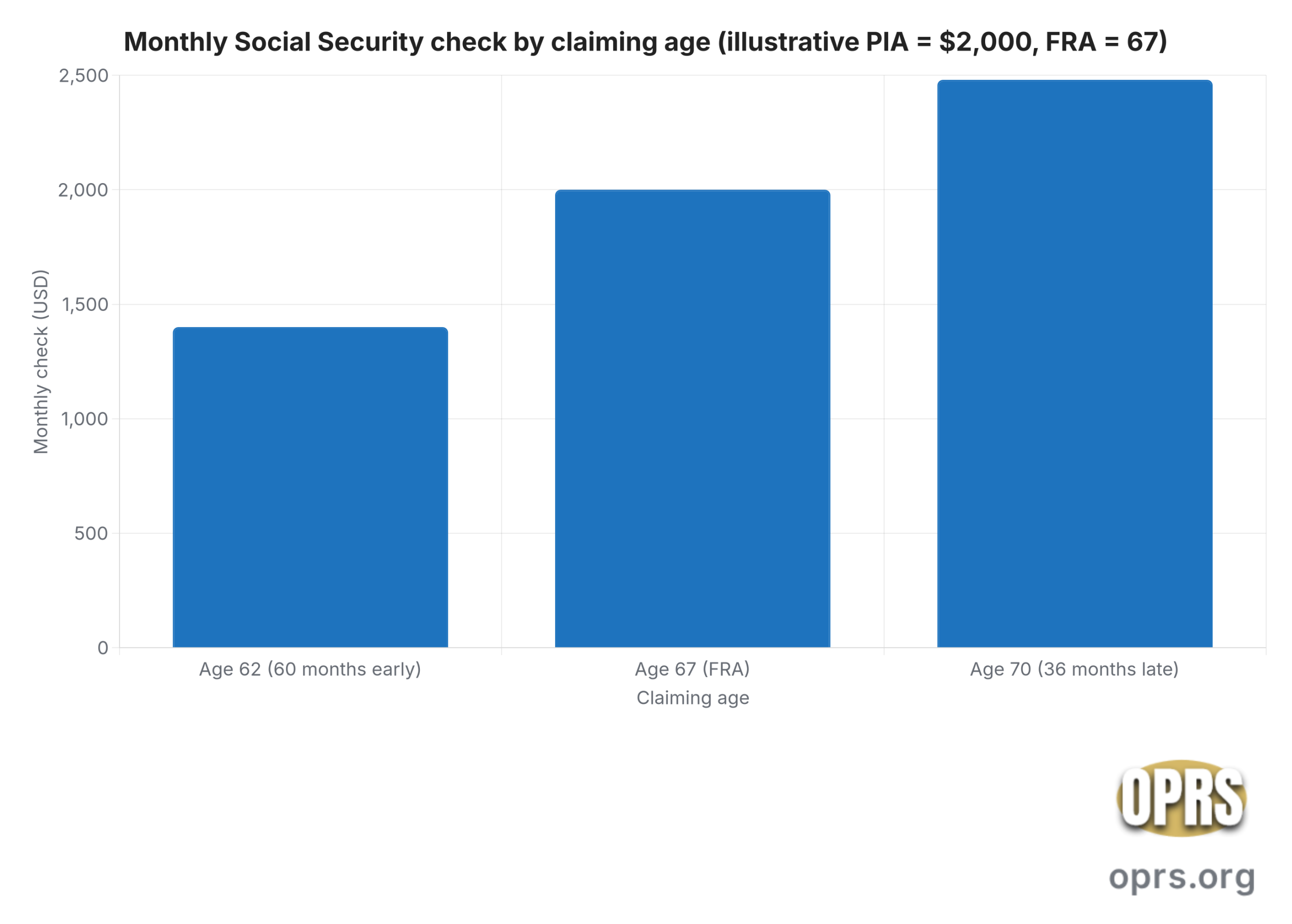
Assume a worker with a labeled illustrative PIA of $2,000 and an FRA of 67. Apply the rules above and the monthly check at three key ages looks like this.
At age 62, the check is 70 percent of $2,000, which is $1,400 per month. At FRA of 67, the check is $2,000 per month, the unreduced PIA. At age 70, the check is 124 percent of $2,000, which is $2,480 per month.
The spread between the age 62 and age 70 checks is $1,080 per month. In percentage terms, the age 70 check is about 77 percent larger than the age 62 check for the same person and the same lifetime earnings record. This gap is fixed by the SSA reduction and credit rules. It is not a market forecast.
The break-even question, without market predictions
Filing early trades a smaller monthly check for more months of collection. Filing late trades fewer months of collection for a larger monthly check. The break-even age is the age at which the total dollars collected under two filing choices are equal.
The pure-arithmetic break-even between filing at 62 and filing at FRA sits in the late 70s for most workers. The break-even between filing at FRA and filing at 70 sits in the early 80s. These are simple accounting figures. They do not include cost-of-living adjustments, investment returns on early checks, or income taxes.
Any real break-even analysis has to account for those factors. Live longer than the break-even and delayed filing pays more in total. Live shorter and early filing pays more. Nobody knows their own longevity in advance, which is why SSA describes the choice as a personal decision, not a math problem with one answer.
Widow and widower benefits and the higher earner
When one spouse dies, the surviving spouse can switch to a survivor benefit if it is larger than their own. The survivor benefit is based on the deceased spouse’s benefit amount, including any delayed-retirement credits earned before death.
This mechanic changes how couples should think about the higher earner’s filing age. If the higher earner delays to 70, the survivor benefit locks in at that higher amount for the rest of the surviving spouse’s life. If the higher earner files at 62 at a reduced amount, the survivor is capped at the reduced figure.
Reduction rules apply if the surviving spouse claims the survivor benefit before their own survivor FRA. Those reduction rules are separate from the retired-worker rules described above. They are documented on the SSA planner for survivors.
Consider a couple where the higher earner has a PIA of $2,000 and an FRA of 67. If the higher earner files at 62, the check is $1,400 per month, and the survivor benefit is capped at that same $1,400 figure.
If the higher earner instead delays to 70, the check is $2,480 per month, and the survivor benefit tracks that larger figure. The gap of $1,080 per month can persist for many years after the first spouse dies, especially when the surviving spouse outlives the higher earner by a decade or more.
This is why financial planners often frame the higher earner’s filing choice as insurance on the surviving spouse’s income floor, not as an isolated bet on personal longevity. The math of the survivor benefit is the same whether the couple is planning together or the survivor is already alone.
Why the age 70 cap matters
Delayed-retirement credits stop the month you turn 70. There is no financial reason inside the Social Security formula to file after 70. Every month past 70 without filing is a month of a check you could have collected, with no offsetting rule anywhere in the statute that boosts your future amount.
SSA does allow up to six months of retroactive payment when you finally file after FRA, but not after 70 in a way that would restore missed months of DRC. If you plan to delay, mark the month you turn 70 on the calendar and file by then.
Every figure in this guide comes from SSA’s own actuarial and benefits pages, current as of 2026. SSA updates the wage-indexing tables and the bend point thresholds each year. The 90, 32, and 15 percent PIA percentages, the 6.67 and 5 percent per year early-filing reductions, and the 8 percent per year delayed-retirement credit are set in statute and do not change year to year.
Sources cited
- Social Security Administration, Early or Late Retirement (rules on the actuarial reduction for filing before FRA and the delayed-retirement credit).
- Social Security Administration, Benefit Calculation Examples for Workers Retiring in the Current Year (AIME, PIA formula, bend points).
- Social Security Administration, Effect of Early or Delayed Retirement on Retirement Benefits (reduction tables by FRA and worked percentages).