

Updated: July 28, 2026
OPRS may receive compensation when readers open an account through partner links on this page. Our analysis is based on independent research, BBB data, and IRS publications.
A retired police officer or firefighter who separated under a governmental defined-benefit plan between ages 50 and 58 spends the next 15 to 23 years drawing a state pension. A parallel pre-tax retirement balance, typically a governmental 457(b), sometimes a 403(b) or a rollover IRA, compounds untouched during that time.
At age 73, under the SECURE Act 2.0 amendments to IRC §401(a)(9), the Required Minimum Distribution from that parallel balance kicks in and lands on the 1040 alongside the pension annuity.
The two streams now flow concurrently for the rest of the retiree’s life, and the marginal-bracket exposure they create together is permanent unless the retiree did something about it in the gap years.
Element I of the planning is the pre-RMD income inventory. Before any rollover, Roth conversion, or precious-metals reallocation is initiated, the retiree needs to know what each income stream will look like, year by year, from the current age through age 78.
For the upstream rollover mechanics, see our 457(b) governmental rollover versus keep guide and public safety officer age-50 exception guide. The dealer the retiree picks for the eventual gold IRA allocation sets the cost basis that every future RMD calculation hits. A look at which gold IRA companies we warn against belongs in the inventory step too.
Before the rollover decision
The dealer the retiree picks for a gold IRA allocation sets the bid-ask spread that surfaces again at every RMD year. It also sets the storage arrangement that compounds the recurring fee and the custodial reporting that feeds the 1099-R. See the dealers OPRS clears and the ones we warn against before any conversion math is committed to the next eight tax years.
3 of 27+ gold IRA dealers reviewed by OPRS make the 2026 trusted list. Updated July 2026.
The three income streams a retired police officer stacks at age 73
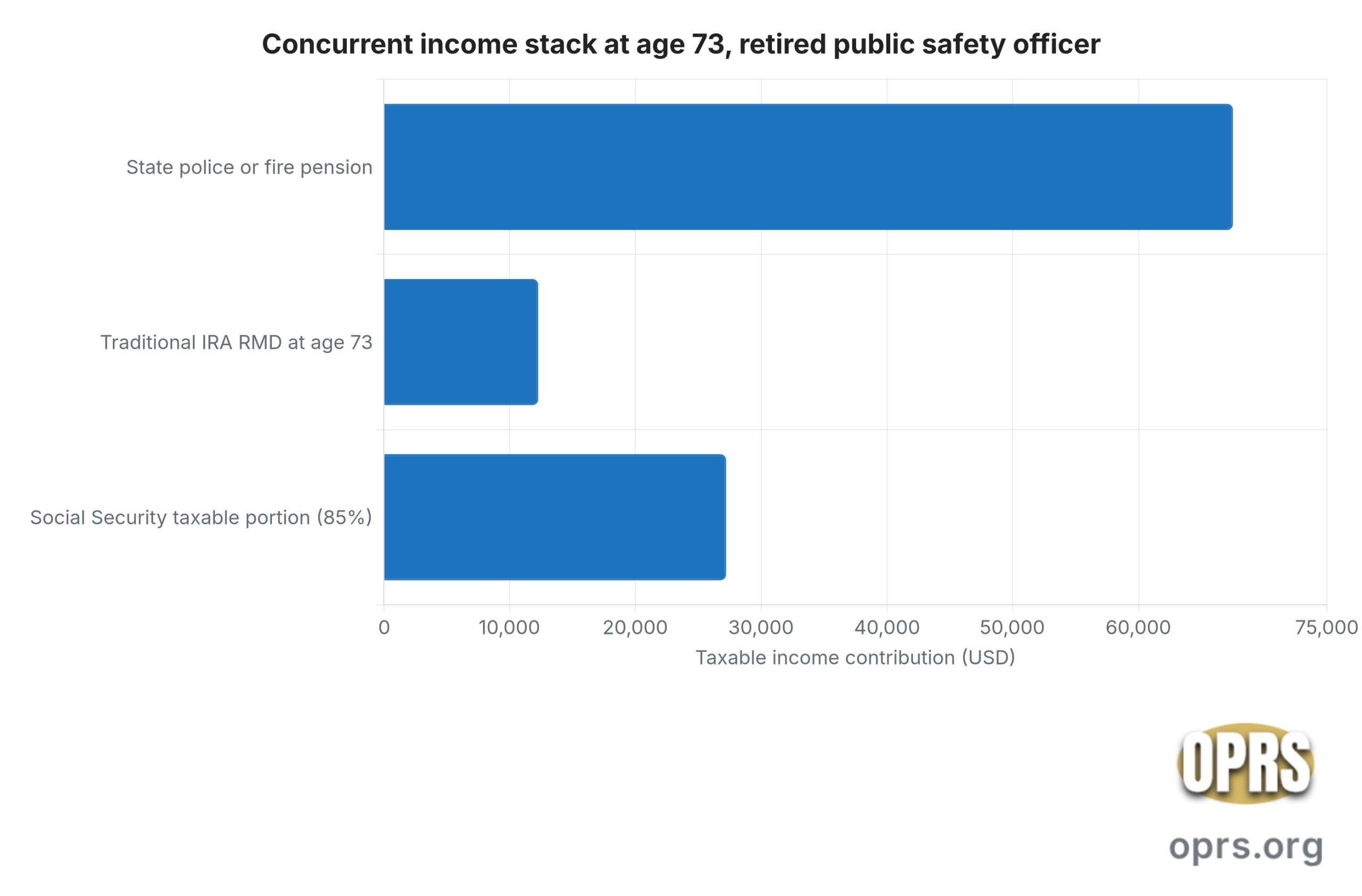
By the time the first RMD year arrives, a typical police or fire retiree who separated at age 50 to 58 reports three distinct income lines on the 1040. Each is governed by a different code section and each interacts differently with the IRMAA tier thresholds. The concurrent flow is what creates the bracket pressure. Isolated, none of the three would push the retiree into a higher tier.
State police or fire pension annuity. Paid monthly by the state retirement system under the applicable governmental plan, this benefit is computed under each state’s formula. Common multipliers run 2.5% to 3.0% of final-average-salary per year of service, with capped multipliers for certain hazardous-duty classifications. The state reports it annually on Form 1099-R.
The full amount is ordinary income for federal tax purposes. State treatment varies, and several states exempt some or all public safety pensions from state income tax. Pennsylvania, Illinois, and Mississippi offer the broadest exemptions for retired police and fire.
A retiree at 25 years of service with a $90,000 final average salary draws roughly $67,500 annually in pension income before any cost-of-living adjustment accrual since separation.
Required minimum distribution from the rolled 457(b) or IRA. The governmental 457(b) balance accumulated during the active-duty years was either left at the plan custodian after separation or rolled to a traditional IRA.
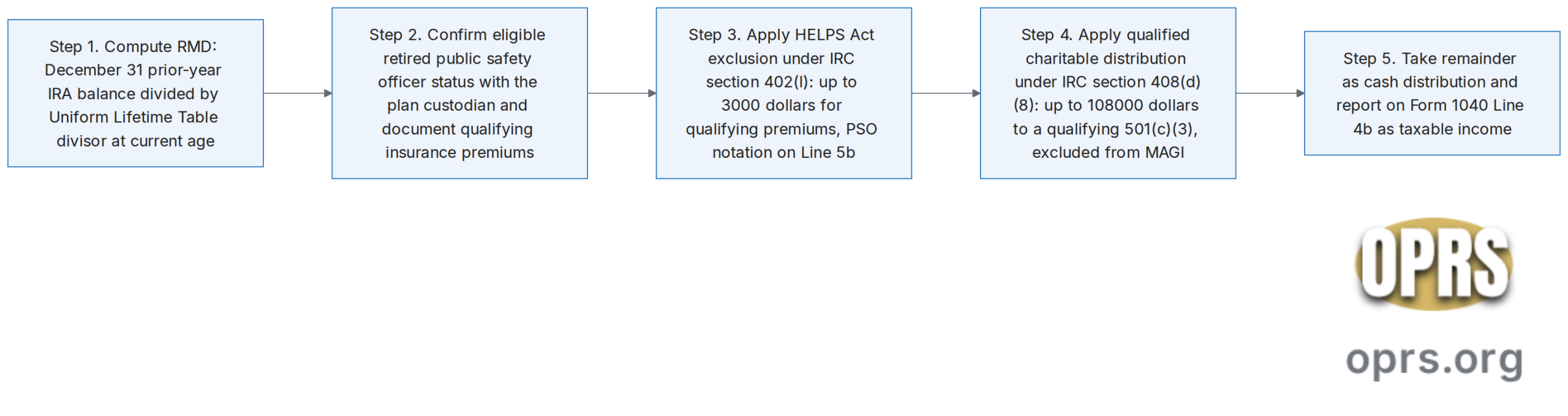
Either way, the retiree turns 73 if born between 1951 and 1959, or 75 if born in 1960 or later. At that point, IRC §401(a)(9) requires the participant to divide the December 31 prior-year balance by the Uniform Lifetime Table divisor for the participant’s age.
At age 73 the divisor is 26.5, which translates to roughly 3.77% of the balance per IRS Publication 590-B, Appendix B. A retiree with $325,000 in the rolled IRA at age 72 takes a first-year RMD of approximately $12,264.
Social Security retirement benefit. For a public safety officer who paid into Social Security during prior or concurrent employment, the benefit begins between age 62 and 70 at the retiree’s election. The taxable portion is computed under IRC §86; up to 85% of the benefit is includable in gross income at higher combined-income thresholds.
For a retiree whose pension alone already exceeds $34,000 of combined income (single filer) or $44,000 (joint), the full 85% inclusion typically applies. The interaction with the RMD is mechanical: every additional dollar of RMD pushes more of the Social Security benefit across the 85% threshold and into taxable territory.
How the concurrent stack pushes a marginal bracket and an IRMAA tier
The combined effect, for the example retiree above, is roughly $67,500 in pension plus $12,264 in RMD plus Social Security at the 85% inclusion rate. A typical Social Security benefit of $32,000 for a high-earning retiree pushes another $27,200 of taxable income onto the return. The total taxable picture reaches approximately $106,964 before any portfolio income or part-time consulting.
Under the 2026 federal brackets the marginal rate at that level is 22% for a single filer, with the upper bracket threshold at roughly $103,350 already crossed.
The Medicare implication arrives two years later. The Income-Related Monthly Adjustment Amount surcharges Medicare Part B and Part D premiums based on modified adjusted gross income from two years prior, per 42 U.S.C. §1395r. The first IRMAA tier for a single retiree begins at $106,000 MAGI; the first tier for a married-filing-jointly retiree begins at $212,000 MAGI.
A retiree whose concurrent pension and RMD push MAGI just above the first tier adds roughly $74 per month to Part B and $13 per month to Part D. That works out to about $1,044 in additional premiums annually. The next tier roughly doubles the surcharge.
The corrective window sits before age 73. Each pre-RMD year is an opportunity to reduce the pre-tax IRA denominator, which reduces every future year’s RMD and the IRMAA exposure that follows it. The Roth conversion executed in that window is the planning instrument the retiree controls; the pension and the Social Security claim age are largely fixed by the time the RMD arrives.
Precious metals IRA required minimum distribution (RMD) estimator
Once required minimum distributions begin (age 73 now, 75 starting 2033), you divide the prior year-end balance by an IRS life-expectancy factor. The result is taxed as ordinary income on your federal return and, in most states, your state return. You can take a precious metals IRA RMD in cash or in metal.
Estimate only, not tax advice. Uses the IRS Uniform Lifetime Table (most owners). A spouse more than 10 years younger and sole beneficiary uses a different table. Roth IRAs have no lifetime RMD. Sources: IRS Publication 590-B (Table III); IRS RMD FAQs. Consult a tax advisor.
The right dealer explains every fee up front. Get Augusta's free precious metals IRA company checklist.
The HELPS Act $3,000 exclusion specific to retired public safety officers
Under IRC §402(l), an eligible retired public safety officer may exclude up to $3,000 per year from gross income. The distribution must come from a governmental defined-benefit plan, governmental 457(b), or qualified IRA. It must be paid directly to the provider of accident, health, or long-term care insurance covering the retiree, the spouse, or a dependent.
The exclusion was originally enacted by the Pension Protection Act of 2006. The Securing a Strong Retirement Act of 2022, commonly the SECURE 2.0 Act, expanded it to allow indirect reimbursement of the retiree as well, beginning in tax years after December 31, 2022.
The retiree reports the exclusion on Form 1040 by entering the gross distribution on Line 5a and the reduced taxable portion on Line 5b. The notation “PSO” goes on the dotted line, per the Form 1040 instructions.
The mechanics interact directly with the RMD. The $3,000 excluded amount counts toward the RMD requirement but does not appear in taxable income. A retiree whose first-year RMD is $12,264 and who pays $3,000 or more in health insurance premiums directly from the IRA effectively reduces the taxable portion to $9,264.
The MAGI used for IRMAA also reflects the reduction, which can be the difference between staying inside the first IRMAA tier and crossing into the second.
The HELPS Act path is available only to retired public safety officers as defined in the Public Safety Officers’ Benefits Act. That definition is materially narrower than civilian retirees or uniformed military retirees, both of which are not eligible.
Many IRA custodians do not accept direct premium payments to insurance carriers. That forces the retiree onto the post-SECURE-2.0 reimbursement path: take the distribution, document the premium payment, and report the exclusion on the 1040. Confirm the custodian’s procedure before the rollover, not after.
The Roth conversion window between separation and age 73
When IRC §408A(d)(3) governs the transaction, a taxpayer selects a dollar amount to move from a traditional IRA to a Roth IRA and pays ordinary income tax on that sum in the same year. The pre-tax account shrinks permanently by that amount, and the transferred balance accumulates tax-free inside the Roth going forward.
For a retired police officer who separated at 55 and began drawing the pension immediately, the window between separation and age 73 spans 18 years. Each year of conversion reduces the future RMD by approximately the converted amount divided by the lifetime-table divisor, compounded forward.
Here is what the sizing looks like in practice. A retiree with $325,000 in a pre-tax IRA and $67,500 in state pension, with no Social Security yet claimed, has a gap between pension income and the top of the 22% bracket. For a single filer in 2026, that bracket tops out at roughly $103,350 in taxable income. That gap is approximately $35,850 per year of conversion headroom.
Over 12 conversion years the retiree could move roughly $430,000 at the 22% marginal rate, more than the entire current IRA balance plus reasonable compounding.
A full conversion is rarely the right move. It accelerates the entire tax bill and forfeits the qualified-charitable-distribution option after age 73. Even so, the headroom calculation shows that the gap years are wider than most retirees use.
The two-year IRMAA lookback complicates the timing once Medicare enrollment approaches. A conversion executed at age 63 surfaces in the MAGI two years later, which is the first Medicare year. Retirees often size conversions smaller in the two years immediately before Medicare enrollment and larger in the early window when there is no IRMAA exposure yet.
How the IRC §72(t) PSO age-50 exception sits inside this picture
The IRC §72(t)(10) public safety officer age-50 exception allows a retiree who separated at or after age 50 to take distributions from the source governmental plan without the 10% additional tax. That penalty normally applies before age 59½. The source plan can be the 457(b), the 403(b), or the defined-benefit plan.
The exception was extended by SECURE 2.0 to private-sector firefighters and to certain corrections officers, broadening the original scope. The key operational fact at the RMD planning stage: the exception lives on the source plan, not on the IRA. Once funds are rolled from the 457(b) to a traditional IRA, the standard 59½ rule reapplies to any pre-rollover distributions.
For a retiree planning concurrent income streams at age 73, the gap-year Roth conversion strategy is unaffected by the Section 72(t)(10) exception. By age 73, the retiree is well past 59 and a half in any case.
The §72(t)(10) carve-out matters for retirees who separated at age 50 to 54 and need early access to the source plan before the rollover decision. Once the rollover is complete and the IRA is in place, the exception is irrelevant.
Treating the two distinctly avoids the common error of rolling early to the IRA and then losing access to the exception at 52 or 53.
The QCD route once RMDs begin and the gold IRA structural constraint
Retirees who reach age 73 carrying a residual pre-tax IRA balance can satisfy the RMD requirement through a qualified charitable distribution under IRC §408(d)(8). That election directs up to $108,000 per year (indexed annually under SECURE Act 2.0) straight from the IRA to a qualifying 501(c)(3).
The distributed amount counts toward the RMD, is not reported as taxable income, and is excluded from MAGI for IRMAA purposes.
For a public safety retiree whose pension and Social Security already cover living expenses, the QCD route is a strict improvement over taking the RMD as cash and donating separately. The cash route triggers IRMAA exposure; the QCD route does not.
Gold IRA holders face one constraint with QCDs. The QCD requires the IRA to distribute cash to the charity, so a balance held primarily in physical metal at the depository must be partially liquidated first. That means the dealer’s bid-ask spread surfaces in the QCD path the same way it surfaces in any other distribution.
A retiree who plans to use QCD for the bulk of the RMD should hold enough cash or near-cash inside the IRA to fund the year’s charitable distributions without forcing metal sales at suboptimal moments. The allocation is a planning decision at the gold IRA establishment stage, not a tactical decision in the QCD year.
Tax treatment of the concurrent income stack at age 73
Side-by-side treatment of the three income streams at the first RMD year shows where the marginal-bracket and IRMAA pressure originates. The retiree controls only the rightmost column substantively; the pension and Social Security have minor timing levers but not amount control once claimed.
| Element | State pension | Social Security | Traditional IRA RMD |
|---|---|---|---|
| Governing statute | State retirement code | 42 U.S.C. §402 | 26 U.S.C. §401(a)(9) |
| Reported on | 1099-R Line 5b | SSA-1099 Line 6a and 6b | 1099-R Line 4b |
| Federal taxable as ordinary income (Status) | Yes, fully (Taxable) | Partial up to 85% (Mostly taxable) | Yes, unless QCD or HELPS exclusion (Taxable) |
| Counts in MAGI for IRMAA | Yes | Yes (taxable portion) | Yes unless QCD or HELPS exclusion |
| Retiree control at age 73 | None (fixed annuity) | None once claimed | Conversion history, QCD use, HELPS exclusion |
| RMD age trigger | N/A | N/A | 73 or 75 per SECURE Act 2.0 |
| Death benefit treatment | State survivor option if elected | SSA survivor benefit per rules | 10-year rule for non-spouse beneficiary |
The IRA RMD is the only income stream that responds materially to advance planning. Three instruments control it: Roth conversions in the gap years before 73, the QCD route used annually from age 73 onward, and the HELPS Act $3,000 exclusion paid directly to a qualifying health insurance carrier. The state pension is fixed at separation, and the Social Security amount is locked once claimed.
Where the dealer choice meets the RMD math
A dealer who recommends a high-premium proof-coin allocation or a non-IRS-approved storage arrangement inflates the cost basis that every future RMD calculation runs against. The bid-ask spread on a forced partial liquidation to satisfy the RMD or QCD can be punitive. Check this dealer against the 2026 OPRS list before the rollover paperwork is signed and the metal is purchased.
3 of 27+ gold IRA dealers reviewed by OPRS make the 2026 trusted list. Updated July 2026.
Common concurrent-stack mistakes retired public safety officers make
Five recurring planning errors show up in CPA case files for retired police and fire personnel who reached age 73 with a substantial residual IRA balance. Each has a documented correction path and each connects back to a decision the retiree made (or failed to make) in the gap years between separation and the RMD age.
Mistake 1: rolling the 457(b) to an IRA before age 55. The governmental 457(b) under IRC §457(b) has no early-withdrawal penalty at any age once the participant separates from service.
Rolling the balance to a traditional IRA loses that feature and replaces it with the standard 59½ rule (subject to the §72(t)(10) PSO age-50 exception, which lives on the source plan). For a retiree who separated at 52 and may need IRA access at 54, the rollover should wait.
Correction: leave the 457(b) at the governmental custodian until the retiree is past the age where early access matters.
Mistake 2: skipping the gap-year Roth conversion entirely. A retiree who reaches age 73 with the full pre-tax balance intact pays the marginal bracket rate on the RMD every year for the rest of life expectancy.
Conversion at 22% in a gap year is cheaper than distribution at 24% or 32% in an RMD year for most retirees whose pension and RMD combined push above the first IRMAA tier. Correction: build a multi-year conversion model beginning the year of separation, sized to fill the current marginal bracket to its top each year.
Mistake 3: claiming Social Security at 62 to avoid touching the IRA. An early Social Security claim locks in a permanently reduced benefit (roughly 70% to 75% of the full retirement age amount) and shifts the IRA distribution window deeper into the higher-bracket years.
For most public safety retirees with a state pension already covering living expenses, delaying Social Security to 67 or 70 preserves the gap years for Roth conversion and increases the eventual Social Security benefit. Correction: model the Social Security claim age alongside the conversion schedule rather than treating them independently.
Mistake 4: paying conversion tax from inside the IRA. A retiree who withholds the conversion-year tax from the IRA itself shrinks the post-conversion Roth balance by the amount paid in tax, which defeats part of the purpose. The 10% additional tax does not apply at age 59½ or older, but the opportunity cost compounds for decades.
Correction: pay the conversion tax from non-IRA cash whenever possible. For retirees whose only liquid balance is inside the IRA, smaller annual conversions keep the proportional erosion lower.
Mistake 5: missing the HELPS Act exclusion entirely. The $3,000 exclusion under IRC §402(l) is among the most under-claimed retirement deductions for retired public safety officers. Many tax-preparation packages do not flag the “PSO” notation requirement on the dotted line of Line 5b.
Correction: confirm the eligible-retired-public-safety-officer status with the plan custodian, document the qualifying premium payments (health, accident, long-term care), and report the exclusion explicitly on the 1040 with the “PSO” notation. The exclusion is permanent across years; once claimed, it should appear on every future return through the retiree’s lifetime.
Frequently asked questions
Does my state police or fire pension count toward my RMD?
No, the state defined-benefit pension is paid as a lifetime annuity from the state retirement system and does not interact with the RMD calculation. The RMD is computed solely on the December 31 prior-year balance of the qualified retirement account (traditional IRA, rolled 457(b), or 403(b) maintained outside an in-service annuity), divided by the Uniform Lifetime Table divisor. The pension stream is a separate annuity payment that satisfies its own actuarial design.
Can I use the HELPS Act $3,000 exclusion alongside the QCD?
Yes, the two are independent. The HELPS Act exclusion under IRC §402(l) covers up to $3,000 of qualifying health or long-term care premiums. The QCD under IRC §408(d)(8) covers up to $108,000 (indexed) of direct charitable distributions. Both reduce the taxable portion of the RMD and both reduce MAGI for IRMAA.
A retiree with $12,264 of first-year RMD could route $3,000 through HELPS to insurance premiums and $5,000 through QCD to a qualifying 501(c)(3). The remaining $4,264 would be taken as cash. Only the cash portion appears as taxable income and counts in MAGI.
Should I roll my 457(b) to a gold IRA before age 73?
Not automatically. The rollover decision should be sequenced after the conversion schedule is built and the early-access scenarios from age 50 to 55 are mapped against the §72(t)(10) PSO exception.
For a retiree who is past 59½ and does not need source-plan access, the rollover to a self-directed gold IRA can proceed. The dealer selected at that stage will set the recurring cost structure for every future RMD year. A high-spread dealer compounds the friction; a transparent-pricing dealer keeps the RMD math clean.
What happens to my gold IRA RMD if the balance is largely physical metal?
The RMD is a dollar amount, not a metal allocation. The custodian satisfies the RMD by selling a portion of the metal at the depository and distributing cash. Alternatively, the custodian can make an in-kind distribution that ships metal to the participant at fair market value on the distribution date.
The bid-ask spread on the partial sale is the friction cost, and the dealer who quoted a wide spread at acquisition is the dealer whose spread surfaces again at every RMD distribution. The dealer choice at acquisition determines the recurring RMD cost for the next 15 to 25 years.
Does the HELPS Act exclusion apply to my spouse’s coverage?
Yes. The IRC §402(l) exclusion covers premiums for accident, health, or long-term care insurance for the retired public safety officer, the officer’s spouse, and the officer’s dependents. The qualifying premiums can be paid directly from the eligible plan to the insurance provider, or (post SECURE 2.0) reimbursed to the retiree from the eligible plan against documented premium payments. The $3,000 annual cap applies across all covered family members combined, not per person.
Sources cited
- IRS Publication 590-B: Distributions from Individual Retirement Arrangements (IRAs)
- 26 U.S.C. §401(a)(9), Required Minimum Distribution rules under SECURE Act 2.0
- 26 U.S.C. §402(l), HELPS Act exclusion for retired public safety officers
- 26 U.S.C. §72(t)(10), Public safety officer age-50 separation exception
- 26 U.S.C. §408(d)(8), Qualified charitable distribution from IRAs
- 26 U.S.C. §408A(d)(3), Rollovers from IRAs to Roth IRAs (conversion mechanics)
- 26 U.S.C. §457(b), Governmental deferred compensation plans
- 42 U.S.C. §1395r, Income-Related Monthly Adjustment Amount (IRMAA) for Medicare Part B
- IRS Form 1040 Instructions, Line 5b “PSO” notation
The planning deliverable is a multi-year income projection. It lists, year by year, the state pension annuity with COLA accrual, the projected Social Security claim age and amount, and the planned Roth conversion sized to the top of the current marginal bracket. It also tracks the projected pre-tax IRA balance at year-end, the projected RMD beginning at the SECURE Act 2.0 age, and the planned HELPS Act and QCD usage from age 73 forward.
The projection feeds the dealer-selection decision. A dealer whose pricing adds friction to every future RMD undoes the planning. Keeping the account clean for the surviving spouse and the next generation is the framing that organizes the entire sequence. Dealers who support that framing belong on the shortlist; operators who do not belong off it.