

Updated: July 28, 2026
OPRS may receive compensation when readers open an account through partner links on this page. Our analysis is based on independent research, BBB data, and IRS publications.
30-second verdict
- For a 60-65 retiree with appreciated RSUs, NUA stock, or a lump-sum-bonus year and an itemizable cash position, the DAF is the right tool now: immediate itemized deduction, multi-year grant pacing, no age gate.
- For a retiree at age 70.5 or older with a six-figure traditional IRA or gold IRA balance facing an RMD, the QCD is the right tool then: the distribution stays out of AGI, reduces IRMAA exposure, and counts toward the RMD.
- QCDs cannot be directed to a DAF, supporting organization, or private foundation. The statute under IRC section 408(d)(8) explicitly excludes those three destinations.
- Overall: a HNW retiree usually runs both tools in sequence, not as substitutes. The DAF carries the charitable intent across the gap years from 60 to 70.5; the QCD takes over for life from age 70.5 forward.
A retired executive at 61 with a $1.8 million traditional IRA, vested RSUs, and a frozen-pension stream rarely benefits from choosing a single charitable vehicle. A Donor Advised Fund or a Qualified Charitable Distribution each serves a distinct role when charitable intent runs into the high five figures.
The two tools resolve different tax problems at different points on the retirement timeline, and the cleanest plan usually sequences them: DAF in the high-income years before RMDs begin, QCD from age 70.5 onward.
This page walks through what each tool can and cannot do for a gold IRA retiree. We cover the tax math at common giving levels and the sequenced strategy the OPRS desk most often sees work for high-net-worth pre-retirees in the 60-to-65 window.
Before any dealer conversation that ties a charitable element to a precious metals purchase, see our running list of the gold IRA dealers we currently warn rollover savers against. Charitable framing is a common pressure script on six-figure accounts.
Before you sign
The DAF-versus-QCD decision is a tax-architecture problem, not a dealer-selection problem. Vet the dealer first against operators we rule out before committing any IRA dollars to a charitable framing they suggest.
3 of 27+ gold IRA dealers reviewed by OPRS make the 2026 trusted list.
The two tools at a glance
The table below is the side-by-side that most HNW retirees see for the first time when their CPA introduces the QCD and the DAF in the same meeting. Every figure here cites the statute or the IRS publication directly; nothing is industry-reported.
| Criterion | Donor Advised Fund (DAF) | Qualified Charitable Distribution (QCD) |
|---|---|---|
| Authorizing statute | IRC section 4966 (DAF definition); section 170 (deduction) | IRC section 408(d)(8); SECURE 2.0 section 307 indexing |
| Minimum age | None | 70.5 (the half-year matters; not 70) |
| Annual cap | None on contribution; AGI deduction caps apply (60% for cash, 30% for appreciated long-term securities) | Around $108,000 per person per year (indexed from $105,000 in 2024) |
| Source of funds | Cash, appreciated public securities, closely held stock, real estate, crypto | Direct from a traditional IRA, inherited IRA, or self-directed gold IRA only |
| Eligible destinations | Any qualified 501(c)(3) public charity recommended by the donor | Public 501(c)(3) charities only; not DAFs, supporting orgs, or private foundations |
| Income tax treatment | Itemized deduction in the year of contribution (subject to AGI cap, 5-year carryforward) | Excluded from AGI; no itemized deduction (and no need for one) |
| RMD interaction | None; DAF contributions do not satisfy the RMD | QCD counts toward the RMD up to the annual cap |
| IRMAA interaction | Reduces AGI only via itemized deduction (if itemizing); does not exclude from MAGI | Excludes the distribution from AGI and MAGI; direct IRMAA-tier benefit |
| Split-interest carve-out | Not applicable | One-time election up to roughly $54,000 (indexed from the 2024 figure of $53,000) to a charitable remainder trust, charitable gift annuity, or pooled income fund |
| Grant pacing | Donor recommends grants over multiple years on the donor’s schedule | Annual; each tax year is its own QCD opportunity, no carryforward |
| Estate planning fit | Successor advisor named at the DAF; legacy grants can run for years | Annual giving only during life; estate-planning value is the IRMAA and RMD reduction, not the legacy mechanism |
Precious metals IRA required minimum distribution (RMD) estimator
Once required minimum distributions begin (age 73 now, 75 starting 2033), you divide the prior year-end balance by an IRS life-expectancy factor. The result is taxed as ordinary income on your federal return and, in most states, your state return. You can take a precious metals IRA RMD in cash or in metal.
Estimate only, not tax advice. Uses the IRS Uniform Lifetime Table (most owners). A spouse more than 10 years younger and sole beneficiary uses a different table. Roth IRAs have no lifetime RMD. Sources: IRS Publication 590-B (Table III); IRS RMD FAQs. Consult a tax advisor.
The right dealer explains every fee up front. Get Augusta's free precious metals IRA company checklist.
Donor Advised Fund: what it does for a gold IRA retiree
A Donor Advised Fund is a separately identified account at a public sponsoring 501(c)(3) (Schwab Charitable, Fidelity Charitable, Vanguard Charitable, or a regional community foundation). The donor contributes cash, appreciated public securities, restricted stock, or other complex assets; the sponsoring charity takes legal control; the donor retains advisory privileges to recommend grants over time. Contribution is irrevocable.
Deduction is taken in the contribution year subject to AGI caps of 60% for cash and 30% for long-term appreciated securities, with a five-year carryforward.
Why a HNW pre-retiree at 60 to 65 typically funds a DAF first: those years, between corporate retirement and the RMD start at 73, are usually the lowest-bracket window a HNW saver will see. That is the right time to act.
Add an RSU vesting cliff, a Net Unrealized Appreciation election on employer stock, or a deferred-compensation payout, and a single year can carry a tax bill the DAF deduction can directly offset. The DAF lets the retiree front-load multiple years of charitable intent into one high-income year while pacing actual grants across the next decade.
Why the appreciated-asset feature is decisive: consider a 60-year-old who contributes $50,000 of appreciated employer stock with a $10,000 cost basis to a DAF. That move avoids the long-term capital gains tax on the $40,000 of appreciation: 15% or 20% federal plus the 3.8% net investment income tax for higher-income filers. The full $50,000 itemized deduction at fair market value still applies.
The DAF route is the single most efficient way to move concentrated employer stock toward a charitable goal before the gold IRA conversation begins. See our breakdown of RSU concentration risk and diversification into a gold IRA for the parallel non-charitable sequencing.
The trade-off: the DAF is not a tax-free retirement vehicle. The deduction is only useful if the retiree itemizes, and the DAF does nothing to address the RMD problem that arrives at 73. The DAF is the right tool for the gap years; the wrong tool for the RMD-and-IRMAA management problem that takes over at 70.5 and 73.
Qualified Charitable Distribution: what it does for a gold IRA retiree
A Qualified Charitable Distribution is a direct transfer from a traditional IRA, inherited IRA, or self-directed gold IRA to a qualified 501(c)(3) public charity. The IRA custodian sends the funds directly; they never pass through the IRA owner’s hands. The QCD became permanent under PATH 2015 and was expanded by SECURE 2.0 in 2022 to index the annual cap and to permit a one-time split-interest election. Statute: IRC section 408(d)(8). Operative guidance: IRS Publication 590-B.
The age 70.5 trigger: the IRA owner must have attained age 70.5 on the distribution date. This is the half-year, not 70 or 73. SECURE and SECURE 2.0 raised the RMD start age (to 72 then 73), but Congress did not raise the QCD age.
That creates a planning gap from 70.5 to 73 where the QCD is available but no RMD is yet required. You can begin pulling IRA balances out at the AGI-excluded rate before the RMD machinery forces AGI higher.
Why a HNW retiree at 70.5+ runs the QCD every year: the QCD does two things no other charitable tool does. First, it counts toward the RMD up to the annual cap.
Second, the QCD excludes the distribution from AGI and MAGI. That directly reduces the IRMAA premium tier on Medicare Parts B and D. A $50,000 QCD by a 73-year-old single filer with a $1.8 million IRA can move the filer down two IRMAA tiers. Over a Medicare lifetime, that is a five-figure premium savings on top of the federal income tax saved.
The annual cap and the split-interest carve-out: the cap was $105,000 per person in 2024 and indexes annually under SECURE 2.0 section 307. For 2026 the cap is roughly $108,000 per person (verify at IRS retirement-plan limits). A separately indexed one-time election allows up to roughly $54,000 (from a $53,000 base) to fund a split-interest entity: charitable remainder annuity trust, charitable remainder unitrust, or charitable gift annuity. This SECURE 2.0 expansion was not available before 2023.
The hard limit: the QCD cannot be directed to a Donor Advised Fund, a supporting organization under IRC section 509(a)(3), or a private foundation. The statute explicitly excludes those three destinations. A retiree who has built a DAF in the high-income years cannot use the QCD to add to it.
The DAF and the QCD on the same six-figure charitable goal
Take a $50,000 annual charitable goal and run it through both tools. Assume a single filer at 73 with a $1.8M IRA and an RMD of approximately $67,900 (based on the Uniform Lifetime Table divisor of about 26.5 for age 73). Add $40,000 of other taxable income from pension and Social Security, and a standard-deduction year. The chart below shows AGI and IRMAA outcome under three strategies.
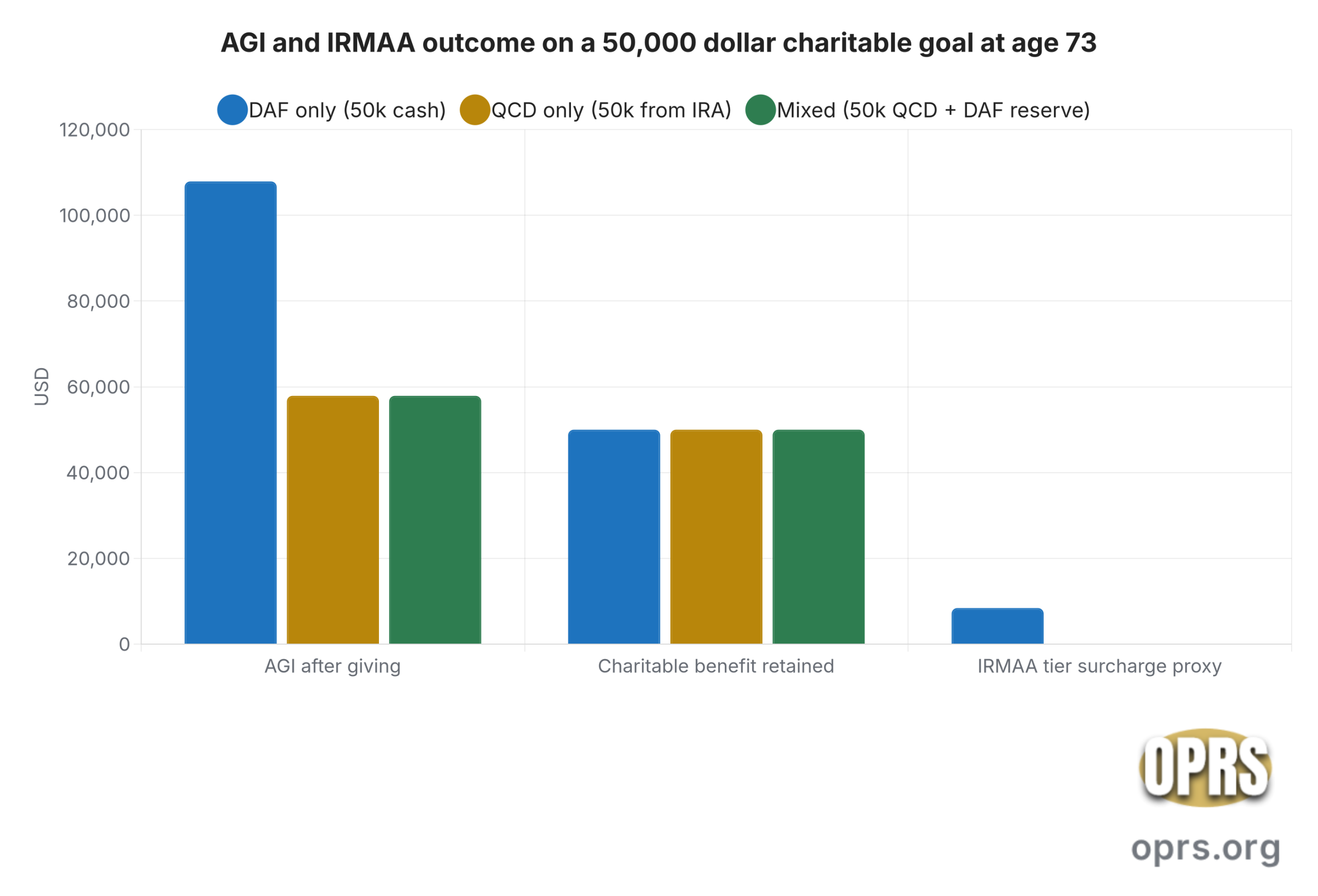
The QCD-only path keeps AGI roughly $50,000 lower than the DAF-only path because the IRA distribution is excluded rather than deducted. For a retiree whose itemized total barely exceeds the standard deduction, the DAF contribution often produces a smaller real tax benefit than the headline number suggests.
The QCD works whether the retiree itemizes or not, which is why it is the dominant charitable tool from age 70.5 forward for any IRA owner with an RMD obligation.
The mixed-strategy column shows what most HNW retirees actually do: maximum QCD against the RMD up to the annual cap, then top up remaining intent from the DAF funded in the gap years.
The sequenced strategy: DAF in the 60s, QCD from 70.5 forward
The procedural sequence below is the one the OPRS desk most often sees work for a HNW retiree in the 60-to-65 window who carries a charitable intent into the post-RMD years. It treats the DAF and the QCD as a two-stage charitable pipeline rather than competing tools.

Stage 1 runs from retirement to age 70.5 and uses the DAF to capture the high-income years before any RMD pressure. Stage 2 starts the calendar day of the retiree’s 70.5 birthday and runs for life, using the QCD against the IRA balance and the gold IRA balance directly.
Stage 3 is the optional one-time split-interest election under SECURE 2.0 if the retiree wants a life-income stream paired with a remainder gift to charity. The split-interest election is usually deferred to age 75 or later because the actuarial value of the income stream improves with age.
Where a self-directed gold IRA fits the QCD mechanics
A self-directed gold IRA is a traditional IRA for tax purposes; the QCD rules apply identically. The custodian (not the dealer) executes the QCD by directing cash from the IRA to the named 501(c)(3). Two practical wrinkles matter at the custodian level.
First, the IRA cash balance must cover the QCD on the distribution date. If the gold IRA is fully invested in bullion, the custodian must first liquidate enough metal at the prevailing dealer bid that day, re-introducing the bullion-spread cost.
For QCDs approaching the annual cap, the spread can be a four-figure number; FINRA’s investor insight on precious metals notes that dealer pricing is rarely transparent and the bid-ask gap is borne by the seller. Retirees planning a recurring annual QCD usually keep one cap’s worth of cash in the IRA.
Second, the custodian’s Form 1099-R reports the gross distribution and the taxable amount (Box 2a) as the same figure. The QCD exclusion is claimed on the retiree’s Form 1040 by writing “QCD” next to the IRA distribution line and reducing the taxable amount accordingly. The custodian does not adjust the 1099-R; the exclusion is a taxpayer-side election.
A retiree who does not flag the QCD on the return will be double-taxed by the IRS matching system. Publication 590-B sets out the reporting mechanics.
When the DAF is the wrong tool and the QCD is the wrong tool
The two tools rule each other out in specific situations, and a retiree who picks the wrong one wastes capital that does not come back. The clearest disqualifiers in each direction:
The DAF is the wrong tool when:
- The retiree does not itemize. The 2026 standard deduction (roughly $15,750 single over 65; roughly $31,500 plus age add-ons MFJ) is high enough that many HNW retirees with paid-off homes never itemize. A DAF contribution by a non-itemizer produces no current tax benefit.
- The retiree is already over 70.5 with a six-figure IRA and an RMD obligation: the QCD is strictly better (counts toward the RMD and excludes from AGI).
- The retiree wants the gift to count toward the RMD; only QCDs do.
- The charitable goal is to fund a private foundation, supporting organization, or another DAF.
The QCD is the wrong tool when:
- The retiree is under age 70.5. The trigger is statutory; no exception.
- The destination is a DAF, supporting organization, or private foundation.
- The retiree wants to give appreciated stock rather than IRA dollars. The QCD only works from an IRA.
- Annual giving exceeds the QCD cap by a wide margin. Excess should route through a DAF or directly.
- The retiree wants to space the gift over years. The QCD is annual; unused cap does not carry forward.
Verdict by reader profile
Retired executive at 60-65 with vested RSUs, NUA election in progress, $50,000 annual charitable intent: the DAF is the right vehicle now, funded with appreciated RSU shares. Hold for multi-year grant pacing. Begin the QCD program at 70.5 as the primary tool from then on.
Retiree at 73 with a $1.8M IRA, no employer stock, $40,000 annual charitable intent: the QCD is the right and only tool. The DAF would produce no usable deduction against the standard-deduction floor and would not reduce the RMD or the IRMAA tier. Skip the DAF.
Couple in late 60s with $150,000 of annual charitable intent: use the DAF for the next three to five years to capture the gap-year deduction at peak bracket. At 70.5, switch to dual QCDs and let the DAF wind down at preferred grant pace. The DAF is the bridge; the QCD is the destination.
When neither tool fits and the gold IRA conversation is premature
Three situations rule out both tools as the primary charitable vehicle. In each case, pause the gold IRA dealer conversation. First, if charitable intent falls below the standard deduction floor and below the QCD-effective threshold (typically under $15,000 a year), neither tool offers a meaningful tax benefit. Direct cash giving on a non-itemized return is simpler.
Second, if the charitable destination is a private foundation the retiree controls (often a family foundation with adult children as directors), neither tool can fund it. Direct funding from non-IRA assets is the right vehicle.
Third, in the 70.5-to-73 gap window, a Roth conversion sometimes takes priority over the QCD because the conversion fills lower brackets while the QCD fills the still-required-but-not-yet RMD slot. Our Roth conversion ladder gold IRA pre-RMD window walks through the sequencing. The QCD and the conversion compete for the same IRA dollar; order of operations matters.
FAQ
Can a QCD be made from a Roth IRA?
Technically yes, but it is almost never useful. A qualified Roth IRA distribution is already tax-free, so the QCD exclusion adds no tax benefit. The QCD mechanic is built for traditional IRAs (and inherited and SEP IRAs once no further employer contributions are being made), where the distribution would otherwise be ordinary income. Publication 590-B confirms the technical eligibility but the planning answer is to leave the Roth alone and route the QCD from a traditional IRA.
What happens if I take an RMD and then make a QCD later the same year?
The QCD only counts toward the RMD if it is taken before the RMD is satisfied for the year. The first dollars out of the IRA in the calendar year are deemed to be RMD dollars under the IRS “first dollars out” rule.
If the RMD is taken in February and the QCD is made in November, the QCD is a valid QCD (exclusion still applies) but it does not retroactively replace the February distribution as the RMD.
To use the QCD against the RMD, the QCD must be the first distribution of the year or must occur before the RMD is fully satisfied. This is the most common QCD timing error.
Can I contribute metals from my gold IRA to a DAF?
Not directly from the IRA. IRA holdings cannot transfer in kind to a non-charitable account without a taxable distribution. Metals can be liquidated inside the gold IRA, with cash then routed via QCD (if donor is 70.5+) or distributed taxably and then contributed to the DAF in cash.
Separately held bullion outside any IRA can be contributed to a DAF at fair market value, subject to the sponsoring charity’s complex-asset acceptance policy. SEC investor alerts on retail precious metals pricing apply to valuation.
The procedural lever that decides the lifetime tax saving on a high-net-worth charitable plan is the order of operations. Use the DAF in the gap years before age 70.5. Switch to the QCD from 70.5 forward. Let the DAF carry any annual giving above the QCD cap. The gold IRA conversation belongs after this architecture is in place.
A dealer who introduces a DAF or a QCD as part of a bullion sales pitch is conflating two separate problems. The tax architecture and the dealer selection are independent decisions. They should be sequenced separately.
Affiliate disclosure: OPRS may receive compensation when readers open an account through partner links on this page. The DAF-versus-QCD comparison, the statutory references, and the verdict draw from IRC sections 408(d)(8) and 4966, IRS Publication 590-B, and the SECURE 2.0 Act. FINRA and SEC investor alerts, and BBB records, informed the verdict, not any partner relationship.
Augusta Precious Metals: company comparison checklist
Request the Augusta company comparison checklist to vet the dealer on the same criteria the OPRS desk uses before any IRA architecture decision. It covers Money Magazine Best Overall Gold IRA Company 2022 to 2026 and Investopedia Most Transparent Gold IRA Company 2022 to 2026. BBB A+ accredited since 2014 with the zero-complaints reference, and 4,000+ verified 5-star ratings across Trustpilot, Google, and Consumer Affairs.
Industry-reported minimum around $50,000. Current terms reviewed during the free consultation.
Pre-call homework: re-read our list of operators we currently rule out for six-figure rollovers before any consultation. The DAF and QCD architecture must be in place before the bullion conversation.
Sources cited
- IRS Publication 590-B, Distributions from Individual Retirement Arrangements (QCD mechanics, age 70.5 trigger, reporting on Form 1040)
- 26 U.S. Code section 408(d)(8), Qualified Charitable Distribution statute (Cornell Legal Information Institute)
- 26 U.S. Code section 4966, Donor Advised Fund excise tax definition (Cornell Legal Information Institute)
- SECURE 2.0 Act of 2022, section 307 (indexing of QCD annual cap and split-interest carve-out)
- IRS retirement-plan and IRA contribution limits (annual indexing reference)
- FINRA, Investing in Precious Metals (Investor Insight on dealer pricing)
- SEC investor alerts on retail precious metals pricing and valuation