

Updated: August 16, 2026
OPRS may receive compensation when readers open an account through partner links on this page. Our analysis is based on independent research, BBB data, and IRS publications.
A deferred income annuity, or DIA, is the deferred cousin of a single premium immediate annuity (SPIA). Same insurer, same guaranteed lifetime payments, same actuarial math. The one structural difference is timing: the buyer hands over a lump sum today, and income does not start until a chosen future age, most often between 75 and 85. The delay is the whole point.
The Securities and Exchange Commission’s investor education site describes annuities as insurance contracts that provide a stream of periodic payments (investor.gov, Annuities). Within that broad category, the DIA is the plainest way to convert savings today into a guaranteed paycheck that starts in retirement’s later years. This page walks through the mechanics, the tax rules, and the trade-offs a US retiree age 55 to 75 should understand before writing a check.
What a deferred income annuity actually is
A DIA is an insurance contract issued by a life insurance company. The buyer pays a single premium (single-premium DIA) or a series of scheduled premiums (flexible-premium DIA) during the deferral window. In exchange, the insurer promises to pay a guaranteed income stream that begins on a specific future date. That date is fixed at purchase and can typically be pushed forward or pulled back within a contractual window later.
Once income begins, the payments continue for the annuitant’s life, for a set number of years, or for the joint lives of a couple, depending on the option chosen. The contract has no cash surrender value in its purest form. The premium is committed. That commitment is what unlocks the payout advantage described below.
The National Association of Insurance Commissioners publishes consumer material on annuity contracts and the state regulators that oversee them (NAIC Insurance Topics, Annuities). Every DIA sold in the United States is regulated by the state insurance department where the buyer resides, not by the federal government.
Why the deferral period boosts monthly income
Two forces compound during the deferral window and push the eventual payment higher than an immediate annuity purchased at the same start age.
Interest accrual. The insurer invests the premium in its general account (bonds, mortgages, some equities) for the entire deferral period. Even a modest credited rate compounds into a meaningful base by the time payments begin fifteen or twenty years later.
Mortality credits. This is the piece that separates annuities from any other retirement product. A DIA pool is a group of buyers of the same age who commit their premium to the insurer. Some members die before the income start date. Their premium stays in the pool and funds larger payments for the survivors. The longer the deferral, the more members exit the pool, and the higher the survivor payout climbs.
Mortality credits cannot be replicated with a bond ladder or a dividend portfolio. Only an insurer with a large mortality pool can deliver them. That is the economic reason a DIA can pay a higher lifetime rate than any self-managed drawdown strategy on the same principal.
Worked example: $50,000 at 65 with different start ages
Consider a US buyer age 65 with $50,000 to commit to an income stream. Four scenarios sit on the shelf: an immediate SPIA that pays right away, and DIAs that defer the income start to age 70, 75, or 80. The timeline below shows the DIA lifecycle from purchase to income.
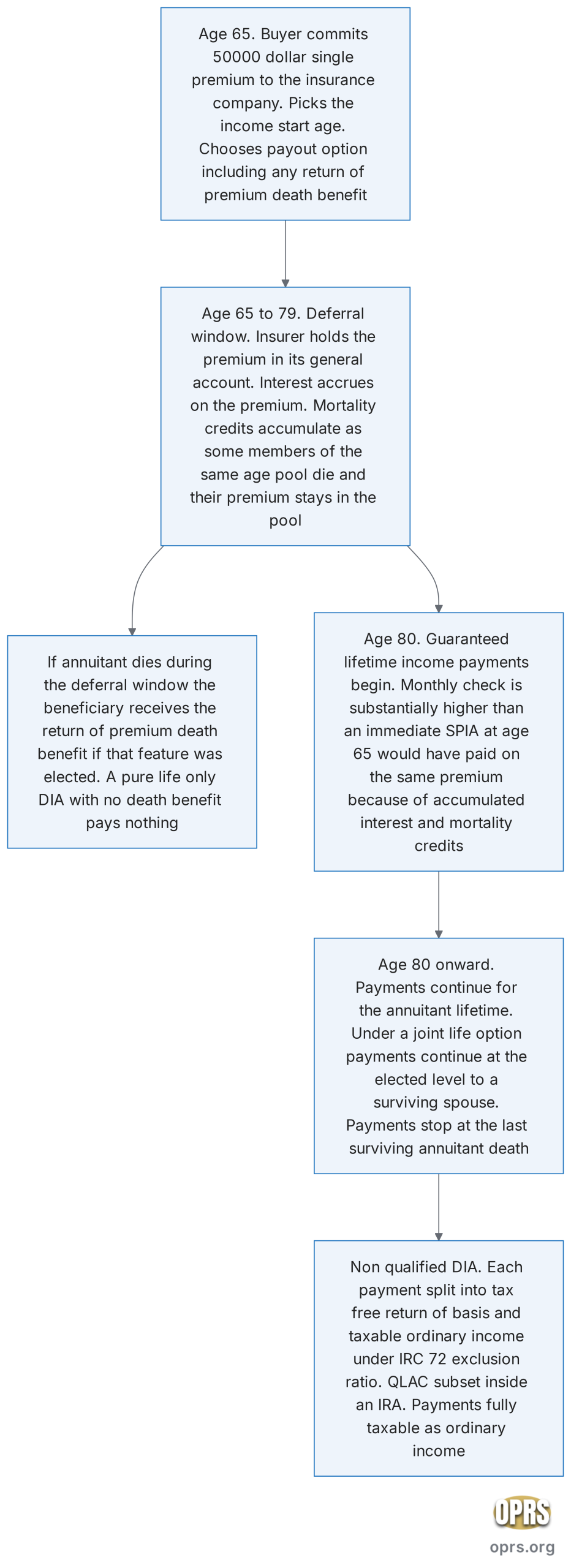
The immediate SPIA at 65 pays the lowest monthly amount. The mortality pool has barely thinned and interest has had no time to compound. A DIA that defers to age 80 pays substantially more per month. Most of the original pool has left the risk pool and the premium has earned interest for fifteen years.
Industry payout quotes for a healthy male age 65 committing $50,000 to a life-only contract can show the age-80 start delivering roughly three to four times the monthly income of the immediate SPIA. Public quote engines and the SEC’s investor education site outline the pattern (investor.gov, Annuities). Exact figures vary by insurer, gender, and rider selection.
The trade is straightforward. A larger check comes with a longer wait and a higher probability of dying before collecting a dime. That risk is what the return-of-premium options below try to soften.
A pure life-only DIA pays nothing if the annuitant dies before the income start date. That is the version with the highest monthly income, because it feeds the mortality pool without a survivor benefit clawback. Most buyers prefer a milder version.
- Cash refund: if the annuitant dies before the total payments received equal the original premium, the insurer pays the difference in a lump sum to the beneficiary.
- Installment refund: same idea, but the balance pays in continued monthly installments rather than a lump sum.
- Period certain: payments are guaranteed to a beneficiary for a set number of years (often 10 or 20), even if the annuitant dies early in the payout window.
- Joint life: payments continue at the same or a reduced level to a surviving spouse.
- Return-of-premium death benefit during deferral: if the annuitant dies before payments start, the insurer returns the premium (with or without interest) to the beneficiary.
Each feature reduces the monthly payment relative to a pure life-only contract. The reduction can range from a few percent (a modest cash refund) to twenty or thirty percent (a joint life with 100 percent survivor benefit). The right structure depends on marital status, health, other guaranteed income sources, and how much the buyer values passing a residual to heirs.
Longevity insurance framing
Academics and financial planners often describe the DIA with a late start date as longevity insurance. The framing is literal: the contract insures the annuitant against outliving other assets. A retiree who buys a DIA at 65 with an age-85 start covers the years when portfolio survival is least certain.
The insurance parallel matters for portfolio design. A buyer typically commits a slice of investable assets to the DIA (some planners suggest 10 to 25 percent) and keeps the rest liquid for the years before the DIA kicks in. The liquid bucket can be drawn down with less caution because a guaranteed floor is set to arrive in the future. The DIA is not a bond substitute; it is a longevity hedge that a bond cannot replicate.
The QLAC subset: a DIA inside an IRA or 401(k)
When a DIA sits inside a Traditional IRA, SEP-IRA, SIMPLE-IRA, or qualified employer plan (401(k), 403(b), 457(b)) and meets specific IRS conditions, it becomes a Qualified Longevity Annuity Contract (QLAC). A QLAC has one tax benefit that a plain DIA in a taxable account does not. The QLAC contract value is excluded from the year-end account balance the IRA custodian uses to compute the required minimum distribution (IRS, Retirement Plans FAQs on RMDs).
The QLAC framework caps the premium at a statutory dollar limit indexed annually by the IRS. Payments must start no later than the first day of the month after the annuitant turns 85. The contract cannot have a cash surrender value and must carry a QLAC endorsement page. Our walk-through of the QLAC mechanics, the SECURE 2.0 changes, and the four-step purchase process is on the dedicated page: QLAC: defer part of your RMD to age 85.
A non-QLAC DIA can still be held inside an IRA. The dollar cap and RMD-exclusion benefit simply do not apply, and the contract counts in the annual RMD computation like any other IRA asset. Most buyers who want the RMD carve-out shop for a QLAC-compliant contract from the outset.
Non-qualified DIAs and the exclusion ratio
When a DIA is purchased with after-tax dollars in a non-qualified (taxable) account, each future annuity payment is split into two parts for federal tax purposes under Internal Revenue Code Section 72. Part of every payment is a tax-free return of the original premium (basis). The rest is taxable ordinary income representing the accumulated interest and mortality credits.
The ratio between the two is the exclusion ratio, calculated at the income start date using the annuitant’s investment in the contract, the expected total return, and the life expectancy under IRS tables. The ratio stays fixed for the annuitant’s normal life expectancy. Once the annuitant outlives that expectancy, the entire monthly payment becomes taxable ordinary income (IRS Publication 575, Pension and Annuity Income).
For a buyer in a moderate tax bracket, the exclusion ratio smooths out the tax bill during the early payout years. For a buyer inside an IRA (QLAC or otherwise), the exclusion ratio does not apply; every payment is fully taxable as ordinary income because the entire premium was pre-tax.
Why DIAs often price better than FIAs on lifetime-income math
A fixed indexed annuity (FIA) with a guaranteed lifetime withdrawal benefit rider markets itself as a comparable lifetime income vehicle. On the pure economics of dollars-per-month for the same premium, a DIA usually wins.
The reason is fee stack. A DIA has minimal features and a low embedded commission (typically 1 to 4 percent of premium at issue). The FIA carries a higher upfront commission (typically 5 to 9 percent), an ongoing rider fee (often 0.9 to 1.25 percent per year of account value), a cap or spread that limits index crediting, and a long surrender schedule. All of that eats into the payout rate the FIA can support on the same premium.
The trade-off is real. An FIA gives the holder ongoing access to a stated account value (subject to surrender charges) and some upside if the linked index rises. A DIA gives up all liquidity and any index participation in exchange for a higher guaranteed check.
A buyer whose only goal is the largest possible late-life paycheck for a fixed premium usually finds the DIA more efficient. Our walk-through of annuity fee mechanics covers the FIA cost stack in detail: annuity fees and commissions explained.
State guaranty association coverage limits
A DIA is only as strong as the insurer standing behind it. If the insurance company fails, the annuitant does not have federal deposit insurance to fall back on. Coverage runs through the state guaranty association of the state where the annuitant resides at the time of insolvency.
Guaranty associations are set up under state law and coordinated nationally through the National Organization of Life & Health Insurance Guaranty Associations (NOLHGA, Policyholder Information). Coverage limits vary by state, but the common floor for annuity present value is $250,000 per annuitant per insurer. Some states go higher.
Two practical rules follow. First, do not concentrate more than the state’s coverage limit with any single insurer; split a large premium across two or more highly rated carriers. Second, check the insurer’s A.M. Best, S&P, Moody’s, or Fitch rating before signing. The state insurance department (accessible through the NAIC directory) can confirm the insurer is licensed in the state.
Frequently asked questions on deferred income annuities
How is a DIA different from a SPIA?
Both are single-premium income annuities from a life insurance company, and both pay a guaranteed lifetime stream. The SPIA starts payments within twelve months of purchase. The DIA starts on a chosen future date, often ten or twenty years out. Longer wait, larger monthly check for the same premium.
Can I cancel a DIA and get my money back?
A pure DIA has no cash surrender value once the state free-look period expires (usually 10 to 30 days after issue, set by state law). Some contracts include an optional cash-refund or commutation feature, which trades a lower monthly payout for the right to walk away later. Without that feature, the premium is committed.
Can I buy a DIA inside a Roth IRA?
Yes for a standard DIA, no for a QLAC. A Roth IRA can hold a regular DIA, and the future payments come out under normal Roth rules (tax-free once the five-year and age tests are met). The QLAC framework specifically excludes Roth IRAs because Roth owners have no lifetime RMDs, so the RMD-exclusion benefit is structurally pointless there.
What happens if the insurance company fails before I collect?
The state guaranty association where the annuitant resides steps in, up to the state’s coverage limit for annuity present value (commonly $250,000). NOLHGA coordinates the process across state lines. Splitting a large premium across two insurers keeps each contract inside the state’s coverage floor.
How are DIA quotes usually compared?
Independent broker quote engines pull rates from multiple insurers on the same input (age, gender, premium, start date, payout option). Compare on monthly income per $1,000 of premium and on the insurer’s financial strength rating side by side. FINRA’s investor material on annuity products is a useful overview for readers unfamiliar with the quote format (FINRA Investor Insights, Annuities).
Where a DIA fits (and where it does not)
A DIA fits when the buyer wants to lock in a guaranteed late-life paycheck. Other liquid assets should cover the years before payments start. The premium is not needed back for any purpose, and there is a reasonable expectation of living well past the income start date. Family longevity, current health, and existing guaranteed income (Social Security, pension) all factor in.
A DIA does not fit for a buyer who might need the premium in an emergency. It also does not fit a buyer whose family history suggests a shorter life expectancy, whose pension and Social Security already cover essential retirement expenses, or who values liquidity over guaranteed income. The IRS RMD guidance is the right place to start reading if the buyer is weighing a QLAC subset inside an IRA (IRS RMD FAQs).
Sources cited
- SEC investor.gov, Annuities (overview of insurance-product annuities)
- IRS, Retirement Plans FAQs Regarding Required Minimum Distributions
- NAIC Insurance Topics, Annuities (consumer information and state adoption)
- NAIC Directory of State Insurance Departments
- Internal Revenue Code Section 72, Annuities (Cornell LII)
- Internal Revenue Code Section 408, Individual Retirement Accounts (Cornell LII)
- IRS Publication 575, Pension and Annuity Income
- IRS Publication 590-B, Distributions from Individual Retirement Arrangements
- FINRA Investor Insights, Annuities Overview
- NOLHGA, Policyholder Information (state guaranty association coverage)
OPRS is not a financial, tax, or legal advisor. DIA contract terms, tax outcomes, and state guaranty association limits are specific; consult a CPA, a licensed insurance professional, and your state insurance department before purchasing any annuity. Past performance is not a guarantee of future results.