

Updated: August 16, 2026
OPRS may receive compensation when readers open an account through partner links on this page. Our analysis is based on independent research, BBB data, and IRS publications.
A fixed indexed annuity is often pitched as a way to get stock-market upside without stock-market losses. The mechanics behind that pitch matter, because three moving parts decide how much of the market you actually receive: the participation rate, the cap, and the spread. Understanding them is the difference between a contract that fits your retirement plan and one you regret at year three.
This page walks through the fixed indexed annuity, or FIA, as its own contract type. The goal is plain-English mechanics, not a product recommendation. Every worked number below appears in the sources cited at the end.
What a fixed indexed annuity actually is
A fixed indexed annuity is a deferred fixed annuity issued by a life insurance company. It sits on the same regulatory chassis as any other fixed annuity. The insurer promises to protect the owner’s principal from declines in the index. Interest is credited each contract period based on the movement of a named equity index, most often the S&P 500, subject to the crediting formula stated in the contract.
The owner is not invested in the index. The insurer holds bonds and hedges that approximate the payoff. That distinction is why FIAs are regulated as insurance products by state insurance departments, not as securities by the federal Securities and Exchange Commission. FINRA licensed agents can sell them, but a separate securities license is not required to solicit a fixed indexed annuity contract in most states.
Principal protection is a floor of zero on index returns, not a guarantee that the account value grows every year. If the index falls, the contract credits zero interest for that period. Contract charges and rider fees, if any, can still reduce the account value even when index performance is flat or negative.
The crediting method vocabulary
Every FIA states its crediting method in the contract. The most common building blocks are annual point-to-point, monthly average, and monthly sum. Each measures the index over the year differently, and each interacts with the participation rate, cap, and spread to arrive at the credit that lands in your account.
- Annual point-to-point. The insurer compares the index value on the contract anniversary to the value one year earlier. If the index is higher, that percentage change feeds into the formula. If it is lower, the credit is zero.
- Monthly average. The insurer averages the twelve monthly closing values of the index over the year, then compares the average to the starting value. This method smooths sharp end-of-year moves in either direction.
- Monthly sum, also called monthly point-to-point. The insurer measures the index change each month, applies a monthly cap to each positive change, keeps negative months at their full value, and sums the twelve results. A single steep down month can wipe out a strong year.
- Participation rate. The percentage of the index gain that the formula recognizes. A 60 percent participation rate on a 10 percent gain credits 6 percent before any cap.
- Cap rate. A ceiling on the credited interest for the period. An 8 percent cap means the credit cannot exceed 8 percent, no matter what the participation rate produces.
- Spread, margin, or asset fee. A percentage subtracted from the calculated gain. A 3.5 percent spread on a 10 percent index change leaves 6.5 percent, before any cap or participation adjustment.
Many contracts allow the insurer to reset the participation rate, cap, or spread each year within a stated minimum. That renewal risk is disclosed in the contract and matters because it can change the economics well before the surrender schedule ends.
A labeled worked example
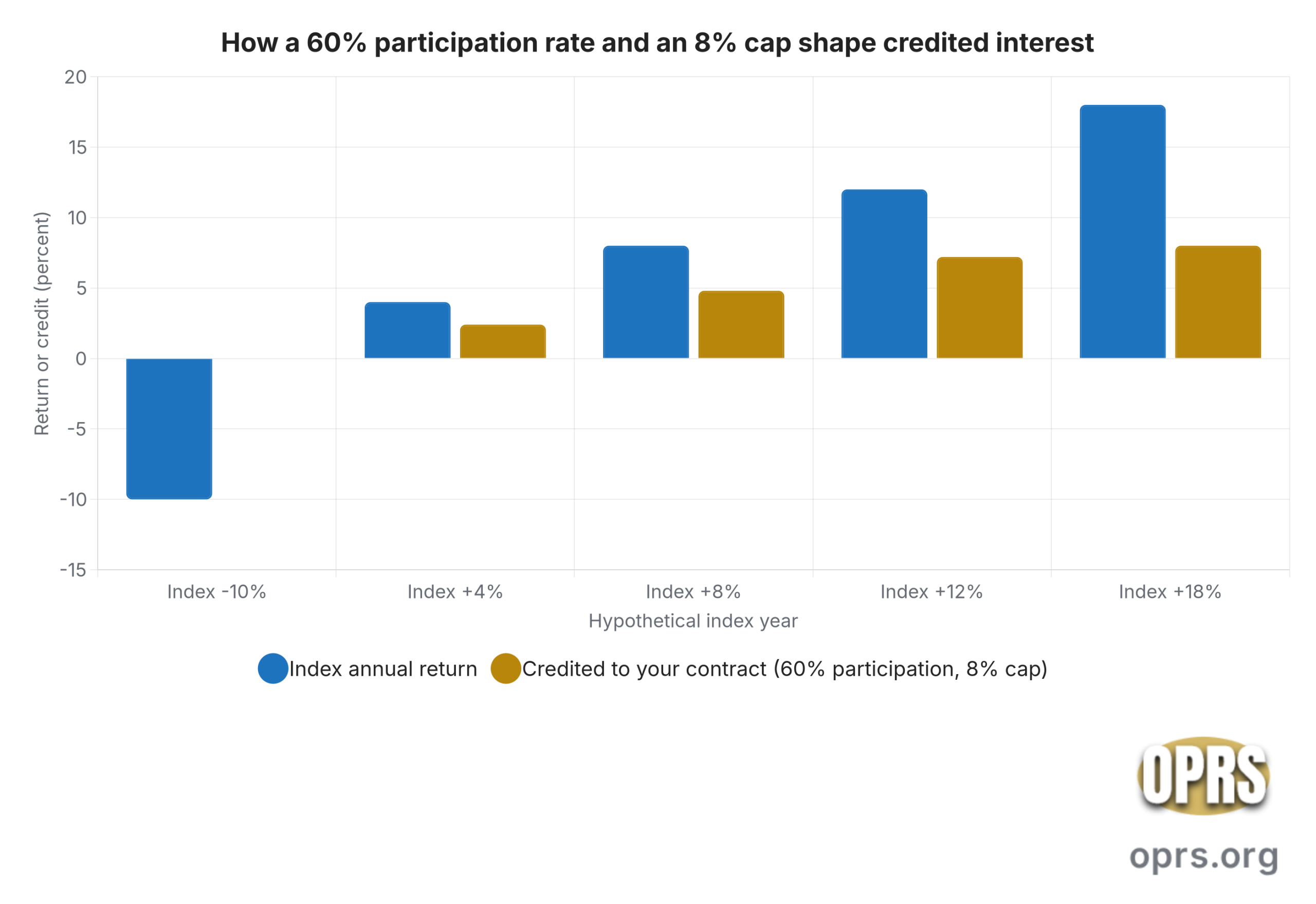
Assume a contract with a 60 percent participation rate, an 8 percent annual cap, no spread, and the annual point-to-point method. The named index rises 12 percent over the contract year.
- Step 1: apply the participation rate. 12 percent multiplied by 60 percent equals 7.2 percent.
- Step 2: apply the cap. The lesser of 7.2 percent and 8 percent is 7.2 percent.
- Step 3: apply the spread. There is no spread in this example, so the credit stays at 7.2 percent.
- Credited interest for the contract year: 7.2 percent.
Now assume the same contract, but the index rises 18 percent. Step 1 produces 10.8 percent. Step 2 applies the 8 percent cap, which becomes the binding constraint. The credit is 8 percent, and the remaining 2.8 percent of participation-adjusted return is retained by the insurer.
If the index falls 10 percent, the credit is zero. The account value does not go down because of index performance, though any rider fee for that year still deducts from the account value.
The chart below shows how the same 60 percent participation rate and 8 percent cap trims a range of hypothetical index years. Read it as illustration, not projection. Historical index behavior does not repeat on schedule, and the specific caps and participation rates in your contract may reset each year.
The guaranteed minimum surrender value
Under the NAIC Standard Nonforfeiture Law for Individual Deferred Annuities, adopted by state insurance departments, an FIA must guarantee a minimum surrender value if the owner walks away. The industry standard is at least 87.5 percent of the premium paid, compounded at a minimum annual interest rate between 1 percent and 3 percent, less any prior withdrawals.
This floor is a legal minimum, not a target. In most years the account value grows above the guaranteed floor because index credits, when they occur, exceed the minimum interest rate. The floor becomes relevant if index credits are zero for several years, or if the owner surrenders during a poor stretch of index performance.
Two account values coexist on any FIA statement: the accumulation value that responds to index credits, and the guaranteed minimum floor that grows at the stated fixed rate. The surrender-value column on the annual statement reflects whichever is higher, less any surrender charge that still applies.
Surrender charges lock the contract for years
Fixed indexed annuities commonly carry surrender charges that decline over seven to ten contract years. A common ten-year layout is 9-8-7-6-5-4-3-2-1-0 percent. The charge applies to any withdrawal above the annual free-withdrawal allowance, which is usually about 10 percent of account value per contract year.
The longer the surrender period, the higher the commission the insurer can pay the selling agent, and the more principal protection the insurer can price into the contract. That trade-off is why a ten-year FIA often shows a more attractive illustration than a five-year contract from the same carrier.
The mechanics of these schedules, the free-withdrawal exception, the state free-look window, and the standard waivers for nursing-home confinement and terminal illness are covered in detail in the OPRS reference on annuity surrender charge schedules explained.
Optional income riders and what they cost
Most fixed indexed annuities offer an optional lifetime income rider, also called a guaranteed lifetime withdrawal benefit or GLWB. The rider carries an annual fee, most often between 0.9 percent and 1.25 percent of the benefit base or the account value, deducted every year the rider is in force. That fee is charged whether the index is up, flat, or down.
The rider maintains a separate benefit base that grows at a stated roll-up rate for a defined period, then serves as the multiplier for a fixed withdrawal percentage based on the age at first withdrawal. The benefit base is a bookkeeping figure. It is not cash, and it cannot be withdrawn as a lump sum.
Two features of income riders are easy to misread. First, the roll-up rate applies to the benefit base, not to the account value the owner sees on the surrender-value column. Second, the withdrawal percentage that later turns the benefit base into income is not a return on money invested. It is a schedule that spreads the benefit base over expected life, adjusted for the insurer’s actuarial assumptions.
Why the hypothetical illustration is not a guarantee
Every FIA sales illustration models future performance using a backcast of a chosen index, applied to the current participation rate and cap. Those numbers are not guaranteed. The insurer can reduce the participation rate, lower the cap, or raise the spread at each contract anniversary, within the minimums stated in the contract.
Backcast returns also depend on the exact ten- or twenty-year window chosen. Two windows over the same index can produce meaningfully different illustrated results. State insurance regulators require the illustration to include a hypothetical worst-case scenario alongside any favorable scenario, and both should be reviewed at signing.
FINRA notes plainly that indexed annuities are difficult to compare to each other because of the variety and complexity of the crediting methods used. A contract that looks best on last year’s index will not necessarily look best in the next ten.
NAIC suitability and the state best-interest standard
Every state has adopted some version of the NAIC Suitability in Annuity Transactions Model Regulation, Model 275. The regulation requires the producer to gather information about the buyer’s financial situation, objectives, and risk tolerance before recommending an annuity, and to document that the recommendation is appropriate.
In February 2020 the NAIC revised Model 275 to add a best-interest standard. Under the revised model, the producer must act in the consumer’s best interest without placing the producer’s or the insurer’s financial interest ahead of the consumer’s. As of 2026 the revised model has been adopted, in whole or in modified form, by a majority of states.
The best-interest standard is not the same as the fiduciary duty imposed on registered investment advisers under the Investment Advisers Act of 1940. It is a suitability-plus rule specific to annuity transactions, enforced by state insurance departments and their market conduct examinations, not by the SEC.
What buyers should ask before signing
The FIA disclosure summary required under state insurance rules names the crediting method, the participation rate, the cap, the spread, and the surrender-charge schedule. Three questions turn that disclosure into a decision an owner can defend three years later.
- What are the guaranteed minimums for the participation rate, the cap, and the spread over the full surrender period, not just the introductory year?
- What is the surrender-charge schedule in years and percentages, and does the schedule extend past my life expectancy or past a foreseeable liquidity need?
- If an income rider is attached, what is the annual fee, is it charged on the benefit base or the account value, and what happens to the benefit base if I take a partial withdrawal?
An agent who cannot answer these three in plain language is describing the wrong contract for a retiree who values transparency. The state insurance department, not the selling firm, is the escalation point if the contract sold does not match the illustration or if a free-look request is delayed.
Sources cited
- FINRA, The Complicated Risks and Rewards of Indexed Annuities, describing participation rates, spreads, interest caps, guaranteed minimum interest rates on at least 87.5 percent of premium, and surrender charge periods common to equity-indexed annuities.
- FINRA, Investors: Annuities overview, defining fixed, variable, and indexed annuity families and the crediting mechanics that distinguish equity-indexed annuities from other indexed annuity forms.
- National Association of Insurance Commissioners, Suitability in Annuity Transactions Model Regulation (Model 275), including the 2020 best-interest revisions requiring producers to act in the consumer’s best interest when recommending an annuity.
- U.S. Securities and Exchange Commission, Indexed Annuities and Certain Other Insurance Contracts release, documenting the SEC’s rulemaking history on when indexed annuities are treated as insurance products regulated at the state level versus federal securities.
- 26 U.S.C. Section 72, Annuities; certain proceeds of endowment and life insurance contracts (Cornell Legal Information Institute), including subsection (q) imposing the 10 percent additional federal tax on early distributions from non-qualified annuity contracts.