

Updated: July 30, 2026
OPRS may receive compensation when readers open an account through partner links on this page. Our analysis is based on independent research, BBB data, and IRS publications.
30-second verdict
- An FLP controlled by the IRA owner’s family is a disqualified person under IRC Section 4975(e)(2)(G) once the family’s combined ownership crosses 50 percent.
- The IRA buying an FLP interest, lending to the FLP, or accepting an FLP guarantee is a prohibited transaction and disqualifies the IRA retroactively to January 1 of that tax year under IRC Section 408(e)(2)(A).
- On a $1M traditional gold IRA the disqualification cost could reach, in illustrative top-bracket scenarios, roughly $320,000 (no state income tax) to $460,000 (high state income tax) before any penalty on the FLP side; actual exposure varies with bracket, state law, and timing; consult a tax advisor.
- The defensible structure is parallel tracks: the FLP holds family operating assets, the gold IRA holds IRS-approved bullion under IRC Section 408(m)(3), neither transacts with the other, and the dealer chain on the gold IRA side is screened against the OPRS 2026 list.
- Augusta Precious Metals sits on the OPRS shortlist with a verified 4-award stack; the company-comparison checklist is the operative screen before any custodian-to-custodian work touches a HNW retiree’s bullion leg.
Family Limited Partnerships and self-directed gold IRAs both surface inside high-net-worth estate plans for the same reason. Each one isolates a category of value, operating assets in the FLP and IRS-approved bullion inside the IRA wrapper, and routes the tax treatment through a distinct set of statutory rules.
Trouble starts when the family reads the two vehicles as one balance sheet and asks the IRA to do work that touches the FLP. See the dealers OPRS clears and the ones we warn against before any custodian or counsel conversation routes value across the two structures. The operational chain on the gold IRA side decides how clean the prohibited-transaction analysis stays when the FLP attorney drafts the next restructuring memo.
Element I of the framework is the disqualified-person determination under IRC Section 4975(e)(2), the test that decides whether the FLP is on the IRA’s no-go list. Element II is the prohibited-transaction catalog under IRC Section 4975(c), the six categories of conduct that trigger the rule.
Element III is the consequence stack under IRC Section 408(e)(2), the retroactive distribution that wipes IRA status. Element IV is the safe-harbor structure: parallel tracks, documented arms-length boundary, and dealer-side screening. This guide walks each layer in the order a HNW retiree at 65 to 70 with a multi-million-dollar combined balance sheet would address it with counsel.
Screen the dealer first
A gold IRA leg that sits next to a HNW FLP is one custodian phone call away from a prohibited-transaction question. A dealer with thin self-directed IRA process documentation shifts the boundary work to the family at the worst possible moment. The dealer-screen step is the cheapest correction in the entire framework.
3 of 27+ gold IRA dealers reviewed by OPRS make the 2026 trusted list. Updated July 2026.
What a Family Limited Partnership is and why it sits next to the gold IRA
A Family Limited Partnership is a state-law limited partnership in which parents typically hold the general-partner interest and adult children (or family trusts) hold limited-partner interests. The FLP holds family operating assets: a closely held business, an investment real-estate portfolio, marketable securities, or a combination. Two estate-planning rationales pull HNW households into the structure.
Centralized control lets the general partner retain management while limited-partner interests are gifted to descendants at valuation discounts. Creditor isolation caps limited-partner liability at capital contribution and makes a charging order the creditor’s primary recourse in many jurisdictions.
A self-directed gold IRA, by contrast, is a single beneficiary’s retirement account holding physical bullion meeting the purity standards in IRC Section 408(m)(3). The custodian is the legal account holder for IRS purposes, the depository is the physical-custody counterparty, and the IRA owner has directive authority over investment selection. The prohibited-transaction surface area expands once the IRA owner asks the custodian to invest in anything other than publicly traded securities or IRS-approved bullion.
Worth knowing before you act: the two structures land in the same household estate plan but solve different problems. Reading them as one balance sheet for transaction routing is the analytical mistake the prohibited-transaction rules are designed to catch.
The disqualified-person test under IRC Section 4975(e)(2)
The disqualified-person definition under IRC Section 4975(e)(2) sweeps in the fiduciary (the IRA owner directing the account) and members of the fiduciary’s family. Family members covered include spouse, ancestor, lineal descendant, and any spouse of a lineal descendant. It also covers any corporation, partnership, trust, or estate in which those persons hold 50 percent or more of the combined voting power or capital interest.
The 50 percent threshold under Section 4975(e)(2)(G) is the operational pressure point for FLPs. Most high-net-worth FLPs are structured so that parents and lineal descendants together control well above 50 percent of capital and general-partner authority.
The case law reinforces the family-attribution reading. DOL Advisory Opinion 2006-09A applies attribution consistently with the statutory text. The Tax Court in Ellis v. Commissioner, T.C. Memo.
2013-245, affirmed by the Eighth Circuit at 787 F.3d 1213 in 2015, reached the same conclusion. An IRA-funded LLC that paid compensation to the IRA owner triggered a Section 4975 prohibited transaction. The IRA was disqualified retroactively to January 1. The entire balance was treated as a deemed distribution.
The logic transfers cleanly to the FLP setting: family-attribution math does not depend on whether the entity is an LLC, a partnership, or a corporation.
Our view: counsel preparing a HNW restructuring memo treats the 50 percent threshold as a binary boundary. Either the FLP is on the disqualified-person list and the gold IRA must avoid every category of transaction with it, or the FLP has genuinely unrelated owners above 50 percent (with its own valuation problems). The middle ground does not exist under post-Ellis case law.
The six prohibited-transaction categories under IRC Section 4975(c)(1)
IRC Section 4975(c)(1) lists six categories of prohibited transaction between an IRA and a disqualified person. Each one is its own trigger, and each one is its own retroactive disqualification under Section 408(e)(2)(A) when the disqualified person is the IRA owner.
- (A) Sale, exchange, or leasing of property. The IRA buying an FLP interest, selling property to the FLP, or leasing FLP-held real estate to the IRA all fall here.
- (B) Lending of money or extension of credit. The FLP guaranteeing an IRA’s purchase or the IRA lending working capital to the FLP each triggers (B).
- (C) Furnishing of goods, services, or facilities. The FLP storing the IRA’s bullion in a family-owned warehouse falls here.
- (D) Transfer or use of plan assets for the benefit of a disqualified person. Any IRA cash flow that ends up financing FLP working capital or carry distributions to family LPs hits (D).
- (E) Fiduciary self-dealing. The IRA owner directing the IRA to take a position that improves the FLP’s posture.
- (F) Receipt of side consideration. A commission, finder’s fee, or other side payment to the IRA owner in connection with IRA activity.
IRS prohibited-transaction guidance applies the rule as binary: the transaction is prohibited and the IRA is disqualified, or it is not. There is no de minimis exception and no good-faith defense.
The cost stack when a HNW gold IRA is disqualified by an FLP transaction
Under IRC Section 408(e)(2)(A), the IRA stops being an IRA on the first day of the tax year in which the prohibited transaction occurred. The entire fair market value of the account on that January 1 is treated as a deemed distribution.
The owner reports the full amount as ordinary income, owes federal income tax at the bracket-driven marginal rate, and owes state income tax under the state-of-residence rules. The 10 percent early-distribution penalty under Section 72(t) does not apply once the owner has reached 59 1/2, which is the typical HNW retiree scenario.
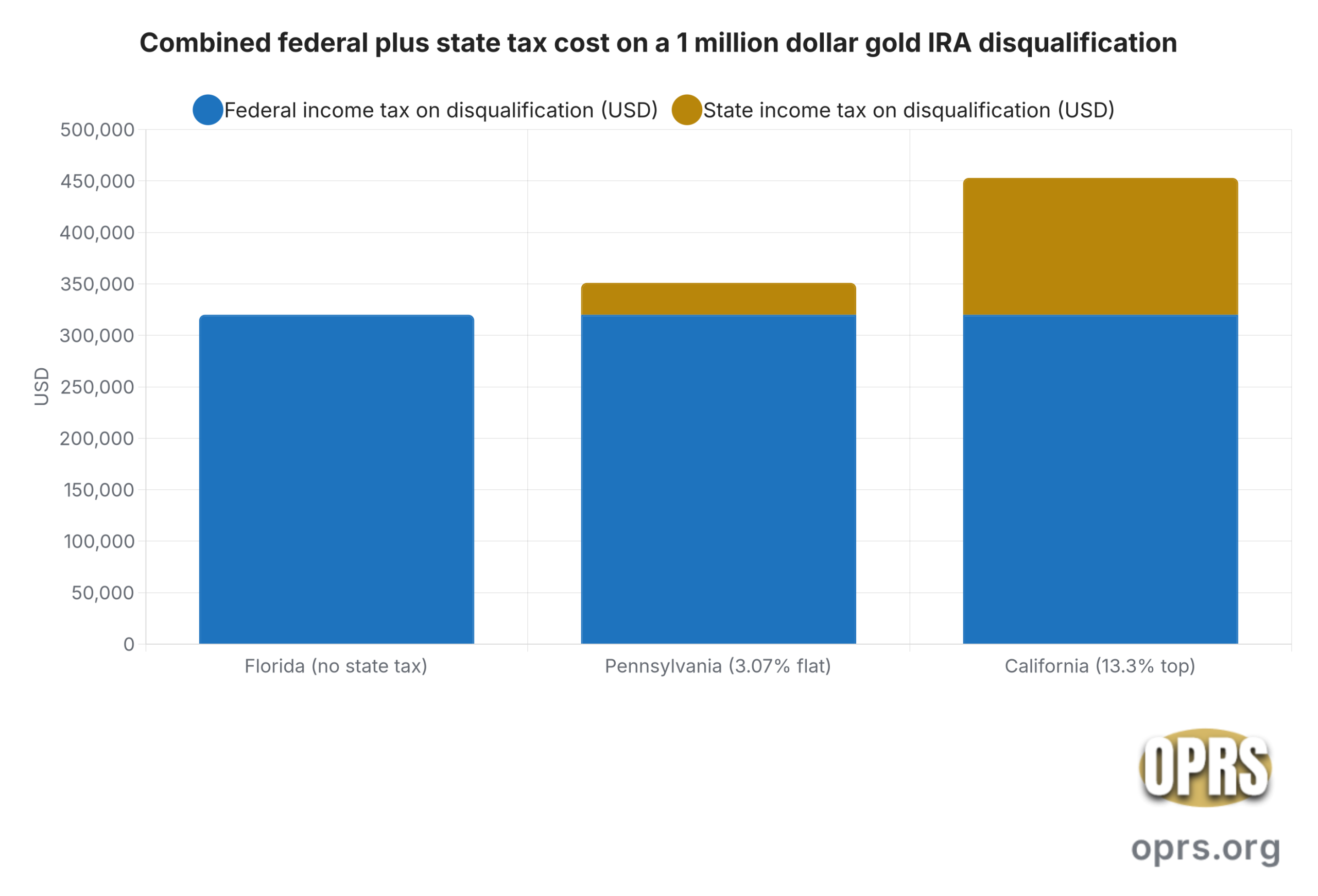
The chart below shows the federal-plus-state tax cost on a $1M traditional gold IRA disqualification for a retiree at 65 to 70 across three state-of-residence scenarios. Florida carries no state income tax. Pennsylvania applies a 3.07 percent flat rate, and the retirement-income exclusion does not extend to a deemed distribution from a disqualified account. California applies a top marginal rate of 13.3 percent per California FTB Form 540 instructions.
The federal layer uses the 2025 single-filer bracket schedule from IRS Publication 17, with $250,000 of other ordinary income assumed. The values exclude any 15 percent first-tier excise tax under IRC Section 4975(a) on the disqualified-person side.
Precious metals IRA early-withdrawal penalty estimator
Taking money out of a precious metals IRA before age 59 and a half triggers a 10% federal additional tax on top of ordinary income tax. State add-on taxes vary; check your state. The federal penalty is estimated below.
Estimate only, not tax advice. The 10% federal additional tax applies to early distributions before age 59 and a half; specific exceptions exist. Your state may add its own tax, and ordinary income tax applies separately. Source: IRS Publication 590-B. Consult a tax advisor.
The right dealer explains every fee up front. Get Augusta's free precious metals IRA company checklist.
The Florida column lands near $320,000 of combined federal-plus-state tax because the federal layer alone absorbs that share once the $1M stacks on top of $250,000 of base income. Pennsylvania adds about $30,000 of state-tax leakage at the 3.07 percent flat rate. California adds roughly $130,000 at the top marginal layer, pushing the total above $460,000 on the $1M balance.
The illustration excludes the first-tier 15 percent excise tax under IRC Section 4975(a) and any state-level interest or penalty for late payment.
The parallel-tracks safe-harbor structure
The defensible structure is parallel tracks with no transaction surface area between the two vehicles. The FLP holds the family’s operating assets, distributes carry to limited partners on its own schedule, and follows the family’s gifting plan on the LP-interest side.
The gold IRA holds IRS-approved bullion under Section 408(m)(3) at a third-party depository, with a separate custodian and dealer, and conducts only transactions inside the IRA wrapper. The two structures land in the same family balance sheet without ever transacting with each other.
The procedural workflow that HNW counsel and the retiree run together to confirm the parallel-tracks posture follows a four-step sequence. Each step has to complete before the next is meaningful. The flow below shows the sequence.
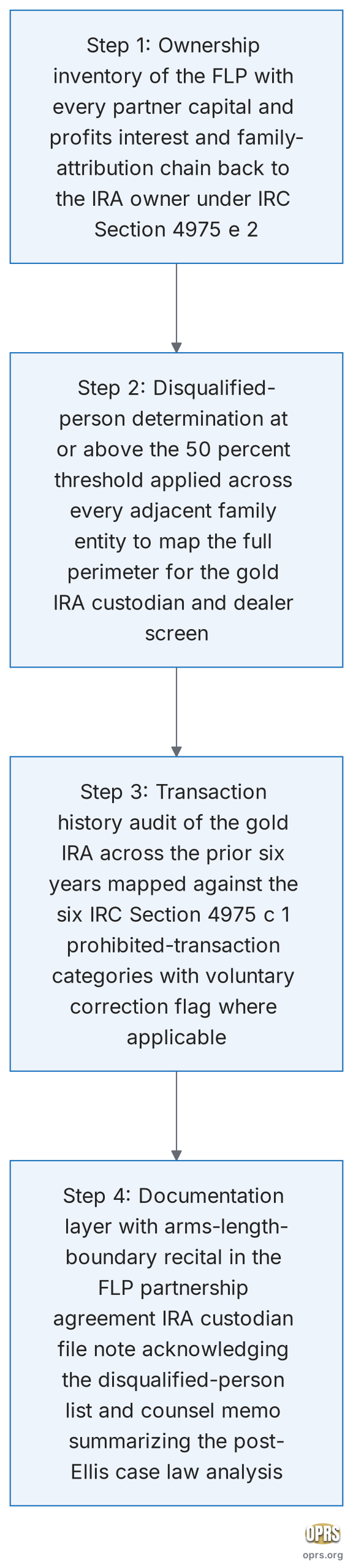
Step 1. Ownership inventory of the FLP. Counsel compiles a single table listing every partner, each partner’s capital and profits interest, the family-attribution chain back to the IRA owner under Section 4975(e)(2)(F)-(I), and the combined attributed percentage. At or above 50 percent, the FLP is a disqualified person and the finding is fixed.
Step 2. Disqualified-person determination on every adjacent entity. The same attribution math runs against the family’s other entities (operating LLCs, holding companies, captive insurance arrangement, family-trust holdings). The output is a written list the gold IRA custodian and dealer use as a deal-screening reference: any proposed IRA transaction touching a listed entity is escalated to counsel before execution.
Step 3. Transaction history audit of the gold IRA. Counsel and the custodian review the IRA’s transaction log for the prior six years (the statute of limitations runs three years from a Form 5329 filing reporting the transaction, six years if unreported). Every distribution, in-kind transfer, contribution, and rollover maps against the Section 4975(c)(1) categories with the disqualified-person list from Step 2. Any potential prohibited transaction is flagged for voluntary-correction analysis.
Step 4. Documentation layer. The retiree receives a written confirmation packet with three components. First, the FLP partnership agreement includes an arms-length-boundary recital stating no FLP-related transaction will be routed through any family IRA. Second, an IRA custodian file note acknowledges the disqualified-person list and the screening procedure. Third, a counsel memo summarizes the analysis under post-Ellis case law.
This layer defends the parallel-tracks posture if the IRS opens a Form 5500 examination of the FLP or a Form 5498 audit of the gold IRA.
Common HNW mistakes on FLP and gold IRA coordination
The mistakes that surface in IRS examinations of HNW retirees with both an FLP and a self-directed gold IRA cluster into six categories. Each one is preventable during the planning years and expensive to correct after a prohibited-transaction trigger has been logged.
- Treating the FLP and the gold IRA as one balance sheet for transaction routing. A common scenario: the family wants the FLP and the gold IRA to share an undivided interest in a single asset. The legal structure makes the IRA a co-investor with a disqualified person. Correction: each vehicle holds the asset independently or one of them stays out.
- Letting the FLP guarantee an IRA-related debt. An FLP guarantee on a self-directed IRA’s non-recourse loan is a Section 4975(c)(1)(B) extension of credit by a disqualified person. Correction: only true non-recourse financing with no family-entity guarantee survives the analysis.
- Storing IRA bullion in a family-controlled warehouse. A family-controlled entity offering storage to the IRA’s bullion is a Section 4975(c)(1)(C) furnishing of services. Correction: bullion stays at an IRS-approved depository with arms-length pricing and no family-entity touch points.
- Relying on the Swanson v. Commissioner reading too aggressively. Swanson, 106 T.C. 76 (1996) permitted an IRA to capitalize a new corporation it solely owned with the IRA owner serving as unpaid director. Ellis and later cases narrowed the reading significantly. Correction: counsel current on the post-2013 case law, not Swanson in isolation.
- Skipping the disqualified-person screen at the custodian and dealer level. A custodian or dealer without a documented disqualified-person screen pushes responsibility back to the IRA owner. Check this dealer against the 2026 OPRS list before any custodian-to-custodian transfer or account opening.
- Missing the voluntary correction window after an inadvertent transaction. The DOL’s Voluntary Fiduciary Correction Program and the IRS’s voluntary closing agreement procedures sometimes preserve part of the IRA. The window closes once an examination opens. Correction: counsel triages the post-discovery clock immediately.
Where Augusta sits in the dealer landscape for this scenario
Augusta Precious Metals is one of three dealers on the OPRS shortlist.
The dealer minimum is industry-reported around $50,000, rarely a constraint for a HNW retiree allocating a single-digit slice to bullion. The coordination-side benefit is a documented dealer-level process that supports the family’s parallel-tracks posture.
Augusta’s published Learn-Talk-Decide process, run by salaried non-commissioned educators, fits the HNW conversation that brings counsel, spouse, and family CFO into the same room. The free company-comparison checklist is the higher-intent asset for a household with an FLP already in place that is screening dealer operators against the four trust-signal markers before committing the bullion leg.
Compare the 4-award stack on a company-comparison checklist
The free company-comparison checklist walks through the dealer, custodian, depository, and screening mechanics that a HNW household coordinating an FLP and a gold IRA has to keep on parallel tracks. Augusta is one of three dealers OPRS currently clears; the checklist is the higher-intent asset for screening any single dealer against the four-marker trust-signal stack before the bullion-leg work begins.
OPRS may receive compensation when readers proceed. Editorial selection is independent. Updated July 2026.
A HNW retiree at 65 to 70 with an FLP in place runs the four-step parallel-tracks sequence with counsel before the next family-restructuring memo lands. The dealer-screen step is the cheapest correction; the disqualified-person inventory is the second-cheapest; the documentation layer closes the analysis. For the surviving spouse and the adult-child beneficiaries, the posture keeps the inherited gold IRA clean of any prohibited-transaction history that would surface as a deemed distribution.
Does the IRA owner serving as the FLP general partner trigger a prohibited transaction automatically?
No, not automatically. The IRA owner serving as the FLP’s general partner is a structural fact about the FLP, not a transaction between the IRA and the FLP.
The prohibited-transaction trigger requires an actual category-(A) through category-(F) action under Section 4975(c)(1): a sale, a loan, a service, a use of plan assets, an act of self-dealing, or a receipt of consideration. As long as no such transaction takes place between the IRA and the FLP, the general-partner role itself does not disqualify the IRA.
The risk surface is that the general-partner role increases the likelihood the family will eventually want to route some transaction through the IRA. That is why the documentation layer in Step 4 of the parallel-tracks sequence explicitly recites the arms-length boundary.
Can a HNW retiree gift FLP limited-partner interests to a Roth IRA?
No. A gift of FLP limited-partner interests from the IRA owner to a Roth IRA owned by the same person is a Section 4975(c)(1)(A) transfer of property between a disqualified person and the plan. The same applies if the gift comes from any family disqualified person.
The Tax Court has treated the analogous fact pattern (gifts of closely held stock to an IRA) as a prohibited transaction even where the gift is structured as a contribution.
The only path that survives the analysis is a true purchase by the IRA from an unrelated third party at arms-length pricing, which is not the family-gifting outcome the planner usually intends.
What is the statute of limitations on a prohibited-transaction excise tax?
Three years from the date Form 5329 (or Form 5330 for plan-side excise tax) was filed reporting the transaction, or six years if the transaction was not reported. There is no statute of limitations if the failure to file is determined to be fraudulent. The longer six-year window is the practical horizon counsel uses for the Step 3 transaction history audit in the parallel-tracks sequence, because the IRS can reach back across that span on a non-reported transaction.
Sources cited
- IRC Section 4975, Tax on Prohibited Transactions
- IRC Section 408(e)(2), Loss of Exemption of Account Where Employee Engages in Prohibited Transaction
- IRC Section 408(m)(3), Definition of Collectibles and Permitted Bullion in an IRA
- IRS Retirement Plans, Prohibited Transactions Guidance
- IRS Publication 590-A, Contributions to Individual Retirement Arrangements
- IRS Publication 17, Your Federal Income Tax (Bracket Schedules)
- DOL Advisory Opinion 2006-09A, Application of Section 4975 to Family-Controlled Entity
- Swanson v. Commissioner, 106 T.C. 76 (1996)
- California Franchise Tax Board, 2024 Form 540 Personal Income Tax Booklet