

Updated: July 30, 2026
OPRS may receive compensation when readers open an account through partner links on this page. Our analysis is based on independent research, BBB data, and IRS publications.
Every IRA custodian files a Form 5498 with the IRS by May 31. A copy lands in the saver’s mailbox or download portal a week or two earlier.
For a self-directed gold IRA, that one-page form is the official IRS record of what the account held on December 31, what was contributed, and what (if anything) was rolled over (IRS, About Form 5498). Element I of reading Form 5498: know what each box reports before the spot-price chatter starts.
Our view: the box-by-box read takes thirty minutes once a year and prevents the two errors that cost gold IRA holders the most, a misstated fair market value and a missed required minimum distribution. Before you read the form, our 2026 list of gold IRA dealers we warn against is the document we hand a saver first when Box 15a flags an unusual hard-asset position.
This guide walks Form 5498 from Box 1 to Box 15b, explains why a gold IRA changes the way Box 5 and Box 15a are filled, and lays out the five-step reconciliation the custodian relies on. The format mirrors what the IRS instructions for Forms 1099-R and 5498 require custodians to file, with the metals-specific overlays a self-directed account adds (IRS, Instructions for Forms 1099-R and 5498).
Before you read Box 15a on Form 5498
Box 15a flags the December 31 fair market value of any hard-asset position the custodian considers not readily tradable. For a gold IRA, that is the entire metals holding. If the figure looks off, the original dealer behind the purchase is the first lead. The 2026 OPRS dealer list names operators we warn against, the few we consider acceptable, and the documented BBB and state-attorney-general records behind each verdict.
3 of 27+ gold IRA dealers reviewed by OPRS make the 2026 trusted list.
What Form 5498 is and why gold IRA holders always receive one
Form 5498 is an information return. The IRA custodian files it. The account holder does not. The form reports five categories of activity to the IRS. Contributions land in Boxes 1, 8, 9, and 10. Rollover and conversion amounts land in Boxes 2, 3, and 13a.
The December 31 fair market value of the account sits in Box 5. The required minimum distribution figure for the next plan year sits in Boxes 11 and 12. Hard-to-value asset details sit in Boxes 15a and 15b.
A self-directed gold IRA receives the same form a brokerage IRA receives. The difference sits in Box 5 and Box 15a. The custodian must report a fair market value for the physical metals on December 31. Most custodians treat metals as a Box 15a hard asset because the position lacks a continuous public market quote at the account level (IRS, Instructions for Forms 1099-R and 5498).
Form 5498 is not a tax bill. It does not change what the saver owes. It is the IRS reconciliation tool. The IRS cross-checks Box 1 against the deduction claimed on Form 1040, Box 5 against the next year’s required minimum distribution computation, and Box 15a against the alternative-asset language disclosed in the account agreement.
The box-by-box read of Form 5498 for a gold IRA
Box 1: regular IRA contributions for the year
Box 1 reports the saver’s regular contributions for the plan year. The 2025 limit is $7,000 under age 50, and $8,000 for savers age 50 and older under the catch-up rule (IRS, Retirement Topics, IRA Contribution Limits). The figure here must not exceed the cap. If it does, the saver has an excess contribution and the IRS expects a corrective distribution under 26 U.S.C. §408(d)(4).
For a gold IRA, Box 1 is the cash that came in from the saver’s bank during the year. The cash is what the custodian then used to buy metals through the dealer. The metals purchase itself does not appear on Form 5498. The cash contribution that funded the purchase does.
Box 2: rollover contributions from another retirement plan
Box 2 reports money moved into the IRA from another tax-qualified plan. A direct trustee-to-trustee transfer from a 401(k), 403(b), TSP, or 457(b) appears here. A 60-day indirect rollover also appears here once the saver redeposits the funds within the IRS window (IRS Publication 590-A).
The dollar in Box 2 is the cash side of the rollover. If the rollover was completed in early January for a December event, the custodian still reports the value in the year the funds arrived. A common error: a December rollover wire that arrives January 2 is sometimes coded to the prior year. Compare against the original plan’s distribution statement.
Box 3: Roth IRA conversion amount
Box 3 reports any conversion from a traditional IRA into a Roth IRA. For a saver who converts a slice of a traditional gold IRA into a Roth gold IRA, the dollar amount of the conversion appears here. The conversion is a taxable event in the year the conversion is completed, regardless of how the saver allocates the metals afterward (IRS Publication 590-A).
Box 5: fair market value of the account on December 31
Box 5 is the single most consequential box on Form 5498 for a gold IRA. It is the dollar figure the custodian uses to compute next year’s required minimum distribution. The figure is the December 31 closing fair market value of the entire account: metals plus any cash sitting in the account at year end.
For the metals piece, the custodian uses the December 31 closing spot price applied to the troy-ounce inventory recorded by the depository on that date. The custodian receives the depository inventory file by mid-January. The custodian applies the spot. The custodian books the Box 5 figure on Form 5498 and files by May 31.
A misstated Box 5 cascades. The next year’s RMD is wrong. The saver under-distributes. The IRS assesses an excise tax of 25 percent of the shortfall under 26 U.S.C. §4974, reduced to 10 percent if corrected within two years.
Box 7: the account type checkboxes
Box 7 carries four checkboxes: IRA, SEP, SIMPLE, and Roth IRA. Confirm the checked box matches the account the saver opened. A Roth gold IRA labeled as a traditional IRA on Form 5498 is a high-consequence error: every distribution code that flows to Form 1099-R is keyed off Box 7. Call the custodian the same day if the box is wrong.
Boxes 8, 9, 10: SEP, SIMPLE, and Roth contributions
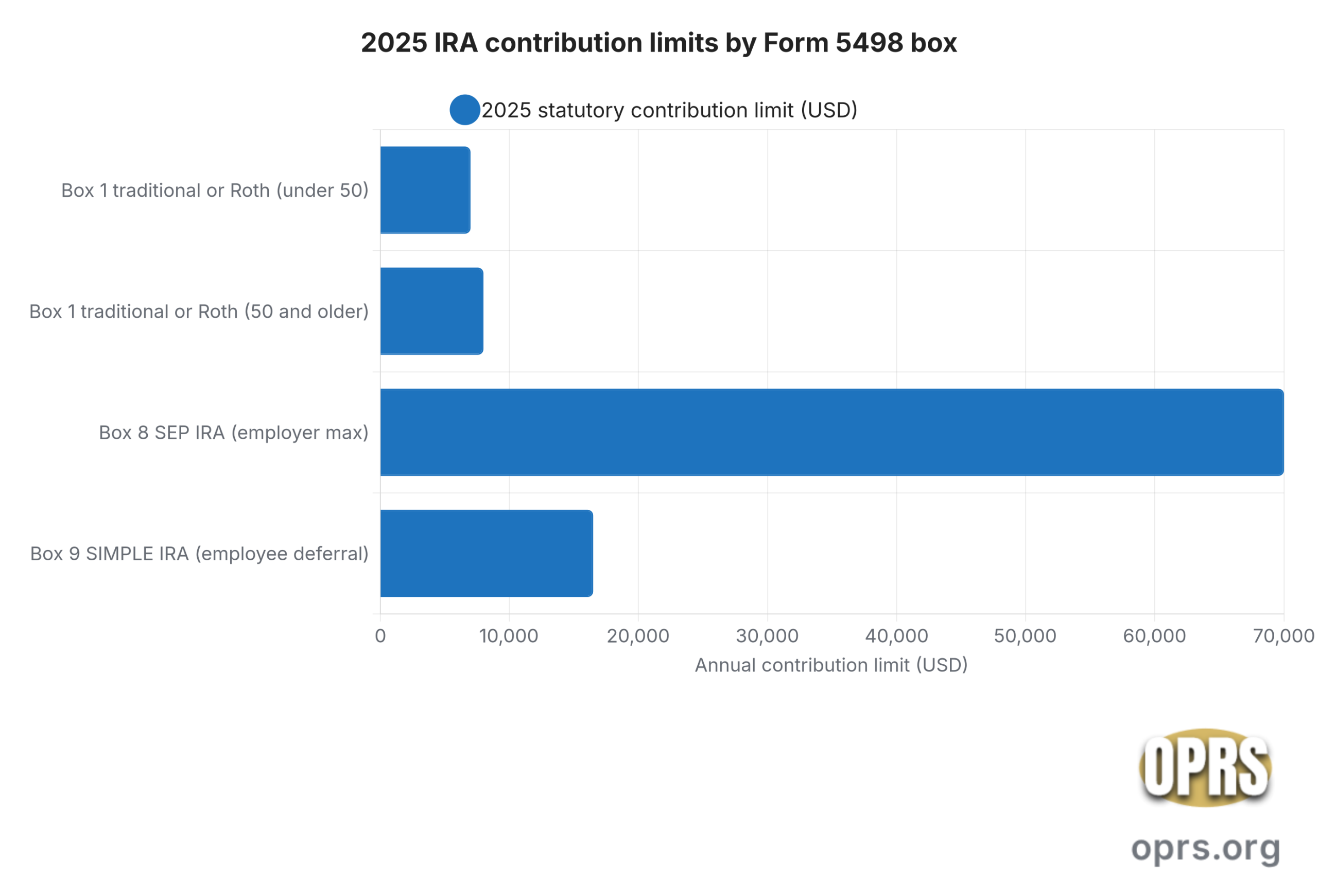
Box 8 reports employer SEP contributions, Box 9 reports SIMPLE contributions, and Box 10 reports Roth IRA contributions. The 2025 SEP IRA limit is 25 percent of compensation up to $70,000, and the 2025 SIMPLE IRA limit is $16,500 (IRS, IRA contribution limits). Roth contributions in Box 10 follow the same dollar ceiling as Box 1.
The chart below compares the 2025 contribution limits the custodian must enforce when filling Boxes 1, 8, 9, and 10. A SEP gold IRA holder will see Box 8 figures the brokerage-IRA neighbor never sees.
Precious metals IRA early-withdrawal penalty estimator
Taking money out of a precious metals IRA before age 59 and a half triggers a 10% federal additional tax on top of ordinary income tax. State add-on taxes vary; check your state. The federal penalty is estimated below.
Estimate only, not tax advice. The 10% federal additional tax applies to early distributions before age 59 and a half; specific exceptions exist. Your state may add its own tax, and ordinary income tax applies separately. Source: IRS Publication 590-B. Consult a tax advisor.
The right dealer explains every fee up front. Get Augusta's free precious metals IRA company checklist.
Boxes 11 and 12: the required minimum distribution figure
Box 11 is a checkbox: the custodian checks it if a required minimum distribution is due for the next plan year. Box 12a carries the RMD due date. Box 12b carries the RMD dollar amount the custodian computed from the prior year-end fair market value and the IRS Uniform Lifetime Table (IRS Publication 590-B).
The age threshold for RMDs is 73 for savers born between 1951 and 1959, and 75 for savers born in 1960 or later, under the SECURE Act 2.0. Box 11 is checked only when the saver crosses that threshold. The Box 12b dollar figure is the custodian’s calculation. The saver remains personally liable for confirming the math, because the IRS levies the excise tax on the saver, not on the custodian.
Boxes 15a and 15b: the hard-asset fair market value
Box 15a is where a self-directed gold IRA looks different from a brokerage IRA. The box reports the December 31 fair market value of any account asset that is not readily tradable on an established securities market. Box 15b carries the IRS code identifying the asset type.
The IRS instructions list eight codes for Box 15b. Code A covers stock that is not readily tradable. Code D covers real estate. Code G covers any other asset that does not have a readily available fair market value (IRS, Instructions for Forms 1099-R and 5498). Most self-directed custodians code a gold IRA position with Code G, because spot-price tables exist for metals but a continuous account-level public quote does not.
The dollar figure in Box 15a is therefore the same as the metals portion of Box 5. If the figures diverge, the custodian has miscoded one of them. The reconciliation is straightforward when the account holds only metals. It becomes more careful when the account also holds cash, a money-market sleeve, or a non-metals alternative position.
When Form 5498 arrives and what to do with it
The custodian must file Form 5498 with the IRS by May 31 each year. The saver receives a copy by the same date (IRS, About Form 5498). A separate statement showing the fair market value and the next-year RMD is required to arrive by January 31, ahead of the full Form 5498, so the saver can compute the RMD on time.
When Form 5498 arrives in May, place it in the same folder as the annual gold IRA statement, the Form 1099-R for any distribution paid out, and the depository’s December 31 inventory list if the saver requested it. The four documents together form the audit packet a CPA needs at tax filing time. They also form the reconciliation packet the saver needs before signing the next quarterly statement.
The saver does not attach Form 5498 to Form 1040. The form is informational only. The IRS receives its copy directly from the custodian. The saver keeps the personal copy for at least six years, matching the IRS statute of limitations for substantial under-reporting (26 U.S.C. §6501).
How Form 5498 connects to the custodian’s annual statement
Form 5498 is the IRS-facing summary. The custodian’s annual statement is the operational record. The two must reconcile to the dollar on three figures: the December 31 fair market value, the year’s total contributions, and the year’s rollover or conversion total.
The annual statement carries more detail than Form 5498. It lists the depository, the holdings line by line, the fee schedule, and the activity ledger. Our line-by-line guide to the annual gold IRA statement walks the seven blocks of that document. Form 5498 is the tax-reporting summary that the statement feeds.
The fair market value on Form 5498 Box 5 should match the December 31 closing balance line on the annual statement. The contribution total on Box 1 should match the contribution roll-forward in the statement’s summary block. The rollover total on Box 2 should match the activity ledger entries flagged as transfers in.
The fair market value problem for precious metals
A brokerage IRA holding a publicly traded ETF has an unambiguous Box 5 figure: the closing price on the last trading day of the year, multiplied by share count. A gold IRA does not have that ease. The custodian must estimate a fair market value for physical metals on a specific calendar date.
Most custodians use the December 31 closing spot price published by LBMA, COMEX, or the Federal Reserve Bank of New York gold reference. The spot is applied to the troy-ounce inventory the depository confirms on that date. Numismatic premiums above spot, if the account holds graded coins eligible under 26 U.S.C. §408(m)(3), are typically not included in Box 5 unless the custodian has a documented valuation policy that captures them.
The exclusion of numismatic premium from Box 5 is a quiet trap. The saver bought the coin with a premium baked in. The Box 5 spot-only valuation under-reports what the saver actually paid. That under-report is fine for the RMD computation (a lower base means a lower RMD), but it is a problem at distribution time, when the 1099-R fair-value figure may diverge from the secondary-market sale price.
How to reconcile Form 5498 with the custodian and the dealer
When Form 5498 arrives in May, the saver runs a five-step reconciliation against the prior year’s records. The sequence below is the order we follow in our editorial review process. Each step has a clear pass-fail outcome.
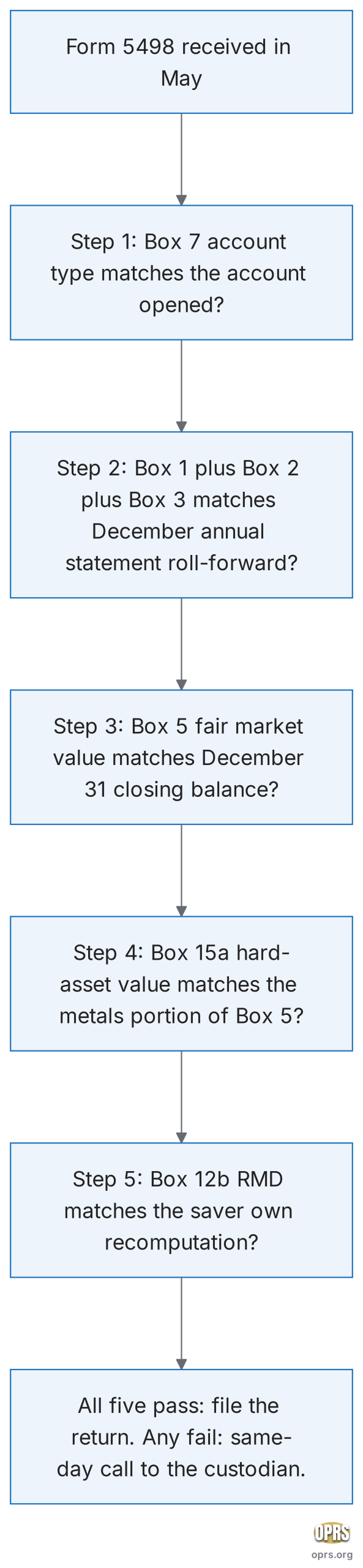
Step 1: confirm Box 7 matches the account type the saver opened. Step 2: confirm Box 1 plus Box 2 plus Box 3 matches the contribution roll-forward in the December annual statement.
Step 3: confirm Box 5 matches the December 31 closing balance on the annual statement. Step 4: confirm Box 15a matches the metals portion of Box 5 when the account is metals-only. Step 5: confirm Box 12b matches the saver’s own RMD recomputation from the prior-year Box 5 figure and the Uniform Lifetime factor.
A pass on all five steps means the form is clean. A fail on any step is a same-day call to the custodian. Most discrepancies resolve in a single phone conversation: a reposting, a code correction, a re-issued form. The custodian files a corrected Form 5498 with the IRS within ten business days.
Common Form 5498 errors that hit gold IRA holders hardest
Five errors recur in our review pile. Each one is fixable if caught before the next quarterly statement closes.
Error 1: a January contribution intended for the prior year, coded to the current year. The contribution belongs in Box 1 of the prior-year form. Coded to the current year, Box 1 of the prior year understates the deduction the saver claimed on Form 1040. The IRS notice arrives 18 to 24 months later. The fix: ask the custodian to amend the prior-year Form 5498 with the corrected Box 1.
Error 2: a Box 5 figure that uses the wrong December 31 spot. Two custodians serving the same depository can publish different Box 5 values for the same metals position if they used different spot sources. The fix: ask the custodian to identify the source and the published rate, then recompute against the LBMA London PM fix or the New York spot.
Error 3: Box 7 checked as IRA when the account is Roth. Every downstream distribution code on Form 1099-R is keyed off Box 7. A Roth gold IRA distribution at age 75 should be tax-free under the qualified-distribution rule, but a traditional-coded Box 7 will make the 1099-R show the distribution as taxable. The fix: amended Form 5498 with the correct box checked, before the next 1099-R generation cycle.
Error 4: a missing Box 11 check when the saver crosses the RMD threshold. If the custodian fails to check Box 11 in the year the saver turns 73 (or 75 under the later SECURE 2.0 schedule), the saver may not realize an RMD is due. The fix: confirm against the saver’s own birth-year calculation. The custodian’s checkbox is a courtesy, not an excuse, under IRS Publication 590-B.
Error 5: Box 15a omitted when the account holds metals. The IRS treats Box 15a as required for any IRA holding hard-to-value assets. A custodian that leaves Box 15a blank on a metals account has a reporting gap. The fix: ask the custodian to issue an amended form with Box 15a populated and Box 15b coded G.
If Box 15a or the dealer of record raises a question
Three signals on Form 5498 warrant a same-day call. An unusual Box 15a figure. A Box 5 that drifts from the prior year without a market reason. A dealer name on the custodian record the saver does not remember choosing. Check the dealer against the 2026 OPRS list before any transfer decision. The list names the operators we currently warn savers against and the few we consider acceptable, with the public BBB and state-attorney-general records behind each verdict.
3 of 27+ gold IRA dealers reviewed by OPRS make the 2026 trusted list. Updated July 2026.
Frequently asked questions
Do I report Form 5498 on my tax return?
No. Form 5498 is informational. The custodian files a copy with the IRS by May 31 and sends a copy to the saver. Box 1 supports the IRA-deduction line on Form 1040 for traditional contributions, but the form itself is not attached. Keep the saver’s copy for at least six years.
Why does my Form 5498 arrive after I filed my return?
The May 31 filing deadline for Form 5498 sits after the April 15 deadline for Form 1040. The IRS allows the gap because the saver can make a prior-year contribution between January 1 and April 15. The custodian needs the late-April window closed before issuing the form. The fair market value and RMD figures arrive separately by January 31 so the saver can plan distributions on time.
Should my gold IRA show a Box 15a figure every year?
Yes for a self-directed gold IRA that holds physical metals. Box 15a should equal the metals portion of Box 5, with Box 15b coded G under the IRS instructions for hard-to-value assets. If Box 15a is blank in a year when the account held metals on December 31, the custodian has a reporting gap to correct.
How is the December 31 fair market value calculated for physical gold?
The custodian applies the December 31 closing spot price to the troy-ounce inventory the depository confirmed on that date. Most custodians use the LBMA London PM fix, the COMEX December close, or a comparable institutional reference. Numismatic premiums above spot are usually excluded from Box 5 unless the custodian has a documented valuation policy.
What if the custodian sends a corrected Form 5498 in August?
An amended Form 5498 is allowed. It carries a corrected-box check at the top. File it with the prior year’s records. If the correction touched Box 1, Box 2, Box 3, or Box 5, the saver may need to file an amended Form 1040X to align the deduction or basis. Consult a tax advisor before sending the amendment to the IRS.
Does a rollover from a 401(k) into my gold IRA appear on Form 5498?
Yes, in Box 2. A direct trustee-to-trustee rollover from a 401(k), 403(b), TSP, or 457(b) plan is reported there. The original plan also issues a Form 1099-R showing the distribution with code G for direct rollover. The two forms together document a tax-free rollover under IRS Publication 590-A.
Open the form. Run the five-step reconciliation against the prior year’s annual statement, the depository inventory, and the dealer invoices. Confirm Box 5, Box 7, Box 11, and Box 15a. Write the one-sentence summary per box.
File the packet with the will, the durable power of attorney, and the healthcare directive. If reading Box 5 or Box 15a raises a question about the dealer of record, the 2026 OPRS dealer list is the document we hand a saver before any transfer decision.
The Education-First benchmark to compare a dealer against
The dealer behind the original purchase shapes the Box 15a figure in ways the saver cannot see at year end. Augusta Precious Metals carries BBB A+ accreditation since 2014 with no complaints on file. It has been named Money Magazine’s Best Overall Gold IRA Company every year from 2022 through 2026. It has been named Investopedia’s Most Transparent Gold IRA Company 2022 through 2026. It reports more than 4,000 5-star ratings across Trustpilot, Google, and Consumer Affairs.
The educator team is salaried and non-commissioned. The public process framing is Learn, Talk, Decide. The industry-reported minimum sits around $50,000, which fits most retiree balances inside the eligible range.
Industry-reported minimum around $50,000. Free company comparison checklist on request.
Sources cited
- IRS, About Form 5498, IRA Contribution Information
- IRS, Instructions for Forms 1099-R and 5498 (latest plan year)
- IRS, About Form 1099-R, Distributions From Pensions, Annuities, Retirement or Profit-Sharing Plans, IRAs
- IRS Publication 590-A, Contributions to Individual Retirement Arrangements
- IRS Publication 590-B, Distributions from Individual Retirement Arrangements
- IRS, Retirement Topics, IRA Contribution Limits
- 26 U.S.C. §408(m), IRA-eligible precious metals coins and bars
- 26 U.S.C. §4974, Excise tax on certain accumulations in qualified retirement plans
- 26 U.S.C. §6501, Limitations on assessment and collection