

Updated: August 26, 2026
OPRS may receive compensation when readers open an account through partner links on this page. Our analysis is based on independent research, BBB data, and IRS publications.
A retired corporate executive in the pre-RMD years with a $1 million to $3 million household balance sheet carries a specific set of variables. Those include an in-pay defined-benefit pension, a vested NUA-eligible position in former-employer common stock, and an RSU tranche still on the corporate broker’s books. That combination means the gold IRA allocation question is typically asked the wrong way around.
The three-to-ten-percent precious-metals baseline comes from research on a generic retirement-portfolio profile (sixty percent equity, forty percent fixed income, no pension, no concentrated single-stock position, no pre-RMD conversion calendar). None of those assumptions match the Jim-profile household.
The right sequence starts at the corporate-side concentrations and runs through the pension capitalized value. Only then does it arrive at the IRA wrapper that may or may not hold a physical precious-metals slice under IRC §408(m).
Before any custodian paperwork is signed on the destination IRA, screen the proposed dealer against the 2026 OPRS dealer list. Dealer-side markup and buy-back posture materially affect realized return, independent of the allocation percentage chosen.
The framework below treats the pension capitalized value, NUA-exit timing, the pre-RMD Roth conversion calendar, and the IRC §408(m) precious-metals slice as one allocation sequence.
Before you allocate
The allocation percentage is the last number set, not the first. Corporate-side concentration, pension capitalized value, and pre-RMD conversion calendar set the constraints. The precious-metals slice fits inside what remains. Screen the destination dealer against the operators OPRS does not recommend before the percentage is even discussed. A high-quality allocation framework run through a misaligned dealer produces the same realized loss as a sloppy framework run through a clean dealer.
3 of 27+ gold IRA dealers reviewed by OPRS make the 2026 trusted list. Updated August 2026.
What “investable net worth” actually means for a Jim-profile household
The three-to-ten-percent allocation rule of thumb references investable assets, not net worth.
Consider a $2 million Jim-profile household with a $90,000 in-pay pension, a $500,000 NUA-eligible employer-stock position, $300,000 in RSU tranches vesting through year three of retirement, and a Florida primary residence with no mortgage. The denominator in “three to ten percent” depends on which assets the household treats as long-horizon, principal-protected, dollar-denominated portfolio capital. The pension is not investable capital. It is a stream.
The NUA position is investable but concentrated. The home is illiquid. The IRA balance, the taxable brokerage account, and the post-NUA-exit proceeds form the investable base against which the precious-metals slice is sized.
The household-finance literature, including FINRA’s concentrated-positions investor education, treats a single-stock position above ten percent of investable assets as a concentration that warrants a defined exit plan. A vested NUA-eligible position at $500,000 inside a $2 million household sits at twenty-five percent of investable assets before any allocation framework is applied.
The precious-metals slice question runs second to that concentration question; sized against the wrong denominator, the gold IRA percentage either overweights or underweights the actual hedge requirement the household balance sheet produces.
How a defined-benefit pension changes the allocation arithmetic
The capitalized value of an in-pay defined-benefit pension is the present value of the income stream against the household’s discount-rate assumption. A $90,000-per-year pension with a thirty-year actuarial horizon and a five-percent discount rate has a capitalized value near $1.4 million; the same pension priced against a three-percent discount rate sits near $1.8 million.
The capitalized value behaves as a bond substitute on the household balance sheet. The cash flow is contractual, periodic, and not subject to market-price volatility outside the sponsor-default scenarios covered by the Pension Benefit Guaranty Corporation maximum guarantee tables.
The standard portfolio framework that sets a sixty-forty equity-to-fixed-income split assumes the fixed-income side sits inside the investable portfolio. For a Jim-profile household with a $1.4 million capitalized pension, the household balance sheet already runs a substantial implicit fixed-income allocation outside the investable accounts.
The IRA balance, the taxable brokerage, and the post-NUA-exit proceeds can run a higher equity-and-real-asset tilt because the pension carries the bond-substitute weight. The precious-metals slice inside the investable accounts then sizes against a smaller-than-default fixed-income complement and a larger-than-default real-asset and equity complement.
Allocation scenarios across the Jim-profile household balance sheet
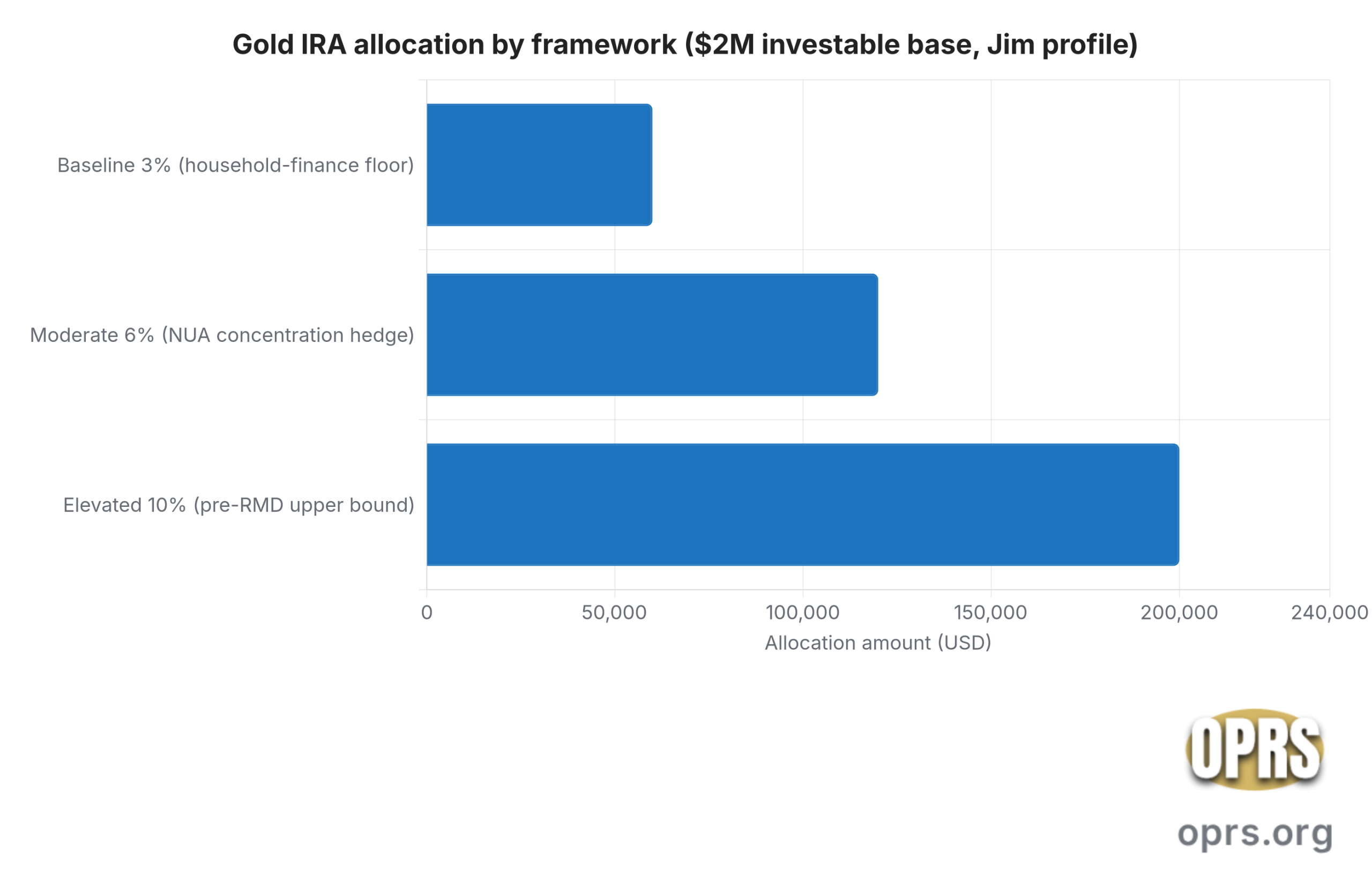
Figure 1 below shows three illustrative gold IRA allocations for a $2 million Jim-profile household. Three frameworks are shown: the household-finance baseline (three percent), the moderate concentrated-position hedge (six percent), and the elevated pre-RMD hedge some HNW advisors apply during the conversion years (ten percent). The dollar figures sit at the $2 million investable-base tier. The percentages are sourced from the household-finance literature and the FINRA concentrated-positions guidance, held constant for illustration.
Precious metals IRA required minimum distribution (RMD) estimator
Once required minimum distributions begin (age 73 now, 75 starting 2033), you divide the prior year-end balance by an IRS life-expectancy factor. The result is taxed as ordinary income on your federal return and, in most states, your state return. You can take a precious metals IRA RMD in cash or in metal.
Estimate only, not tax advice. Uses the IRS Uniform Lifetime Table (most owners). A spouse more than 10 years younger and sole beneficiary uses a different table. Roth IRAs have no lifetime RMD. Sources: IRS Publication 590-B (Table III); IRS RMD FAQs. Consult a tax advisor.
The right dealer explains every fee up front. Get Augusta's free precious metals IRA company checklist.
The baseline three percent sizes the gold IRA slice at $60,000 inside the $2 million investable base. The moderate six percent doubles that to $120,000, reflecting the additional hedge a household with a concentrated NUA-eligible position carries through the exit calendar. The elevated ten percent reaches $200,000, the upper bound of the household-finance literature. Allocations above that level cross into single-asset concentration on the precious-metals side and create the symmetric risk the framework was meant to manage.
The four-step procedural sequence for setting the allocation
The sequence below is what we observe executed cleanly by the high-net-worth households we hear from in reader correspondence. Steps one and two are the corporate-side and pension-side measurements; step three sets the conversion-calendar overlay; step four sizes and sites the precious-metals slice. Each step is reversible until the dealer purchase order is signed at step four.
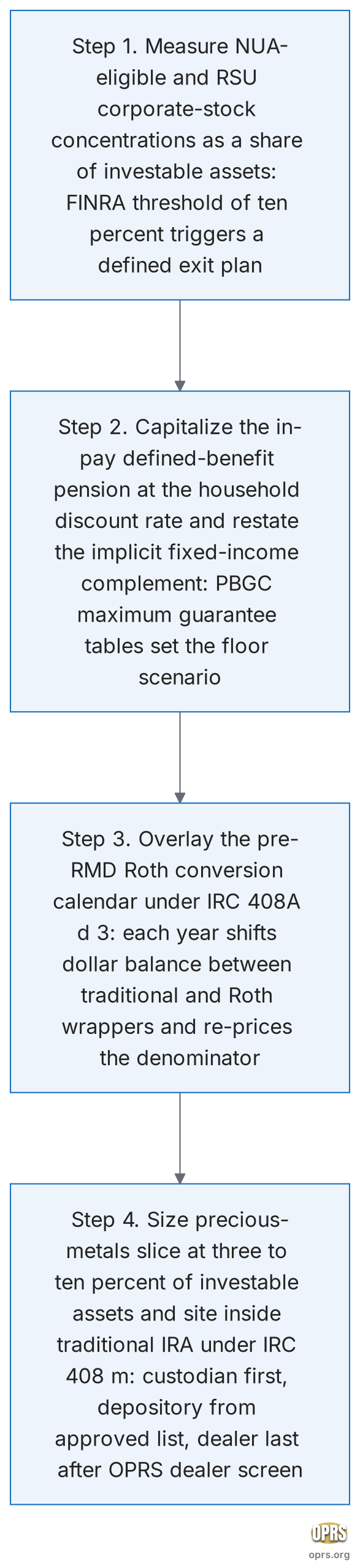
Step 1. Measure the NUA-eligible and RSU concentrations against investable assets. Aggregate the vested NUA-eligible position at fair market value, the RSU tranches at the most recent grant-price marker, and the taxable brokerage cash position. Divide each by the total investable base.
A combined corporate-stock concentration above twenty percent of investable assets triggers a defined exit plan. The exit timing then sets the year over which the gold IRA allocation can be sized against a denominator that is moving each tax year.
Step 2. Capitalize the pension and re-state the fixed-income complement. Calculate the present value of the in-pay pension stream against the household’s discount-rate assumption (the PBGC maximum guarantee schedule sets the floor scenario). Subtract the capitalized pension from the implicit fixed-income target. The IRA balance, the taxable brokerage, and the post-NUA-exit proceeds then carry a smaller-than-default fixed-income slice and proportionally larger real-asset and equity slices.
Step 3. Overlay the pre-RMD Roth conversion calendar. Each conversion year shifts a tranche of pre-tax IRA balance into the Roth wrapper at the conversion-year marginal rate. The traditional-IRA-side balance shrinks; the Roth-side balance grows. The precious-metals slice is most often sited on the traditional-IRA side because the Roth wrapper is generally allocated to the highest-expected-return assets.
The conversion calendar therefore changes the allocation arithmetic year by year, and the year-one allocation percentage will not be the year-five allocation percentage at the same dollar slice. The IRC §408A(d)(3) conversion mechanic and the IRS Publication 590-A guidance set the operational rules.
Step 4. Size the precious-metals slice and site it inside the IRA wrapper. The slice sits at three to ten percent of investable assets, sized against the corporate-stock-exit-adjusted denominator from Step 1 and the pension-capitalized-value-adjusted complement from Step 2.
The slice is held inside a self-directed IRA under IRC §408(m), funded by qualified-plan rollover or existing IRA balance, never by post-conversion Roth balance. The custodian decision precedes the dealer decision; the depository sits inside the custodian’s approved list. Check the 2026 OPRS dealer screen before any custodian or dealer paperwork is signed.
NUA exit timing and the gold IRA allocation question
The net unrealized appreciation election under IRC §402(e)(4) lets a participant move employer-stock balance out of a qualified plan. The original cost basis is recognized as ordinary income. The appreciation then sits in a taxable brokerage account at long-term capital gains rates.
The election is operationally one-shot: a lump-sum distribution of the entire account balance inside a single calendar year. The employer stock transfers in kind to a taxable account. The non-employer-stock balance rolls into a traditional IRA inside that same window. IRS guidance sits in Publication 575.
Before the NUA election is executed, the employer-stock balance sits inside the qualified plan and counts against the qualified-plan side of the household balance sheet. After the election, the appreciation sits in the taxable brokerage account and counts inside the investable base; the basis portion was the income recognition in the election year.
The denominator against which the gold IRA percentage is sized expands materially in the NUA-election year. A six-percent target allocation set against a pre-NUA $1.5 million investable base sizes at $90,000; the same six-percent target against a post-NUA $2 million investable base sizes at $120,000.
The household either tops up the slice through a partial rollover at the election year or holds the slice flat and lets the percentage drift down.
Evaluate the destination dealer
Augusta’s Company Comparison Checklist is among the more transparent side-by-side tools published by any dealer in this category. Fee disclosure, depository options, buy-back stance, and educator-versus-salesperson conduct all appear as evaluation columns. For HNW households building a self-directed IRA allocation that includes a precious-metals slice, the checklist belongs at the custodian-selection stage, not as an afterthought.
Affiliate disclosure: OPRS may receive a commission if you open an account with Augusta through this link, at no additional cost to you. Augusta’s industry-reported minimum is widely reported to require around $50,000 in eligible retirement assets. Updated August 2026.
State-tax domicile and the allocation siting decision
A Florida-domiciled retiree pays no state income tax on Roth conversion income, on NUA ordinary-income recognition at election, or on traditional IRA distributions. A high-tax-state retiree (California, New York, New Jersey, Oregon, Minnesota) layers the state marginal rate on each of those events.
For a Jim-profile household relocated to Florida at retirement, the entire pre-RMD window runs at federal-only tax cost; the allocation siting decision is therefore independent of state-tax considerations.
For a household still domiciled in a high-tax state, the gold IRA siting question runs through the state-tax filter at every conversion year and at the NUA-election year. The allocation calendar tightens around the relocation timing. Our companion piece on the Florida-to-North-Carolina relocation tax framework covers the cross-state case at one level deeper.
Common mistakes HNW households make on the allocation question
Each mistake below is correctable when the four-step sequence above is run in order, before any custodian or dealer paperwork is signed.
Mistake 1. Sizing the gold IRA percentage against gross net worth, not investable assets. A $2 million household carrying a $700,000 primary residence with no mortgage runs an investable base of $1.3 million, not $2 million. A six-percent target sized against the wrong denominator pushes the slice to $120,000 when the correct denominator produces $78,000. Correction: the denominator is investable assets (IRA, taxable brokerage, post-NUA-exit proceeds), not gross household balance sheet.
Mistake 2. Treating the in-pay pension as a portfolio asset. The pension is a stream, not a balance. The capitalized value belongs in the bond-substitute side of the implicit asset-allocation framework, not in the investable-base denominator for the precious-metals slice. Correction: capitalize the pension separately and re-state the fixed-income complement before sizing the gold IRA slice.
Mistake 3. Siting the precious-metals slice on the Roth side. The Roth wrapper is generally allocated to the highest-expected-return assets in the household. A precious-metals slice targets equity and currency tail-risk exposure, not an outsized expected return. Correction: site the gold IRA slice on the traditional-IRA side, where the wrapper sits at the lower expected-return side of the asset spectrum.
Mistake 4. Sizing the slice once and holding it flat through the conversion years. The conversion calendar shifts dollar balance between the traditional and Roth wrappers each year. The same dollar slice runs a rising percentage of the shrinking traditional-IRA side. Correction: re-size the percentage each conversion year and adjust through partial dealer purchases or partial buy-backs as the denominator moves.
Mistake 5. Picking the dealer before the custodian and depository are confirmed. A self-directed gold IRA has three counterparties: custodian, depository, dealer. Correction: custodian first, depository from the custodian’s approved list, dealer last. The 2026 OPRS dealer list applies at the final step.
Frequently asked questions
What allocation percentage do household-finance researchers recommend for precious metals?
The household-finance literature places the precious-metals allocation between three and ten percent of investable assets for a generic retirement portfolio. The FINRA concentrated-positions guidance covers the symmetric concentration question on the upside of the range. For a Jim-profile household with an in-pay pension and a concentrated employer-stock position, the percentage runs against an adjusted denominator produced by the four-step sequence above, not against the gross balance sheet.
Should the precious-metals slice sit inside the Roth IRA or the traditional IRA?
Generally the traditional IRA. The Roth wrapper is allocated to the highest-expected-return assets, and a precious-metals slice produces a hedge rather than an outsized return. The traditional-IRA side, which the household will draw down at ordinary-income rates from the RMD year forward, is the more efficient destination for assets with lower expected returns and lower tax-deferral upside.
Can I fund the gold IRA slice from the post-conversion Roth balance?
Operationally yes, but the household-finance logic argues against it. The Roth balance is the tax-free side of the balance sheet; the precious-metals slice produces a hedge, not a tax-free growth profile that matches the Roth wrapper’s structural advantage. Fund the slice from a qualified-plan rollover or an existing traditional IRA balance.
Does the NUA election change the gold IRA allocation calculation?
Yes, materially. The election moves the employer-stock balance from inside the qualified plan (where it sat on the qualified-plan side of the balance sheet) to the taxable brokerage account (where it sits inside the investable base). The investable-base denominator expands at the election year, and the allocation percentage either tops up through a partial rollover or holds flat and drifts down. Our companion piece on the NUA election and gold IRA destination covers the timing in detail.
Should I evaluate Augusta against other dealers?
Yes. Across 2026 reviews, the OPRS engine clears three dealers; Augusta is one. Augusta’s Company Comparison Checklist gives HNW self-directed IRA households a useful side-by-side view of the dealer layer. Pairing it with the 2026 dealer list completes the structural complement to a four-step allocation sequence.
The practical sequence is the four-step framework above, executed in order, with the NUA-exit timing and the pension capitalized value resolved before the allocation percentage is set. The most consequential decision is not which dealer holds the precious-metals slice; it is whether the slice is sized against the correct denominator after the corporate-side concentrations and the pension-side stream are accounted for.
Sources cited
- IRC §408(m), Investment in collectibles treated as distribution (precious metals exception)
- IRC §408A, Roth IRAs (conversion and distribution rules)
- IRC §402(e)(4), Net unrealized appreciation election for employer securities
- IRS Publication 590-A, Contributions to Individual Retirement Arrangements
- IRS Publication 590-B, Distributions from Individual Retirement Arrangements
- IRS Publication 575, Pension and Annuity Income (NUA election guidance)
- FINRA, Concentrated positions investor education
- Pension Benefit Guaranty Corporation, Maximum monthly guarantee tables
- SEC investor.gov, Investor Bulletin on self-directed IRAs
More on OPRS
For the conversion-calendar overlay that runs in parallel with the allocation framework, see our Roth conversion ladder pre-RMD window guide. For the NUA-side decision that resets the investable-base denominator, see the NUA election and gold IRA destination guide. For the RSU-concentration question that runs in parallel with the NUA exit, see our RSU concentration and gold IRA diversification guide. The OPRS-reviewed dealer shortlist sits at our 2026 gold IRA dealer list.
Important note: OPRS is an editorial platform, not a law firm, registered investment advisor, or tax advisor. Gold IRA allocation framework decisions, NUA election timing, pension capitalized-value assumptions, Roth conversion calendar overlays, and self-directed IRA destination decisions depend on transaction-specific facts that only a licensed CPA, enrolled agent, or attorney can evaluate. Past performance is not a guarantee of future results.
Published by OPRS Editorial.