

The lever the household can pull is product selection. A self-directed gold IRA can hold IRS-approved bullion coins and bars under IRC Section 408(m)(3). The Code lists the eligible products by fineness standard, not by premium.
A buyer is free to pick a 1 oz American Gold Eagle at a 5 to 8 percent spread. A buyer is also free to pick a graded proof coin at a 25 to 40 percent spread. The selection decision drives more total cost over the holding period than the custodian fee schedule.
Disadvantage 3: physical metals pay no dividends and no interest
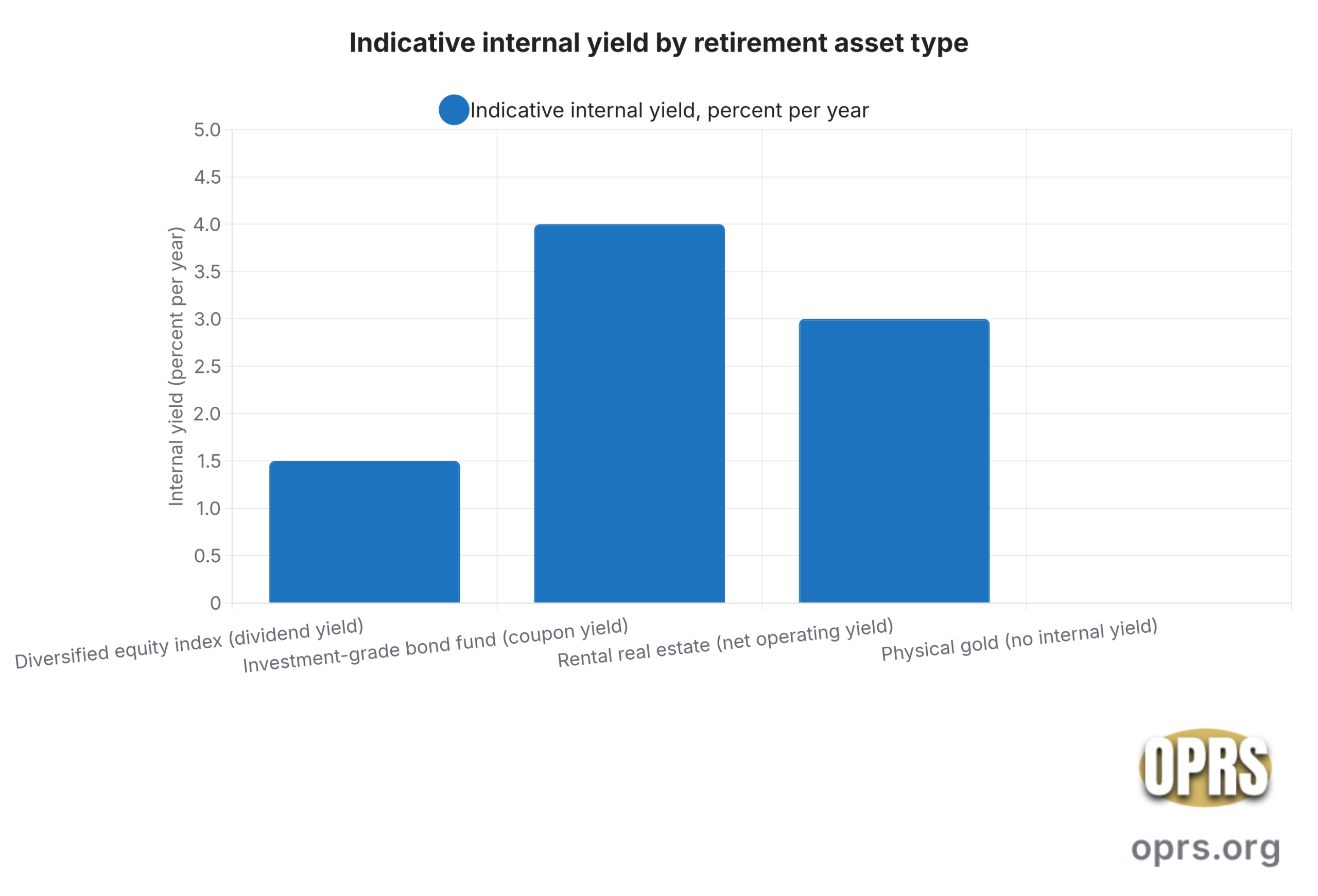
A diversified equity index fund pays dividends. An investment-grade bond fund pays interest. A rental real estate position pays net operating income. A physical gold position pays nothing during the holding period. The only return path is price appreciation against the dollar. A household that holds physical metal for 20 years receives no internal coupon and no internal cash distribution along the way.
The implication for retirement income planning is direct. A retiree drawing 4 percent per year from a balanced paper IRA can fund the draw partly with dividends and interest. The principal is consumed more slowly. A retiree drawing 4 percent per year from a gold-only IRA must sell metal at every draw. The dealer spread runs against the household at every sale. Required minimum distributions under IRC Section 401(a)(9) force the same dynamic at age 73 and beyond.
The mitigant is allocation discipline. The SEC publishes a general asset allocation primer at investor.gov that frames diversification as the central risk control. A gold IRA sized to a meaningful but limited share of total retirement wealth lets paper assets fund the income side and lets metals serve the inflation-hedge and tail-risk side. A 100 percent gold allocation is rarely the right answer for a household that needs steady retirement cash flow.
Disadvantage 4: custody concentrates at a narrow set of operators
A self-directed IRA cannot hold metal at the account owner home address. IRC Section 408(m) requires a qualified trustee and an approved depository. The eligible IRS-approved depositories number in the single digits across the United States. The qualified self-directed IRA custodians that specialize in precious metals number a few dozen. The structure relies on a narrow operational layer.
The operational risks at the custody layer include three failure modes worth naming. The first is custodian operational failure, where a trust company stalls distribution requests or transfer-in-kind requests for weeks. The second is depository commingling error, where allocated holdings get treated as unallocated under depository operations. The third is paperwork coding error, where a Form 1099-R distribution code lands as an early distribution instead of a normal rollover.
None of the three is fatal in normal operating conditions. Each becomes material when paired with a household timing constraint such as a required minimum distribution deadline, a rollover 60 day window, or a Roth conversion deadline. The mitigant is the same one that mitigates the buying-side risk. Pick a custodian with a verifiable record across multiple business cycles, an A+ Better Business Bureau rating, and written documentation of the relevant fee and distribution coding schedules.
Disadvantage 5: the buying side is uneven, and high-pressure tactics persist
The single most controllable disadvantage sits with the dealer that fills the order. A small group of operators publishes fee schedules in writing and refuses to charge premiums on proof or numismatic coins inside an IRA. The household compares line items against the published IRC Section 408(m) eligibility list before any wire moves. A wider field of operators relies on scripted urgency, scarcity framing, and complex premium structures that obscure the all-in cost.
The patterns to screen against are documented. The FINRA investor insights library publishes general guidance on commodity and metals investment risks. The CFTC consumer advisory cited above lists telltale signs of high-pressure precious metals sales. The signs include pressure to act on a same-day window, claims of insider knowledge of a price move, and product steering toward high-premium graded coins instead of standard bullion. Any of the three patterns at a dealer pitch warrants a pause and an independent comparison.
The Education-First model goes the other direction. The dealer publishes the buy spread, the storage schedule, and the custodian fee schedule in writing. The buyer can review the documents on a no-commitment call. The dealer holds a long-running A+ rating at the Better Business Bureau, has been recognized as Best Overall by Money for several years running, and carries an Investopedia award for transparency. The household decision lands on documented terms instead of phone-call pressure.
How the five disadvantages stack against household profiles
The disadvantages do not weigh equally across households. A retiree with a $750,000 paper IRA sees a small flat-fee drag, has discretionary income from dividends, and can absorb a 10 percent dealer spread on a small allocation. A pre-retiree with a $40,000 IRA sees a meaningful flat-fee drag, has no internal income to spare, and cannot absorb a 10 percent round-trip spread without erasing several years of expected return.
| Household profile | Flat-fee drag | Liquidity spread cost | Yield gap | Net fit |
|---|---|---|---|---|
| Under $50,000 in eligible balances | Material (over 0.60 percent annual drag at typical fee stack) | Material (no slack to absorb spread) | Material (needs every basis point of yield) | Status: poor fit |
| $50,000 to $150,000 in eligible balances, age 50-plus | Modest (0.20 to 0.60 percent annual) | Manageable on a small allocation | Manageable if paper assets dominate | Status: conditional fit, allocation discipline required |
| $150,000 to $500,000, pre-retiree | Small (0.06 to 0.20 percent annual) | Acceptable on a 5 to 15 percent allocation | Acceptable as inflation-hedge sleeve | Status: workable fit |
| Over $500,000, retired with paper income | Negligible (under 0.06 percent annual) | Acceptable, can stage entries and exits | Not binding, paper sleeve funds income | Status: good structural fit |
The conditional-fit and workable-fit rows are where most decisions actually land. A balanced sizing approach pairs a partial gold allocation with the existing paper IRA. The metal sleeve sits as one risk-control layer, not as a replacement for the diversified core. Households exploring the partial allocation path can study a measured framework for gold allocation sizing before committing to a custodian.
How to mitigate the disadvantages without abandoning the structure
None of the five disadvantages is automatic. Each has a documented mitigant. The flat-fee drag responds to account-size discipline. The dealer spread responds to product selection. The yield gap responds to allocation sizing. The custody risk responds to custodian due diligence. The buying-side risk responds to dealer screening against verifiable public criteria.
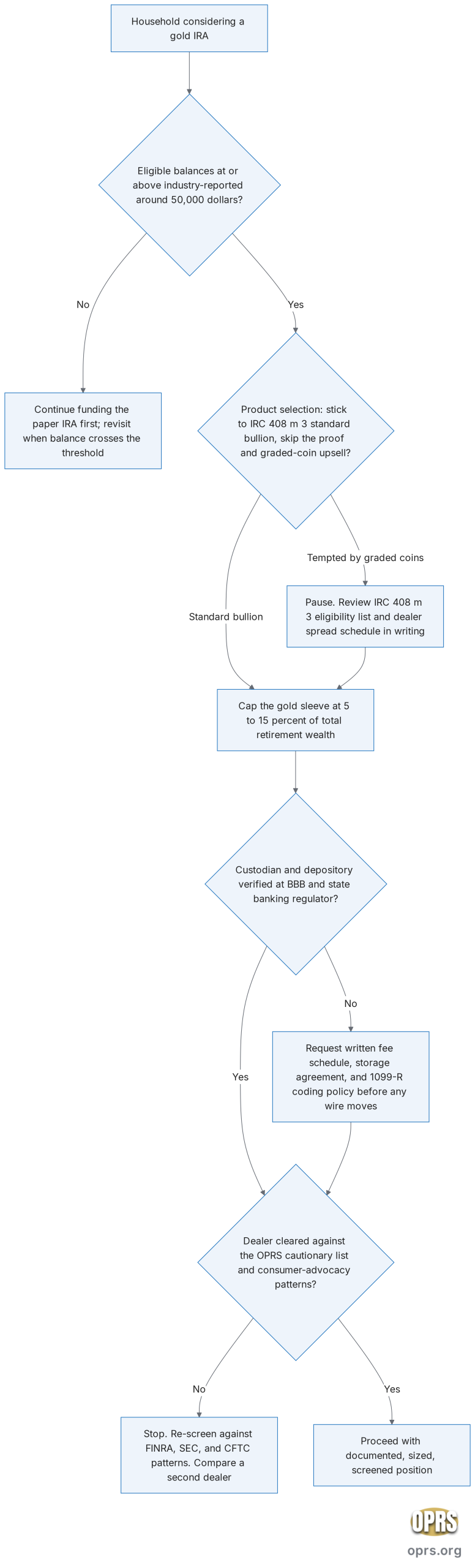
- Set an account-size floor. Below industry-reported around $50,000 in eligible balances, the flat-fee drag dominates the return profile. Most Education-First operators publish a minimum at or near this number for a reason that aligns with the household interest.
- Stick to standard bullion eligible under IRC Section 408(m)(3). American Gold Eagles, American Silver Eagles, and standard bars from approved refiners carry the lowest dealer spreads. Skip the proof and graded-coin upsell unless the household specifically wants a numismatic position outside the IRA.
- Cap the allocation. Treat the gold sleeve as a risk-control layer at 5 to 15 percent of total retirement wealth, sized to the household tolerance for the yield gap. Keep the rest in income-producing paper assets that can fund retirement draws.
- Verify the custodian at public sources. Cross-check the trust company at the relevant state banking regulator and at the Better Business Bureau. Request written copies of the fee schedule, the storage agreement, and the distribution coding policy before signing.
- Cross-check the dealer against the OPRS cautionary list. An Education-First dealer with a long A+ Better Business Bureau record, a Money Best Overall recognition, and an Investopedia transparency award sits in a different operational tier from a high-pressure cold-call shop. Use the OPRS list as a screening filter, not as an endorsement.
Cross-check the dealer before mitigation can work
The five mitigants above only land cleanly when the dealer at the other end of the transaction operates on transparent terms. A high-pressure operator can defeat allocation discipline, product-selection discipline, and custodian due diligence with a single same-day-pricing pitch. The cautionary list at OPRS exists to flag the patterns that consumer-advocacy guidance from FINRA, the SEC, and the CFTC consistently identify as material concerns.
Run the dealer name against the OPRS 2026 cautionary list before any rollover paperwork, contribution, or buy order moves. The screen takes a few minutes and prevents the most expensive mistakes documented in the consumer-advocacy record.
Common critiques answered with the published record
The five recurring anti-gold-IRA arguments each carry a partial truth. Each one is either narrowed or reframed by the actual data from the World Gold Council’s strategic asset research, the Federal Reserve FRED gold series, and the IRS Publication 590-A framework.
A saver rebuilding a six-figure balance in the 55-to-65 band hears these objections in family conversations, on talk radio, and in generalist finance blogs. The section below restates each in its strongest form, then sets it against the published record.
Critique 1: gold pays no yield, no interest, no rent
The strong-form argument is real. An S&P 500 index fund represents a claim on corporate earnings. A Treasury bond pays a coupon. A gold bar in a depository produces no cash flow at all.
The reframe: a retirement portfolio is an allocation problem, not a single-asset bet on the highest-yielding instrument. The role of gold inside that allocation is correlation, not yield. The World Gold Council research documents that gold’s price has historically moved differently from equities and investment-grade bonds across the five largest US equity drawdowns since 1971.
A 55-year-old saver with a $200,000 base who suffers a 30 percent equity drawdown at age 58 has roughly seven years to recover. The same saver with a 90-10 equity-gold split sees a portfolio-level decline closer to 23 percent. That recovery clock shortens by 12 to 18 months.
Critique 2: equities beat gold over the long run, so gold is dead money
The strong-form argument: the S&P 500 has returned roughly 10.5 percent annualized including dividends since 1971. Gold has returned roughly 8.0 percent nominal over the same window. On a 50-year buy-and-hold, equities win.
The reframe: the 50-year average clusters in equity bull markets and obscures windows where gold materially outperformed. A 55-year-old in 2026 is not making a 50-year decision. The saver is making a 10-to-15-year decision in a starting context where US equity valuations sit at the upper end of their historical range.
The FRED gold spot series and the FRED S&P 500 series together show three windows where gold materially outperformed equities.
| Window | Gold annualized | S&P annualized |
|---|---|---|
| 1971 to 2024 full era | ~8.0% | ~10.5% |
| 1973 to 1982 stagflation decade | ~33% | ~7% |
| 2000 to 2010 lost decade | ~15% | ~-1.4% |
| Calendar year 2008 alone | +5.5% | -37.0% |
The stress-decade pattern matters more to a late-career rebuilder than the full-era average. A saver whose 55-to-65 window happens to include a stress decade benefits asymmetrically from a 10 percent allocation that holds up while the equity slice rebuilds.
Critique 3: gold is a fear trade, equities are the optimist’s asset
The strong-form argument: the long-arc story of US wealth creation has been told by productive enterprises, not by a non-productive metal. A retirement saver should be on the side of human productivity, not on the side of hedging against its failure.
The reframe: optimist-versus-pessimist framing is a category error inside a retirement portfolio. A 60-year-old with a ten-year horizon is solving for two things at once: long-term growth and drawdown management. The conservative slice has traditionally been investment-grade bonds. In the inflation regime of 2021 to 2024, that slice failed in real terms for the first time in two generations.
Gold inside a retirement portfolio is a partial substitute for the part of the conservative slice that no longer reliably preserves purchasing power across an inflation surprise. The equity slice keeps doing the long-term compounding work. A saver committed to productive enterprise can hold 70 to 90 percent of the portfolio there and still own a sized hedge.
Critique 4: fees are too high to justify the allocation
The strong-form argument: an S&P 500 index fund inside a 401(k) costs 3 to 9 basis points per year. A self-directed gold IRA charges setup, annual custodian, annual storage, and a dealer spread on each purchase. On a $25,000 allocation the all-in first-year cost can run 4 to 7 percent of principal.
The reframe: the fee structure is a percentage problem at small balances and a much smaller drag at the balances most savers actually use. The annual custodian and storage fees are flat dollar amounts, not percentages.
On a $100,000 allocation, $300 to $525 of annual recurring fees works out to 30 to 53 basis points per year. On a $250,000 allocation, the same fee stack drops to 12 to 21 basis points. The setup fee and the dealer spread amortize across the holding period: a 5 percent spread over a ten-year hold is 50 basis points per year. See our detailed gold IRA fee breakdown for per-vendor math at common balance sizes.
Critique 5: dealers prey on retirees, the whole sector is unsafe
The strong-form argument sits on the public docket. CFTC Press Release 8266-20 covers a $185 million recovery from a dealer network that marketed self-directed IRA rollovers to elderly investors with rare-coin overcharges. FINRA investor alerts warn specifically about IRA-linked precious-metals pitches.
The reframe: the existence of bad operators in a regulated industry does not invalidate the regulated structure itself. IRC Section 408(m)(3) defines eligible metals. IRC Section 408(a)(2) requires a non-bank trustee approved by the IRS. The metals must sit in a qualified depository. None of those constraints depend on the dealer. The dealer’s role is sourcing, and the dealer can be vetted independently.
Of the 27+ gold IRA dealers OPRS has reviewed, three pass the bar for the 2026 trusted list. The remaining 24+ either fail the trust filter or are still under review. The shortlist and the methodology sit at the 2026 dealer review page.
Four-step dealer due-diligence procedure
The procedure runs in under an hour on publicly searchable databases. Order matters: a dealer that fails an earlier step does not need the more time-consuming later ones.
- BBB business profile lookup. Search the Better Business Bureau database for the dealer’s exact legal name. Any rating below A, any pattern of unresolved complaints over the last three years, or any alert tag is a hard stop.
- CFTC and SEC enforcement docket. Search the CFTC press release archive and the SEC litigation release archive for the dealer name and principals. A single settlement in the last seven years is a hard stop.
- Fee transparency review. Request the published fee schedule, setup-fee disclosure, custodian-and-storage statement, and bullion markup methodology. A dealer that will not provide a written fee schedule in advance of a sales call is a hard stop.
- Buyback policy and reference check. Ask for the published buyback policy and three customer references in your state who completed a rollover in the last 18 months. Ask each reference one question: did the invoice price match the phone quote with no surprise add-ons.
A dealer that clears all four steps is on the small list. The list is currently three operators wide.
Five mistakes when responding to a one-line dismissal
Mistake one: matching the dismissal with an opposite dismissal. Cite the World Gold Council research, the FRED data series, and the actual allocation band. Let the numbers do the work.
Mistake two: arguing the absolute return instead of the correlation effect. Gold is in competition with the conservative slice for drawdown management, not with equities for long-term return. Framing the comparison as gold versus the S&P concedes the framing.
Mistake three: ignoring the fee math and pretending fees are not real. The fees are real at small balances. Acknowledge the structure, point out the amortization across a ten-year hold, and run the basis-point math at the actual allocation size.
Mistake four: defending every dealer in the industry instead of pre-vetting one. Acknowledge the bad operators by name where the CFTC has done so. Then walk through the four-step vetting procedure for a specific dealer.
Mistake five: allocating before vetting. Vet the dealer through the four-step procedure first, then size the allocation. A saver who cannot find a dealer that clears all four steps should not be allocating at all.
Frequently asked questions on gold IRA disadvantages
Is a gold IRA riskier than a regular IRA?
The federal tax shell is identical. The price volatility of the underlying asset is different. Gold price history shows wider drawdowns over short horizons than a diversified bond fund and narrower drawdowns than a single-stock position. The structural risks specific to a gold IRA, custody concentration and dealer-spread liquidity, are different from the market risk of a regular IRA. Neither structure is automatically riskier across the full retirement horizon.
What is the minimum balance for a gold IRA to make sense?
Education-First operators commonly publish an industry-reported around $50,000 minimum. The number is not arbitrary. Below the threshold, a typical first-year flat-fee stack of $250 to $400 represents over 0.50 percent annual drag on the balance. The drag erodes the inflation-hedge benefit that motivates most gold IRA decisions. A household with under $50,000 in eligible balances generally gets better economics from continuing to fund the existing paper IRA before adding a metals sleeve.
Can a household hold the gold at home to avoid the custody risk?
Not inside an IRA. IRC Section 408(m) requires a qualified trustee and an approved depository. A home-storage arrangement marketed as a checkbook LLC home-storage IRA has been the subject of IRS guidance on individual retirement arrangements and case law that treats home possession as a deemed distribution. The deemed distribution is taxable as ordinary income plus a 10 percent additional tax under IRC Section 72(t) when the account owner is under age 59 and a half.
How fast can a household exit a gold IRA position?
The mechanics typically take a few business days at a transparent operator. The custodian liquidates the metal at the dealer bid price, settles the proceeds, and either distributes the cash to the account owner or transfers it in kind to a successor IRA. The dealer spread runs against the seller on the exit leg. A buy-and-quickly-sell cycle is the worst use case for the structure because the round-trip spread is paid in full against a short holding window.
Does the IRS approve specific gold IRA dealers?
The IRS approves depositories and qualified trustees, not retail dealers. A dealer can sell IRS-approved metal under IRC Section 408(m)(3) without IRS endorsement. The household must verify three things: the dealer fee schedule, the custodian fee schedule, and the depository agreement. Each layer is a separate vendor relationship. The OPRS cautionary list collects the patterns that warrant a closer look.
The tax framework, the fee economics, the liquidity profile, and the operational layer all sit in plain view once the household reads past the dealer pitch. A balanced answer recognizes both the documented disadvantages and the documented mitigants.
The structure earns a place in a diversified retirement plan when sized and screened with discipline. It sits as a poor fit when it stretches a balance too small to absorb the cost stack. It also sits as a poor fit when it concentrates household wealth at the wrong dealer.
For deeper background on the underlying tax mechanics, see the OPRS overview of gold IRA tax benefits. For a procedural walk-through on rolling existing balances in, see the OPRS step-by-step on 401(k) rollovers.
Sources cited
- IRC Section 408, Individual Retirement Accounts (Legal Information Institute, Cornell)
- IRC Section 408(m), Investment in Collectibles and Approved Bullion (Legal Information Institute, Cornell)
- IRC Section 401(a)(9), Required Minimum Distribution Rules (Legal Information Institute, Cornell)
- SEC investor.gov, Asset Allocation Primer (SEC.gov)
- CFTC Consumer Advisory on Precious Metals Fraud (CFTC.gov)
- CFTC Press Release 8266-20, precious metals fraud enforcement action (CFTC.gov)
- FINRA Investor Insights Library (FINRA.org)
- FINRA Investor Insights, Precious Metals investor alert (FINRA.org)
- SEC Litigation Release archive (SEC.gov)
- Better Business Bureau, business profile search (BBB.org)
- World Gold Council, Relevance of Gold as a Strategic Asset, US Edition (Gold.org)
- Federal Reserve Bank of St. Louis, FRED Gold Fixing Price 10:30 AM London bullion market series (FRED)
- Federal Reserve Bank of St. Louis, FRED S&P 500 series (FRED)
- IRS Guidance, Individual Retirement Arrangements (IRS.gov)
- IRS Publication 590-A, Contributions to Individual Retirement Arrangements (IRS.gov)
- IRS Publication 590-B, Distributions from Individual Retirement Arrangements (IRS.gov)
More on OPRS
- 2026 OPRS list of gold IRA dealers we warn against
- Gold IRA Tax Benefits Overview: Deferral, Roth, QCD
- 401(k) rollover to a gold IRA, step by step
- How much gold should I have in my retirement portfolio?
A share of a low-cost index fund trades on a regulated exchange at a bid-ask spread of a fraction of a basis point. A bullion coin or bar trades over the counter through a precious metals dealer. The buy price and the sell price diverge by a spread the dealer keeps as gross margin.
The spread varies by product. Generic bullion bars sit at the low end. Sovereign coins sit in the middle. Proof coins and numismatic-graded coins sit at the high end. Those high-end coins can carry premiums of 30 percent or more above the spot price of the underlying metal.
The published CFTC consumer advisory on precious metals fraud documents the spread mechanic. A buyer pays the dealer ask price at entry. A seller receives the dealer bid price at exit. The difference is the spread, and the dealer keeps it. A 10 percent round-trip spread on a $100,000 position costs the household $10,000 over the entry-exit cycle. That cost is independent of whether the spot price of gold rises or falls during the holding window.
The lever the household can pull is product selection. A self-directed gold IRA can hold IRS-approved bullion coins and bars under IRC Section 408(m)(3). The Code lists the eligible products by fineness standard, not by premium.
A buyer is free to pick a 1 oz American Gold Eagle at a 5 to 8 percent spread. A buyer is also free to pick a graded proof coin at a 25 to 40 percent spread. The selection decision drives more total cost over the holding period than the custodian fee schedule.
Disadvantage 3: physical metals pay no dividends and no interest
A diversified equity index fund pays dividends. An investment-grade bond fund pays interest. A rental real estate position pays net operating income. A physical gold position pays nothing during the holding period. The only return path is price appreciation against the dollar. A household that holds physical metal for 20 years receives no internal coupon and no internal cash distribution along the way.
The implication for retirement income planning is direct. A retiree drawing 4 percent per year from a balanced paper IRA can fund the draw partly with dividends and interest. The principal is consumed more slowly. A retiree drawing 4 percent per year from a gold-only IRA must sell metal at every draw. The dealer spread runs against the household at every sale. Required minimum distributions under IRC Section 401(a)(9) force the same dynamic at age 73 and beyond.
The mitigant is allocation discipline. The SEC publishes a general asset allocation primer at investor.gov that frames diversification as the central risk control. A gold IRA sized to a meaningful but limited share of total retirement wealth lets paper assets fund the income side and lets metals serve the inflation-hedge and tail-risk side. A 100 percent gold allocation is rarely the right answer for a household that needs steady retirement cash flow.
Disadvantage 4: custody concentrates at a narrow set of operators
A self-directed IRA cannot hold metal at the account owner home address. IRC Section 408(m) requires a qualified trustee and an approved depository. The eligible IRS-approved depositories number in the single digits across the United States. The qualified self-directed IRA custodians that specialize in precious metals number a few dozen. The structure relies on a narrow operational layer.
The operational risks at the custody layer include three failure modes worth naming. The first is custodian operational failure, where a trust company stalls distribution requests or transfer-in-kind requests for weeks. The second is depository commingling error, where allocated holdings get treated as unallocated under depository operations. The third is paperwork coding error, where a Form 1099-R distribution code lands as an early distribution instead of a normal rollover.
None of the three is fatal in normal operating conditions. Each becomes material when paired with a household timing constraint such as a required minimum distribution deadline, a rollover 60 day window, or a Roth conversion deadline. The mitigant is the same one that mitigates the buying-side risk. Pick a custodian with a verifiable record across multiple business cycles, an A+ Better Business Bureau rating, and written documentation of the relevant fee and distribution coding schedules.
Disadvantage 5: the buying side is uneven, and high-pressure tactics persist
The single most controllable disadvantage sits with the dealer that fills the order. A small group of operators publishes fee schedules in writing and refuses to charge premiums on proof or numismatic coins inside an IRA. The household compares line items against the published IRC Section 408(m) eligibility list before any wire moves. A wider field of operators relies on scripted urgency, scarcity framing, and complex premium structures that obscure the all-in cost.
The patterns to screen against are documented. The FINRA investor insights library publishes general guidance on commodity and metals investment risks. The CFTC consumer advisory cited above lists telltale signs of high-pressure precious metals sales. The signs include pressure to act on a same-day window, claims of insider knowledge of a price move, and product steering toward high-premium graded coins instead of standard bullion. Any of the three patterns at a dealer pitch warrants a pause and an independent comparison.
The Education-First model goes the other direction. The dealer publishes the buy spread, the storage schedule, and the custodian fee schedule in writing. The buyer can review the documents on a no-commitment call. The dealer holds a long-running A+ rating at the Better Business Bureau, has been recognized as Best Overall by Money for several years running, and carries an Investopedia award for transparency. The household decision lands on documented terms instead of phone-call pressure.
How the five disadvantages stack against household profiles
The disadvantages do not weigh equally across households. A retiree with a $750,000 paper IRA sees a small flat-fee drag, has discretionary income from dividends, and can absorb a 10 percent dealer spread on a small allocation. A pre-retiree with a $40,000 IRA sees a meaningful flat-fee drag, has no internal income to spare, and cannot absorb a 10 percent round-trip spread without erasing several years of expected return.
| Household profile | Flat-fee drag | Liquidity spread cost | Yield gap | Net fit |
|---|---|---|---|---|
| Under $50,000 in eligible balances | Material (over 0.60 percent annual drag at typical fee stack) | Material (no slack to absorb spread) | Material (needs every basis point of yield) | Status: poor fit |
| $50,000 to $150,000 in eligible balances, age 50-plus | Modest (0.20 to 0.60 percent annual) | Manageable on a small allocation | Manageable if paper assets dominate | Status: conditional fit, allocation discipline required |
| $150,000 to $500,000, pre-retiree | Small (0.06 to 0.20 percent annual) | Acceptable on a 5 to 15 percent allocation | Acceptable as inflation-hedge sleeve | Status: workable fit |
| Over $500,000, retired with paper income | Negligible (under 0.06 percent annual) | Acceptable, can stage entries and exits | Not binding, paper sleeve funds income | Status: good structural fit |
The conditional-fit and workable-fit rows are where most decisions actually land. A balanced sizing approach pairs a partial gold allocation with the existing paper IRA. The metal sleeve sits as one risk-control layer, not as a replacement for the diversified core. Households exploring the partial allocation path can study a measured framework for gold allocation sizing before committing to a custodian.
How to mitigate the disadvantages without abandoning the structure
None of the five disadvantages is automatic. Each has a documented mitigant. The flat-fee drag responds to account-size discipline. The dealer spread responds to product selection. The yield gap responds to allocation sizing. The custody risk responds to custodian due diligence. The buying-side risk responds to dealer screening against verifiable public criteria.
- Set an account-size floor. Below industry-reported around $50,000 in eligible balances, the flat-fee drag dominates the return profile. Most Education-First operators publish a minimum at or near this number for a reason that aligns with the household interest.
- Stick to standard bullion eligible under IRC Section 408(m)(3). American Gold Eagles, American Silver Eagles, and standard bars from approved refiners carry the lowest dealer spreads. Skip the proof and graded-coin upsell unless the household specifically wants a numismatic position outside the IRA.
- Cap the allocation. Treat the gold sleeve as a risk-control layer at 5 to 15 percent of total retirement wealth, sized to the household tolerance for the yield gap. Keep the rest in income-producing paper assets that can fund retirement draws.
- Verify the custodian at public sources. Cross-check the trust company at the relevant state banking regulator and at the Better Business Bureau. Request written copies of the fee schedule, the storage agreement, and the distribution coding policy before signing.
- Cross-check the dealer against the OPRS cautionary list. An Education-First dealer with a long A+ Better Business Bureau record, a Money Best Overall recognition, and an Investopedia transparency award sits in a different operational tier from a high-pressure cold-call shop. Use the OPRS list as a screening filter, not as an endorsement.
Cross-check the dealer before mitigation can work
The five mitigants above only land cleanly when the dealer at the other end of the transaction operates on transparent terms. A high-pressure operator can defeat allocation discipline, product-selection discipline, and custodian due diligence with a single same-day-pricing pitch. The cautionary list at OPRS exists to flag the patterns that consumer-advocacy guidance from FINRA, the SEC, and the CFTC consistently identify as material concerns.
Run the dealer name against the OPRS 2026 cautionary list before any rollover paperwork, contribution, or buy order moves. The screen takes a few minutes and prevents the most expensive mistakes documented in the consumer-advocacy record.
Common critiques answered with the published record
The five recurring anti-gold-IRA arguments each carry a partial truth. Each one is either narrowed or reframed by the actual data from the World Gold Council’s strategic asset research, the Federal Reserve FRED gold series, and the IRS Publication 590-A framework.
A saver rebuilding a six-figure balance in the 55-to-65 band hears these objections in family conversations, on talk radio, and in generalist finance blogs. The section below restates each in its strongest form, then sets it against the published record.
Critique 1: gold pays no yield, no interest, no rent
The strong-form argument is real. An S&P 500 index fund represents a claim on corporate earnings. A Treasury bond pays a coupon. A gold bar in a depository produces no cash flow at all.
The reframe: a retirement portfolio is an allocation problem, not a single-asset bet on the highest-yielding instrument. The role of gold inside that allocation is correlation, not yield. The World Gold Council research documents that gold’s price has historically moved differently from equities and investment-grade bonds across the five largest US equity drawdowns since 1971.
A 55-year-old saver with a $200,000 base who suffers a 30 percent equity drawdown at age 58 has roughly seven years to recover. The same saver with a 90-10 equity-gold split sees a portfolio-level decline closer to 23 percent. That recovery clock shortens by 12 to 18 months.
Critique 2: equities beat gold over the long run, so gold is dead money
The strong-form argument: the S&P 500 has returned roughly 10.5 percent annualized including dividends since 1971. Gold has returned roughly 8.0 percent nominal over the same window. On a 50-year buy-and-hold, equities win.
The reframe: the 50-year average clusters in equity bull markets and obscures windows where gold materially outperformed. A 55-year-old in 2026 is not making a 50-year decision. The saver is making a 10-to-15-year decision in a starting context where US equity valuations sit at the upper end of their historical range.
The FRED gold spot series and the FRED S&P 500 series together show three windows where gold materially outperformed equities.
| Window | Gold annualized | S&P annualized |
|---|---|---|
| 1971 to 2024 full era | ~8.0% | ~10.5% |
| 1973 to 1982 stagflation decade | ~33% | ~7% |
| 2000 to 2010 lost decade | ~15% | ~-1.4% |
| Calendar year 2008 alone | +5.5% | -37.0% |
The stress-decade pattern matters more to a late-career rebuilder than the full-era average. A saver whose 55-to-65 window happens to include a stress decade benefits asymmetrically from a 10 percent allocation that holds up while the equity slice rebuilds.
Critique 3: gold is a fear trade, equities are the optimist’s asset
The strong-form argument: the long-arc story of US wealth creation has been told by productive enterprises, not by a non-productive metal. A retirement saver should be on the side of human productivity, not on the side of hedging against its failure.
The reframe: optimist-versus-pessimist framing is a category error inside a retirement portfolio. A 60-year-old with a ten-year horizon is solving for two things at once: long-term growth and drawdown management. The conservative slice has traditionally been investment-grade bonds. In the inflation regime of 2021 to 2024, that slice failed in real terms for the first time in two generations.
Gold inside a retirement portfolio is a partial substitute for the part of the conservative slice that no longer reliably preserves purchasing power across an inflation surprise. The equity slice keeps doing the long-term compounding work. A saver committed to productive enterprise can hold 70 to 90 percent of the portfolio there and still own a sized hedge.
Critique 4: fees are too high to justify the allocation
The strong-form argument: an S&P 500 index fund inside a 401(k) costs 3 to 9 basis points per year. A self-directed gold IRA charges setup, annual custodian, annual storage, and a dealer spread on each purchase. On a $25,000 allocation the all-in first-year cost can run 4 to 7 percent of principal.
The reframe: the fee structure is a percentage problem at small balances and a much smaller drag at the balances most savers actually use. The annual custodian and storage fees are flat dollar amounts, not percentages.
On a $100,000 allocation, $300 to $525 of annual recurring fees works out to 30 to 53 basis points per year. On a $250,000 allocation, the same fee stack drops to 12 to 21 basis points. The setup fee and the dealer spread amortize across the holding period: a 5 percent spread over a ten-year hold is 50 basis points per year. See our detailed gold IRA fee breakdown for per-vendor math at common balance sizes.
Critique 5: dealers prey on retirees, the whole sector is unsafe
The strong-form argument sits on the public docket. CFTC Press Release 8266-20 covers a $185 million recovery from a dealer network that marketed self-directed IRA rollovers to elderly investors with rare-coin overcharges. FINRA investor alerts warn specifically about IRA-linked precious-metals pitches.
The reframe: the existence of bad operators in a regulated industry does not invalidate the regulated structure itself. IRC Section 408(m)(3) defines eligible metals. IRC Section 408(a)(2) requires a non-bank trustee approved by the IRS. The metals must sit in a qualified depository. None of those constraints depend on the dealer. The dealer’s role is sourcing, and the dealer can be vetted independently.
Of the 27+ gold IRA dealers OPRS has reviewed, three pass the bar for the 2026 trusted list. The remaining 24+ either fail the trust filter or are still under review. The shortlist and the methodology sit at the 2026 dealer review page.
Four-step dealer due-diligence procedure
The procedure runs in under an hour on publicly searchable databases. Order matters: a dealer that fails an earlier step does not need the more time-consuming later ones.
- BBB business profile lookup. Search the Better Business Bureau database for the dealer’s exact legal name. Any rating below A, any pattern of unresolved complaints over the last three years, or any alert tag is a hard stop.
- CFTC and SEC enforcement docket. Search the CFTC press release archive and the SEC litigation release archive for the dealer name and principals. A single settlement in the last seven years is a hard stop.
- Fee transparency review. Request the published fee schedule, setup-fee disclosure, custodian-and-storage statement, and bullion markup methodology. A dealer that will not provide a written fee schedule in advance of a sales call is a hard stop.
- Buyback policy and reference check. Ask for the published buyback policy and three customer references in your state who completed a rollover in the last 18 months. Ask each reference one question: did the invoice price match the phone quote with no surprise add-ons.
A dealer that clears all four steps is on the small list. The list is currently three operators wide.
Five mistakes when responding to a one-line dismissal
Mistake one: matching the dismissal with an opposite dismissal. Cite the World Gold Council research, the FRED data series, and the actual allocation band. Let the numbers do the work.
Mistake two: arguing the absolute return instead of the correlation effect. Gold is in competition with the conservative slice for drawdown management, not with equities for long-term return. Framing the comparison as gold versus the S&P concedes the framing.
Mistake three: ignoring the fee math and pretending fees are not real. The fees are real at small balances. Acknowledge the structure, point out the amortization across a ten-year hold, and run the basis-point math at the actual allocation size.
Mistake four: defending every dealer in the industry instead of pre-vetting one. Acknowledge the bad operators by name where the CFTC has done so. Then walk through the four-step vetting procedure for a specific dealer.
Mistake five: allocating before vetting. Vet the dealer through the four-step procedure first, then size the allocation. A saver who cannot find a dealer that clears all four steps should not be allocating at all.
Frequently asked questions on gold IRA disadvantages
Is a gold IRA riskier than a regular IRA?
The federal tax shell is identical. The price volatility of the underlying asset is different. Gold price history shows wider drawdowns over short horizons than a diversified bond fund and narrower drawdowns than a single-stock position. The structural risks specific to a gold IRA, custody concentration and dealer-spread liquidity, are different from the market risk of a regular IRA. Neither structure is automatically riskier across the full retirement horizon.
What is the minimum balance for a gold IRA to make sense?
Education-First operators commonly publish an industry-reported around $50,000 minimum. The number is not arbitrary. Below the threshold, a typical first-year flat-fee stack of $250 to $400 represents over 0.50 percent annual drag on the balance. The drag erodes the inflation-hedge benefit that motivates most gold IRA decisions. A household with under $50,000 in eligible balances generally gets better economics from continuing to fund the existing paper IRA before adding a metals sleeve.
Can a household hold the gold at home to avoid the custody risk?
Not inside an IRA. IRC Section 408(m) requires a qualified trustee and an approved depository. A home-storage arrangement marketed as a checkbook LLC home-storage IRA has been the subject of IRS guidance on individual retirement arrangements and case law that treats home possession as a deemed distribution. The deemed distribution is taxable as ordinary income plus a 10 percent additional tax under IRC Section 72(t) when the account owner is under age 59 and a half.
How fast can a household exit a gold IRA position?
The mechanics typically take a few business days at a transparent operator. The custodian liquidates the metal at the dealer bid price, settles the proceeds, and either distributes the cash to the account owner or transfers it in kind to a successor IRA. The dealer spread runs against the seller on the exit leg. A buy-and-quickly-sell cycle is the worst use case for the structure because the round-trip spread is paid in full against a short holding window.
Does the IRS approve specific gold IRA dealers?
The IRS approves depositories and qualified trustees, not retail dealers. A dealer can sell IRS-approved metal under IRC Section 408(m)(3) without IRS endorsement. The household must verify three things: the dealer fee schedule, the custodian fee schedule, and the depository agreement. Each layer is a separate vendor relationship. The OPRS cautionary list collects the patterns that warrant a closer look.
The tax framework, the fee economics, the liquidity profile, and the operational layer all sit in plain view once the household reads past the dealer pitch. A balanced answer recognizes both the documented disadvantages and the documented mitigants.
The structure earns a place in a diversified retirement plan when sized and screened with discipline. It sits as a poor fit when it stretches a balance too small to absorb the cost stack. It also sits as a poor fit when it concentrates household wealth at the wrong dealer.
For deeper background on the underlying tax mechanics, see the OPRS overview of gold IRA tax benefits. For a procedural walk-through on rolling existing balances in, see the OPRS step-by-step on 401(k) rollovers.
Sources cited
- IRC Section 408, Individual Retirement Accounts (Legal Information Institute, Cornell)
- IRC Section 408(m), Investment in Collectibles and Approved Bullion (Legal Information Institute, Cornell)
- IRC Section 401(a)(9), Required Minimum Distribution Rules (Legal Information Institute, Cornell)
- SEC investor.gov, Asset Allocation Primer (SEC.gov)
- CFTC Consumer Advisory on Precious Metals Fraud (CFTC.gov)
- CFTC Press Release 8266-20, precious metals fraud enforcement action (CFTC.gov)
- FINRA Investor Insights Library (FINRA.org)
- FINRA Investor Insights, Precious Metals investor alert (FINRA.org)
- SEC Litigation Release archive (SEC.gov)
- Better Business Bureau, business profile search (BBB.org)
- World Gold Council, Relevance of Gold as a Strategic Asset, US Edition (Gold.org)
- Federal Reserve Bank of St. Louis, FRED Gold Fixing Price 10:30 AM London bullion market series (FRED)
- Federal Reserve Bank of St. Louis, FRED S&P 500 series (FRED)
- IRS Guidance, Individual Retirement Arrangements (IRS.gov)
- IRS Publication 590-A, Contributions to Individual Retirement Arrangements (IRS.gov)
- IRS Publication 590-B, Distributions from Individual Retirement Arrangements (IRS.gov)
More on OPRS
- 2026 OPRS list of gold IRA dealers we warn against
- Gold IRA Tax Benefits Overview: Deferral, Roth, QCD
- 401(k) rollover to a gold IRA, step by step
- How much gold should I have in my retirement portfolio?
Screen the dealer before the disadvantages compound
Four of the five disadvantages live in the structure itself. The fifth, buying-side conduct, lives at the dealer that fills the order. A high-pressure operator can stack a 15 percent bullion premium on top of a flat fee schedule. The combination converts a marginal disadvantage into a material one.
The reverse is also true. An Education-First operator publishes fee schedules in writing and holds an A+ Better Business Bureau rating. The household compares line items against IRS guidance before any wire moves.
3 of 27+ gold IRA dealers reviewed by OPRS make the 2026 trusted list. Updated August 2026.
Disadvantage 1: flat-dollar fees drag harder on small balances
A standard brokerage IRA holding index funds typically charges a fund expense ratio in the range of 3 to 10 basis points on the balance. The cost scales linearly with assets. A self-directed gold IRA charges flat-dollar fees instead. The setup fee, the annual administrative fee, the storage fee, and any wire fees do not scale with the balance. A $50 administrative fee costs the same on a $20,000 account and a $500,000 account.
The industry-reported first-year cost stack at a transparent operator sits in the range of $250 to $400. Setup runs $50 to $80. Annual administration runs $80 to $150. Non-segregated storage runs roughly $100 to $150. Segregated storage runs higher, often $150 to $300. The figures vary by custodian and by depository, and a household can request a written line-item schedule before signing.
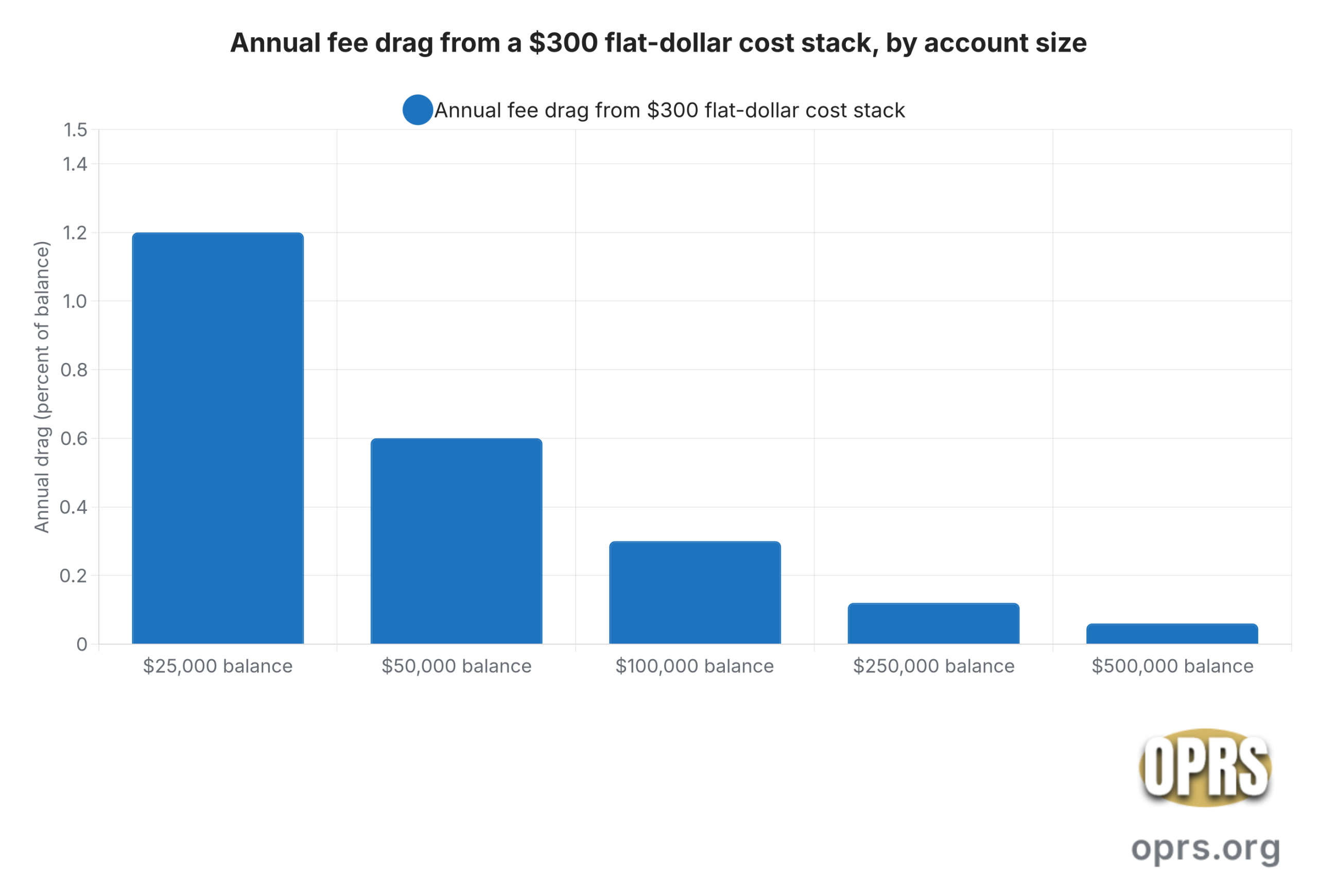
The annualized drag of a flat-dollar cost stack falls quickly as the account size rises. The same $300 first-year cost equals 1.20 percent on a $25,000 account, 0.60 percent on a $50,000 account, 0.30 percent on a $100,000 account, 0.12 percent on a $250,000 account, and 0.06 percent on a $500,000 account. The drag curve explains why Education-First operators publish an industry-reported around $50,000 account minimum. Below the minimum, the cost stack consumes a meaningful slice of expected return.
Precious metals IRA fee-drag calculator
Precious metals IRAs charge mostly flat dollar fees (setup, annual custodian, storage). Flat fees take a much bigger bite out of a small account than a large one. Enter your numbers to see the drag.
Estimate only. Fee amounts vary by provider and are often not published; enter figures you confirm in writing. This tool ignores metal price changes and the dealer spread, which also affect returns. Not financial advice.
The right dealer explains every fee up front. Get Augusta's free precious metals IRA company checklist.
The drag is not unrecoverable. A household that holds the position for a long horizon can absorb the front-loaded flat fees against multi-year compounding. A household that expects to liquidate within 2 to 3 years sees the cost stack chew a larger share of return, because the fees are flat in dollars while the holding window is short.
Disadvantage 2: bullion liquidity passes through a dealer spread
A share of a low-cost index fund trades on a regulated exchange at a bid-ask spread of a fraction of a basis point. A bullion coin or bar trades over the counter through a precious metals dealer. The buy price and the sell price diverge by a spread the dealer keeps as gross margin.
The spread varies by product. Generic bullion bars sit at the low end. Sovereign coins sit in the middle. Proof coins and numismatic-graded coins sit at the high end. Those high-end coins can carry premiums of 30 percent or more above the spot price of the underlying metal.
The published CFTC consumer advisory on precious metals fraud documents the spread mechanic. A buyer pays the dealer ask price at entry. A seller receives the dealer bid price at exit. The difference is the spread, and the dealer keeps it. A 10 percent round-trip spread on a $100,000 position costs the household $10,000 over the entry-exit cycle. That cost is independent of whether the spot price of gold rises or falls during the holding window.
The lever the household can pull is product selection. A self-directed gold IRA can hold IRS-approved bullion coins and bars under IRC Section 408(m)(3). The Code lists the eligible products by fineness standard, not by premium.
A buyer is free to pick a 1 oz American Gold Eagle at a 5 to 8 percent spread. A buyer is also free to pick a graded proof coin at a 25 to 40 percent spread. The selection decision drives more total cost over the holding period than the custodian fee schedule.
Disadvantage 3: physical metals pay no dividends and no interest
A diversified equity index fund pays dividends. An investment-grade bond fund pays interest. A rental real estate position pays net operating income. A physical gold position pays nothing during the holding period. The only return path is price appreciation against the dollar. A household that holds physical metal for 20 years receives no internal coupon and no internal cash distribution along the way.
The implication for retirement income planning is direct. A retiree drawing 4 percent per year from a balanced paper IRA can fund the draw partly with dividends and interest. The principal is consumed more slowly. A retiree drawing 4 percent per year from a gold-only IRA must sell metal at every draw. The dealer spread runs against the household at every sale. Required minimum distributions under IRC Section 401(a)(9) force the same dynamic at age 73 and beyond.
The mitigant is allocation discipline. The SEC publishes a general asset allocation primer at investor.gov that frames diversification as the central risk control. A gold IRA sized to a meaningful but limited share of total retirement wealth lets paper assets fund the income side and lets metals serve the inflation-hedge and tail-risk side. A 100 percent gold allocation is rarely the right answer for a household that needs steady retirement cash flow.
Disadvantage 4: custody concentrates at a narrow set of operators
A self-directed IRA cannot hold metal at the account owner home address. IRC Section 408(m) requires a qualified trustee and an approved depository. The eligible IRS-approved depositories number in the single digits across the United States. The qualified self-directed IRA custodians that specialize in precious metals number a few dozen. The structure relies on a narrow operational layer.
The operational risks at the custody layer include three failure modes worth naming. The first is custodian operational failure, where a trust company stalls distribution requests or transfer-in-kind requests for weeks. The second is depository commingling error, where allocated holdings get treated as unallocated under depository operations. The third is paperwork coding error, where a Form 1099-R distribution code lands as an early distribution instead of a normal rollover.
None of the three is fatal in normal operating conditions. Each becomes material when paired with a household timing constraint such as a required minimum distribution deadline, a rollover 60 day window, or a Roth conversion deadline. The mitigant is the same one that mitigates the buying-side risk. Pick a custodian with a verifiable record across multiple business cycles, an A+ Better Business Bureau rating, and written documentation of the relevant fee and distribution coding schedules.
Disadvantage 5: the buying side is uneven, and high-pressure tactics persist
The single most controllable disadvantage sits with the dealer that fills the order. A small group of operators publishes fee schedules in writing and refuses to charge premiums on proof or numismatic coins inside an IRA. The household compares line items against the published IRC Section 408(m) eligibility list before any wire moves. A wider field of operators relies on scripted urgency, scarcity framing, and complex premium structures that obscure the all-in cost.
The patterns to screen against are documented. The FINRA investor insights library publishes general guidance on commodity and metals investment risks. The CFTC consumer advisory cited above lists telltale signs of high-pressure precious metals sales. The signs include pressure to act on a same-day window, claims of insider knowledge of a price move, and product steering toward high-premium graded coins instead of standard bullion. Any of the three patterns at a dealer pitch warrants a pause and an independent comparison.
The Education-First model goes the other direction. The dealer publishes the buy spread, the storage schedule, and the custodian fee schedule in writing. The buyer can review the documents on a no-commitment call. The dealer holds a long-running A+ rating at the Better Business Bureau, has been recognized as Best Overall by Money for several years running, and carries an Investopedia award for transparency. The household decision lands on documented terms instead of phone-call pressure.
How the five disadvantages stack against household profiles
The disadvantages do not weigh equally across households. A retiree with a $750,000 paper IRA sees a small flat-fee drag, has discretionary income from dividends, and can absorb a 10 percent dealer spread on a small allocation. A pre-retiree with a $40,000 IRA sees a meaningful flat-fee drag, has no internal income to spare, and cannot absorb a 10 percent round-trip spread without erasing several years of expected return.
| Household profile | Flat-fee drag | Liquidity spread cost | Yield gap | Net fit |
|---|---|---|---|---|
| Under $50,000 in eligible balances | Material (over 0.60 percent annual drag at typical fee stack) | Material (no slack to absorb spread) | Material (needs every basis point of yield) | Status: poor fit |
| $50,000 to $150,000 in eligible balances, age 50-plus | Modest (0.20 to 0.60 percent annual) | Manageable on a small allocation | Manageable if paper assets dominate | Status: conditional fit, allocation discipline required |
| $150,000 to $500,000, pre-retiree | Small (0.06 to 0.20 percent annual) | Acceptable on a 5 to 15 percent allocation | Acceptable as inflation-hedge sleeve | Status: workable fit |
| Over $500,000, retired with paper income | Negligible (under 0.06 percent annual) | Acceptable, can stage entries and exits | Not binding, paper sleeve funds income | Status: good structural fit |
The conditional-fit and workable-fit rows are where most decisions actually land. A balanced sizing approach pairs a partial gold allocation with the existing paper IRA. The metal sleeve sits as one risk-control layer, not as a replacement for the diversified core. Households exploring the partial allocation path can study a measured framework for gold allocation sizing before committing to a custodian.
How to mitigate the disadvantages without abandoning the structure
None of the five disadvantages is automatic. Each has a documented mitigant. The flat-fee drag responds to account-size discipline. The dealer spread responds to product selection. The yield gap responds to allocation sizing. The custody risk responds to custodian due diligence. The buying-side risk responds to dealer screening against verifiable public criteria.
- Set an account-size floor. Below industry-reported around $50,000 in eligible balances, the flat-fee drag dominates the return profile. Most Education-First operators publish a minimum at or near this number for a reason that aligns with the household interest.
- Stick to standard bullion eligible under IRC Section 408(m)(3). American Gold Eagles, American Silver Eagles, and standard bars from approved refiners carry the lowest dealer spreads. Skip the proof and graded-coin upsell unless the household specifically wants a numismatic position outside the IRA.
- Cap the allocation. Treat the gold sleeve as a risk-control layer at 5 to 15 percent of total retirement wealth, sized to the household tolerance for the yield gap. Keep the rest in income-producing paper assets that can fund retirement draws.
- Verify the custodian at public sources. Cross-check the trust company at the relevant state banking regulator and at the Better Business Bureau. Request written copies of the fee schedule, the storage agreement, and the distribution coding policy before signing.
- Cross-check the dealer against the OPRS cautionary list. An Education-First dealer with a long A+ Better Business Bureau record, a Money Best Overall recognition, and an Investopedia transparency award sits in a different operational tier from a high-pressure cold-call shop. Use the OPRS list as a screening filter, not as an endorsement.
Cross-check the dealer before mitigation can work
The five mitigants above only land cleanly when the dealer at the other end of the transaction operates on transparent terms. A high-pressure operator can defeat allocation discipline, product-selection discipline, and custodian due diligence with a single same-day-pricing pitch. The cautionary list at OPRS exists to flag the patterns that consumer-advocacy guidance from FINRA, the SEC, and the CFTC consistently identify as material concerns.
Run the dealer name against the OPRS 2026 cautionary list before any rollover paperwork, contribution, or buy order moves. The screen takes a few minutes and prevents the most expensive mistakes documented in the consumer-advocacy record.
Common critiques answered with the published record
The five recurring anti-gold-IRA arguments each carry a partial truth. Each one is either narrowed or reframed by the actual data from the World Gold Council’s strategic asset research, the Federal Reserve FRED gold series, and the IRS Publication 590-A framework.
A saver rebuilding a six-figure balance in the 55-to-65 band hears these objections in family conversations, on talk radio, and in generalist finance blogs. The section below restates each in its strongest form, then sets it against the published record.
Critique 1: gold pays no yield, no interest, no rent
The strong-form argument is real. An S&P 500 index fund represents a claim on corporate earnings. A Treasury bond pays a coupon. A gold bar in a depository produces no cash flow at all.
The reframe: a retirement portfolio is an allocation problem, not a single-asset bet on the highest-yielding instrument. The role of gold inside that allocation is correlation, not yield. The World Gold Council research documents that gold’s price has historically moved differently from equities and investment-grade bonds across the five largest US equity drawdowns since 1971.
A 55-year-old saver with a $200,000 base who suffers a 30 percent equity drawdown at age 58 has roughly seven years to recover. The same saver with a 90-10 equity-gold split sees a portfolio-level decline closer to 23 percent. That recovery clock shortens by 12 to 18 months.
Critique 2: equities beat gold over the long run, so gold is dead money
The strong-form argument: the S&P 500 has returned roughly 10.5 percent annualized including dividends since 1971. Gold has returned roughly 8.0 percent nominal over the same window. On a 50-year buy-and-hold, equities win.
The reframe: the 50-year average clusters in equity bull markets and obscures windows where gold materially outperformed. A 55-year-old in 2026 is not making a 50-year decision. The saver is making a 10-to-15-year decision in a starting context where US equity valuations sit at the upper end of their historical range.
The FRED gold spot series and the FRED S&P 500 series together show three windows where gold materially outperformed equities.
| Window | Gold annualized | S&P annualized |
|---|---|---|
| 1971 to 2024 full era | ~8.0% | ~10.5% |
| 1973 to 1982 stagflation decade | ~33% | ~7% |
| 2000 to 2010 lost decade | ~15% | ~-1.4% |
| Calendar year 2008 alone | +5.5% | -37.0% |
The stress-decade pattern matters more to a late-career rebuilder than the full-era average. A saver whose 55-to-65 window happens to include a stress decade benefits asymmetrically from a 10 percent allocation that holds up while the equity slice rebuilds.
Critique 3: gold is a fear trade, equities are the optimist’s asset
The strong-form argument: the long-arc story of US wealth creation has been told by productive enterprises, not by a non-productive metal. A retirement saver should be on the side of human productivity, not on the side of hedging against its failure.
The reframe: optimist-versus-pessimist framing is a category error inside a retirement portfolio. A 60-year-old with a ten-year horizon is solving for two things at once: long-term growth and drawdown management. The conservative slice has traditionally been investment-grade bonds. In the inflation regime of 2021 to 2024, that slice failed in real terms for the first time in two generations.
Gold inside a retirement portfolio is a partial substitute for the part of the conservative slice that no longer reliably preserves purchasing power across an inflation surprise. The equity slice keeps doing the long-term compounding work. A saver committed to productive enterprise can hold 70 to 90 percent of the portfolio there and still own a sized hedge.
Critique 4: fees are too high to justify the allocation
The strong-form argument: an S&P 500 index fund inside a 401(k) costs 3 to 9 basis points per year. A self-directed gold IRA charges setup, annual custodian, annual storage, and a dealer spread on each purchase. On a $25,000 allocation the all-in first-year cost can run 4 to 7 percent of principal.
The reframe: the fee structure is a percentage problem at small balances and a much smaller drag at the balances most savers actually use. The annual custodian and storage fees are flat dollar amounts, not percentages.
On a $100,000 allocation, $300 to $525 of annual recurring fees works out to 30 to 53 basis points per year. On a $250,000 allocation, the same fee stack drops to 12 to 21 basis points. The setup fee and the dealer spread amortize across the holding period: a 5 percent spread over a ten-year hold is 50 basis points per year. See our detailed gold IRA fee breakdown for per-vendor math at common balance sizes.
Critique 5: dealers prey on retirees, the whole sector is unsafe
The strong-form argument sits on the public docket. CFTC Press Release 8266-20 covers a $185 million recovery from a dealer network that marketed self-directed IRA rollovers to elderly investors with rare-coin overcharges. FINRA investor alerts warn specifically about IRA-linked precious-metals pitches.
The reframe: the existence of bad operators in a regulated industry does not invalidate the regulated structure itself. IRC Section 408(m)(3) defines eligible metals. IRC Section 408(a)(2) requires a non-bank trustee approved by the IRS. The metals must sit in a qualified depository. None of those constraints depend on the dealer. The dealer’s role is sourcing, and the dealer can be vetted independently.
Of the 27+ gold IRA dealers OPRS has reviewed, three pass the bar for the 2026 trusted list. The remaining 24+ either fail the trust filter or are still under review. The shortlist and the methodology sit at the 2026 dealer review page.
Four-step dealer due-diligence procedure
The procedure runs in under an hour on publicly searchable databases. Order matters: a dealer that fails an earlier step does not need the more time-consuming later ones.
- BBB business profile lookup. Search the Better Business Bureau database for the dealer’s exact legal name. Any rating below A, any pattern of unresolved complaints over the last three years, or any alert tag is a hard stop.
- CFTC and SEC enforcement docket. Search the CFTC press release archive and the SEC litigation release archive for the dealer name and principals. A single settlement in the last seven years is a hard stop.
- Fee transparency review. Request the published fee schedule, setup-fee disclosure, custodian-and-storage statement, and bullion markup methodology. A dealer that will not provide a written fee schedule in advance of a sales call is a hard stop.
- Buyback policy and reference check. Ask for the published buyback policy and three customer references in your state who completed a rollover in the last 18 months. Ask each reference one question: did the invoice price match the phone quote with no surprise add-ons.
A dealer that clears all four steps is on the small list. The list is currently three operators wide.
Five mistakes when responding to a one-line dismissal
Mistake one: matching the dismissal with an opposite dismissal. Cite the World Gold Council research, the FRED data series, and the actual allocation band. Let the numbers do the work.
Mistake two: arguing the absolute return instead of the correlation effect. Gold is in competition with the conservative slice for drawdown management, not with equities for long-term return. Framing the comparison as gold versus the S&P concedes the framing.
Mistake three: ignoring the fee math and pretending fees are not real. The fees are real at small balances. Acknowledge the structure, point out the amortization across a ten-year hold, and run the basis-point math at the actual allocation size.
Mistake four: defending every dealer in the industry instead of pre-vetting one. Acknowledge the bad operators by name where the CFTC has done so. Then walk through the four-step vetting procedure for a specific dealer.
Mistake five: allocating before vetting. Vet the dealer through the four-step procedure first, then size the allocation. A saver who cannot find a dealer that clears all four steps should not be allocating at all.
Frequently asked questions on gold IRA disadvantages
Is a gold IRA riskier than a regular IRA?
The federal tax shell is identical. The price volatility of the underlying asset is different. Gold price history shows wider drawdowns over short horizons than a diversified bond fund and narrower drawdowns than a single-stock position. The structural risks specific to a gold IRA, custody concentration and dealer-spread liquidity, are different from the market risk of a regular IRA. Neither structure is automatically riskier across the full retirement horizon.
What is the minimum balance for a gold IRA to make sense?
Education-First operators commonly publish an industry-reported around $50,000 minimum. The number is not arbitrary. Below the threshold, a typical first-year flat-fee stack of $250 to $400 represents over 0.50 percent annual drag on the balance. The drag erodes the inflation-hedge benefit that motivates most gold IRA decisions. A household with under $50,000 in eligible balances generally gets better economics from continuing to fund the existing paper IRA before adding a metals sleeve.
Can a household hold the gold at home to avoid the custody risk?
Not inside an IRA. IRC Section 408(m) requires a qualified trustee and an approved depository. A home-storage arrangement marketed as a checkbook LLC home-storage IRA has been the subject of IRS guidance on individual retirement arrangements and case law that treats home possession as a deemed distribution. The deemed distribution is taxable as ordinary income plus a 10 percent additional tax under IRC Section 72(t) when the account owner is under age 59 and a half.
How fast can a household exit a gold IRA position?
The mechanics typically take a few business days at a transparent operator. The custodian liquidates the metal at the dealer bid price, settles the proceeds, and either distributes the cash to the account owner or transfers it in kind to a successor IRA. The dealer spread runs against the seller on the exit leg. A buy-and-quickly-sell cycle is the worst use case for the structure because the round-trip spread is paid in full against a short holding window.
Does the IRS approve specific gold IRA dealers?
The IRS approves depositories and qualified trustees, not retail dealers. A dealer can sell IRS-approved metal under IRC Section 408(m)(3) without IRS endorsement. The household must verify three things: the dealer fee schedule, the custodian fee schedule, and the depository agreement. Each layer is a separate vendor relationship. The OPRS cautionary list collects the patterns that warrant a closer look.
The tax framework, the fee economics, the liquidity profile, and the operational layer all sit in plain view once the household reads past the dealer pitch. A balanced answer recognizes both the documented disadvantages and the documented mitigants.
The structure earns a place in a diversified retirement plan when sized and screened with discipline. It sits as a poor fit when it stretches a balance too small to absorb the cost stack. It also sits as a poor fit when it concentrates household wealth at the wrong dealer.
For deeper background on the underlying tax mechanics, see the OPRS overview of gold IRA tax benefits. For a procedural walk-through on rolling existing balances in, see the OPRS step-by-step on 401(k) rollovers.
Sources cited
- IRC Section 408, Individual Retirement Accounts (Legal Information Institute, Cornell)
- IRC Section 408(m), Investment in Collectibles and Approved Bullion (Legal Information Institute, Cornell)
- IRC Section 401(a)(9), Required Minimum Distribution Rules (Legal Information Institute, Cornell)
- SEC investor.gov, Asset Allocation Primer (SEC.gov)
- CFTC Consumer Advisory on Precious Metals Fraud (CFTC.gov)
- CFTC Press Release 8266-20, precious metals fraud enforcement action (CFTC.gov)
- FINRA Investor Insights Library (FINRA.org)
- FINRA Investor Insights, Precious Metals investor alert (FINRA.org)
- SEC Litigation Release archive (SEC.gov)
- Better Business Bureau, business profile search (BBB.org)
- World Gold Council, Relevance of Gold as a Strategic Asset, US Edition (Gold.org)
- Federal Reserve Bank of St. Louis, FRED Gold Fixing Price 10:30 AM London bullion market series (FRED)
- Federal Reserve Bank of St. Louis, FRED S&P 500 series (FRED)
- IRS Guidance, Individual Retirement Arrangements (IRS.gov)
- IRS Publication 590-A, Contributions to Individual Retirement Arrangements (IRS.gov)
- IRS Publication 590-B, Distributions from Individual Retirement Arrangements (IRS.gov)
More on OPRS
- 2026 OPRS list of gold IRA dealers we warn against
- Gold IRA Tax Benefits Overview: Deferral, Roth, QCD
- 401(k) rollover to a gold IRA, step by step
- How much gold should I have in my retirement portfolio?
Updated: August 12, 2026
OPRS may receive compensation when readers open an account through partner links on this page. Our analysis is based on independent research, BBB data, and IRS publications.
30-second verdict
- Flat-dollar fees hit small balances hardest. A first-year cost stack of roughly $250 to $400 in setup, maintenance, and storage charges drags 1 percent or more on a $25,000 balance and a few basis points on a $500,000 balance.
- Bullion liquidity costs a dealer spread. The buy price and the sell price diverge by an industry-reported 5 to 15 percent on common coins. The spread is real money paid to the dealer at entry and again at exit.
- The account carries no internal yield. Physical metals pay no dividends, no interest, no rental income. The only return path is price appreciation against the dollar, taxed as ordinary income at distribution from a traditional gold IRA.
- Custody concentrates at a small set of operators. Self-directed IRA custodians and IRS-approved depositories under IRC Section 408(m) form a narrow choke point. A custodian operational failure can stall distributions, transfers, and rollovers.
- The sales side is uneven. A small group of Education-First dealers operates on transparent terms. A wider field of operators relies on urgency tactics, scarcity framing, and high-spread products. The buying-side risk is the single most controllable disadvantage on the list.
A gold IRA is not a free-lunch retirement product. It is a self-directed individual retirement account that holds IRS-approved precious metals instead of stocks, bonds, or mutual funds. The federal tax shell is the same one that governs every other IRA under IRC Section 408. The differences live in the cost stack, the liquidity profile, the yield profile, and the operational layer.
Element I is the cost lever. Element II is the liquidity lever. Element III is the yield lever. Element IV is the custody lever. Element V is the buying-side lever. The five elements decide whether the structure earns a place in a given household plan or sits as a poor fit. Households can sanity-check any dealer pitch against the OPRS dealer cautionary list before any rollover paperwork moves.
Screen the dealer before the disadvantages compound
Four of the five disadvantages live in the structure itself. The fifth, buying-side conduct, lives at the dealer that fills the order. A high-pressure operator can stack a 15 percent bullion premium on top of a flat fee schedule. The combination converts a marginal disadvantage into a material one.
The reverse is also true. An Education-First operator publishes fee schedules in writing and holds an A+ Better Business Bureau rating. The household compares line items against IRS guidance before any wire moves.
3 of 27+ gold IRA dealers reviewed by OPRS make the 2026 trusted list. Updated August 2026.
Disadvantage 1: flat-dollar fees drag harder on small balances
A standard brokerage IRA holding index funds typically charges a fund expense ratio in the range of 3 to 10 basis points on the balance. The cost scales linearly with assets. A self-directed gold IRA charges flat-dollar fees instead. The setup fee, the annual administrative fee, the storage fee, and any wire fees do not scale with the balance. A $50 administrative fee costs the same on a $20,000 account and a $500,000 account.
The industry-reported first-year cost stack at a transparent operator sits in the range of $250 to $400. Setup runs $50 to $80. Annual administration runs $80 to $150. Non-segregated storage runs roughly $100 to $150. Segregated storage runs higher, often $150 to $300. The figures vary by custodian and by depository, and a household can request a written line-item schedule before signing.
The annualized drag of a flat-dollar cost stack falls quickly as the account size rises. The same $300 first-year cost equals 1.20 percent on a $25,000 account, 0.60 percent on a $50,000 account, 0.30 percent on a $100,000 account, 0.12 percent on a $250,000 account, and 0.06 percent on a $500,000 account. The drag curve explains why Education-First operators publish an industry-reported around $50,000 account minimum. Below the minimum, the cost stack consumes a meaningful slice of expected return.
Precious metals IRA fee-drag calculator
Precious metals IRAs charge mostly flat dollar fees (setup, annual custodian, storage). Flat fees take a much bigger bite out of a small account than a large one. Enter your numbers to see the drag.
Estimate only. Fee amounts vary by provider and are often not published; enter figures you confirm in writing. This tool ignores metal price changes and the dealer spread, which also affect returns. Not financial advice.
The right dealer explains every fee up front. Get Augusta's free precious metals IRA company checklist.
The drag is not unrecoverable. A household that holds the position for a long horizon can absorb the front-loaded flat fees against multi-year compounding. A household that expects to liquidate within 2 to 3 years sees the cost stack chew a larger share of return, because the fees are flat in dollars while the holding window is short.
Disadvantage 2: bullion liquidity passes through a dealer spread
A share of a low-cost index fund trades on a regulated exchange at a bid-ask spread of a fraction of a basis point. A bullion coin or bar trades over the counter through a precious metals dealer. The buy price and the sell price diverge by a spread the dealer keeps as gross margin.
The spread varies by product. Generic bullion bars sit at the low end. Sovereign coins sit in the middle. Proof coins and numismatic-graded coins sit at the high end. Those high-end coins can carry premiums of 30 percent or more above the spot price of the underlying metal.
The published CFTC consumer advisory on precious metals fraud documents the spread mechanic. A buyer pays the dealer ask price at entry. A seller receives the dealer bid price at exit. The difference is the spread, and the dealer keeps it. A 10 percent round-trip spread on a $100,000 position costs the household $10,000 over the entry-exit cycle. That cost is independent of whether the spot price of gold rises or falls during the holding window.
The lever the household can pull is product selection. A self-directed gold IRA can hold IRS-approved bullion coins and bars under IRC Section 408(m)(3). The Code lists the eligible products by fineness standard, not by premium.
A buyer is free to pick a 1 oz American Gold Eagle at a 5 to 8 percent spread. A buyer is also free to pick a graded proof coin at a 25 to 40 percent spread. The selection decision drives more total cost over the holding period than the custodian fee schedule.
Disadvantage 3: physical metals pay no dividends and no interest
A diversified equity index fund pays dividends. An investment-grade bond fund pays interest. A rental real estate position pays net operating income. A physical gold position pays nothing during the holding period. The only return path is price appreciation against the dollar. A household that holds physical metal for 20 years receives no internal coupon and no internal cash distribution along the way.
The implication for retirement income planning is direct. A retiree drawing 4 percent per year from a balanced paper IRA can fund the draw partly with dividends and interest. The principal is consumed more slowly. A retiree drawing 4 percent per year from a gold-only IRA must sell metal at every draw. The dealer spread runs against the household at every sale. Required minimum distributions under IRC Section 401(a)(9) force the same dynamic at age 73 and beyond.
The mitigant is allocation discipline. The SEC publishes a general asset allocation primer at investor.gov that frames diversification as the central risk control. A gold IRA sized to a meaningful but limited share of total retirement wealth lets paper assets fund the income side and lets metals serve the inflation-hedge and tail-risk side. A 100 percent gold allocation is rarely the right answer for a household that needs steady retirement cash flow.
Disadvantage 4: custody concentrates at a narrow set of operators
A self-directed IRA cannot hold metal at the account owner home address. IRC Section 408(m) requires a qualified trustee and an approved depository. The eligible IRS-approved depositories number in the single digits across the United States. The qualified self-directed IRA custodians that specialize in precious metals number a few dozen. The structure relies on a narrow operational layer.
The operational risks at the custody layer include three failure modes worth naming. The first is custodian operational failure, where a trust company stalls distribution requests or transfer-in-kind requests for weeks. The second is depository commingling error, where allocated holdings get treated as unallocated under depository operations. The third is paperwork coding error, where a Form 1099-R distribution code lands as an early distribution instead of a normal rollover.
None of the three is fatal in normal operating conditions. Each becomes material when paired with a household timing constraint such as a required minimum distribution deadline, a rollover 60 day window, or a Roth conversion deadline. The mitigant is the same one that mitigates the buying-side risk. Pick a custodian with a verifiable record across multiple business cycles, an A+ Better Business Bureau rating, and written documentation of the relevant fee and distribution coding schedules.
Disadvantage 5: the buying side is uneven, and high-pressure tactics persist
The single most controllable disadvantage sits with the dealer that fills the order. A small group of operators publishes fee schedules in writing and refuses to charge premiums on proof or numismatic coins inside an IRA. The household compares line items against the published IRC Section 408(m) eligibility list before any wire moves. A wider field of operators relies on scripted urgency, scarcity framing, and complex premium structures that obscure the all-in cost.
The patterns to screen against are documented. The FINRA investor insights library publishes general guidance on commodity and metals investment risks. The CFTC consumer advisory cited above lists telltale signs of high-pressure precious metals sales. The signs include pressure to act on a same-day window, claims of insider knowledge of a price move, and product steering toward high-premium graded coins instead of standard bullion. Any of the three patterns at a dealer pitch warrants a pause and an independent comparison.
The Education-First model goes the other direction. The dealer publishes the buy spread, the storage schedule, and the custodian fee schedule in writing. The buyer can review the documents on a no-commitment call. The dealer holds a long-running A+ rating at the Better Business Bureau, has been recognized as Best Overall by Money for several years running, and carries an Investopedia award for transparency. The household decision lands on documented terms instead of phone-call pressure.
How the five disadvantages stack against household profiles
The disadvantages do not weigh equally across households. A retiree with a $750,000 paper IRA sees a small flat-fee drag, has discretionary income from dividends, and can absorb a 10 percent dealer spread on a small allocation. A pre-retiree with a $40,000 IRA sees a meaningful flat-fee drag, has no internal income to spare, and cannot absorb a 10 percent round-trip spread without erasing several years of expected return.
| Household profile | Flat-fee drag | Liquidity spread cost | Yield gap | Net fit |
|---|---|---|---|---|
| Under $50,000 in eligible balances | Material (over 0.60 percent annual drag at typical fee stack) | Material (no slack to absorb spread) | Material (needs every basis point of yield) | Status: poor fit |
| $50,000 to $150,000 in eligible balances, age 50-plus | Modest (0.20 to 0.60 percent annual) | Manageable on a small allocation | Manageable if paper assets dominate | Status: conditional fit, allocation discipline required |
| $150,000 to $500,000, pre-retiree | Small (0.06 to 0.20 percent annual) | Acceptable on a 5 to 15 percent allocation | Acceptable as inflation-hedge sleeve | Status: workable fit |
| Over $500,000, retired with paper income | Negligible (under 0.06 percent annual) | Acceptable, can stage entries and exits | Not binding, paper sleeve funds income | Status: good structural fit |
The conditional-fit and workable-fit rows are where most decisions actually land. A balanced sizing approach pairs a partial gold allocation with the existing paper IRA. The metal sleeve sits as one risk-control layer, not as a replacement for the diversified core. Households exploring the partial allocation path can study a measured framework for gold allocation sizing before committing to a custodian.
How to mitigate the disadvantages without abandoning the structure
None of the five disadvantages is automatic. Each has a documented mitigant. The flat-fee drag responds to account-size discipline. The dealer spread responds to product selection. The yield gap responds to allocation sizing. The custody risk responds to custodian due diligence. The buying-side risk responds to dealer screening against verifiable public criteria.
- Set an account-size floor. Below industry-reported around $50,000 in eligible balances, the flat-fee drag dominates the return profile. Most Education-First operators publish a minimum at or near this number for a reason that aligns with the household interest.
- Stick to standard bullion eligible under IRC Section 408(m)(3). American Gold Eagles, American Silver Eagles, and standard bars from approved refiners carry the lowest dealer spreads. Skip the proof and graded-coin upsell unless the household specifically wants a numismatic position outside the IRA.
- Cap the allocation. Treat the gold sleeve as a risk-control layer at 5 to 15 percent of total retirement wealth, sized to the household tolerance for the yield gap. Keep the rest in income-producing paper assets that can fund retirement draws.
- Verify the custodian at public sources. Cross-check the trust company at the relevant state banking regulator and at the Better Business Bureau. Request written copies of the fee schedule, the storage agreement, and the distribution coding policy before signing.
- Cross-check the dealer against the OPRS cautionary list. An Education-First dealer with a long A+ Better Business Bureau record, a Money Best Overall recognition, and an Investopedia transparency award sits in a different operational tier from a high-pressure cold-call shop. Use the OPRS list as a screening filter, not as an endorsement.
Cross-check the dealer before mitigation can work
The five mitigants above only land cleanly when the dealer at the other end of the transaction operates on transparent terms. A high-pressure operator can defeat allocation discipline, product-selection discipline, and custodian due diligence with a single same-day-pricing pitch. The cautionary list at OPRS exists to flag the patterns that consumer-advocacy guidance from FINRA, the SEC, and the CFTC consistently identify as material concerns.
Run the dealer name against the OPRS 2026 cautionary list before any rollover paperwork, contribution, or buy order moves. The screen takes a few minutes and prevents the most expensive mistakes documented in the consumer-advocacy record.
Common critiques answered with the published record
The five recurring anti-gold-IRA arguments each carry a partial truth. Each one is either narrowed or reframed by the actual data from the World Gold Council’s strategic asset research, the Federal Reserve FRED gold series, and the IRS Publication 590-A framework.
A saver rebuilding a six-figure balance in the 55-to-65 band hears these objections in family conversations, on talk radio, and in generalist finance blogs. The section below restates each in its strongest form, then sets it against the published record.
Critique 1: gold pays no yield, no interest, no rent
The strong-form argument is real. An S&P 500 index fund represents a claim on corporate earnings. A Treasury bond pays a coupon. A gold bar in a depository produces no cash flow at all.
The reframe: a retirement portfolio is an allocation problem, not a single-asset bet on the highest-yielding instrument. The role of gold inside that allocation is correlation, not yield. The World Gold Council research documents that gold’s price has historically moved differently from equities and investment-grade bonds across the five largest US equity drawdowns since 1971.
A 55-year-old saver with a $200,000 base who suffers a 30 percent equity drawdown at age 58 has roughly seven years to recover. The same saver with a 90-10 equity-gold split sees a portfolio-level decline closer to 23 percent. That recovery clock shortens by 12 to 18 months.
Critique 2: equities beat gold over the long run, so gold is dead money
The strong-form argument: the S&P 500 has returned roughly 10.5 percent annualized including dividends since 1971. Gold has returned roughly 8.0 percent nominal over the same window. On a 50-year buy-and-hold, equities win.
The reframe: the 50-year average clusters in equity bull markets and obscures windows where gold materially outperformed. A 55-year-old in 2026 is not making a 50-year decision. The saver is making a 10-to-15-year decision in a starting context where US equity valuations sit at the upper end of their historical range.
The FRED gold spot series and the FRED S&P 500 series together show three windows where gold materially outperformed equities.
| Window | Gold annualized | S&P annualized |
|---|---|---|
| 1971 to 2024 full era | ~8.0% | ~10.5% |
| 1973 to 1982 stagflation decade | ~33% | ~7% |
| 2000 to 2010 lost decade | ~15% | ~-1.4% |
| Calendar year 2008 alone | +5.5% | -37.0% |
The stress-decade pattern matters more to a late-career rebuilder than the full-era average. A saver whose 55-to-65 window happens to include a stress decade benefits asymmetrically from a 10 percent allocation that holds up while the equity slice rebuilds.
Critique 3: gold is a fear trade, equities are the optimist’s asset
The strong-form argument: the long-arc story of US wealth creation has been told by productive enterprises, not by a non-productive metal. A retirement saver should be on the side of human productivity, not on the side of hedging against its failure.
The reframe: optimist-versus-pessimist framing is a category error inside a retirement portfolio. A 60-year-old with a ten-year horizon is solving for two things at once: long-term growth and drawdown management. The conservative slice has traditionally been investment-grade bonds. In the inflation regime of 2021 to 2024, that slice failed in real terms for the first time in two generations.
Gold inside a retirement portfolio is a partial substitute for the part of the conservative slice that no longer reliably preserves purchasing power across an inflation surprise. The equity slice keeps doing the long-term compounding work. A saver committed to productive enterprise can hold 70 to 90 percent of the portfolio there and still own a sized hedge.
Critique 4: fees are too high to justify the allocation
The strong-form argument: an S&P 500 index fund inside a 401(k) costs 3 to 9 basis points per year. A self-directed gold IRA charges setup, annual custodian, annual storage, and a dealer spread on each purchase. On a $25,000 allocation the all-in first-year cost can run 4 to 7 percent of principal.
The reframe: the fee structure is a percentage problem at small balances and a much smaller drag at the balances most savers actually use. The annual custodian and storage fees are flat dollar amounts, not percentages.
On a $100,000 allocation, $300 to $525 of annual recurring fees works out to 30 to 53 basis points per year. On a $250,000 allocation, the same fee stack drops to 12 to 21 basis points. The setup fee and the dealer spread amortize across the holding period: a 5 percent spread over a ten-year hold is 50 basis points per year. See our detailed gold IRA fee breakdown for per-vendor math at common balance sizes.
Critique 5: dealers prey on retirees, the whole sector is unsafe
The strong-form argument sits on the public docket. CFTC Press Release 8266-20 covers a $185 million recovery from a dealer network that marketed self-directed IRA rollovers to elderly investors with rare-coin overcharges. FINRA investor alerts warn specifically about IRA-linked precious-metals pitches.
The reframe: the existence of bad operators in a regulated industry does not invalidate the regulated structure itself. IRC Section 408(m)(3) defines eligible metals. IRC Section 408(a)(2) requires a non-bank trustee approved by the IRS. The metals must sit in a qualified depository. None of those constraints depend on the dealer. The dealer’s role is sourcing, and the dealer can be vetted independently.
Of the 27+ gold IRA dealers OPRS has reviewed, three pass the bar for the 2026 trusted list. The remaining 24+ either fail the trust filter or are still under review. The shortlist and the methodology sit at the 2026 dealer review page.
Four-step dealer due-diligence procedure
The procedure runs in under an hour on publicly searchable databases. Order matters: a dealer that fails an earlier step does not need the more time-consuming later ones.
- BBB business profile lookup. Search the Better Business Bureau database for the dealer’s exact legal name. Any rating below A, any pattern of unresolved complaints over the last three years, or any alert tag is a hard stop.
- CFTC and SEC enforcement docket. Search the CFTC press release archive and the SEC litigation release archive for the dealer name and principals. A single settlement in the last seven years is a hard stop.
- Fee transparency review. Request the published fee schedule, setup-fee disclosure, custodian-and-storage statement, and bullion markup methodology. A dealer that will not provide a written fee schedule in advance of a sales call is a hard stop.
- Buyback policy and reference check. Ask for the published buyback policy and three customer references in your state who completed a rollover in the last 18 months. Ask each reference one question: did the invoice price match the phone quote with no surprise add-ons.
A dealer that clears all four steps is on the small list. The list is currently three operators wide.
Five mistakes when responding to a one-line dismissal
Mistake one: matching the dismissal with an opposite dismissal. Cite the World Gold Council research, the FRED data series, and the actual allocation band. Let the numbers do the work.
Mistake two: arguing the absolute return instead of the correlation effect. Gold is in competition with the conservative slice for drawdown management, not with equities for long-term return. Framing the comparison as gold versus the S&P concedes the framing.
Mistake three: ignoring the fee math and pretending fees are not real. The fees are real at small balances. Acknowledge the structure, point out the amortization across a ten-year hold, and run the basis-point math at the actual allocation size.
Mistake four: defending every dealer in the industry instead of pre-vetting one. Acknowledge the bad operators by name where the CFTC has done so. Then walk through the four-step vetting procedure for a specific dealer.
Mistake five: allocating before vetting. Vet the dealer through the four-step procedure first, then size the allocation. A saver who cannot find a dealer that clears all four steps should not be allocating at all.
Frequently asked questions on gold IRA disadvantages
Is a gold IRA riskier than a regular IRA?
The federal tax shell is identical. The price volatility of the underlying asset is different. Gold price history shows wider drawdowns over short horizons than a diversified bond fund and narrower drawdowns than a single-stock position. The structural risks specific to a gold IRA, custody concentration and dealer-spread liquidity, are different from the market risk of a regular IRA. Neither structure is automatically riskier across the full retirement horizon.
What is the minimum balance for a gold IRA to make sense?
Education-First operators commonly publish an industry-reported around $50,000 minimum. The number is not arbitrary. Below the threshold, a typical first-year flat-fee stack of $250 to $400 represents over 0.50 percent annual drag on the balance. The drag erodes the inflation-hedge benefit that motivates most gold IRA decisions. A household with under $50,000 in eligible balances generally gets better economics from continuing to fund the existing paper IRA before adding a metals sleeve.
Can a household hold the gold at home to avoid the custody risk?
Not inside an IRA. IRC Section 408(m) requires a qualified trustee and an approved depository. A home-storage arrangement marketed as a checkbook LLC home-storage IRA has been the subject of IRS guidance on individual retirement arrangements and case law that treats home possession as a deemed distribution. The deemed distribution is taxable as ordinary income plus a 10 percent additional tax under IRC Section 72(t) when the account owner is under age 59 and a half.
How fast can a household exit a gold IRA position?
The mechanics typically take a few business days at a transparent operator. The custodian liquidates the metal at the dealer bid price, settles the proceeds, and either distributes the cash to the account owner or transfers it in kind to a successor IRA. The dealer spread runs against the seller on the exit leg. A buy-and-quickly-sell cycle is the worst use case for the structure because the round-trip spread is paid in full against a short holding window.
Does the IRS approve specific gold IRA dealers?
The IRS approves depositories and qualified trustees, not retail dealers. A dealer can sell IRS-approved metal under IRC Section 408(m)(3) without IRS endorsement. The household must verify three things: the dealer fee schedule, the custodian fee schedule, and the depository agreement. Each layer is a separate vendor relationship. The OPRS cautionary list collects the patterns that warrant a closer look.
The tax framework, the fee economics, the liquidity profile, and the operational layer all sit in plain view once the household reads past the dealer pitch. A balanced answer recognizes both the documented disadvantages and the documented mitigants.
The structure earns a place in a diversified retirement plan when sized and screened with discipline. It sits as a poor fit when it stretches a balance too small to absorb the cost stack. It also sits as a poor fit when it concentrates household wealth at the wrong dealer.
For deeper background on the underlying tax mechanics, see the OPRS overview of gold IRA tax benefits. For a procedural walk-through on rolling existing balances in, see the OPRS step-by-step on 401(k) rollovers.
Sources cited
- IRC Section 408, Individual Retirement Accounts (Legal Information Institute, Cornell)
- IRC Section 408(m), Investment in Collectibles and Approved Bullion (Legal Information Institute, Cornell)
- IRC Section 401(a)(9), Required Minimum Distribution Rules (Legal Information Institute, Cornell)
- SEC investor.gov, Asset Allocation Primer (SEC.gov)
- CFTC Consumer Advisory on Precious Metals Fraud (CFTC.gov)
- CFTC Press Release 8266-20, precious metals fraud enforcement action (CFTC.gov)
- FINRA Investor Insights Library (FINRA.org)
- FINRA Investor Insights, Precious Metals investor alert (FINRA.org)
- SEC Litigation Release archive (SEC.gov)
- Better Business Bureau, business profile search (BBB.org)
- World Gold Council, Relevance of Gold as a Strategic Asset, US Edition (Gold.org)
- Federal Reserve Bank of St. Louis, FRED Gold Fixing Price 10:30 AM London bullion market series (FRED)
- Federal Reserve Bank of St. Louis, FRED S&P 500 series (FRED)
- IRS Guidance, Individual Retirement Arrangements (IRS.gov)
- IRS Publication 590-A, Contributions to Individual Retirement Arrangements (IRS.gov)
- IRS Publication 590-B, Distributions from Individual Retirement Arrangements (IRS.gov)