

Updated: July 30, 2026
OPRS may receive compensation when readers open an account through partner links on this page. Our analysis is based on independent research, BBB data, and IRS publications.
30-second verdict
- Days 0 to 7: the custodian opens the self-directed IRA under IRC Section 408 and issues the account number, account agreement, and IRS Form 5305-A or 5305-RA adoption agreement.
- Days 7 to 45: the funding source moves in. A trustee-to-trustee transfer from another IRA carries no 1099-R and no 60-day deadline. A direct rollover from a 401(k), TSP, 403(b), or 457(b) under IRC 408(d)(3) and IRC 401(a)(31) avoids the 20 percent mandatory withholding under IRC 3405(c).
- Days 30 to 90: the first metals order. The participant signs a purchase order with the dealer, the custodian wires the funds, the dealer ships the bullion to the IRS-approved depository, and the custodian books the asset to the IRA.
- Months 4 to 12: the annual cycle starts. The custodian issues a quarterly or annual statement, the storage fee invoice arrives, and the custodian files IRS Form 5498 by the May 31 deadline reporting any contribution and the December 31 fair market value.
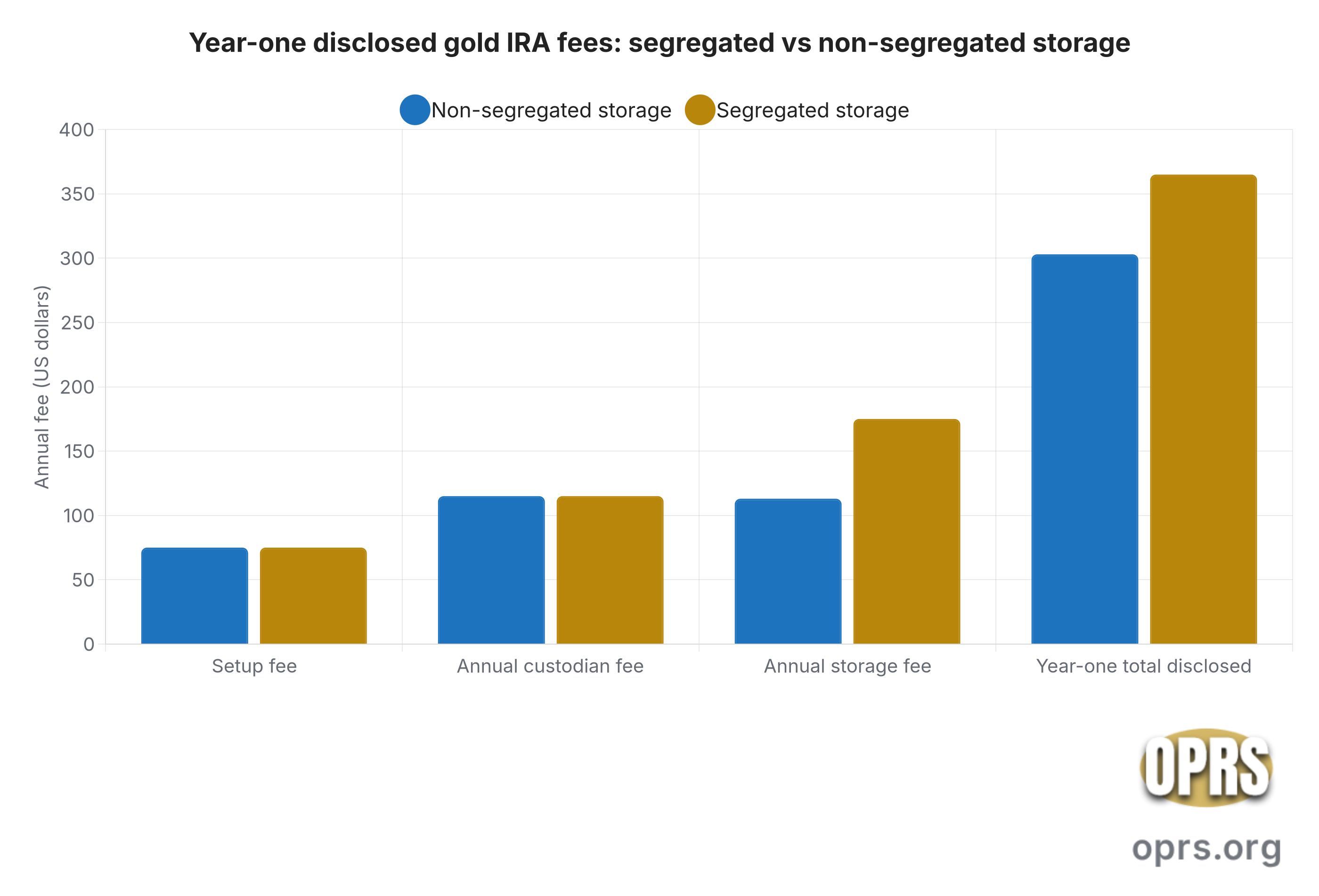
- Year-one disclosed fees usually land between $250 and $500 (setup $50 to $100, annual custodian $80 to $150, annual storage $100 to $200). The dealer markup over spot is the variable line. A 5 percent markup on a $50,000 bullion purchase is $2,500; a 30 percent markup on the same $50,000 in proof or semi-numismatic coins is $15,000.
- The Form 1099-R does not arrive in year one unless the participant took a distribution. The rollover itself is reported by the prior plan administrator with code G (direct rollover) and shows zero taxable amount.
The first year of a gold IRA looks nothing like the first year of a brokerage IRA. There is no trade ticket on day one. There is no real-time portfolio quote. The structure runs on three operator handoffs and a calendar that stretches over 90 days before the first ounce of metal sits behind the participant’s name at an IRS-approved depository.
That timeline is not a flaw. It is the design that keeps the account inside IRC Section 408 and out of the collectibles trap of IRC 408(m)(1). The work of year one is making sure each handoff is documented, priced fairly, and reported correctly to the IRS.
This guide walks the year-one calendar in sequence. It maps the custodian onboarding, the funding window, the first metals purchase, the depository confirmation, and the IRS reporting cycle. See the dealers OPRS clears and the ones we warn against before any custodian onboarding; the structural mechanics matter, the operator delivering them matters more.
The audience for this page is the saver who has decided to open a gold IRA and wants the plain-English month-by-month picture. The page does not give investment advice. It does not predict gold prices. It does not recommend an allocation. It maps what arrives in the mail, what gets emailed, what gets wired, and what does not happen at all in year one.
Day 0 to Day 7: the custodian opens the account
Day zero is the IRA application. The participant signs the custodial agreement with a bank, a credit union, or an IRS-approved nonbank trustee under Treasury Regulations Section 1.408-2(e). The agreement is the IRS Form 5305-A (traditional IRA) or IRS Form 5305-RA (Roth IRA) adoption template, plus the custodian’s fee schedule and disclosure addenda.
The custodian assigns an account number, usually within two to five business days of receiving signed paperwork. The account number is what the prior plan administrator or the prior IRA custodian needs to wire funds in. Nothing else can happen until that number exists.
The fee schedule on this page is the first hard number a participant sees. It usually breaks out the setup fee, the annual custodian fee, the annual storage fee, and a wire-transfer or asset-transfer fee. The fee schedule is a written document and should be re-read before signing. It is the reference for every invoice that follows for the next 10 or 20 years.
The depository is selected at this step or shortly after. The custodian’s depository network is usually fixed (one or two facilities under contract). Common IRS-recognized depositories include Delaware Depository (Wilmington), Brink’s Global Services USA, International Depository Services (Dallas, Delaware), and CNT Depository (Bridgewater, Massachusetts).
The participant chooses segregated storage (the metal is physically separated and identified to the IRA) or non-segregated storage (commingled with other clients’ holdings of the same type). The choice is locked at account opening but can be changed later for a fee.
The dealer is the third party, contracted separately. The participant is free to use any precious-metals dealer that the custodian accepts on its approved-vendor list. The custodian does not sell metals. The custodian does not endorse a single dealer. That decoupling is the structural feature that keeps the dealer relationship at arm’s length from the IRA trustee.
Day 7 to Day 45: the funding moves in
The second window is funding. The path depends on where the money is coming from. Three patterns cover almost every OPRS reader.
The trustee-to-trustee transfer moves funds from an existing IRA at a different custodian (often a brokerage IRA at Fidelity, Schwab, or Vanguard) into the new gold IRA custodian. The transfer is not a distribution. No IRS Form 1099-R is issued.
The 60-day rollover rule does not apply because the participant never receives the funds. There is no annual cap on the dollar amount transferred. The receiving custodian usually issues a Letter of Acceptance, which the participant or the custodian sends to the prior custodian to initiate the wire.
The direct rollover from an employer plan moves funds from a 401(k), TSP, 403(b), or 457(b) under IRC 408(d)(3) and IRC 401(a)(31). The plan administrator wires the funds directly to the new gold IRA custodian. No funds pass through the participant’s hands. The 20 percent mandatory withholding under IRC Section 3405(c) does not apply to a direct rollover. The Form 1099-R issued by the prior employer plan reports the rollover with distribution code G (direct rollover) and zero taxable amount.
The indirect 60-day rollover is the trap. The participant takes a check from the employer plan or from an existing IRA, and re-deposits the full amount into the new gold IRA within 60 days. The employer plan must withhold 20 percent federal income tax under IRC Section 3405(c) on the gross distribution.
The participant must re-deposit the full pre-withholding amount (gross, not net) within 60 days using personal funds, or the withheld portion becomes a taxable distribution. The 60-day clock starts on receipt and is rigid. Missing the deadline turns the rollover into a taxable event with possible IRC Section 72(t) additional 10 percent tax for participants under age 59 and a half.
A separate constraint is the one-rollover-per-12-month rule under IRC 408(d)(3)(B), as interpreted by the U.S. Tax Court in Bobrow v. Commissioner, T.C. Memo. 2014-21. A participant may complete only one indirect 60-day rollover across all IRAs in any rolling 12-month window. Trustee-to-trustee transfers and direct rollovers from employer plans are not counted against the limit. The OPRS recommendation for a first-year gold IRA is always trustee-to-trustee or direct rollover. The indirect path adds a trap without adding any benefit.
Funding usually clears the receiving custodian within 7 to 30 business days for a trustee-to-trustee transfer. A direct rollover from an employer plan usually takes 14 to 45 business days. The 401(k) and TSP wire timelines are the slowest because the prior plan administrator processes the request through a benefits-department queue, not in real time.
For the federal employee path see our TSP to gold IRA rollover guide; for the private-sector path see our 401(k) to gold IRA penalty-free rollover walkthrough.
Day 30 to Day 90: the first metals order
The first metals order is the moment the dealer markup becomes a real number. It is also the moment the IRC 408(m)(3) eligibility test runs on every line item of the order.
The participant calls the dealer (or uses a web portal) and requests a quote. The quote should reference the spot price of the metal at a stated time, the dealer’s premium over spot in dollars per ounce, and the total dollar amount of the order.
A reputable dealer’s published premium on a one-ounce American Gold Eagle in 2025 typically ran from 3 to 6 percent over spot. Premiums on fractional Eagles (one-tenth ounce, one-quarter ounce) ran higher because the per-ounce production cost is amortized over a smaller coin.
Premiums on proof Eagles, “semi-numismatic” coins, and graded “rare” coins ran much higher, often 20 to 50 percent and sometimes more. The metal content of a one-ounce proof Eagle and a one-ounce bullion Eagle is identical. The premium pays the dealer, not the participant. A dealer who steers a first-year IRA buyer toward proof or semi-numismatic coins is signaling a higher-markup sales motion.
The eligibility test runs on every coin and bar on the order. Bullion gold must meet 99.5 percent fineness under IRC 408(m)(3)(B). The American Gold Eagle is allowed by name under the statutory coin exception of IRC 408(m)(3)(A) even though it is 0.9167 fineness.
A South African Krugerrand (0.9167) is not on the statutory list and fails the fineness branch; it is not IRA-eligible. The U.S. Tax Court applied IRC 408(m) and the physical-possession rule against the taxpayers in McNulty v. Commissioner, 157 T.C. 10 (2021). A “home storage gold IRA” is not a recognized IRS structure.
Before the order is placed, the participant should ask for the spot reference price and the dollar premium in writing. The cleanest practice is a written quote that lists each line item, the spot reference at the timestamp, the per-coin or per-bar premium in dollars, and the total.
Check this dealer against the 2026 OPRS list before requesting that quote. The 27+ dealers reviewed by OPRS span the BBB A+ end of the market down to operators with FTC consent orders and pending CFTC matters.

Can you roll your account into a precious metals IRA? Eligibility checker
Most retirement money can move into a precious metals IRA once it qualifies as an eligible rollover distribution. Pick your account type and situation for a general answer. Always confirm specifics with your plan administrator or custodian.
General guidance only, not tax or financial advice. Eligibility depends on your specific plan document and IRS rules; confirm with your plan administrator and a tax advisor. A direct trustee-to-trustee transfer avoids the 60-day rule and 20% mandatory withholding.
The right dealer explains every fee up front. Get Augusta's free precious metals IRA company checklist.
Once the order is accepted, the custodian wires the dealer the dollar amount. The dealer locks the spot price, prepares the bullion, and arranges insured shipment to the depository. The participant never sees, holds, or stores the metal during this step. Shipment to the depository typically takes 5 to 15 business days, depending on the dealer’s inventory location and the depository’s receiving schedule.
Day 45 to Day 100: depository receipt and custodian confirmation
The depository receives the bullion in a sealed shipment, verifies the count and assay against the dealer’s packing list, and notifies the custodian. The custodian books the metal to the participant’s IRA on the custodial ledger. The participant receives a written confirmation showing the metal type, the weight, the serial numbers (for bars), the date of receipt at the depository, and the storage type (segregated or non-segregated).
This written confirmation is the document that proves the metal is held under the IRA’s name at an IRS-approved facility. It is the document a tax professional would want to see if the IRA were ever examined. Filing it with the year-one account paperwork is the first piece of the long-term record.
The first statement from the custodian usually arrives within 30 to 45 days of the depository receipt. It will show the IRA balance, the metals held, the storage type, and the cumulative fee charges to date.
The statement valuation is usually based on the spot price at the statement date, not on the dealer’s purchase premium. A reader who paid 25 percent over spot for proof coins will see that gap appear on the very first statement: the statement value will be roughly the spot value, and the premium paid is not recoverable on the statement.

The year-one fee invoices: what actually shows up on the credit card
A gold IRA carries four fee buckets in year one. The first three are disclosed in the custodian fee schedule. The fourth is the variable line that decides the real bill.
The setup fee is one-time, charged at account opening. Industry-reported figures typically fall in the $50 to $100 range. Some custodians waive the setup fee on accounts above a stated balance threshold.
The annual custodian fee covers ongoing account administration: ledger maintenance, IRS Form 5498 filing, contribution tracking, statement generation. Industry-reported figures typically fall in the $80 to $150 range. The fee is flat (not asset-based) at most self-directed custodians.
The annual storage fee is paid to the depository. Non-segregated storage typically runs $100 to $125 per year. Segregated storage typically runs $150 to $200 per year. The choice locks at account opening. For a typical first-year account holding bullion bars, non-segregated storage is the more common pick.
The dealer markup over spot is the variable. A 5 percent markup on a $50,000 bullion purchase is $2,500. A 12 percent markup on the same $50,000 in fractional Eagles is $6,000. A 25 percent markup on proof Eagles is $12,500. A 40 percent markup on a “semi-numismatic” lot is $20,000.
The metal content is the same. The dollar markup is the line that decides the real year-one cost. OPRS maintains an industry fee benchmark for the disclosed fee stack. The dealer markup is the line that benchmarks cannot capture because dealers rarely publish premiums.
The 2026 OPRS dealer screen ranks operators on disclosure quality of the markup, written quote practice, BBB rating, FTC enforcement history, and product mix. A first-year buyer who runs the screen before requesting a quote eliminates the highest-risk operators in advance. The screen is the cheapest insurance available against a year-one numismatic-coin overpay.
IRS reporting in year one: what arrives and what does not
The year-one IRS reporting cycle is short. Two documents matter, and only one is guaranteed to arrive.
IRS Form 5498 is the contribution report. The custodian files it by May 31 of the year following the tax year. It reports any contribution made for the tax year, any rollover received from another plan, any trustee-to-trustee transfer received, and the December 31 fair market value of the IRA.
The participant receives a copy. The Form 5498 is informational; it does not need to be attached to the federal tax return. The IRS uses it to cross-check contribution and rollover claims.
IRS Form 1099-R is the distribution report. It is filed by the prior plan administrator (the 401(k), TSP, or prior IRA custodian) for the rollover or transfer they sent out, not by the receiving gold IRA custodian.
A direct rollover from a 401(k) is reported with distribution code G (direct rollover) and zero taxable amount in Box 2a. A trustee-to-trustee IRA transfer is not reported on a 1099-R at all. The receiving gold IRA custodian does not file a 1099-R in year one unless the participant took a distribution from the gold IRA itself.
The federal tax return for the rollover year reports the rollover on Form 1040, line 4a or 5a (gross IRA or pension distribution). Line 4b or 5b shows zero taxable amount with the word “Rollover” written next to the line per the Form 1040 instructions.
A direct rollover from a 401(k) under IRC 401(a)(31) follows the same line treatment. See IRS Publication 590-A for the contribution and rollover rules and IRS Publication 590-B for the distribution and required minimum distribution rules.
Required minimum distributions under IRC Section 401(a)(9), as amended by SECURE 2.0, do not apply to a traditional gold IRA in year one. The RMD start age is 73 (born 1951 to 1959) or 75 (born 1960 or later). A Roth gold IRA is not subject to RMDs during the original participant’s lifetime under IRC 408A(c)(5).
First-year mistakes that quietly cost real money
- Taking the indirect 60-day rollover route by accident. A participant who requests a check from the 401(k) “to roll over later” triggers 20 percent mandatory withholding under IRC 3405(c). The participant must re-deposit the gross pre-withholding amount within 60 days from personal funds, or the withheld portion is taxed and (for participants under age 59 and a half) subject to the IRC 72(t) additional 10 percent tax. The fix is to always request a direct rollover, plan-to-custodian, with the gold IRA custodian’s account number written on the request form.
- Buying proof or “semi-numismatic” coins on the first order. The metal content is identical to bullion Eagles, but the dealer markup is 5 to 10 times higher. The premium paid is not recoverable on the statement and is rarely recovered at sale. A dealer who pitches proofs to a first-year buyer is signaling a high-margin sales motion. The fix is to insist on bullion Eagles, Buffalos, Maple Leaves, or Philharmonics on the first order, and to ask for the spot reference plus dollar premium in writing.
- Confusing segregated and non-segregated storage on the application. Segregated storage is the metal physically separated and identified to the IRA. Non-segregated storage is commingling with other clients’ holdings of the same type. The price difference is roughly $50 per year. For bullion bars, segregated storage matters more (the serial numbers are tracked); for fungible coins, non-segregated storage is usually fine. The choice locks at opening and is annoying (but not impossible) to change later.
- Skipping the dealer screen before requesting a quote. A dealer with FTC consent orders or CFTC enforcement history will not advertise that history on the sales call. Running the screen before the quote eliminates the highest-risk operators in advance. Run the 2026 dealer screen before any custodian conversation is the highest-leverage step available to a first-year buyer.
- Forgetting that the first statement does not show the premium paid. A buyer who paid 25 percent over spot for proof coins will see roughly the spot value on the first statement and will assume the IRA “lost money in the first month.” It did not. The premium paid the dealer at the order step. The metal value is what the depository holds. This is one reason the dealer markup matters at the order step, not after.
- Trying a “home storage” or “checkbook LLC” structure. The U.S. Tax Court applied IRC 408(m)(3) and the physical-possession rule against the taxpayers in McNulty v. Commissioner, 157 T.C. 10 (2021). A first-year buyer who takes physical possession of IRA metal under any structure is at risk of a deemed distribution under IRC 408(m)(1), with ordinary income tax on the full account value and the IRC 72(t) additional tax for participants under age 59 and a half. The IRA trustee, not the participant, must hold the metal at all times before a qualified distribution.
The reader who finishes this guide has the year-one calendar mapped. Account opening sits in week one. Funding clears in weeks two to six. First purchase lands by month two or three. Depository confirmation arrives by month three or four. Fee invoices and IRS Form 5498 close out months four to twelve. The structural picture is the easy part. The dealer choice is the hard part.
The dealer screen OPRS uses to evaluate any operator includes four trust markers that travel across all 50 states. The markers are listed below.
- Money Magazine Best Overall Gold IRA Company (2022 to 2026)
- Investopedia Most Transparent Gold IRA Company (2022 to 2026)
- BBB A+ Rating with Zero Complaints (accredited since 2014)
- Education-First Process run by salaried, non-commissioned customer success agents
Augusta Precious Metals carries all four markers and its industry-reported minimum sits around $50,000, which fits a rollover from a 401(k), a TSP, a 403(b), or a transferred prior-employer IRA at retirement. The Learn, Talk, Decide process is run by salaried non-commissioned educators. The free company comparison checklist walks through the custodian, depository, fee schedule, written-quote practice, and segregated vs non-segregated storage questions a first-year gold IRA holder should ask before any purchase order.
Get the Augusta company comparison checklist
The free company comparison checklist walks through the custodian, depository, fee schedule, written-quote practice, Form 1099-R coding, and segregated vs non-segregated storage questions a first-year gold IRA holder should ask before any purchase order. It also covers the spot-reference and dollar-premium practice that decides the real year-one cost. The checklist is the higher-intent asset for screening a single dealer against the four-marker trust-signal stack at the pre-purchase planning moment.
OPRS may receive compensation when readers proceed. Editorial selection is independent. Updated July 2026.
How long does the rollover take in year one?
A trustee-to-trustee transfer between IRA custodians usually clears in 7 to 30 business days, depending on the prior custodian’s processing queue. A direct rollover from a 401(k), TSP, 403(b), or 457(b) usually clears in 14 to 45 business days, depending on the plan administrator’s schedule.
The TSP path is generally the slowest because the TSP Form TSP-77 (now TSP-99 for separated employees) is processed in batch cycles, not in real time. The participant should plan for the first metals purchase to happen 30 to 90 days after the account is opened, not in the first week.
When do I see the metals on a statement?
The first statement showing the metals on the IRA ledger usually arrives 30 to 45 days after the depository confirms receipt of the shipment from the dealer. For a gold IRA opened on day zero and funded by a direct 401(k) rollover, the first statement showing metals typically arrives somewhere between month three and month five. The statement value is based on the spot price at the statement date, not on the dealer’s purchase premium.
When does IRS Form 5498 arrive for a gold IRA?
The Form 5498 contribution report is filed by the custodian by May 31 of the year following the tax year. For a gold IRA opened and funded in tax year 2025, the Form 5498 covering 2025 contributions, rollovers, and the December 31, 2025 fair market value is due to the IRS and the participant by May 31, 2026.
The participant receives a paper or electronic copy. The Form 5498 is informational and does not need to be attached to the federal tax return. The IRS uses it to cross-check the rollover entries on Form 1040.
Can I sell or distribute the metals in year one?
Yes, with the standard IRA rules. A participant age 59 and a half or older may take a distribution at any time without the IRC 72(t) additional 10 percent tax. A participant under age 59 and a half who takes a distribution pays ordinary income tax on the distributed value and the IRC 72(t) additional 10 percent tax unless an exception applies.
The distribution may be in cash (the depository sells the metal at spot, the custodian wires cash) or in-kind (the depository ships the metal to the participant), with a shipping and insurance fee for the in-kind route. A sale-and-reinvestment inside the IRA (sell bars, buy coins, no distribution) is allowed and does not trigger tax.
Sources cited
- IRC Section 408, Individual Retirement Accounts
- IRC Section 408(m), Collectibles Rule and Bullion Exception
- IRC Section 408(d), IRA Distributions and Rollovers (60-day rule)
- IRC Section 401(a)(31), Direct Rollover from Qualified Plan
- IRC Section 401(a)(9), Required Minimum Distributions
- IRC Section 3405(c), Mandatory 20 Percent Withholding on Plan Distributions
- IRC Section 72(t), Additional Tax on Early Distributions
- Treasury Regulations Section 1.408-2(e), Nonbank Trustee Approval
- IRS Publication 590-A, Contributions to Individual Retirement Arrangements
- IRS Publication 590-B, Distributions from Individual Retirement Arrangements
- IRS Form 5498, IRA Contribution Information
- IRS Form 1099-R, Distributions From Pensions, Annuities, Retirement or Profit-Sharing Plans
- McNulty v. Commissioner, 157 T.C. 10 (2021)
- CFTC Customer Advisory: Beware of Gold and Silver Schemes Designed to Drain Your Retirement Savings