

Updated: July 28, 2026
OPRS may receive compensation when readers open an account through partner links on this page. Our analysis is based on independent research, BBB data, and IRS publications.
30-second verdict
- A gold IRA opens in six procedural steps under IRC Section 408 and IRC Section 408(m). The order matters because skipping a step can break the federal tax shelter.
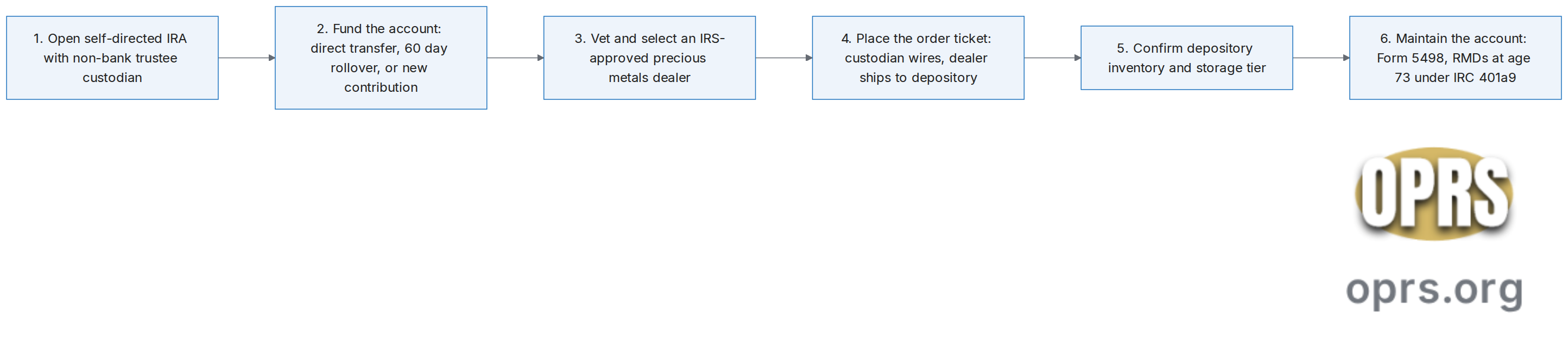
- Step 1 is the self-directed IRA custodian. Step 2 is funding. Step 3 is dealer vetting. Step 4 is the order ticket. Step 5 is depository confirmation. Step 6 is ongoing administration.
- The setup typically takes two to four weeks once the custodian receives a complete application and the funding paperwork from the prior trustee.
- The 2026 industry-reported fee stack lands between $230 and $900 per year per account, with segregated storage at the top of the band and commingled storage at the lower end.
- Three counterparties run the account at all times: the custodian holds title, the dealer sources the metal, the depository holds the physical inventory. The owner never takes home delivery during the accumulation years.
A self-directed gold IRA is a tax-advantaged retirement account that holds IRS-approved precious metals under IRC Section 408(m)(3). The federal tax shelter only holds when the account follows a specific procedural order: custodian first, funding second, dealer third, order ticket fourth, depository confirmation fifth, and ongoing administration sixth. Reverse any of those steps and the tax status is at risk.
Element I of this guide covers the legal foundation of a self-directed gold IRA. Element II walks the six setup steps in order. Element III breaks down the typical fee stack with sourced numbers. Element IV lists the common errors that derail the setup. Element V is the broader retirement context that surrounds the new account.
Element I starts here. Before committing a retirement balance to any custodian or dealer, the saver can cross-check the 2026 OPRS list of dealers we clear and the ones we warn against. The operator that books the contribution and the order ticket sets the procedural tone for the next decade of account life.
Screen the dealer before signing the setup paperwork
The Internal Revenue Code defines the gold IRA shell. The custodian and dealer execute it. A dealer that mishandles the order ticket, the wire instruction, or the depository delivery can trigger a deemed distribution that strips the tax shelter from the entire account balance. The federal framework cannot fix an operator error after the fact.
3 of 27+ gold IRA dealers reviewed by OPRS make the 2026 trusted list. Updated July 2026.
What a self-directed gold IRA actually is
A self-directed gold IRA is an individual retirement account opened under IRC Section 408. The account holds physical gold, silver, platinum, or palladium that meets the fineness standards under IRC Section 408(m)(3). Gold must be at least 99.5 percent pure, silver at least 99.9 percent pure, and platinum and palladium at least 99.95 percent pure. A handful of named coins, including the American Gold Eagle, are permitted despite a lower stated fineness.
The shell is self-directed because the IRA owner picks the asset, not a brokerage menu. A trust company or qualifying non-bank trustee holds legal title and handles every reporting form. The IRA owner directs which metal to hold and which depository to use, subject to the IRS purity rules and the prohibited-transaction limits under IRC Section 4975.
Three counterparties run the account at all times. The custodian holds title and books the contribution. The dealer sources the bullion or coin product. The depository physically stores the metal in an IRS-approved vault. The IRA owner never takes home delivery during the accumulation years. Home storage triggers a deemed distribution under IRC Section 408(m), and the entire balance becomes taxable.
The 6-step setup process in order
The procedural map below runs from step 1 (open the self-directed IRA) to step 6 (ongoing administration). The order is set by the Internal Revenue Code and by the operational mechanics of the three counterparties. Skipping or reversing a step is the single most common reason a new gold IRA setup runs into trouble in the first year.
Can you roll your account into a precious metals IRA? Eligibility checker
Most retirement money can move into a precious metals IRA once it qualifies as an eligible rollover distribution. Pick your account type and situation for a general answer. Always confirm specifics with your plan administrator or custodian.
General guidance only, not tax or financial advice. Eligibility depends on your specific plan document and IRS rules; confirm with your plan administrator and a tax advisor. A direct trustee-to-trustee transfer avoids the 60-day rule and 20% mandatory withholding.
The right dealer explains every fee up front. Get Augusta's free precious metals IRA company checklist.
Step 1: Open the self-directed IRA with a non-bank trustee custodian
The first step is the IRA application itself. A self-directed IRA requires a non-bank trustee approved by the IRS to hold alternative assets, including physical bullion. The custodian collects the standard new-account paperwork: identity verification, beneficiary designation, fee schedule acknowledgment, and a self-directed account agreement that authorizes asset categories beyond stocks and mutual funds.
This step usually takes between two and five business days once the application is complete. The custodian issues an account number that becomes the funding destination for step 2. The IRA owner picks the account type at this step: traditional, Roth, SEP, or SIMPLE, each with its own contribution and distribution rules. A Roth gold IRA uses the same six-step procedural map but reports contributions on the Roth side of Form 5498.
Step 2: Fund the account by transfer, rollover, or new contribution
Three funding routes feed the new self-directed IRA. The cleanest is the direct trustee-to-trustee transfer between two IRAs of the same tax type. The funds move directly from the old custodian to the new one with no withholding and no 1099-R taxable event. The IRS describes this route in IRS Publication 590-A.
The second route is the 60 day indirect rollover. The current trustee pays the distribution to the account owner, who has 60 days to deposit the full amount in the new IRA. Miss the deadline and the distribution becomes taxable as ordinary income, with the 10 percent additional tax under IRC Section 72(t) for owners under age 59 and a half. Only one indirect rollover is permitted per 12 month period across all IRAs, under the one-rollover-per-year rule.
The third route is a new annual contribution. The 2026 IRA contribution limit is $7,000 for filers under age 50 and $8,000 for filers age 50 and over, per the IRS retirement plans guidance on IRA contribution limits. The combined limit applies across every IRA the owner holds, whether traditional or Roth. A rollover from a 401(k), 403(b), or 457(b) plan is uncapped and does not count against the annual contribution limit.
Step 3: Vet and select the IRS-approved precious metals dealer
The custodian holds title to the account. The dealer sources and ships the metal. The two roles are independent. A self-directed IRA owner can pick any dealer who sells IRS-approved bullion and coin products and who can deliver to the chosen depository. The dealer choice is the single largest variable in setup cost and ongoing markup.
The vetting checklist at this step matters because the dealer is the only counterparty whose pricing is not regulated by the IRS. Verify the Better Business Bureau profile, the years in operation, the Trustpilot or Google reviews aggregate, the published spot premium on common bullion products, and the depository delivery options. Check this dealer against the 2026 OPRS list before signing the order ticket in step 4.
A small set of dealers carry the strongest external signal stack. One operator on the current OPRS shortlist holds an A plus Better Business Bureau accreditation dating to 2014, with no complaints on file.
The same operator has been named Money magazine Best Overall Gold IRA Company every year from 2022 through 2026. It also holds the Investopedia Most Transparent Gold IRA Company listing across the same span. The Education-First process (Learn, Talk, Decide) explains the federal framework before any product pitch. That stack is rare across the 27 plus dealers OPRS reviews.
Step 4: Place the order ticket and execute the wire
The order ticket is the contractual heart of the setup. The IRA owner signs a buy direction that tells the custodian which products to purchase, in what quantity, and from which dealer. The custodian wires the funds from the IRA cash balance to the dealer. The dealer ships the metal to the depository named in the order ticket.
The wire instruction and the shipping address belong on the same order ticket. A wire that arrives at the dealer without a paired ship-to depository address is a procedural break. The dealer cannot ship to the IRA owner personal address under any condition: that delivery would trigger a deemed distribution. The custodian and the dealer both verify the depository address before the wire releases.
This step usually clears within five to ten business days, depending on the dealer fulfillment cycle and the freight schedule to the depository. The IRA owner receives a trade confirmation from the dealer and a transaction record from the custodian. Both documents tie back to the depository delivery receipt in step 5.
Step 5: Confirm depository inventory and storage tier
The depository issues a delivery receipt once the metal arrives and is logged into inventory. The IRA owner receives a copy through the custodian portal or by mail. The receipt names the products, the serial numbers (where applicable), the weight, and the storage tier.
Two storage tiers run on most IRS-approved depositories. Commingled storage pools the IRA-owned metal with other client holdings of the same product. The account owner has title to a specific quantity, not specific bars. Segregated storage keeps the IRA-owned bars or coins on a dedicated shelf with serial numbers attached to the account number. Segregated storage costs more, typically at the top of the industry-reported $150 to $400 annual storage band.
The depository sends an inventory statement at least once a year. Many depositories provide quarterly or on-demand statements through the custodian portal. Review the first statement carefully to verify the products and the storage tier match the order ticket.
Step 6: Maintain the account through annual reporting and distributions
The setup ends and the maintenance phase begins after step 5. The custodian issues Form 5498 each May, reporting the year-end fair market value and any contribution or rollover activity. The IRS uses Form 5498 to track contribution caps, RMD calculations, and the underlying account type.
A traditional gold IRA owner reaches the required minimum distribution age at 73 under IRC Section 401(a)(9). The first RMD is due by April 1 of the year after the owner turns 73, with every subsequent RMD due by December 31. A Roth gold IRA has no lifetime RMD for the original owner under IRC Section 408A(c)(5).
Distributions can be taken in cash or in kind. A cash distribution requires the dealer to repurchase the metal, with proceeds wired to the IRA owner. An in-kind distribution ships the physical metal to the owner once the distribution is processed, with the fair market value reported on Form 1099-R. Either route reports under the same federal framework that governs every IRA distribution.
The typical fee stack and the timing of each fee
The fee stack on a self-directed gold IRA stacks across the six steps. The account setup fee is one-time and arrives in step 1. The annual custodian administration fee starts in step 1 and recurs every year. The depository storage fee starts in step 5 and recurs every year. Wire transfer fees show up at every funding event and at every metal purchase or sale.
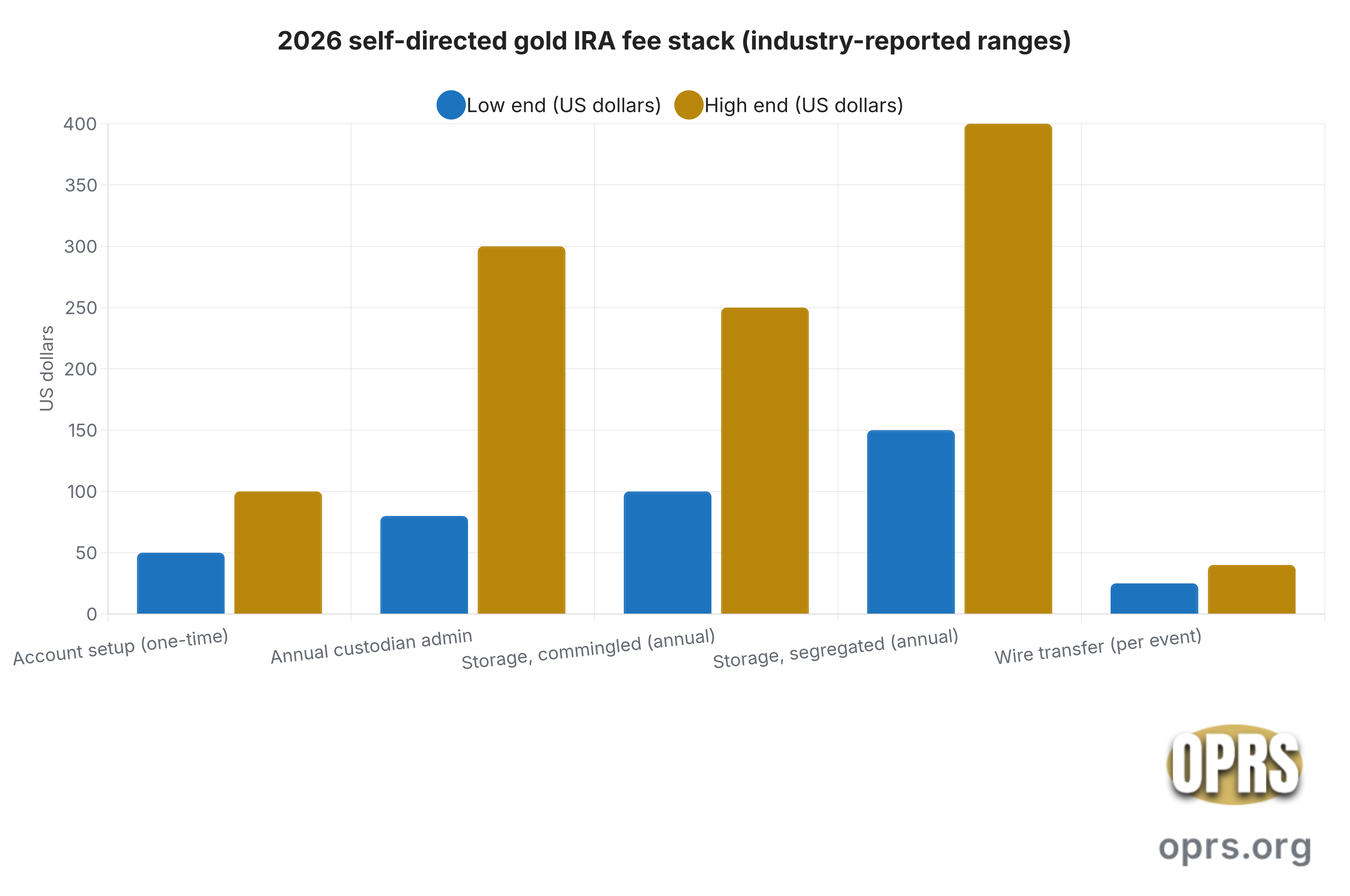
The 2026 industry-reported annual fee total on a self-directed gold IRA lands between $230 and $900 per year per account once setup, administration, and storage are added together. Segregated storage and a higher-tier custodian sit at the top of the band. Commingled storage and a flat-fee custodian sit at the lower end.
Some custodians use a flat annual fee structure that does not vary with account size. Others use a tiered or asset-based fee that scales with the year-end fair market value. The flat structure favors larger accounts. The tiered structure can be more economical for smaller balances under the first pricing breakpoint. Confirm the structure before signing the account agreement in step 1.
| Fee line | Timing | Typical range (US dollars) | Step where it lands |
|---|---|---|---|
| Account setup | One-time | $50 to $100 | Step 1 |
| Annual custodian administration | Recurring annual | $80 to $300 | Steps 1 and 6 |
| Depository storage (commingled) | Recurring annual | $100 to $250 | Step 5 |
| Depository storage (segregated) | Recurring annual | $150 to $400 | Step 5 |
| Wire transfer | Per event | $25 to $40 | Steps 2 and 4 |
Timeline expectations: how long the setup actually takes
The full six-step setup usually clears in two to four weeks from the day the custodian receives a complete application. Step 1 (custodian application) takes two to five business days. Step 2 (funding) takes five to fifteen business days depending on the prior trustee responsiveness and the chosen funding route. Step 3 (dealer vetting) is owner-paced and can take a single afternoon or several weeks.
Step 4 (order ticket and wire) typically clears within five to ten business days. Step 5 (depository confirmation) follows the freight schedule, usually two to seven business days after the wire. Step 6 (ongoing administration) is the recurring phase that lasts the life of the account.
The slowest leg is almost always the prior trustee response in step 2. A direct trustee-to-trustee transfer from a brokerage IRA can take ten business days even with clean paperwork. A 401(k) rollover from a former employer plan can take longer, especially when the plan administrator requires a notarized spousal consent form.
Vet the dealer before the order ticket in step 4
The custodian and the depository are the federally-supervised counterparties. The dealer is not. The dealer chooses the markup, the product mix, and the fulfillment cycle that runs steps 3 and 4. A dealer that pressures a switch from common bullion to high-premium proof coins can quietly drain 30 percent of the funded balance before step 5 confirms inventory.
See the 2026 OPRS dealer list before the order ticket clears. The federal framework cannot recover dollars lost to dealer markup once the metal lands at the depository.
Common errors that derail the setup
Error 1: taking home delivery during the accumulation years
A self-directed gold IRA owner who instructs the dealer to ship to a personal address triggers a deemed distribution under IRC Section 408(m). The full fair market value of the shipment becomes taxable as ordinary income. Owners under age 59 and a half also owe the 10 percent additional tax under IRC Section 72(t).
The fix: keep the depository address on every order ticket from step 4 onward. Route any post-distribution shipment through a separately-documented in-kind distribution event in step 6.
Error 2: missing the 60 day window on an indirect rollover
An indirect rollover from the prior trustee starts a 60 day clock. The full distribution amount must arrive in the new IRA within 60 days. That total includes any 20 percent mandatory withholding the prior plan sent to the IRS. Miss the deadline and the entire distribution is taxable, with the 10 percent additional tax for owners under age 59 and a half.
The fix: use a direct trustee-to-trustee transfer wherever the prior plan supports it. The transfer route has no 60 day clock and no withholding.
Error 3: buying a metal product that fails IRS purity standards
A self-directed gold IRA can only hold metal that meets the IRC Section 408(m)(3) fineness thresholds and the named coin list. Buying a non-eligible coin or bar inside the IRA triggers a deemed distribution of that purchase amount. The fix: cross-check every product against the IRS-approved metals list before signing the order ticket. A reputable custodian and dealer both block ineligible orders, but the IRA owner stays ultimately responsible for the asset choice.
Error 4: skipping the depository confirmation in step 5
The depository delivery receipt is the only document that proves the IRA actually owns the metal. A new account owner who never opens the first inventory statement may not catch a wrong product, a wrong storage tier, or a missing serial number until many months later. The fix: review the first depository statement within seven days of receipt, and reconcile every line against the original order ticket.
Error 5: using a single counterparty for custody, sales, and storage
The IRS framework expects three independent counterparties. A vertically integrated provider that combines all three roles in one entity raises a prohibited-transaction risk under IRC Section 4975. The fix: confirm the custodian, the dealer, and the depository are three separate legal entities, with separate bank accounts and separate insurance policies. The three should never share common ownership.
How the 6-step setup fits a broader retirement plan
A gold IRA is one slice of a broader retirement allocation. The six-step setup covers the account opening procedure. The decision to fund the account from a 401(k), a 403(b), a TSP, or a brokerage IRA is upstream of step 2. That choice depends on the household income picture, the source plan eligibility, and the planned distribution sequence in retirement.
Federal employees with a TSP balance can map a partial transfer through the TSP to gold IRA rollover guide. Private-sector workers with a 401(k) can map step 2 through the 401(k) to gold IRA rollover playbook. A saver who already holds a traditional IRA can complete step 2 through the IRA to gold IRA conversion process. The procedural map in steps 1, 3, 4, 5, and 6 stays the same regardless of the funding source.
Broader education on the IRA framework that surrounds the new account sits at SEC investor.gov on individual retirement accounts and at FINRA on individual retirement accounts. A check on a specific dealer Better Business Bureau profile sits at BBB.org before step 3 closes. The metal itself can compound across the full retirement, helping protect purchasing power for a spouse or heirs over the next several inflation cycles.
Frequently asked questions about the gold IRA setup
Can a saver hold the gold from a gold IRA at home?
No. The metal must sit at an IRS-approved depository during the accumulation years under IRC Section 408(m). Home storage triggers a deemed distribution of the full account value as ordinary income, with the 10 percent additional tax for owners under age 59 and a half. The depository is one of the three required counterparties: custodian, dealer, depository.
What is the minimum to open a gold IRA?
The IRS sets no minimum. The dealer typically does. Industry-reported dealer minimums range from $2,000 to $50,000 depending on the operator and the product mix. One privileged operator on the current OPRS list sits at an industry-reported minimum around $50,000 for gold IRA accounts. The custodian minimum is usually below the dealer minimum, often $0 to $1,000.
How long does the full 6-step setup take?
The full setup usually clears in two to four weeks. Step 1 takes two to five business days. Step 2 takes five to fifteen business days. Step 4 takes five to ten business days. Step 5 takes two to seven business days after the wire releases. The slowest leg is almost always the prior trustee response in step 2.
Does the saver pick the depository?
Yes. The custodian usually offers a short list of IRS-approved depositories. The IRA owner picks the depository and the storage tier (commingled or segregated) at step 5. The depository must be on the IRS-approved list, must carry the appropriate insurance, and must accept the products listed on the order ticket.
Can the saver fund a new gold IRA with a 60 day indirect rollover?
Yes, but the direct trustee-to-trustee transfer is the cleaner route. The 60 day indirect rollover starts a deadline clock and triggers 20 percent withholding on a 401(k) source. The owner has to replace the withheld amount out of personal cash to keep the full balance inside the tax shelter. The transfer route has no 60 day clock and no withholding.
Can a gold IRA hold silver, platinum, and palladium too?
Yes. The same self-directed IRA can hold gold, silver, platinum, and palladium that meet the IRC Section 408(m)(3) fineness standards. Gold must be at least 99.5 percent pure, silver at least 99.9 percent pure, and platinum and palladium at least 99.95 percent pure. A handful of named coins, including the American Gold Eagle, are permitted despite a lower stated fineness.
The six-step procedural map sits inside the Internal Revenue Code. The custodian, the dealer, and the depository each play one of the three required roles. The shelter holds when the order is respected from step 1 to step 6. The shelter breaks when an operator mishandles a wire, a ship-to address, or a Form 5498 contribution code.
OPRS reviews 27 plus gold IRA dealers each year and keeps the trusted list public. One operator on the current list holds an A plus BBB accreditation dating to 2014, with no complaints on file.
The same operator has been named Money magazine Best Overall Gold IRA Company every year from 2022 through 2026. It also holds the Investopedia Most Transparent Gold IRA Company listing across the same span. Its Education-First process explains the federal IRA framework before any product pitch. That stack is rare and worth a careful look before opening the account in step 1.
Sources cited
- IRC Section 408, Individual Retirement Accounts (Legal Information Institute, Cornell)
- IRC Section 408(m), Investment in Collectibles Treated as Distributions (Legal Information Institute, Cornell)
- IRC Section 408(m)(3), Exception for Certain Coins and Bullion (Legal Information Institute, Cornell)
- IRC Section 4975, Prohibited Transactions in IRAs (Legal Information Institute, Cornell)
- IRC Section 72(t), 10 Percent Additional Tax on Early Distributions (Legal Information Institute, Cornell)
- IRC Section 401(a)(9), Required Minimum Distribution Rules (Legal Information Institute, Cornell)
- IRS Publication 590-A, Contributions to Individual Retirement Arrangements (IRS.gov)
- IRS Retirement Topics, IRA Contribution Limits (IRS.gov)
- SEC investor.gov, Individual Retirement Account (IRA) Glossary Entry
- FINRA, Individual Retirement Accounts Investor Education (FINRA.org)
- Better Business Bureau, Business Profile Search (BBB.org)