

Updated: July 28, 2026
OPRS may receive compensation when readers open an account through partner links on this page. Our analysis is based on independent research, BBB data, and IRS publications.
30-second verdict
- Plan for 30 to 60 calendar days from application to confirmed metal in the depository. The fast path (about three weeks) requires a direct rollover and a single-state custodian; the long path (six to nine weeks) involves an old 401(k) plan with a paper-only release process.
- The custodian account itself opens in 1 to 3 business days at modern self-directed trustees. The bottleneck is almost never the custodian.
- Funding is the longest leg. Trustee-to-trustee IRA transfers run 7 to 14 business days. Plan rollovers depend on the releasing employer plan and can stretch to 4 to 6 weeks.
- The 60-day rule under IRC §408(d)(3) is the hard deadline that turns a slow rollover into a taxable event. Indirect rollovers also trigger 20 percent mandatory withholding under IRC §3405.
- Element VI lists the four delays that account for most timeline overruns. None of them is rare.
Setting expectations on timing is the most useful thing a first-time gold IRA buyer can do. The mechanics are not hard. The waiting is. Every step in the chain depends on a counterparty (custodian, releasing plan administrator, dealer, depository) and each adds its own processing window. Knowing the realistic range protects the buyer from two failure modes: signing with the dealer who promised a 7-day setup, and panicking in week three when the wire has not landed.
Element I lays out the full 30 to 60 day map. Element II to V break each step into its real processing window. Element VI lists the four delays that drag a timeline from three weeks to six. Element VII is the common-mistakes section that separates this guide from generic explainers. Before you commit a retirement balance, you can cross-check the 2026 OPRS list of dealers we clear and the ones we caution against.
The 30 to 60 day overall map
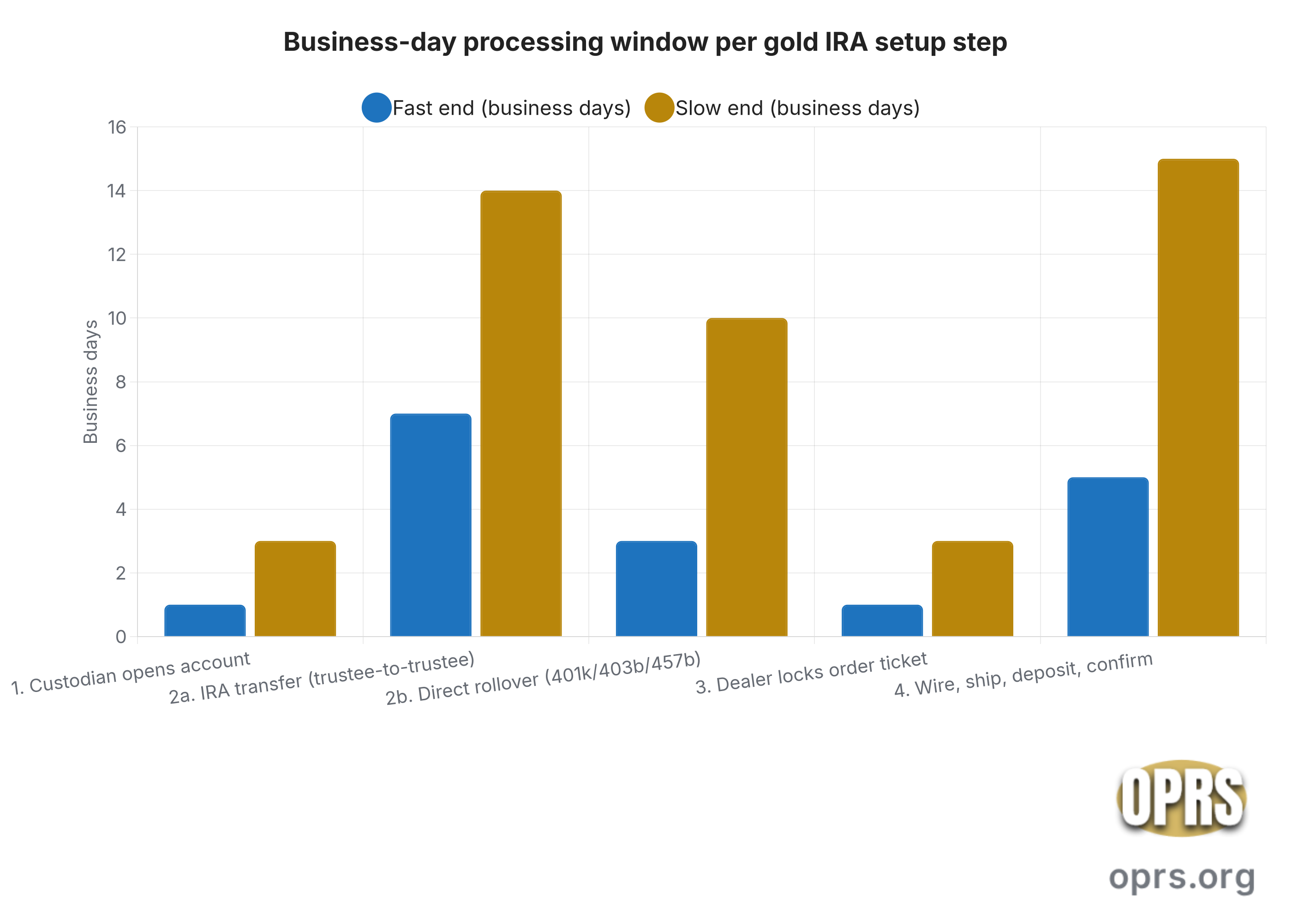
A gold IRA is built on a chain of four sequential events. The custodian opens the account. Funding lands in the account. The dealer locks the order. The depository confirms the inventory. Each event triggers the next. The chain is serial, not parallel. That structure is why even a “fast” gold IRA never opens in under two weeks.
The chart below shows the typical processing window for each leg. Sources include published custodian service standards and the funding-method classifications in IRS rollover guidance and FINRA’s gold IRA insight.
Can you roll your account into a precious metals IRA? Eligibility checker
Most retirement money can move into a precious metals IRA once it qualifies as an eligible rollover distribution. Pick your account type and situation for a general answer. Always confirm specifics with your plan administrator or custodian.
General guidance only, not tax or financial advice. Eligibility depends on your specific plan document and IRS rules; confirm with your plan administrator and a tax advisor. A direct trustee-to-trustee transfer avoids the 60-day rule and 20% mandatory withholding.
The right dealer explains every fee up front. Get Augusta's free precious metals IRA company checklist.
Two takeaways drive the rest of this guide. First, the custodian almost never sets the pace. The funding source does. Second, indirect rollovers (the 60-day route) are the only path where the deadline is regulatory, not operational. Every other window is a service standard the counterparties usually meet.
Step 1. Opening the self-directed IRA: 1 to 3 business days
The self-directed IRA custodian is a non-bank trustee authorized under IRC §408(a) to hold alternative assets such as physical precious metals. Modern self-directed trustees (Equity Trust, STRATA Trust, Kingdom Trust, Goldstar Trust) run online applications. Most accounts open in 1 to 3 business days once the applicant submits a clean form with the right identity documents.
The application asks for the basic IRA paperwork: legal name, address, Social Security number, beneficiary designation, and a signed custodial agreement. The custodian runs a standard KYC check. Once cleared, the account number is issued and the custodian sends a funding instruction packet for the next leg.
The two common reasons a custodian application takes longer than three days are an address mismatch on the identity documents and an incomplete beneficiary form. Both are 24 to 48 hour fixes, but the clock pauses while the custodian waits.
The mechanics: the custodian is the legal title-holder of the IRA. The dealer cannot open the account, even if the dealer’s sales script implies otherwise. A dealer who tells you they handle “everything end to end” is folding the custodian application into their internal pipeline, but the legal opening still happens at the trustee.
Step 2. Funding the account: the longest leg
Funding is the leg that determines the overall timeline. Three funding routes exist, and the day count varies by an order of magnitude across them.
Trustee-to-trustee IRA transfer: 7 to 14 business days
An IRA-to-IRA transfer moves money between two IRA custodians without a tax event. The receiving custodian sends a transfer request to the releasing custodian, the releasing custodian liquidates positions if needed, and the funds wire over. Most modern IRA platforms complete the wire in 7 to 14 business days.
There is no withholding on a trustee-to-trustee transfer. There is no 60-day deadline. There is no annual cap on the number of transfers. The transfer route is the operational default and the audit-safe route. The trade-off is that the releasing custodian sometimes mails a paper check to the receiving custodian, which adds a 3 to 5 day mail delay on top of the wire timeline.
Direct rollover from a qualified plan: 3 to 10 business days (or 4 to 6 weeks)
A direct rollover moves money from a 401(k), 403(b), 457(b), or TSP into the IRA without going through the participant’s hands. The receiving custodian sends the rollover packet to the plan administrator, the participant signs the release, and the plan administrator sends a check or wire directly to the receiving custodian.
Modern recordkeepers (Fidelity, Schwab, Empower) often process direct rollovers in 3 to 10 business days. Older plans, particularly union-administered, public-sector, and small-employer plans, can take 4 to 6 weeks because the release requires multiple wet signatures and the disbursement is made by mailed paper check.
The Thrift Savings Plan (TSP), for example, requires a TSP-99 form and processes a direct rollover in roughly 7 to 10 business days from receipt of a complete request. Releases from a former employer’s 401(k) at a smaller third-party administrator are the most variable line item in the whole timeline.
Indirect (60-day) rollover: the route with the regulatory clock
An indirect rollover sends the money to the participant first. The participant has 60 calendar days to redeposit the full amount into a new IRA, or the distribution is treated as a taxable event. The deadline is set by IRC §408(d)(3)(A) and is documented in IRS Publication 590-A.
Two extra rules apply to the indirect route. First, distributions from a qualified plan such as a 401(k) carry a 20 percent mandatory federal withholding under IRC §3405(c). The participant has to redeposit the gross amount within 60 days using outside cash, then wait until the next year’s refund to recover the withheld 20 percent.
Second, the one-rollover-per-12-months rule under IRC §408(d)(3)(B) limits the participant to a single IRA-to-IRA indirect rollover in any rolling 12-month window. The IRS clarified in Announcement 2014-15 that the limit aggregates across all of the taxpayer’s IRAs, not per-account.
In practice: the indirect route is a route to avoid for a first gold IRA funding. The direct trustee-to-trustee or direct plan rollover is operationally simpler and removes the 60-day clock. The 60-day deadline is the line item the IRS rollover-rules page flags as the most common cause of taxable rollover failures.
Step 3. Selecting the dealer and locking the order: 1 to 3 business days
Once the cash lands in the IRA, the dealer step moves quickly. Dealer vetting takes as long as the buyer wants. The order-ticket signature itself takes a single business day at the dealer’s end. The price lock typically holds for 24 to 72 hours, depending on the dealer’s policy and the volatility of the spot price that day.
The dealer reviews the order ticket, confirms IRA-eligible products under IRC §408(m)(3), and sends the executed ticket to the custodian. The custodian then queues the wire to the dealer. Most custodian wire queues run on a same-day or next-business-day schedule for wires submitted before the daily cutoff.
The realistic compression on this step is dealer vetting. The CFTC enforcement action against Lear Capital documented average markups of 33 percent on products disclosed as 5 percent. Signing the first dealer’s price sheet without comparing markup, BBB record, and buy-back policy is the most expensive shortcut on the timeline. The markup compounds across the entire holding period.
The realistic dealer vetting window is 3 to 7 business days. The OPRS editorial team treats anything shorter as a pressure-sale red flag, and the 2026 OPRS dealer list applies the same standard.
Step 4. Wire, ship, deposit, confirm: 5 to 15 business days
The final leg covers the physical movement and the paper trail that follows. The custodian wires funds to the dealer (same business day to T+1). The dealer ships the metal to the IRS-approved depository (1 to 5 business days for insured ground freight; same-day for high-volume armored runs). The depository inventories the shipment (1 to 3 business days). The custodian posts the holding to the account (1 to 2 business days after the inventory report).
Most retail gold IRAs land in the depository in 5 to 10 business days from the wire date. The outer 15-day window applies when the dealer batches shipments or routes through a refiner for an exotic product. The depository (Delaware Depository, Brinks Global Services, IDS of Delaware) reports the inventory to the custodian, who then posts the holding to the IRA statement. The investor receives a quarterly statement listing the metal type, weight, refiner, and storage tier.
Where this matters: the depository confirmation, not the dealer’s “metal shipped” email, is the event that closes the legal loop. A dealer that delays the depository confirmation is the operational red flag. The metal title sits in the IRA name from the moment the wire sends. The depository’s inventory report is the audit-defensible trail that supports that title.
Where the delays actually come from
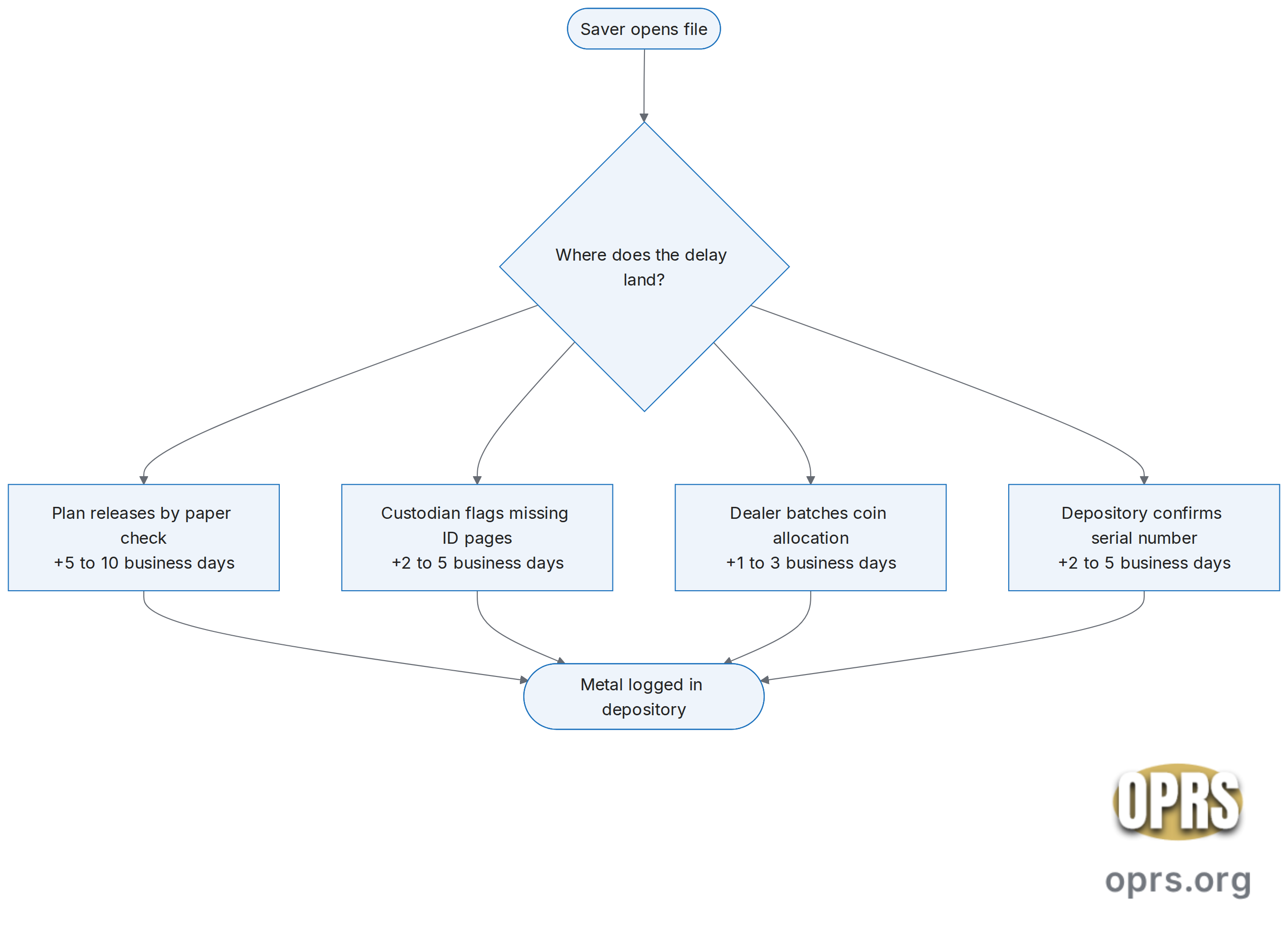
Four sources account for most timeline overruns. None is rare. Knowing them in advance lets the buyer either pick the faster funding route or set realistic expectations with their household before signing.
Delay 1: paper-only releasing plan
An old 401(k) at a small third-party recordkeeper, a state pension, or a union-administered plan often requires the participant to sign a paper rollover form, mail it in, and wait for a paper-check disbursement. The mail leg alone adds 5 to 10 business days. The disbursement check then has to clear the receiving custodian’s deposit hold.
Delay 2: incomplete identity documents
The custodian’s KYC review pauses the account opening clock whenever a document is missing, the addresses do not match, or the beneficiary form is unsigned. Each round of re-submission adds 24 to 72 hours. Two rounds is the norm for buyers who have moved in the last 12 months.
Delay 3: dealer batching
Some dealers ship to the depository on a weekly batch schedule instead of per order. The metal sits in the dealer’s vault for up to 7 business days until the next outbound shipment day. The buyer’s metal title is still IRA-held during this window, but the depository inventory report is delayed.
Delay 4: depository inventory backlog
Around year-end and tax season, depositories see an inventory spike. The standard 1 to 3 business day inventory window can stretch to 5 to 7 business days. The metal is on-site and insured during the wait. The statement-posting timestamp is the only thing delayed.
Common timing mistakes new buyers make
Mistake 1: choosing the indirect rollover route. The 60-day deadline under IRC §408(d)(3)(A) turns a slow rollover into a taxable distribution, and the 20 percent withholding under IRC §3405(c) forces the buyer to fund the 20 percent gap from outside cash. The correction: use the direct trustee-to-trustee transfer or the direct plan rollover route. Both remove the clock.
Mistake 2: signing with the first dealer who calls. Compressing the dealer-vetting step is the most expensive shortcut. The markup on the order ticket compounds across the entire holding period. The correction: vet at least three dealers on markup transparency, BBB record, and buy-back policy before signing.
Mistake 3: starting the rollover in late December. The IRS treats the rollover as completed in the year the funds land in the receiving IRA, not the year they leave the releasing plan. A December-start rollover that lands in January is a next-year event for tax-reporting purposes. The correction: start any year-end rollover by mid-November to allow buffer.
Mistake 4: failing the one-rollover-per-12-months test. The aggregation rule under IRC §408(d)(3)(B) covers every IRA the taxpayer owns. A second indirect rollover within 12 months is taxable, even if it comes from a different IRA. The correction: use direct rollovers (trustee-to-trustee or plan-to-IRA), which are not subject to the once-per-year limit.
Mistake 5: assuming the custodian sets the pace. Most timeline complaints land on the wrong counterparty. The custodian’s open and post-trade legs run 1 to 3 days each at modern self-directed trustees. The releasing plan and the dealer ship date are the real variables. The correction: when calling for an update, call the releasing plan and the dealer, not the IRA custodian.
FAQ
How fast can a gold IRA realistically be funded?
The fastest realistic path is about three weeks. That assumes a direct trustee-to-trustee transfer from an existing IRA at a modern brokerage, a clean custodian application, a pre-vetted dealer, and a routine bullion order. Anything shorter is either a paid expedite (rare) or a sales-script promise that the operational chain cannot back up.
Does the 60-day deadline apply to a trustee-to-trustee transfer?
No. The 60-day deadline applies only to indirect rollovers (the route where the participant receives the funds before redepositing them). A trustee-to-trustee transfer is not a rollover for purposes of IRC §408(d)(3), per IRS Publication 590-A. There is no deadline and no withholding on the transfer route.
Can I do two gold IRA rollovers in the same year?
Yes, if both are direct rollovers (plan-to-IRA or trustee-to-trustee). The one-rollover-per-12-months rule under IRC §408(d)(3)(B) applies only to indirect IRA-to-IRA rollovers, per IRS guidance on the once-per-year rule. Direct rollovers and plan-to-IRA rollovers are exempt.
What happens if the depository delays the inventory report?
The metal is already in the IRA name from the moment the dealer ships. The depository’s inventory report is the documentation event, not the title event. A 5 to 7 business day depository backlog at year end is operationally normal. The custodian posts the holding to the IRA statement once the inventory report arrives.
Is there a faster route for an existing IRA versus a 401(k)?
Usually yes. A trustee-to-trustee transfer between two IRA custodians runs 7 to 14 business days at most modern platforms. A direct rollover from a 401(k) runs 3 to 10 business days at major recordkeepers but stretches to 4 to 6 weeks at smaller plan administrators. The IRA-to-IRA route is the more predictable timeline.
Sources cited
- 26 U.S. Code §408 (Individual retirement accounts), Cornell Legal Information Institute
- 26 U.S. Code §3405 (Special rules for pensions, annuities, and certain other deferred income), Cornell Legal Information Institute
- IRS Publication 590-A, Contributions to Individual Retirement Arrangements (IRAs)
- IRS, Rollovers of Retirement Plan and IRA Distributions
- IRS, IRA One-Rollover-Per-Year Rule (Announcement 2014-15)
- FINRA Investor Insights, Gold IRAs and IRAs in Precious Metals
- CFTC Press Release 8696-23, Lear Capital settlement