

Updated: July 30, 2026
OPRS may receive compensation when readers open an account through partner links on this page. Our analysis is based on independent research, BBB data, and IRS publications.
30-second verdict
- For a rollover-ready retirement balance above 50,000 dollars: a Roth gold IRA on a 10-year horizon. The qualified distribution pays zero federal tax against 14,000 dollars on the personal path.
- For dollars already taxed (cash savings, after-tax brokerage): physical gold owned personally. The IRA path cannot accept after-tax non-rollover cash above the contribution limit, so the comparison breaks down at the funding stage.
- For a five-figure tactical sleeve under 25,000 dollars: physical gold in a bank safe-deposit box. The IRA flat fees push the percentage drag uncompetitive at this size.
- Avoid both routes if liquidity is needed inside 24 months, or if the pitch involves “home storage IRA” or a “checkbook LLC” gold IRA. Both schemes are Tax Court losses.
A retiree who wants real gold exposure outside paper instruments faces two structural choices. One is a self-directed gold IRA holding IRS-approved bullion at a regulated depository. The other is owning the metal personally in a taxable context, stored at home, in a bank safe-deposit box, or at a private allocated vault. Both deliver direct exposure to the spot gold price. Their tax, custody, and access chains diverge sharply.
the 2026 OPRS dealer verdicts before any IRA setup call or large personal bullion order. The dealer choice is the load-bearing decision on both paths. It is also the choice that turns most gold ownership complaints into BBB cases.
This page maps the two vehicles on six axes. Section I covers what is inside a gold IRA. Section II covers what personal ownership actually looks like. Section III stacks the 10-year cost on a 100,000 dollar position. Section IV runs the tax math on a 50,000 dollar gain. Section V issues the verdict per investor profile. Section VI flags the cases where neither path fits.
Screen the dealer before any setup call or bullion order
Both the IRA path and the personal-ownership path start at a dealer. A thin or opaque dealer at this stage is the source of most BBB complaints in this category. A 6 percent spread compounds across both wrappers. Run the dealer screen before any opening call.
3 of 27+ gold IRA dealers reviewed by OPRS make the 2026 trusted list. Updated July 2026.
What is actually inside a gold IRA
A gold IRA is a self-directed traditional or Roth IRA that holds physical bullion. The purity and form rules sit in IRC Section 408(m). The account opens with an IRS-approved non-bank custodian. The bullion stays at an IRS-approved third-party depository.
The investor never takes home possession of the metal. Section 408(m) and the U.S. Tax Court ruling in McNulty v. Commissioner, T.C. Memo 2021-129, treat home storage as a deemed distribution. The full IRA balance becomes taxable at the moment the metal is received personally.
The eligible bullion list under Section 408(m)(3) is narrow. Gold must be at least 99.5 percent pure. The American Gold Eagle is the named exception at 91.67 percent fineness. Silver must be 99.9 percent pure. Platinum and palladium must be 99.95 percent pure. Numismatic and semi-numismatic coins are not eligible regardless of dealer pitch.
The all-in cost stack on a gold IRA has three layers. A one-time dealer spread of 3 to 6 percent is paid at acquisition on IRS-approved coins. Bars are tighter at 1 to 3 percent. The annual custodian fee runs about 80 to 150 dollars. The annual depository storage fee runs about 100 to 200 dollars on a five-figure to low-six-figure position.
The tax posture is the structural feature most investors underweight. Inside the IRA, growth is sheltered. There is no annual tax on appreciation. There is no 28 percent collectibles long-term capital gains rate at sale. There is no 1099-B at year-end. A traditional gold IRA pays ordinary income tax on the distribution at the investor’s marginal bracket. A Roth gold IRA pays zero federal tax on a qualified distribution.
The hard constraints come from IRC Section 4975 (prohibited transactions). The IRA cannot transact with a disqualified person. That means the account owner, spouse, lineal ascendants or descendants, or any entity they control. A prohibited transaction collapses the entire IRA into a fully taxable distribution dated to the start of that year.
What is actually inside personal physical gold ownership
Personal physical gold ownership in a taxable context means the investor takes title to the bullion. The metal sits at home, in a bank safe-deposit box, or at a private allocated vault outside the IRS depository system. There is no custodian agreement. There is no Section 408(m) compliance burden. The trade-off is no tax shelter.
Storage options split into three operational tiers. Home storage is free but uninsured by default. A bank safe-deposit box runs 40 to 200 dollars per year and is also uninsured by the FDIC under FDIC Consumer News on safe-deposit boxes. A private allocated vault (Brink’s Global Services, Loomis International, IDS of Texas private accounts) runs 0.5 to 1.2 percent of asset value per year with insurance bundled.
The dealer spread on personal-path coins is similar to the IRA path. Sovereign bullion coins (American Gold Eagle, Canadian Maple Leaf, Austrian Philharmonic, South African Krugerrand) carry 3 to 7 percent at retail. Generic bars carry 1 to 3 percent at major dealers (APMEX, JM Bullion, SD Bullion). Numismatic and semi-numismatic coins carry 15 to 50 percent and almost never recover the spread on resale.
The tax treatment is structurally inferior on the gain side. A long-term gain on physical bullion held more than 12 months is taxed at the maximum 28 percent collectibles rate under IRC Section 1(h)(5). The 28 percent rate is a ceiling. It applies only to investors whose ordinary marginal rate exceeds 28 percent. Below that line the collectibles gain is taxed at the lower ordinary-income marginal rate.
Reporting obligations also differ. Sales of certain bullion lot sizes trigger dealer 1099-B reporting under IRS 1099-B instructions and 26 CFR 1.6045-1. Reportable lots include 25 ounces or more of gold bars or rounds in 0.995-fine bullion form, and any sale of one kilo or 32.15 troy ounces of gold bars. American Gold Eagles in any quantity are not 1099-B reportable. The investor is responsible for tracking cost basis across multiple lots.
Personal-path access is the structural counterweight to the tax cost. The investor holds the metal. There is no 5-to-15-business-day custodian liquidation window. A sale to a reputable dealer settles in 1 to 7 days. The buyback spread typically runs 1 to 4 percent below spot for sovereign coins at major dealers, wider for off-brand bars.
Side-by-side: 10-year cost on a $100,000 gold position
The chart below stacks the 10-year cumulative cost of a 100,000 dollar gold position across three structures. The first is a gold IRA. It carries a 5 percent dealer spread on IRS-approved coins plus 230 dollars per year in custodian and storage fees.
The second structure is personal physical gold stored at home or in a bank safe-deposit box. The same 5 percent dealer spread applies, plus 50 dollars per year in box rental. The third is personal physical gold stored at a private allocated vault at 0.6 percent of asset value per year.

Precious metals IRA fee-drag calculator
Precious metals IRAs charge mostly flat dollar fees (setup, annual custodian, storage). Flat fees take a much bigger bite out of a small account than a large one. Enter your numbers to see the drag.
Estimate only. Fee amounts vary by provider and are often not published; enter figures you confirm in writing. This tool ignores metal price changes and the dealer spread, which also affect returns. Not financial advice.
The right dealer explains every fee up front. Get Augusta's free precious metals IRA company checklist.
The pure-cost ranking depends on storage choice. A home or bank-box personal setup is the cheapest at 5,500 dollars over 10 years. The gold IRA at 7,300 dollars comes second. The private vault at 11,000 dollars is the most expensive. The cost gap between the IRA and the home-box setup is 1,800 dollars over 10 years. That gap matters at small sizes and disappears against the tax math at larger ones.
| Criterion | Gold IRA (Trad or Roth) | Physical, home or bank box | Physical, private allocated vault |
|---|---|---|---|
| Annual recurring fees on $100k | ~$230 (custodian + storage) | ~$50 (box rental) | ~$600 (0.6% fee) |
| One-time dealer spread at acquisition | 3% to 6% on IRS coins | 3% to 7% on sovereign coins | 3% to 7% on sovereign coins |
| Tax on growth inside the wrapper | $0 (sheltered) | None until sale | None until sale |
| Federal tax rate on long-term gain at sale | Ordinary income (Trad) or 0% (Roth qualified) | Up to 28% collectibles | Up to 28% collectibles |
| Custody chain | Custodian + IRS-approved depository | Investor + box or home safe | Investor + private vault operator |
| Insurance posture | Depository policy bundled | Self-insured (rider needed) | Vault policy bundled |
| Liquidation timeline | 5 to 15 business days via custodian | 1 to 7 days dealer buyback | 1 to 7 days dealer buyback |
| 1099-B reporting at sale | None until distribution | Triggered on reportable lots | Triggered on reportable lots |
| Inheritance treatment | SECURE Act 10-year rule (heir) | Stepped-up basis at death | Stepped-up basis at death |
| IRS rule that governs eligibility | IRC Section 408(m)(3) purity + custody | IRC Section 1(h)(5) collectibles rate | IRC Section 1(h)(5) collectibles rate |
| Industry-reported minimum investment | Around $50,000 retirement balance | 1 coin (about $2,500) | 1 coin to vault account minimum |
| Best operational fit | Sheltered rollover balance, 10-year horizon | Five-figure tactical sleeve | Six-figure-plus, insurance prioritized |
Tax math on a $50,000 long-term gain
The 10-year cost chart above is only half the picture. The other half is the federal tax owed at sale or distribution. The chart below models a 50,000 dollar realized long-term gain across four structures.
The four structures are physical bullion in a taxable context at the 28 percent collectibles ceiling, a traditional gold IRA at the 22 percent bracket, the same IRA at 24 percent, and a Roth gold IRA on a qualified distribution. Roth qualified is defined in IRS Publication 590-B.

The Roth gold IRA dominates by a 14,000 dollar margin against the personal path. The traditional gold IRA at 22 percent beats the personal path by 3,000 dollars. At the 24 percent bracket it still beats the personal path by 2,000 dollars.
The personal path only wins on this view when the investor’s ordinary bracket is below 22 percent. In that case the collectibles ceiling gets capped at the lower ordinary rate. For a typical retiree in the 22 or 24 percent bracket, the tax shelter is worth real money on every realized dollar of appreciation.
The personal path has one structural tax advantage the IRA cannot match. At death, the cost basis steps up to fair market value under IRC Section 1014. An heir who sells inherited bullion shortly after the date of death pays close to zero federal capital gains. The same gold inside a traditional IRA passes under the SECURE Act 10-year distribution rule and triggers ordinary-income tax on the heir over that window.
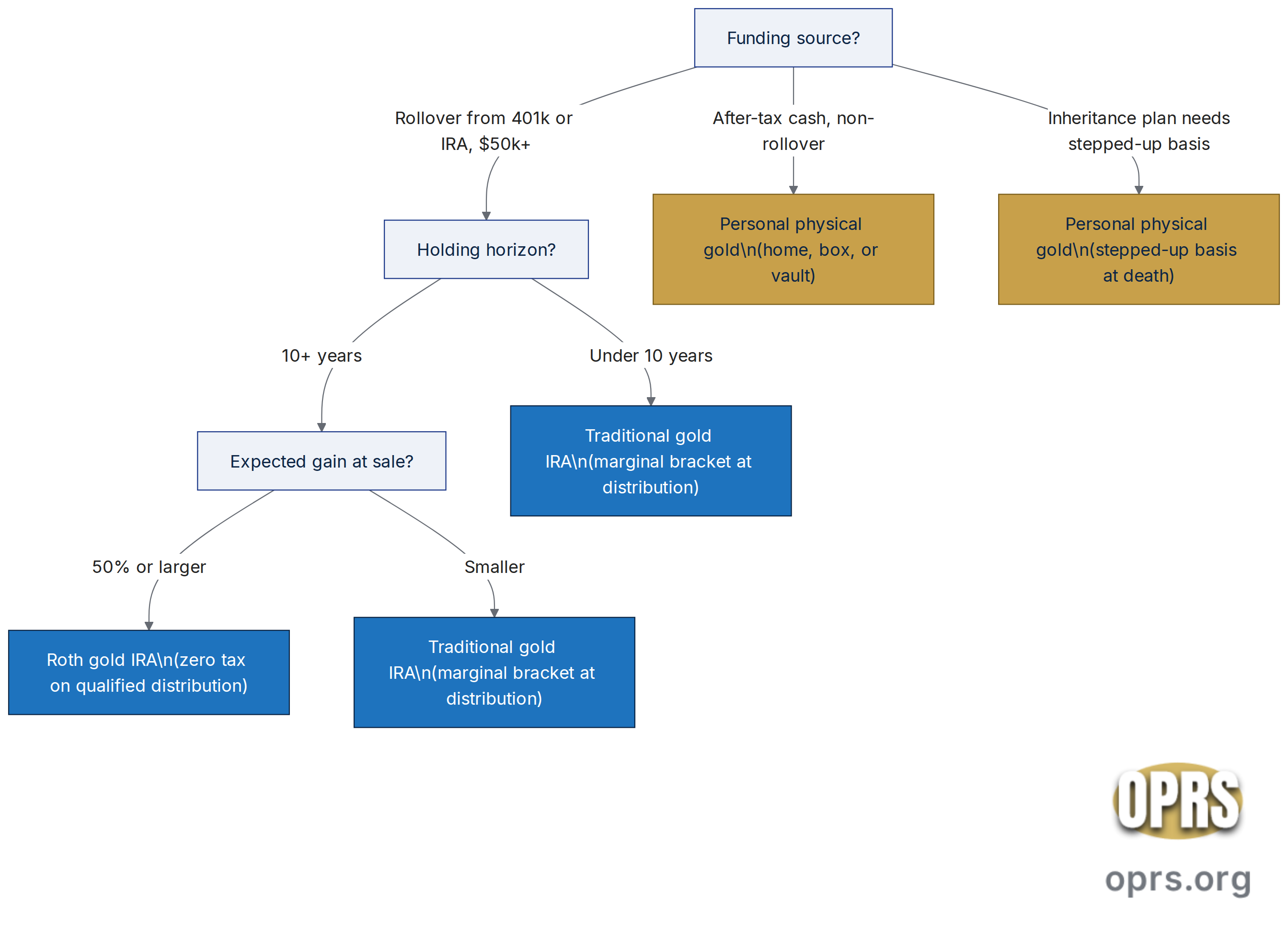
The decision path between the two routes
The decision is not a single yes or no. Five factors stack to point one way or the other: the source of funds, the holding horizon, the size of the gain expected, the investor’s marginal bracket, and the inheritance plan. The flow below maps the four common outcomes.
Verdict per investor profile
- The retiree with a 401(k) or IRA being rolled over (age 55 to 75, balance above 50,000 dollars): a gold IRA is the structurally correct vehicle. The dollars were already going into a rollover. Using one to fund a self-directed gold IRA preserves the tax shelter that personal ownership cannot match. Roth conversion is the strongest variant if bracket capacity exists.
- The pre-retiree with after-tax savings and no rollover catalyst (age 45 to 60): personal physical gold in a bank safe-deposit box. The IRA path will not accept non-rollover cash above the annual contribution limit, so the comparison breaks at the funding stage. The 28 percent collectibles ceiling is the operating tax assumption.
- The high-net-worth investor (above 500,000 dollars in eligible retirement balance): split the gold sleeve. Hold a Roth gold IRA for the permanent allocation. Add a private allocated vault position for the tactical sleeve and the stepped-up-basis play. Check the dealer against the 2026 OPRS list before any IRA setup call.
- The investor with under 25,000 dollars to allocate: physical gold at home or in a bank box. The IRA flat fees make the percentage drag uncompetitive at this size. Revisit the IRA decision when the balance crosses 50,000 dollars or a rollover catalyst arrives.
When neither vehicle fits
Three investor profiles should not be in either vehicle. The first is the investor who needs the dollars liquid inside 24 months. Gold prices are volatile on a 1-to-2-year window. The 28 percent ceiling on the personal path and the dealer spread on the IRA both punish short holding periods.
The second is the investor with no IRA, no 401(k), and no taxable savings. Open the brokerage account first. Allocate to a diversified base. Then consider gold. The third is the investor whose retirement balance is below 25,000 dollars and not growing. The IRA setup overhead is structurally too high there, and a 25,000 dollar personal allocation in a single asset class is also overconcentrated.
A fourth profile is the investor pitched a “home storage gold IRA” or a “checkbook LLC gold IRA” scheme. Neither structure complies with IRC Section 408(m). The U.S. Tax Court ruled on this in McNulty v. Commissioner, T.C. Memo 2021-129. Physical possession of IRA-titled coins by the IRA owner is a deemed distribution of the full IRA balance. The 10 percent early-withdrawal penalty applies if the owner is under 59 and a half. Walk away from any such sales conversation.
Frequently asked questions
Can I move personally owned bullion into a gold IRA later?
No. IRC Section 408(m) requires that IRS-approved bullion be acquired by the IRA itself through an IRS-approved dealer and sent directly to the IRS-approved depository. Personally owned bullion cannot be contributed in-kind to an IRA. The metal would first have to be sold (triggering the 28 percent collectibles tax) and the cash contributed within the annual IRA limit.
The clean path is to fund the IRA with rollover dollars from an existing 401(k) or traditional IRA. The custodian then purchases new IRS-approved coins or bars on the IRA’s behalf. The previously owned personal bullion stays in the taxable side of the investor’s balance sheet.
What is the 28 percent collectibles tax rate and when does it apply?
IRC Section 1(h)(5) caps the federal long-term capital gains rate on collectibles at 28 percent. The rate applies to direct ownership of precious-metal bullion held more than 12 months in a taxable account. It is a ceiling for taxpayers whose ordinary marginal rate exceeds 28 percent.
Below that line the collectibles gain is taxed at the lower ordinary-income marginal rate. The 28 percent ceiling matters most for higher-income investors who would otherwise pay 15 or 20 percent on a non-collectibles long-term gain. The rate does not apply to gold held inside an IRA.
Does a bank safe-deposit box have FDIC insurance on the gold inside?
No. The FDIC insures deposit accounts (checking, savings, CDs). It does not insure the contents of a safe-deposit box. The bank’s general liability policy is also typically excluded by contract. The box renter is responsible for separate insurance on the contents.
Homeowner or renter policies sometimes offer a precious-metals rider with a low cap. A scheduled personal-property endorsement is the structurally correct fit for five-figure-plus bullion. Verify the carrier covers safe-deposit-box storage; some policies require an in-home safe meeting specific UL ratings.
Which physical gold sales trigger a 1099-B from the dealer?
The reportable lots are set in 26 CFR 1.6045-1 and listed in the IRS 1099-B instructions. For gold the threshold is 25 ounces or more in a single transaction of bars or rounds at 0.995-fineness, or any sale of a one-kilo (32.15 troy ounces) gold bar. American Gold Eagles in any quantity are not 1099-B reportable.
The 1099-B obligation falls on the dealer, not the investor. The investor still owes capital gains tax whether the sale is reported or not. Cost basis tracking is the investor’s responsibility across multiple purchase lots.
What happens to inherited physical gold versus inherited IRA gold?
Inherited physical gold gets a stepped-up cost basis to fair market value at the date of death under IRC Section 1014. An heir who sells shortly after typically owes close to zero federal capital gains tax on the appreciation that occurred during the original owner’s life.
Inherited gold inside a traditional IRA does not get a basis step-up. The full account balance passes to the heir as a traditional inherited IRA. Under the SECURE Act 10-year rule, the heir must distribute the full balance within 10 years of death, each distribution taxed as ordinary income.
If the answer above points toward a gold IRA, the load-bearing decision is the dealer. The custodian and depository are commodities at this point in the market. The dealer is where spread opacity and high-pressure sales practices live.
Run the dealer screen before any opening call. See the 2026 OPRS dealer list for the operators we currently warn against and the names we have cleared.
Sources cited
- IRC Section 408(m): Investment in collectibles treated as distributions (purity and storage rules for IRA-eligible precious metals)
- IRC Section 1(h)(5): Maximum 28 percent capital gains rate for collectibles
- IRC Section 4975: Prohibited transactions and disqualified persons (IRA self-dealing)
- IRC Section 1014: Basis of property acquired from a decedent (stepped-up basis at death)
- IRS Publication 590-B: Distributions from Individual Retirement Arrangements (IRAs)
- IRS Instructions for Form 1099-B (broker and barter exchange reporting on precious metal sales)
- IRC Section 72(t): 10 percent additional tax on early distributions from qualified retirement plans
- FDIC: Five Things to Know About Safe Deposit Boxes, Home Safes, and Your Valuables