

Updated: July 30, 2026
OPRS may receive compensation when readers open an account through partner links on this page. Our analysis is based on independent research, BBB data, and IRS publications.
30-second verdict
- The two accounts share the same tax framework, contribution limits, rollover rules, and RMD age. The differences are mechanical, not tax-status.
- A traditional IRA at a no-load brokerage costs effectively $0 per year in custodial fees. A gold IRA costs roughly $250 to $500 per year in disclosed fees, plus a one-time dealer markup of 3 to 8 percent on the metal purchased.
- The gold IRA exists because of IRC Section 408(m). Under 408(m)(1), an IRA buying a coin or bar is treated as taking a deemed distribution. Section 408(m)(3) carves out a narrow exception for IRS-approved bullion at specific fineness floors.
- For a saver who already has a traditional IRA at Fidelity, Schwab, or Vanguard and wants gold exposure: a gold ETF (GLD, IAU, SGOL) is held inside the existing IRA with zero custodial change.
- The gold IRA is the right structure only when the saver wants physical metal directly registered to the IRA with in-kind delivery available at distribution.
- The dealer-selection step carries the largest cost variance. Disclosed fees vary by hundreds across custodians. Dealer markup can vary by thousands on the same dollar amount of bullion.
A retiree comparing a gold IRA to a traditional IRA is usually asking one of two questions. “Are these the same account with different assets?” or “Should I move my current traditional IRA into a gold IRA?”
The federal tax code answers the first question affirmatively on the structural side and negatively on the asset-list side. The second question depends on what the saver actually wants from the gold exposure: a paper position that tracks the spot price, or physical metal directly registered to a retirement account.
This page maps the seven mechanical differences point by point, with the IRC citation for each. It closes with a verdict-per-profile section that ties the comparison to the saver’s actual situation. See the dealers OPRS clears and the ones we warn against before any gold IRA conversation. The IRS-approved structure works the same at every custodian. The dealer named on the onboarding paperwork is the variable that decides the year-one cost.
The audience is the saver age 55 to 75 who already understands what a traditional IRA is and wants a clean comparison before any sales call. The page is not investment advice and does not predict gold prices.
The seven differences at a glance
The table below summarizes the seven mechanical differences. Each row maps to a section below with the IRC citation and the practical implication for the retiree.
| Difference | Traditional IRA | Gold IRA | IRC citation |
|---|---|---|---|
| 1. Asset class held | Stocks, bonds, mutual funds, ETFs, cash | IRS-approved bullion only | IRC 408(m)(1) and (m)(3) |
| 2. Custodian type | Retail brokerage (Fidelity, Schwab, Vanguard) | IRS-approved nonbank trustee (Equity Trust, STRATA, Kingdom) | Treas. Reg. 1.408-2(e) |
| 3. Storage location | Brokerage account record (book entry) | IRS-approved depository (Delaware, Brink’s, IDS, Texas Bullion) | IRC 408(a)(5) |
| 4. Year-one cash cost | $0 to about $50 (no-load brokerage) | $250 to $500 disclosed + one-time 3 to 8 percent dealer markup | Custodian and depository fee schedules |
| 5. Distribution mechanics | Cash distribution from account balance | Cash sale to dealer OR in-kind physical delivery at FMV | IRC 408(d)(1), IRS Pub. 590-B |
| 6. Permitted investment list | Broad securities universe | Narrow 408(m)(3) bullion list only | IRC 408(m)(3)(A) and (B) |
| 7. Reason the structure exists | Default IRA wrapper since 1974 | Statutory exception to the 408(m) collectibles rule | IRC 408(m)(3) |
| Tax treatment of contributions | Deductible if income limits met | Same: deductible if income limits met | IRC 219(b)(5) |
| Contribution limit (2026) | $7,000 ($8,000 if age 50+) | Same: $7,000 ($8,000 if age 50+) | IRC 219(b)(5)(B) |
| Rollover rules | 60-day rule, trustee-to-trustee preferred | Same: 60-day rule, trustee-to-trustee preferred | IRC 408(d)(3) |
| Required minimum distribution age | 73 (rising to 75 in 2033) | Same: 73 (rising to 75 in 2033) | IRC 401(a)(9) |
| Early withdrawal penalty | 10 percent under 59 and a half | Same: 10 percent under 59 and a half | IRC 72(t) |
Precious metals IRA fee-drag calculator
Precious metals IRAs charge mostly flat dollar fees (setup, annual custodian, storage). Flat fees take a much bigger bite out of a small account than a large one. Enter your numbers to see the drag.
Estimate only. Fee amounts vary by provider and are often not published; enter figures you confirm in writing. This tool ignores metal price changes and the dealer spread, which also affect returns. Not financial advice.
The right dealer explains every fee up front. Get Augusta's free precious metals IRA company checklist.
The bottom five rows are intentionally listed as “same.” They show where the comparison reduces to a single account type with different assets. The top seven rows are where the comparison actually splits.
Difference 1: The asset class actually held inside the wrapper
A traditional IRA at a retail brokerage holds securities. The account application authorizes the brokerage to hold stocks, bonds, mutual funds, ETFs, certificates of deposit, and cash equivalents on behalf of the IRA owner. The brokerage acts as custodian under IRC Section 408. The asset menu is whatever the brokerage’s trading platform supports.
A gold IRA is a self-directed IRA wrapper. The account application authorizes a different type of custodian (a nonbank trustee under Treasury Regulations Section 1.408-2(e)) to hold alternative assets.
The asset menu inside that wrapper is narrowly defined by IRC Section 408(m)(3): specific U.S. and foreign bullion coins, and bullion bars meeting fineness floors (99.5 percent gold, 99.9 percent silver, 99.95 percent platinum and palladium).
A gold IRA cannot hold stocks, bonds, mutual funds, or ETFs. A traditional IRA can hold a gold ETF (GLD, IAU, SGOL) without triggering the collectibles rule, because an ETF share is a security, not a collectible. The two account types are mutually exclusive on the asset side, even though the federal tax wrapper is the same Section 408 IRA.
Difference 2: The custodian is a different entity type
A traditional IRA custodian is typically a retail brokerage: Fidelity, Charles Schwab, Vanguard, E*TRADE, or a similar registered broker-dealer. The brokerage holds the IRA assets in street name in a custodial account.
Account opening takes minutes online. The annual custodial fee on a no-load IRA is typically $0. The trading platform is the same one a taxable brokerage account uses.
A gold IRA custodian must be an IRS-approved nonbank trustee under Treasury Regulations Section 1.408-2(e). The gold IRA market is concentrated at a small number of operators: Equity Trust Company, STRATA Trust Company, Kingdom Trust Company, Madison Trust Company, and a handful of others.
These custodians do not maintain a trading platform. They coordinate with a separate precious metals dealer (Augusta Precious Metals, Birch Gold Group, Noble Gold Investments, and others) and an IRS-approved depository to execute purchases and storage.
The custodian-dealer split is the operational complexity that does not exist in a traditional IRA. A retail brokerage IRA has one party. A gold IRA has three: custodian, dealer, depository. Each party signs a separate set of paperwork.
Difference 3: The storage location is a physical vault, not a book entry
A traditional IRA holds the asset as a book entry on the brokerage’s records. The retiree does not physically possess a stock certificate or a bond. The brokerage’s clearing firm (typically DTCC for U.S. securities) holds the master record, and the brokerage’s account statement shows the IRA owner’s pro-rata share.
A gold IRA holds the asset as a physical bullion stack at an IRS-approved depository. The retiree still does not physically possess the metal. Taking possession before age 59 and a half triggers a deemed distribution under IRC Section 408(a)(5) and the IRC 408(m) collectibles rule.
The approved depository options include Delaware Depository Service Company (Wilmington), Brink’s Global Services USA, International Depository Services (IDS) in Texas and Delaware, A-M Global Logistics (Las Vegas), and Texas Bullion Depository (Leander, Texas).
Storage at the depository comes in two forms: segregated and commingled. Segregated storage means the IRA’s metal is physically separated and identifiable to the specific account, typically at a higher annual fee. Commingled storage means the IRA owns a pro-rata share of a pool of identical metals, at a lower annual fee.
Both are legally valid. The choice is a fee-versus-traceability trade-off. The IRS does not require segregated storage for the bullion exception under Section 408(m)(3) to apply.
The “home storage gold IRA” structure marketed by some dealers is not a recognized IRS structure. The U.S. Tax Court applied the physical-possession rule against the taxpayers in McNulty v. Commissioner, 157 T.C. 10 (2021).
Physical possession of IRA-owned bullion at a personal residence is a deemed distribution of the full account balance. The full amount is taxable as ordinary income, with potential 10 percent additional tax under IRC Section 72(t) if the holder is under 59 and a half.
Difference 4: The fee stack has a one-time line item the traditional IRA does not
A traditional IRA at a no-load brokerage carries effectively $0 in annual custodial fees on a typical account. Vanguard publishes $0 annual IRA fees for accounts that maintain electronic statements. Fidelity and Schwab publish the same.
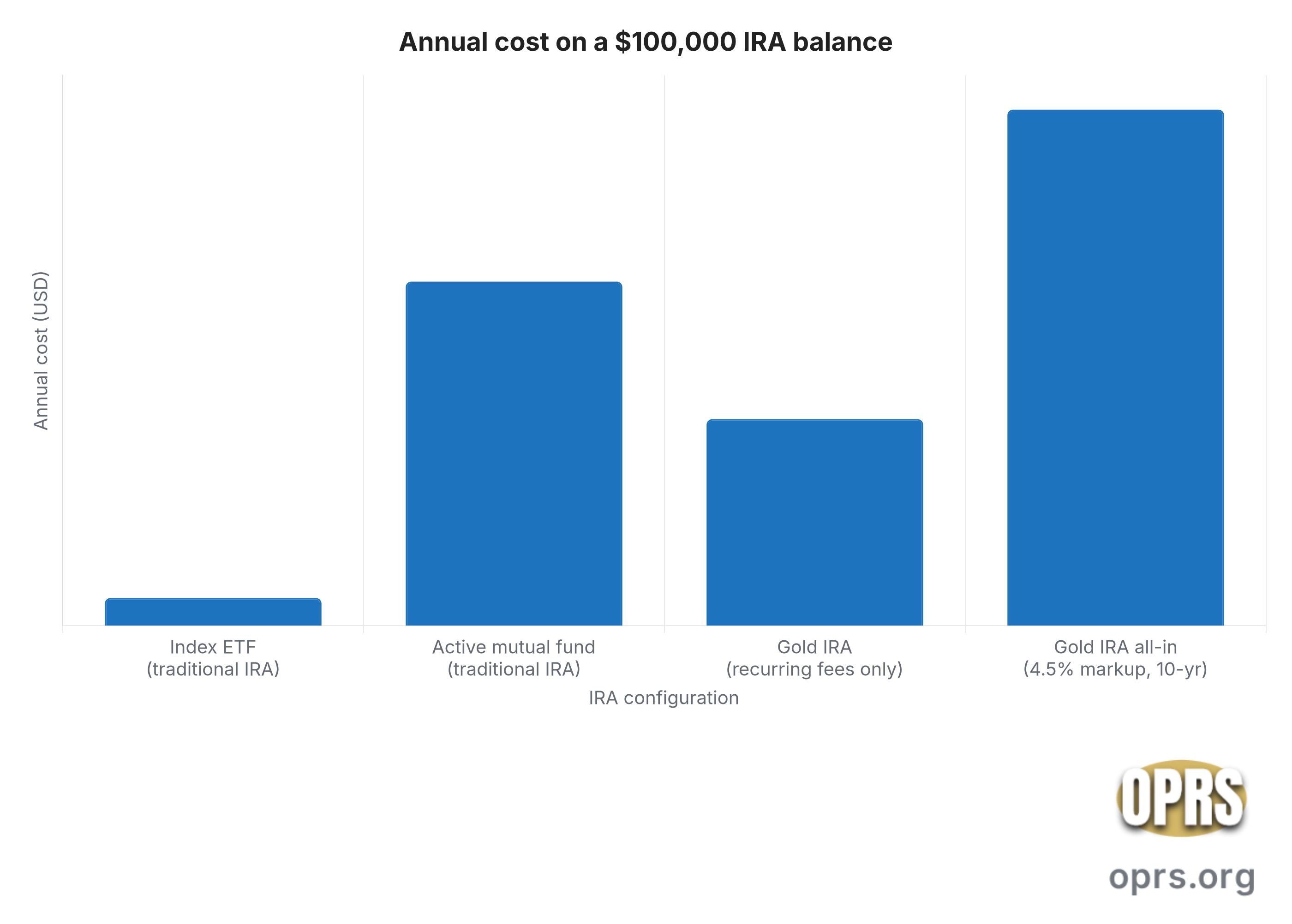
The cost a saver actually pays is the expense ratio embedded in the funds held. That runs about 0.04 percent on a broad-market index ETF (Vanguard Total Stock Market VTI). It runs about 0.50 percent on the median active mutual fund per the Investment Company Institute. It is zero on commission-free trades for individual stocks and ETFs.
A gold IRA fee stack has four layers. The one-time setup fee at a published custodian runs $50 to $80 (Equity Trust Company publishes $50, STRATA Trust Company publishes $75). The annual custodian maintenance fee runs $80 to $300 depending on tier (Equity Trust publishes $225, STRATA Trust publishes $95).
The annual depository storage fee runs $100 to $300 (segregated typically $150 to $300, commingled $100 to $150). The one-time dealer markup on the bullion purchased ranges from 3 to 8 percent for IRS-approved bullion coins and bars at the major dealers.
The dealer markup can run 15 to 30 percent or higher on numismatic or “exclusive” coins that some operators steer first-time buyers toward. The OPRS dealer screen flags this pattern as the primary red flag in the precious metals IRA channel.
On a $100,000 balance, the disclosed recurring annual fees land at roughly $300, or 0.30 percent. The one-time dealer markup of 4.5 percent on a $100,000 first purchase is $4,500. That amortizes to 0.45 percent per year over a 10-year holding period.
The total annualized cost is in the same ballpark as an actively managed mutual fund inside a traditional IRA. The structural difference is that the dealer markup is paid once at purchase, not annually. The long-hold case favors the gold IRA on amortized cost. The short-hold case (under 5 years) favors the traditional IRA at a no-load brokerage.
Difference 5: Distributions can be physical metal, not just cash
A traditional IRA distributes cash. The retiree sells securities inside the IRA, the proceeds settle in the IRA cash sweep, and the cash distribution is reported on Form 1099-R. The tax treatment follows IRC Section 408(d)(1).
The distribution is ordinary income to the extent it exceeds the IRA owner’s basis. Basis is typically zero for a deductible traditional IRA.
A gold IRA offers two distribution paths. The first is a cash distribution. The depository releases the metal to the dealer, the dealer buys back at the prevailing spot price minus the dealer bid spread (typically 1 to 3 percent), and the cash settles in the IRA. The cash distribution follows the same Section 408(d)(1) tax treatment.
The second is an in-kind distribution. The depository ships the physical bullion to the IRA owner. The fair market value on the distribution date is reported on Form 1099-R as a taxable distribution. The retiree then owns the physical metal outside the retirement account.
The in-kind option is the distinct feature of a gold IRA. IRS Publication 590-B covers the FMV reporting requirement. The same option is not available in a traditional IRA holding a gold ETF. The retiree can only take cash distributions of ETF proceeds, not the underlying gold the ETF holds.
Difference 6: The permitted investment list is narrow by statute
A traditional IRA’s permitted investments are bounded by what the brokerage’s platform supports and the general IRA prohibited-transaction rules under IRC Section 4975. In practice the list is open-ended for public securities.
Stocks listed on U.S. exchanges, bonds, mutual funds, ETFs, certificates of deposit, money market funds, and U.S. Treasury securities are all standard fare. Some brokerages also permit options trading and foreign equity ADRs inside the IRA wrapper.
A gold IRA’s permitted investments are bounded by IRC Section 408(m)(3). The qualifying bullion list is short.
Section 408(m)(3)(A) grants a statutory exception by name to specific U.S. coins: the American Gold Eagle (all denominations, despite 0.9167 fineness), the American Silver Eagle, and gold and silver coins issued under 31 U.S.C. Section 5112.
Section 408(m)(3)(B) grants a fineness-based exception. Gold qualifies at 99.5 percent fineness or higher, silver at 99.9 percent, and platinum and palladium at 99.95 percent, in coin or bar form.
Coins that qualify under the fineness branch include the American Gold Buffalo (0.9999) and the Canadian Gold Maple Leaf (0.9999). The Austrian Gold Philharmonic, the Australian Gold Kangaroo, and the British Britannia also clear the 0.995 floor.
Coins that do not qualify include the South African Krugerrand (0.9167, not named in the statutory exception and below the fineness floor). Most pre-1933 U.S. gold coins, numismatic coins, and proof coins outside the named statutory exceptions also fail to qualify. The dealer’s IRA product list is the working reference at account opening.
Difference 7: The gold IRA exists because of one IRC provision
The reason a separate gold IRA structure exists at all is IRC Section 408(m)(1), the collectibles rule. Under 408(m)(1), the acquisition of a collectible by an IRA is treated as a distribution to the IRA owner.
The full purchase price is treated as a taxable distribution under IRC Section 408(d)(1). If the IRA owner is under age 59 and a half, the additional 10 percent tax under IRC Section 72(t) also applies.
Section 408(m)(2) defines “collectible” broadly: any work of art, rug, antique, metal, gem, stamp, coin, alcoholic beverage, or other tangible personal property the Secretary determines to be a collectible. A retail brokerage IRA cannot hold a physical American Gold Eagle without triggering the deemed-distribution rule, despite the Eagle being a U.S. Mint product.
Section 408(m)(3) is the narrow exception that allows specific bullion to be held inside an IRA. Without that exception, every gold purchase by an IRA would trigger the collectibles distribution rule.
The combination of three pieces constitutes a gold IRA: an approved custodian (Treas. Reg. 1.408-2(e)), an approved depository (the storage rule under Section 408(a)(5)), and qualifying bullion (Section 408(m)(3)). Without all three, the structure collapses back to the collectibles rule.
Verdict per profile
Profile A: traditional IRA holder at Fidelity or Vanguard, $100,000 balance, wants gold exposure
For a saver who already has a traditional IRA at a no-load brokerage and wants gold exposure, the gold ETF route is the simpler structure. A purchase of GLD, IAU, or SGOL inside the existing traditional IRA gives spot-price exposure with zero custodial change.
There is zero new paperwork and the existing $0 annual fee continues. The gold IRA is the right structure only when the saver wants physical metal directly registered to a retirement account. The trade-off is the disclosed-fee plus dealer-markup cost stack, with in-kind delivery available at distribution.
Profile B: 401(k) or TSP rollover candidate, $75,000 to $250,000, 10-plus year hold
For a saver rolling over a workplace plan with a 10-plus year horizon, the gold IRA fee stack amortizes favorably. The comparison is against an active mutual fund inside a traditional IRA.
On a $150,000 balance held 10 years, the gold IRA all-in cost (disclosed fees plus amortized dealer markup) lands at roughly 0.75 percent per year. The same balance in a 0.50 percent active mutual fund inside a traditional IRA costs 0.50 percent per year. The gap is small enough that the rollover decision should turn on asset-allocation preference rather than fee math.
Profile C: under-$50,000 IRA balance, considering gold IRA for the first time
For a saver below the $50,000 threshold typical of the precious metals IRA market, the fixed-cost portion of the gold IRA fee stack is a meaningful percentage of the balance. Setup, custodian, and storage do not scale down with balance.
On a $30,000 balance, $300 in recurring fees is 1 percent per year, plus the dealer markup. The traditional IRA at a no-load brokerage is the better structural fit at this balance, with gold exposure via ETF if desired. A 401(k) or TSP rollover that brings the balance above $50,000 changes this analysis.
Profile D: retiree planning in-kind distribution at age 75
For a retiree who specifically wants to take physical delivery of bullion at distribution, the gold IRA is the only structure that supports the in-kind delivery option. A traditional IRA holding a gold ETF can only distribute cash.
The trade-off is the full gold IRA fee stack during the accumulation years. The in-kind delivery option is a structural feature, not an automatic best path. Whether it matters depends on the retiree’s estate plan and the heirs’ preference for cash vs physical metal. Check the dealer against the 2026 OPRS list before the rollover: the in-kind delivery workflow varies in operational quality.
When neither fits
Three scenarios where neither the traditional IRA nor the gold IRA is the right answer, in order of frequency:
- The saver has not yet maxed an employer-sponsored 401(k) match. The match is a 50 to 100 percent immediate return on the contribution, which dwarfs any traditional-vs-gold IRA comparison. Fund the 401(k) to the match ceiling first, then evaluate IRA options.
- The saver is in a high marginal bracket and would benefit more from a Roth conversion than from a gold IRA rollover. A Roth conversion at age 60 to 65, executed across multiple tax years to manage bracket creep, can be more tax-effective than a gold IRA structural change. The two are not mutually exclusive but the sequencing matters.
- The saver wants gold exposure but cannot commit to a 5-plus year holding period. The 4 to 5 percent dealer spread on the way in plus the 1 to 3 percent dealer bid spread on the way out makes a short-hold gold IRA structurally uneconomic. A gold ETF inside a traditional IRA is the appropriate tactical exposure.
Where Augusta sits in the gold IRA picture
Augusta Precious Metals sits on the OPRS three-dealer shortlist for the precious metals IRA category. OPRS verifies four trust-signal markers on a public-only basis.
- Money Magazine Best Overall Gold IRA Company (2022 to 2026).
- Investopedia Most Transparent Gold IRA Company (2022 to 2026).
- BBB A+ Rating with Zero Complaints, accredited since 2014.
- 4,000+ 5-star ratings aggregated across Trustpilot, Google, and Consumer Affairs.
The education-first model (Learn, Talk, Decide) routes savers through salaried, non-commissioned educators before any buy ticket is written.
The dealer minimum is industry-reported around $50,000. That sits at the bottom of the typical retiree balance band considering a gold IRA.
Augusta’s published process emphasizes Learn, Talk, Decide as a stepwise approach. The educators are salaried, not commissioned. The free one-on-one web conference and 2026 Gold IRA Guide are the published lead assets.
Both assets are designed for retirees evaluating the structure before signing custodian paperwork. See Augusta’s published company comparison checklist for a side-by-side review of dealer fees, custodian options, and storage routing once the OPRS dealer screen has cleared the path.
Frequently asked questions
Is a gold IRA taxed differently than a traditional IRA?
No. Both are governed by IRC Section 408 and follow the same contribution, rollover, and distribution tax rules. A traditional gold IRA uses pre-tax contributions and taxes distributions as ordinary income, identical to a traditional IRA at a brokerage.
A Roth gold IRA uses after-tax contributions and produces tax-free qualified distributions, identical to a Roth IRA at a brokerage. The difference is the asset class held inside the wrapper, not the federal tax framework around the wrapper.
Can I roll a traditional IRA into a gold IRA without paying tax?
Yes, with a trustee-to-trustee transfer under IRC Section 408(d)(3). The traditional IRA custodian wires the funds directly to the new gold IRA custodian. No 1099-R taxable code is issued.
The 60-day rule and the 20 percent mandatory withholding under IRC Section 3405(c) do not apply to a direct trustee-to-trustee transfer. The IRS treats the move as a non-taxable transfer between custodians of the same account type. An indirect rollover (the saver receives a check) is taxable to the extent any portion is not redeposited within 60 days.
Can I hold both a traditional IRA and a gold IRA?
Yes. The IRC Section 219(b)(5) contribution limit ($7,000 in 2026, $8,000 if age 50 or older) applies to combined traditional and Roth IRA contributions per person per year. The limit applies regardless of how many accounts the saver maintains.
A retiree can hold a traditional IRA at Fidelity, a traditional gold IRA at Equity Trust, and a Roth IRA at Vanguard. The combined annual contribution across all three is capped at the Section 219 limit. The rollover route from one IRA to another is unlimited in dollar amount.
What happens to the gold IRA at age 73 for the required minimum distribution?
The RMD calculation is the same for a gold IRA as for a traditional IRA at a brokerage. The IRA owner divides the prior year-end account balance by the IRS Uniform Lifetime Table factor for the age. The prior year-end balance is the fair market value of the bullion at December 31.
The distribution can be taken in cash (sell bullion to the dealer, receive cash) or in-kind (depository ships the metal, fair market value reported on Form 1099-R). The SECURE 2.0 Act raised the RMD start age to 73 for savers born 1951 to 1959 and to 75 for those born 1960 or later, under IRC Section 401(a)(9).
Why not just hold a gold ETF inside a traditional IRA?
For most retirees seeking spot-price gold exposure inside an IRA wrapper, the gold ETF approach is the operationally simpler path. The existing traditional IRA at Fidelity, Schwab, or Vanguard already supports it.
The gold IRA structure is the right choice when the retiree specifically wants physical bullion registered to the IRA. The trade-off is the disclosed-fee plus dealer-markup cost stack, with a holding period long enough to amortize the markup. Review the 2026 OPRS dealer evaluation before any gold IRA conversation: the structural choice is downstream of the dealer screen.
Sources cited
- IRC Section 408, Individual Retirement Accounts (traditional IRA framework)
- IRC Section 408(m), Collectibles Rule and Bullion Exception
- IRC Section 408A, Roth IRA Rules
- IRC Section 219(b)(5), IRA Contribution Limits
- IRC Section 408(d), IRA Distributions and Rollovers (60-day rule)
- IRC Section 401(a)(9), Required Minimum Distributions (SECURE 2.0 amended)
- IRC Section 72(t), Additional Tax on Early Distributions
- IRC Section 4975, Prohibited Transactions
- 31 U.S.C. Section 5112, U.S. Mint Coinage Program
- Treasury Regulations Section 1.408-2(e), Nonbank Trustee Approval
- IRS Publication 590-A, Contributions to Individual Retirement Arrangements
- IRS Publication 590-B, Distributions from Individual Retirement Arrangements
- McNulty v. Commissioner, 157 T.C. 10 (2021)
- CFTC Customer Advisory: Beware of Gold and Silver Schemes Designed to Drain Your Retirement Savings