

Updated: July 30, 2026
OPRS may receive compensation when readers open an account through partner links on this page. Our analysis is based on independent research, BBB data, and IRS publications.
30-second verdict
- The Internal Revenue Code does not recognize a home storage gold IRA as a compliant structure. The statutory rule is IRC Section 408(m)(3): bullion is allowed inside an IRA only when it is in the physical possession of a trustee that is a bank or an IRS-approved nonbank trustee under Treas. Reg. 1.408-2(e).
- Marketing programs called Home Storage IRA, Checkbook IRA, or LLC IRA use a single-member LLC owned by the IRA to try to convert personal receipt into trustee possession. The U.S. Tax Court rejected that structure in McNulty v. Commissioner, 157 T.C. No. 6 (Nov 18, 2021) on the constructive-receipt doctrine.
- When the arrangement fails, the IRS treats the full fair market value of the affected IRA balance as an ordinary-income distribution in the year of receipt, adds the Section 6662 accuracy-related penalty, and can charge the Section 4975 prohibited-transaction tax. The IRA wrapper does not return.
- The compliant path is short: a self-directed IRA custodian that holds a bank charter or an IRS nonbank trustee letter, paired with an IRS-approved depository (examples include Delaware Depository, Brink’s, and International Depository Services). The IRA owner never takes physical possession of the coins.
Direct-mail solicitations, radio spots, and coin-dealer landing pages have promoted “home storage gold IRA” and “checkbook IRA LLC” arrangements to retirees for more than a decade. The pitch is straightforward: fund a single-member LLC through a self-directed IRA, use the LLC bank account to buy IRS-approved coins, and store the coins in a home safe.
The reader hears that the LLC is the trustee. The IRS reads the same facts and sees the IRA owner holding IRA-titled assets in a personal safe. Short on time? Skip to the 2026 dealer shortlist we vetted.
This guide sets out what the statute actually says, what the Tax Court held in the leading case on point, and what a compliant structure looks like for a 55-to-75 retirement household. The audience is the reader who has seen one of these programs and wants a plain answer before signing an LLC operating agreement.
The stakes reach the entire IRA balance plus penalties, so the mechanics deserve the space.
Vet the depository question before the LLC paperwork is drafted
A dealer that names the IRS-approved depository, the custodian, and the storage segregation option in writing before any coin order clears the Section 408(m)(3) chain-of-custody test. A dealer that markets a home storage structure fails that test. The OPRS dealer screen filters this question at step one.
3 of 27+ gold IRA dealers reviewed by OPRS make the 2026 trusted list. Updated July 2026.
What the IRS actually allows: IRC Section 408(m)(3) in plain terms
The Internal Revenue Code treats an IRA that acquires a “collectible” as making a distribution equal to the cost of that collectible. That is the general rule in IRC Section 408(m)(1). Section 408(m)(2) enumerates collectibles: art, rugs, antiques, metals, gems, stamps, coins, alcoholic beverages, and other tangible personal property.
Precious metals fall inside that list by default. The base rule: an IRA cannot hold gold, silver, platinum, or palladium at all without triggering a distribution.
Section 408(m)(3) then carves out a narrow exception. Certain U.S. coins listed under 31 U.S.C. Section 5112 are allowed. So are gold, silver, platinum, and palladium bullion at the fineness required for a regulated futures contract.
The exception ends with a single conditional clause: “if such bullion is in the physical possession of a trustee described under subsection (a) of this section.” That last clause is the entire game. Without a qualifying trustee holding the metals, the metals fail the exception and default back to the Section 408(m)(1) collectible rule.
Subsection (a) of Section 408 defines the trustee: a bank as defined in Section 581, or a person who satisfies the Commissioner that the trust will be administered consistent with the statute. That approval is granted by the IRS in writing, after a formal application.
The list of currently approved nonbank trustees is published on the IRS website and updated periodically. An IRA owner is not on that list. A home LLC is not on that list. Only entities that hold a bank charter or an IRS approval letter satisfy the trustee prong.
The Treasury implementing regulation, Treas. Reg. 1.408-2(e), spells out the eight-element application: written application to the IRS, adequacy of net worth, fiduciary experience, separation of duties, continuity of life, regular audits, and additional operational tests. No private individual meets these elements by owning a strong safe. The trustee prong is a procedural status conferred by IRS letter, not a function of physical security.
What “home storage gold IRA” marketing actually promotes
The marketing label appears in three variants that carry the same structural risk. The first is the plain “Home Storage IRA,” pitched as an IRS-authorized way to keep IRA gold at the residence. The second is the “Checkbook IRA” or “IRA LLC,” a self-directed IRA that owns 100 percent of a single-member LLC; the IRA owner then serves as LLC manager.
The third is the “Self-Directed IRA with Home Vault,” which combines the two by using the LLC to buy coins and delivering them to a home safe.
The pitch rests on a theory of “trustee status by proxy”: the LLC is a distinct legal entity, the LLC holds the coins, and therefore (in the marketing) the LLC counts as a Section 408(m)(3) trustee.
This theory has never been endorsed by the IRS or a federal court on the precious-metals fact pattern. The IRS position, followed by the Tax Court, is that the LLC-as-trustee theory collapses under the constructive-receipt doctrine when the IRA owner has unfettered access to the LLC assets.
The self-directed IRA structure with an LLC is not, by itself, illegal. Self-directed IRAs routinely hold real estate, promissory notes, and private-placement interests through an LLC layer with no Section 408(m) issue arising, because those asset classes are not precious-metals collectibles. The failure is specific: the LLC route breaks the moment Section 408(m) bullion is delivered into personal physical possession of the IRA owner.
The controlling case: McNulty v. Commissioner (Tax Court, 2021)
The published Tax Court opinion that closes the argument is McNulty v. Commissioner, 157 T.C. No. 6 (Nov 18, 2021). Donna McNulty opened a self-directed IRA and established a single-member LLC owned 100 percent by the IRA. She funded the LLC bank account and used those funds to buy American Eagle gold and silver coins from a dealer marketing a home storage arrangement.
The coins were shipped to her Rhode Island residence and stored in a personal safe. The IRS audited the returns and asserted a taxable distribution equal to the fair market value of the coins in the year of receipt.
The Tax Court sustained the deficiency. The opinion held that IRA-titled coins delivered into the IRA owner’s personal physical possession are a distribution at fair market value on the date of receipt, regardless of whether an LLC layer sits between the IRA and the coins.
The court applied the constructive-receipt doctrine: an IRA owner who serves as sole LLC manager with unfettered access to the LLC assets is deemed in receipt of those assets for tax purposes. The LLC does not qualify as a trustee under Section 408(m)(3) because it does not meet the requirements of Section 408(a) or Treas. Reg. 1.408-2(e).
The opinion also upheld the accuracy-related penalty under IRC Section 6662. The court rejected the argument that reliance on the promoter’s marketing materials constituted reasonable cause, noting that the taxpayer failed to obtain competent independent tax advice before entering the arrangement.
McNulty remains the leading precedent on point and has been cited by the IRS in subsequent taxpayer guidance for the position that home storage of IRA-titled precious metals is a distribution event.
For readers vetting the operational alternative on the public record, our 2026 dealer review tracks the depositories and custodians each dealer routes to before any coin order is placed.
Quick check: is the arrangement in front of me a Section 408(m)(3) compliant structure?
- The IRA custodian is a bank or is named on the IRS list of approved nonbank trustees.
- The custodial agreement names an IRS-approved depository as the storage location.
- The dealer ships the coins directly from the supplier to the depository, not to a home or LLC address.
- The IRA owner never takes personal physical receipt of the coins for any reason.
All four ticked: the structure clears Section 408(m)(3) on the record. Any one missing: the structure fails the test and the IRS may treat the balance as distributed.
Compliant path versus home storage LLC path: side-by-side
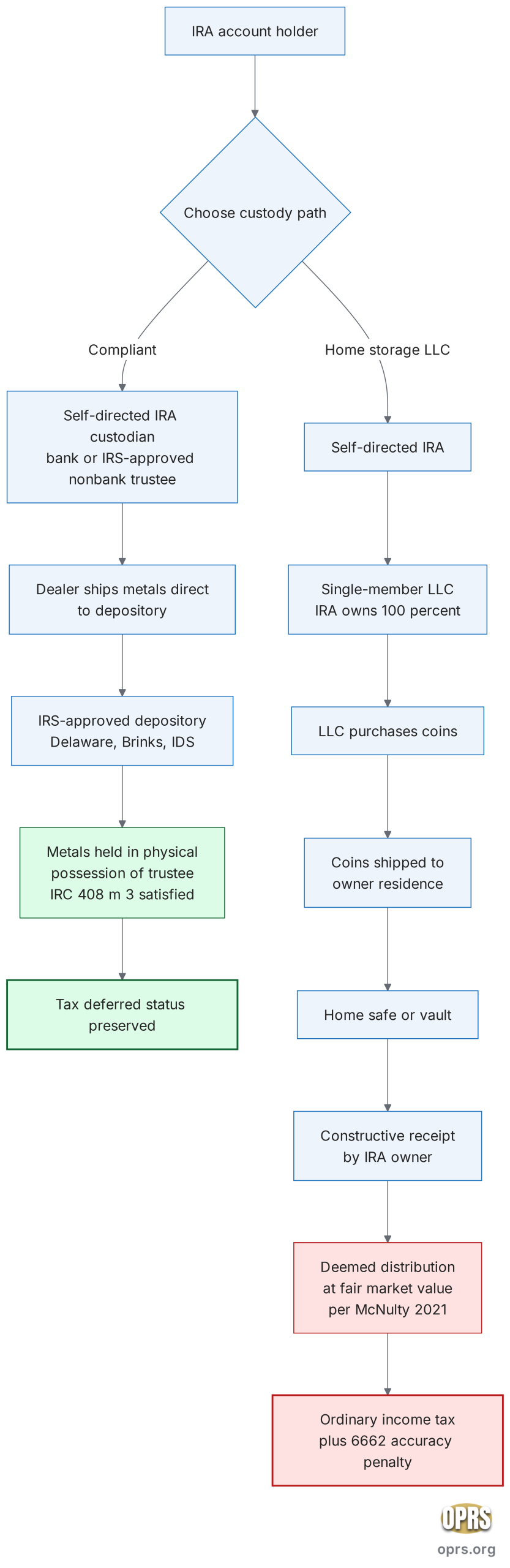
The flowchart below maps the two routes against the Section 408(m)(3) trustee requirement. The compliant path preserves the IRA wrapper. The home storage path collapses it into a taxable distribution on the day the coins reach the residence.
Precious metals IRA fee-drag calculator
Precious metals IRAs charge mostly flat dollar fees (setup, annual custodian, storage). Flat fees take a much bigger bite out of a small account than a large one. Enter your numbers to see the drag.
Estimate only. Fee amounts vary by provider and are often not published; enter figures you confirm in writing. This tool ignores metal price changes and the dealer spread, which also affect returns. Not financial advice.
The right dealer explains every fee up front. Get Augusta's free precious metals IRA company checklist.
The tax cost when the structure fails
The financial cost of a failed home storage structure comes from three stacked federal exposures. First, the affected IRA balance is treated as an ordinary-income distribution at fair market value in the year of receipt, taxed at the household’s marginal federal rate.
Second, if the IRA owner is under age 59 and a half at the time, the 10 percent early distribution tax under IRC Section 72(t) applies on top of the income tax. Third, the accuracy-related penalty under IRC Section 6662 at 20 percent of the underpayment is available to the IRS and was assessed in McNulty. State income tax adds further exposure in states that tax IRA distributions.
A related exposure sits under IRC Section 4975, which imposes a prohibited-transaction tax when a disqualified person (which includes the IRA owner) engages in certain self-dealing transactions with the IRA.
When personal use or possession of IRA assets is characterized as a prohibited transaction, the IRA loses its status as of the first day of the year, and the entire IRA balance is treated as distributed. That is a broader consequence than the McNulty deemed-distribution treatment: it exposes any other assets in the IRA, not just the coins.
The table below shows how the three tax layers stack on a representative $250,000 traditional IRA balance for a household in the 24 percent federal marginal bracket. The figures are illustrative arithmetic on the statutory rates, not a promise of any specific outcome. State tax, other bracket effects, and Medicare surcharges will shift the totals.
| Scenario | Federal income tax at 24% | Section 72(t) 10% early-distribution tax (under 59.5) | Section 6662 accuracy penalty (20% of underpayment) | Status |
|---|---|---|---|---|
| Coins held at IRS-approved depository under Section 408(m)(3) | $0 (deferred) | $0 | $0 | (Safe) |
| $250,000 deemed distribution, taxpayer age 62 (no 72(t)) | Approx. $60,000 | $0 | Approx. $12,000 | (Penalty) |
| $250,000 deemed distribution, taxpayer age 55 (72(t) applies) | Approx. $60,000 | Approx. $25,000 | Approx. $12,000 | (Penalty + early tax) |
| Section 4975 prohibited-transaction characterization on full IRA | Approx. $60,000 (may extend to other IRA assets) | As above if under 59.5 | As above | (Full IRA disqualified) |
The single number that surprises retirement households the most is not the accuracy penalty. It is that the IRA wrapper does not return. The household ends the tax year with the coins still in the safe and roughly one-third of the balance transferred to federal (and possibly state) tax authorities. The deferred wrapper cannot be re-established around the remaining metal without a fresh contribution or rollover from a different qualified source.
Confirm the depository and custodian before any wire clears
A dealer that ships IRA-titled coins to a home address has placed the household on the McNulty fact pattern. A dealer that names the depository, the custodian, and the annual audit firm in writing has cleared the statutory chain of custody. The OPRS shortlist filters this at the vetting stage.
Why the checkbook LLC does not qualify as a trustee
The theoretical case for a checkbook LLC as a Section 408(m)(3) trustee rests on treating the LLC as a separate person under state law. The IRS and the Tax Court reject that framing on three grounds.
First, the LLC has not applied to be an IRS-approved nonbank trustee under Treas. Reg. 1.408-2(e). The application requires audited financials, net-worth thresholds, fiduciary experience, separation of duties, and other elements that a single-purpose IRA-owned LLC does not have.
Second, the IRA owner as sole LLC manager has unfettered access to the LLC bank account and to any assets the LLC buys, which meets the constructive-receipt test. Third, the physical possession of the coins is with a human, not with a fiduciary entity operating under audited controls.
The constructive-receipt doctrine is not new IRS territory. It predates precious-metals IRAs by decades and applies broadly across the Code. Receipt occurs when income is credited or set apart without substantial restriction. The IRA owner-as-LLC-manager holding IRA-titled coins in a home safe fits the classic pattern. McNulty applied the doctrine in a precious-metals fact pattern and gave the IRS a published-opinion precedent it now cites in audit letters.
What a compliant precious-metals IRA structure looks like
The compliant structure has four fixed points. The first is the custodian. This is a bank or an IRS-approved nonbank trustee, contracted to serve as the record holder of the IRA. Examples that show up on public custodial agreements include Equity Trust, STRATA Trust, Kingdom Trust, and Forge Trust for the nonbank trustees, and various state-chartered trust companies. The IRA owner opens the account with the custodian and signs the custodial agreement.
The second is the depository. The custodial agreement names an IRS-approved depository as the storage location. The depositories most commonly named for gold IRA storage include Delaware Depository (Wilmington, Delaware), Brink’s Global Services USA, and International Depository Services (Delaware and Texas).
Each holds the regulatory status and audited operational controls that allow it to serve as the storage agent for the trustee. The IRA owner selects between segregated storage (metals held under the IRA owner’s name in a dedicated location) and commingled storage (metals held fungibly with those of other IRA owners). Segregated storage is typically priced at a higher fee.
The third is the dealer. The dealer sells the coins or bullion to the IRA and ships the metals directly from the supplier to the named depository. The dealer does not ship to the IRA owner’s residence.
Reputable dealers document this routing on a company comparison checklist that names the depository and custodian in writing before the coin order is placed. The fourth is the chain-of-custody record. The custodian records the assets in the IRA, the depository records them in inventory, and the annual audit reconciles the two. The IRA owner never touches the coins during the life of the IRA.
The relevant background statutes for this structure are covered in IRS Publication 590-A (contributions and general IRA rules) and IRS Publication 590-B (distributions, including the deemed distribution rule for collectibles). Both are the plain-English IRS explanations of the Section 408 rules and should be reviewed alongside any custodial paperwork.
Can the IRA owner ever store IRA-titled precious metals at home?
Not while the metals remain IRA-titled. The Section 408(m)(3) exception is conditional on the physical-possession-of-a-trustee requirement, and the IRA owner is not a qualifying trustee.
The IRA owner can, of course, own precious metals personally, outside any IRA wrapper, and store those metals in a home safe. That is not an IRA transaction and Section 408 does not apply. The distinction matters at the kitchen table: personal-side bullion and IRA-side bullion are treated separately, and only the IRA-side has the depository requirement.
A household that wants some bullion physically present at home for the intangible comfort of proximity, and some bullion held in the IRA wrapper for tax-deferred growth, can operate both structures side by side. The personally-owned coins sit in the residential safe under personal title. The IRA-owned coins sit at the depository under trustee title. The two accounts do not interact, and the tax treatment for each follows the applicable rules for that account type.
What to do if a dealer or promoter recommends the home storage structure
Document the representation in writing and end the conversation. The McNulty opinion made clear that reliance on promoter marketing materials is not a defense against the deemed-distribution treatment or the accuracy-related penalty.
The SEC Office of Investor Education and Advocacy Investor Alert on self-directed IRAs catalogs the same risk in plain terms. Promoters of self-directed IRA structures do not vouch for the tax compliance of the underlying transactions, and the taxpayer bears the consequence.
A dealer that markets home storage as compliant should fail the OPRS dealer screen at step one. A dealer that names the depository and custodian in writing before the coin order is placed clears that step and moves to the next round of the vetting process. The vetting distinction is not close.
How to unwind a home storage arrangement already in progress
If the coins have not yet been delivered to a home address, the arrangement can often be re-routed. Contact the IRA custodian and the dealer, open a new depository storage account under the custodial agreement, and re-direct the shipment to the depository before the metals leave the supplier. This is a paper-and-phone fix, not a tax-return event, provided the coins have not been in the IRA owner’s personal possession at any point.
If the coins have already been delivered to a home safe under an existing LLC-IRA structure, the exposure has already crystallized under McNulty’s reading of the constructive-receipt doctrine. The corrective path is a consultation with a qualified tax professional who has direct experience with IRA-owned LLCs and Section 408(m).
Options may include filing a corrected return, entering a voluntary disclosure program, or negotiating with the IRS on the applicable tax and penalty. This is not a self-help situation and the deadlines matter. The sooner the professional review begins after the discovery of the exposure, the wider the range of remediation options.
Related edge cases and common misconceptions
Reliance on a state-court LLC filing is not a Section 408(m)(3) defense. The LLC is properly formed under state law; the state secretary of state does not opine on federal tax treatment. Compliance is a federal Section 408 question, not a state entity-law question.
A safe deposit box at a bank is not a depository under Section 408(m)(3) unless the bank itself is serving as the IRA trustee and holds the metals under its trustee capacity. An ordinary bank safe deposit box rented in the IRA owner’s personal name fails the trustee test the same way a home safe does.
SEP-IRAs and SIMPLE IRAs are subject to the same Section 408(m) rules as traditional IRAs. Business-owner households sometimes assume the SEP or SIMPLE wrapper changes the analysis; it does not.
Solo 401(k) plans present a distinct set of rules under Section 401(a), not Section 408. The custody and prohibited-transaction analysis for a solo 401(k) holding precious metals is not the same analysis as for an IRA and warrants a separate review.
Where Augusta sits on the depository question
Augusta Precious Metals sits on the OPRS three-dealer shortlist for the retirement-household profile because the depository routing on its company comparison checklist is named on the record. Coins ship directly from the supplier to the depository.
The four trust-signal markers OPRS verifies:
- Money Magazine Best Overall Gold IRA Company (2022 to 2026)
- Investopedia Most Transparent Gold IRA Company (2022 to 2026)
- BBB A+ Rating with Zero Complaints (accredited since 2014)
- 4,000-plus 5-star ratings aggregated across Trustpilot, Google, and Consumer Affairs
The published Learn-Talk-Decide process fits a household that wants the depository question answered in writing before any coin order is placed. The dealer minimum is industry-reported around $50,000.
Request the paper company comparison checklist before any coin order
The Augusta company comparison checklist names the depository, the custodian, the storage segregation option, and the annual audit firm in writing. It is the dealer-side document that lets the reader cross-check the Section 408(m)(3) compliance markers before any wire transfer leaves the household account.
OPRS may receive compensation when readers proceed. Editorial selection is independent. Updated July 2026.
Sources cited
- IRC Section 408, Individual Retirement Accounts (text including Section 408(a), (m)(1), (m)(2), (m)(3))
- Treasury Regulation 1.408-2(e), Nonbank Trustees and Custodians of IRAs (eight-element application)
- McNulty v. Commissioner, 157 T.C. No. 6 (Nov 18, 2021)
- IRC Section 6662, Imposition of Accuracy-Related Penalty on Underpayments
- IRC Section 4975, Tax on Prohibited Transactions
- IRC Section 72(t), Additional Tax on Early Distributions from Qualified Retirement Plans
- IRS Publication 590-A, Contributions to Individual Retirement Arrangements (Investment in Collectibles)
- IRS Publication 590-B, Distributions from Individual Retirement Arrangements
- IRS, List of Approved Nonbank Trustees and Custodians
- SEC Office of Investor Education and Advocacy, Investor Alert: Self-Directed IRAs and the Risk of Fraud
- 31 U.S.C. Section 5112, U.S. Mint Coinage Denominations (cross-referenced by IRC 408(m)(3)(A))