

Updated: August 9, 2026
OPRS may receive compensation when readers open an account through partner links on this page. Our analysis is based on independent research, BBB data, and IRS publications.
Total cost of a self-directed gold IRA is not a single number. Six line items stack: setup, annual custodian, storage (segregated or commingled), dealer spread on purchases, buyback spread on distributions, and wire fees. Below is the industry-reported range for each, and a worked example over 10 years on a $100,000 balance.
Fees on a gold IRA are permitted under 26 U.S. Code Section 408, the statute that authorizes individual retirement arrangements. The IRS restates the rules in Publication 590-A. Neither text caps what a custodian, dealer, or depository may charge. The market sets those prices, so ranges vary widely by provider.
The six-line fee ladder
Each line item below reflects industry-reported ranges compiled from published custodian schedules, depository rate cards, and dealer disclosures for 2025 and 2026. These are typical bands, not caps. Any single provider can price above or below.
1. Account setup fee (one-time)
Setup fees run $50 to $180 industry-reported, paid once when the self-directed IRA is opened. Some custodians waive setup during promotional windows. Others bundle it into the first-year invoice. Read the fee schedule the custodian provides before signing the application, and keep a copy.
2. Annual custodian fee
Custodians charge $75 to $300 per year to hold the IRA, based on industry-reported ranges. Two structures dominate. Flat-fee custodians charge the same amount regardless of balance. Tiered custodians step the fee up as balances cross thresholds like $50,000 or $250,000. A third structure, basis-point fees at 0.25% to 0.75% of assets, appears at a small number of providers and scales cost with account size.
3. Storage fee (segregated vs commingled)
IRS-approved depositories charge annual storage fees. Commingled storage runs $100 to $200 per year industry-reported. Your metals are pooled by type in a shared vault space. You own a claim on the pool, not on specific bars.
Segregated storage runs $150 to $300 per year industry-reported. Your specific bars and coins sit in a dedicated compartment with your account number attached. Both formats satisfy the depository rule in IRS Publication 590-A. Segregated is not required. Some retirees prefer it for the audit trail on individual serial numbers.
4. Dealer spread on the purchase
The dealer buying metals on your behalf marks up the spot price. Industry-reported spreads on bullion-grade coins and bars run 3% to 8% above spot. On a $100,000 initial purchase, that spread costs $3,000 to $8,000 upfront, embedded in the transaction. It is not a line item on the invoice. It is the difference between the spot price and the price you pay.
Spreads climb on proof coins, commemoratives, and “exclusive” mint pieces, sometimes to 20% or 30%. FINRA and SEC Office of Investor Education and Advocacy both flag high-premium collectibles inside IRA products as a common cost trap. Standard American Gold Eagle, Canadian Gold Maple Leaf, and generic bullion bars carry the lowest spreads.
5. Buyback spread on distributions
When you sell metals back to the dealer for a cash distribution, the dealer discounts the spot price. Industry-reported buyback spreads run 2% to 5% below spot for standard bullion. On a $100,000 liquidation, that discount costs $2,000 to $5,000. Some dealers publish a formal buyback guarantee at spot minus a fixed percent. Others quote at time of sale.
You can also take an in-kind distribution and receive the physical metals. That skips the buyback spread but creates a taxable event at the metals’ fair market value on the distribution date. The choice depends on whether you want cash or coins in hand.
6. Wire and miscellaneous fees
Outbound wire fees run $25 to $40 per transaction, industry-reported. These apply when the custodian sends funds to the dealer to settle a purchase, or when the dealer sends proceeds to your bank on a cash distribution. Paper check fees, expedited processing, and account termination fees each add $25 to $100 when applicable. Ask for the full miscellaneous schedule before signing.
10-year total cost of ownership: worked example on $100,000
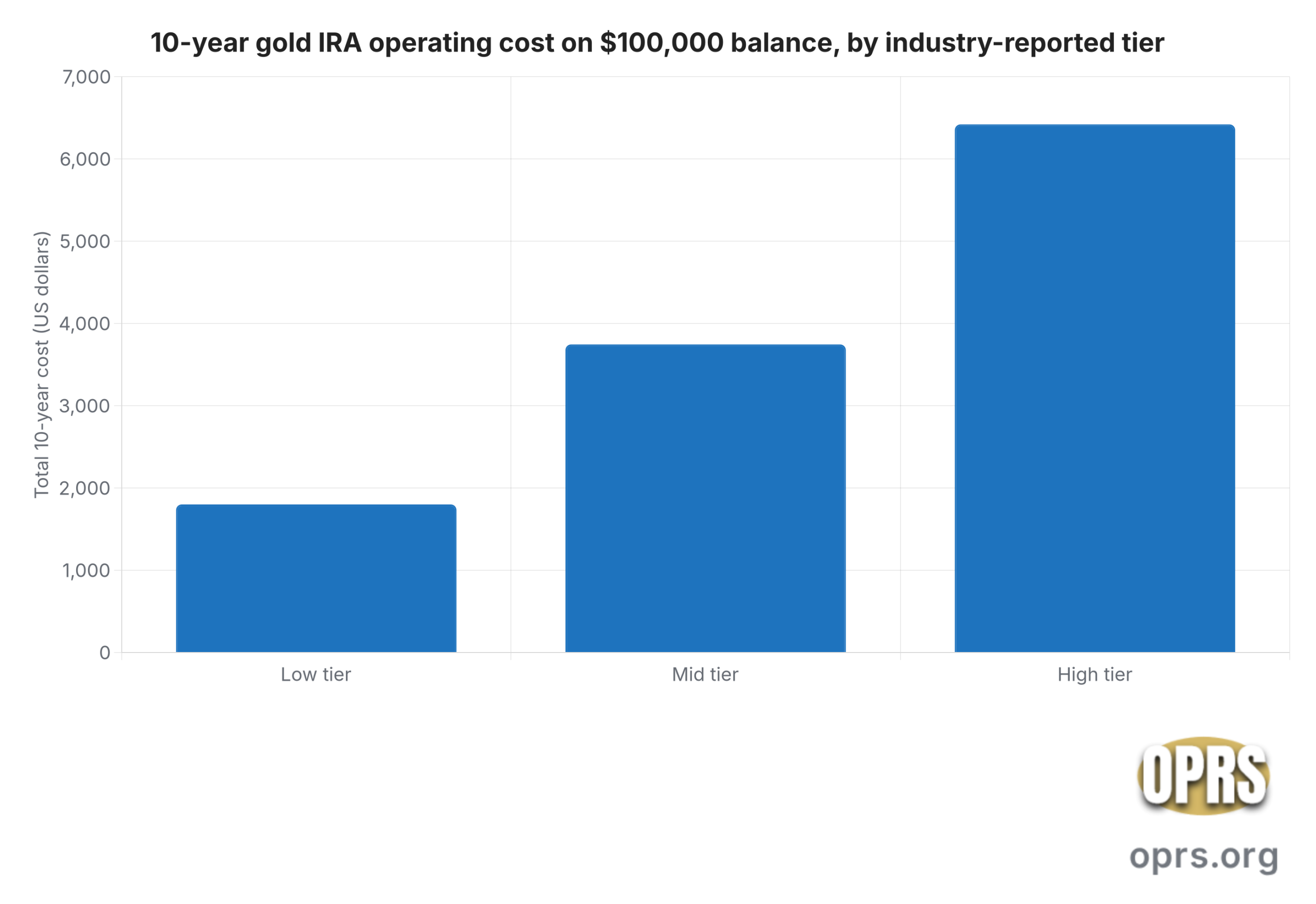
The chart below stacks the industry-reported low, mid, and high ranges for a $100,000 gold IRA held 10 years. Numbers exclude the initial dealer spread and the eventual buyback spread. Those are addressed separately below the figure.
Low tier assumes $50 setup, $75 annual custodian, $100 commingled storage, and two wire fees at $25 each. Mid tier assumes $115 setup, $187 annual custodian, $175 storage, and four wire fees at $30 each. High tier assumes $180 setup, $300 annual custodian, $300 segregated storage, and six wire fees at $40 each. Totals: $1,800, $3,745, and $6,420 over 10 years.
Precious metals IRA fee-drag calculator
Precious metals IRAs charge mostly flat dollar fees (setup, annual custodian, storage). Flat fees take a much bigger bite out of a small account than a large one. Enter your numbers to see the drag.
Estimate only. Fee amounts vary by provider and are often not published; enter figures you confirm in writing. This tool ignores metal price changes and the dealer spread, which also affect returns. Not financial advice.
The initial dealer spread stacks on top. At the industry-reported 3% to 8% range on a $100,000 purchase, that adds $3,000 to $8,000, paid once at the time of the buy. The buyback spread of 2% to 5% adds $2,000 to $5,000 at the eventual sale, if you liquidate for cash rather than take an in-kind distribution.
Full 10-year cost bands, purchase and buyback included: low $6,800, mid $8,745, high $19,420. That maps to roughly 6.8% to 19.4% of the initial balance over a decade. Actual outcomes depend on which spread band you land in and how often you rebalance inside the account, which triggers new dealer spreads.
Commingled storage pools your metals with other clients’ metals of the same type and weight. You are entitled to receive equivalent metal on request, not the specific bars you purchased. Segregated storage assigns your specific serial-numbered bars to a dedicated compartment tagged to your IRA account number.
For most retirees, commingled meets the IRS depository requirement at a lower annual cost. Segregated is worth the premium in three specific cases. You buy numismatic or rare-mint coins where the exact piece has provenance value. You want a documented audit trail on individual serial numbers. Or your custodian recommends it for a high-value account above $250,000.
What drives cost higher
Three variables inflate the total. First, high-premium products like proof coins or “limited mint” pieces push the dealer spread well above the 8% band. Second, basis-point custodian fees compound as the account grows, so a 0.5% fee on a $500,000 balance costs $2,500 per year, not $187. Third, frequent trading inside the IRA multiplies the dealer spread every time you buy or sell.
Segregated storage adds roughly $50 to $150 per year over commingled. That is a modest premium if the audit trail matters to you. It is a wasted cost if it does not.
How to keep total cost near the low end of the range
Five moves push a typical account toward the low-tier band. Choose a flat-fee custodian if the balance is under $250,000. Pick commingled storage unless you have a specific reason to segregate. Buy standard bullion coins and bars where the spread stays in the 3% to 6% range. Consolidate rebalances to limit transaction wire fees. Ask the dealer for a written buyback policy before you buy.
Two moves push cost toward the high-tier band. Basis-point custodian fees on a large balance compound quickly. Frequent trades or a shift into proof and commemorative coins push the effective spread well above the standard 8%. Both are choices, not required costs.
Frequent questions on gold IRA cost
Are gold IRA fees tax-deductible?
Custodian fees paid from personal funds outside the IRA are not deductible as investment expenses under current tax law, following the 2017 Tax Cuts and Jobs Act. Fees paid from inside the IRA reduce the account balance directly and are not separately deductible. IRS Publication 590-A confirms this treatment.
Do dealer spreads count as a “fee”?
Legally, a spread is a markup, not a fee. It does not appear on the custodian’s invoice. It is the gap between the metal’s spot price and the price you pay. In practice, retirees treat it as a cost of ownership, because it reduces the metal you receive per dollar spent.
Are fees higher on a small account?
Yes, as a percentage. A flat annual fee of $187 costs 0.9% on a $20,000 account and 0.09% on a $200,000 account. Storage flat fees behave the same way. This is why many custodians publish account minimums or waive setup on larger balances.
Can I avoid the buyback spread?
Yes, by taking an in-kind distribution of the physical metals rather than selling them back to the dealer. The IRS treats the distribution as taxable ordinary income (or a qualified Roth distribution if the account is a Roth) at the fair market value on the day of transfer. You avoid the buyback spread but not the tax.
How does gold IRA cost compare to a mainstream IRA?
A brokerage IRA holding a gold ETF like GLD carries an expense ratio near 0.40% per year, no custodian fee, no storage fee, no dealer spread, and standard trading commissions. A self-directed physical gold IRA is materially more expensive year over year. The tradeoff is direct ownership of the metal versus a paper claim.