

Updated: July 28, 2026
OPRS may receive compensation when readers open an account through partner links on this page. Our analysis is based on independent research, BBB data, and IRS publications.
30-second verdict
- Seven criteria decide the depository line on the application: COMEX approval, vault class, insurance carrier and policy line size, segregated storage availability, state jurisdiction, fee structure in writing, and audit cadence.
- The depository must be a non-bank trustee or other qualified entity under IRC Section 408(n). Home storage and personal safe deposit boxes fail the rule and trigger a deemed distribution.
- Class 3 UL-rated vault construction, all-risk insurance placed through Lloyd’s of London underwriters, and an annual third-party audit are the operational floor expected on every reputable IRA-approved depository name.
- The depository line is downstream of the dealer choice. The dealers OPRS warns against are the operators that withhold the depository name until after the application is submitted.
The depository line on a gold IRA application is the single field most savers skim past. The dealer name carries the marketing budget. The custodian application has the most paperwork. The depository, where the metals physically sit for the life of the account, often arrives as one line on page four.
That one line carries weight at the $100,000 to $500,000 rollover band. It decides who insures the holding. It decides which state laws govern any future inspection or in-kind distribution. It decides how the bars or coins sit relative to other clients’ metals. The rules come from the IRS, the Underwriters Laboratories vault standard, and the COMEX-approved depository list. The choice between qualifying depositories comes from seven criteria a saver can read on the paperwork before signing.
Before any six-figure rollover paperwork signs, see the 2026 OPRS dealer list and the operators we warn against. The depository name is downstream of the dealer choice, and the dealers we rule out are the ones that hide the depository name until after the application is submitted.
Before you sign
The depository name should appear on the application, in writing, before the order ticket signs. If the dealer will not commit a specific depository name, the storage tier, and the insurance carrier on paper at the application stage, that single behavior is the strongest signal in the entire rollover process.
Updated July 2026. 3 of 27+ gold IRA dealers reviewed by OPRS make the 2026 trusted list.
What an IRS-approved depository actually is
Before the seven criteria matter, the depository has to clear the IRS rule first. Internal Revenue Code Section 408(m) bars the IRA owner from holding the precious metals personally. Section 408(n) limits the qualifying trustees and custodians to banks, federally insured credit unions, and other non-bank entities approved by the Treasury. In practice, the IRA-approved depositories are non-bank trust companies that hold metals on behalf of the IRA, under a custody agreement with the IRA custodian named on the account.
Three structures fail the IRS rule and trigger a deemed distribution. Home storage in a residence safe fails it. A personal bank safe deposit box rented by the IRA owner fails it. An LLC checkbook structure controlled by the IRA owner fails it under the 2021 McNulty v. Commissioner Tax Court ruling.
The IRS position is that the metals must sit in the physical custody of a qualifying trustee, not the IRA owner. Once the qualifying-entity rule is satisfied, the seven operational criteria below decide which qualifying depository to actually pick.
The seven criteria that decide the selection
The depository selection comes down to seven readable items on the application paperwork. None of them require a finance background. All of them can be confirmed by asking the dealer and the custodian to put the answer in writing. The order below moves from the legal floor (item 1) to the operational details that matter most at a $100,000 to $500,000 balance (items 5 through 7).
- COMEX-approved depository status. The COMEX list is the auditable third-party stamp that the facility is approved to hold metals settling COMEX futures contracts.
- Vault class. A Class 3 UL-rated vault is the highest commercial security rating recognized by Underwriters Laboratories.
- Insurance carrier and policy line size. All-risk coverage placed through Lloyd’s of London underwriters is the industry standard. The policy line size is the maximum dollar coverage per vault.
- Segregated storage availability. Segregated storage means the metals sit in a labeled container with the account holder’s name and IRA number, physically separated from other clients’ holdings.
- State jurisdiction. Delaware, Texas, Utah, and New York each carry different non-bank trust company rules and different state inspection processes.
- Fee structure in writing. Annual storage fees, optional segregated-storage premiums, and inspection or distribution fees should appear on the application, in dollar figures, before the order ticket signs.
- Audit cadence and viewing access. Annual third-party audits and on-site viewing by appointment are the two transparency anchors a saver can verify.
Criterion 1: COMEX approval and non-bank trust status
The CME Group runs the COMEX precious metals exchange and maintains a public list of approved depositories where the metals settling COMEX futures contracts physically sit. That list is the most useful third-party stamp on the IRA-approved depository name.
A depository on the COMEX list is audited against exchange standards. It holds inventory tagged to the contract counterparty. It submits to the exchange clearing process. For an IRA holding bars or coins worth $100,000 or more, that audit and reporting infrastructure is already in place.
The other half of criterion 1 is the depository’s own legal status as a non-bank trust company. Delaware Depository, IDS Group, and the Texas Bullion Depository each hold state non-bank trust company charters. A saver can verify the charter on the state’s banking or financial regulation website.
Brink’s Global Services operates as a logistics and security company. The IRA-approved storage piece runs under a separate trust arrangement with the IRA custodians it serves. Either structure is acceptable, as long as the chain is on the paperwork.
Criterion 2: Vault class
Underwriters Laboratories publishes the safe and vault rating system used by insurance carriers and security auditors. Class 3 is the highest commercial vault rating UL recognizes, certifying the structure against documented levels of forced entry, tool attack, and torch attack. Every COMEX-approved precious metals depository in the United States runs at Class 3 UL-rated construction at minimum. A depository name that cannot answer the vault class question in writing has not cleared the basic operational floor.
Class 3 vault construction also matters for the insurance carrier. Lloyd’s of London underwriters price the all-risk policy line off the vault rating, the alarm and access control system, and the depository’s historical loss record. A vault below Class 3 forces the carrier to either charge more, cap the line, or decline the risk.
The downstream effect on a saver is direct. A lower vault class means a lower insurance line per vault. That means the saver’s pro-rata coverage at $200,000 or $500,000 may not cover the full holding in a single-event loss.
Criterion 3: Insurance carrier and policy line size
All-risk insurance through Lloyd’s of London underwriters is the industry standard for IRA-approved depositories. The phrase “all-risk” is the underwriting category that covers theft, mysterious disappearance, fire, water damage, and other named perils, subject to the policy exclusions.
The Lloyd’s of London name on the policy means the carrier is one of the syndicates trading at the Lloyd’s market, not a separate insurance company called Lloyd’s. That distinction matters at the claims stage. A multi-syndicate Lloyd’s placement spreads the loss across multiple underwriters. That structure is the reason the policy line size can scale into the hundreds of millions.
The policy line size is the maximum dollar coverage the carrier will pay on a single loss event at the vault. Delaware Depository public materials reference a $1 billion all-risk insurance line. Brink’s Global Services runs the deepest single-carrier balance sheet of the named depositories. IDS Group references an all-risk line through Lloyd’s underwriters on each of its IDS Delaware and IDS Texas facilities.
For a saver at the $200,000 to $500,000 band, the policy line size is rarely the binding constraint. For a $1 million-plus rollover, the line size and the pro-rata calculation become a real check.
Criterion 4: Segregated storage vs commingled
Segregated storage means the IRA’s metals are physically separated from other clients’ holdings, in a labeled container with the account holder’s name and IRA reference number. Commingled storage means the metals are pooled with other clients’ holdings of the same product type, and the IRA owns a pro-rata claim on the pool.
Both are legal under the IRS rules. The choice between them affects three things: cost, chain of custody during a future in-kind distribution, and what the saver sees during an on-site viewing.
On cost, the typical industry-reported differential between segregated and commingled runs $50 to $100 per year for a $100,000 to $500,000 balance. On chain of custody, segregated storage means the specific bars or coins that arrived from the dealer are the same items that ship out on an in-kind distribution. Commingled storage means the saver receives metals of the same purity and weight, not the specific items that arrived.
On viewing, segregated storage allows the saver to physically see the labeled container during the appointment. The OPRS desk recommends segregated storage at any account balance, on a chain-of-custody basis rather than a cost basis.
Criterion 5: State jurisdiction
The depository’s state of operation decides which state non-bank trust company laws govern the storage, which state’s inspection process applies in any future audit, and which state’s distribution paperwork the IRA custodian uses on an in-kind out. Four states host the bulk of IRA-approved depositories: Delaware (Delaware Depository, IDS Delaware), Texas (IDS Texas, Texas Bullion Depository), Utah (Brink’s Salt Lake City), and New York (Brink’s Manhattan). Each carries a different state framework.
Delaware non-bank trust company status is the longest-running framework in the gold IRA space, dating to the late 1990s for the Wilmington facilities. Texas non-bank trust company rules and the Texas Bullion Depository Act create a state-charter framework built specifically for precious metals storage. Utah and New York both host Brink’s IRA-approved storage under the broader state trust company codes.
For a saver who wants geographic diversification of the storage layer, splitting a holding across two states through two separate depository accounts is a documented option. For a saver who prefers a single-state framework, picking the state with the most familiar legal environment is a reasonable approach.
Criterion 6: Fee structure in writing
The depository fee shows up on the IRA custodian’s annual statement, not on the dealer’s order ticket. That separation is why a saver who reads only the dealer paperwork can sign without ever seeing the storage cost.
The custodian deducts the depository fee from the IRA balance once per year, typically on the anniversary of account opening or on a fixed calendar date. For a $200,000 segregated holding at one of the named depositories, the industry-reported annual storage fee runs in the $150 to $250 band.
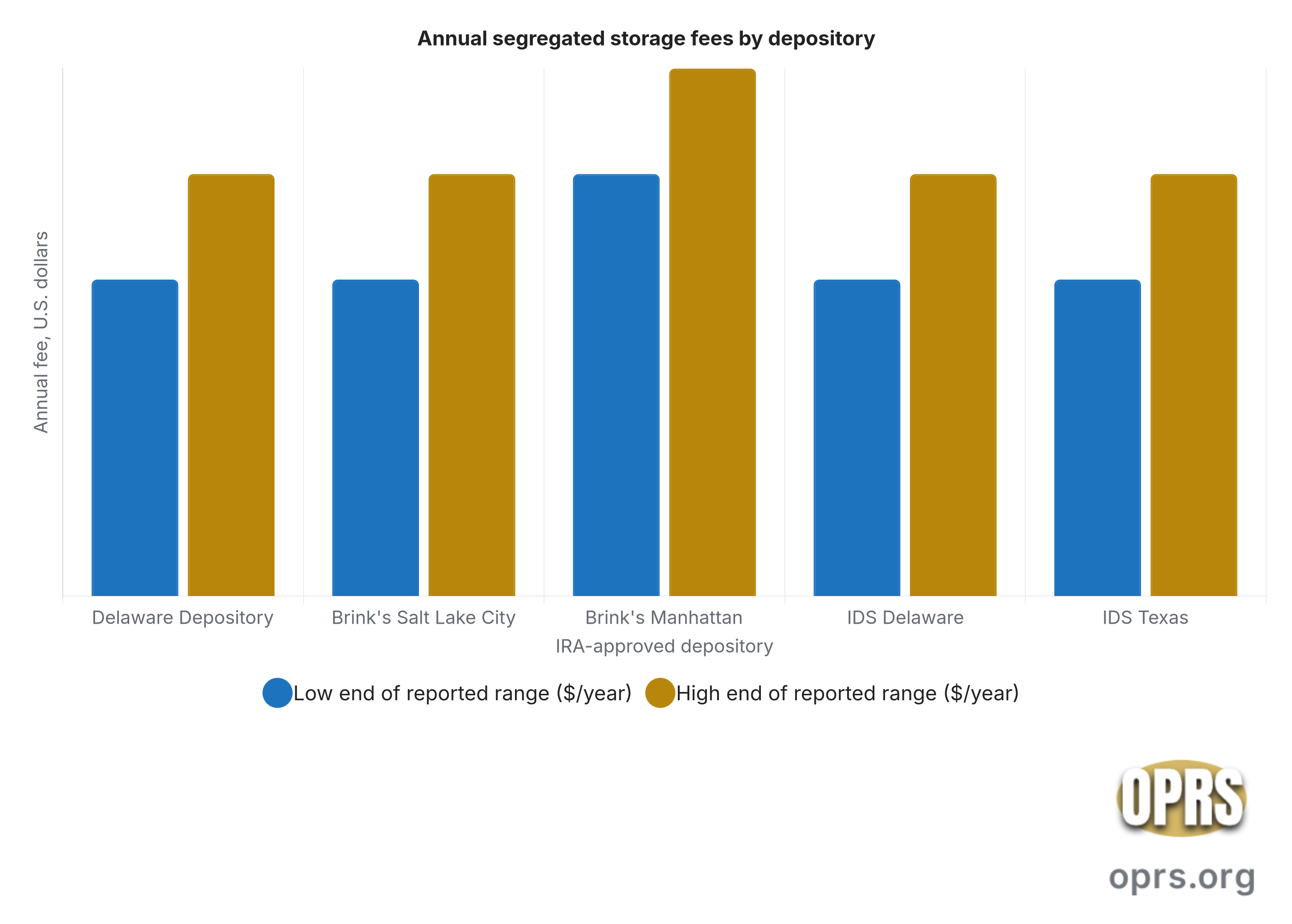
The bar chart below shows the segregated-storage annual fee range at five IRA-approved depositories named on common rollover paperwork. The figures are industry-reported ranges drawn from each depository’s public materials and from the IRA custodians’ published fee schedules. Confirm the actual rate with the dealer and the custodian during the consultation, in writing, before the application signs.
Precious metals IRA fee-drag calculator
Precious metals IRAs charge mostly flat dollar fees (setup, annual custodian, storage). Flat fees take a much bigger bite out of a small account than a large one. Enter your numbers to see the drag.
Estimate only. Fee amounts vary by provider and are often not published; enter figures you confirm in writing. This tool ignores metal price changes and the dealer spread, which also affect returns. Not financial advice.
The right dealer explains every fee up front. Get Augusta's free precious metals IRA company checklist.
Beyond the annual storage fee, two other fee lines belong on the paperwork. The first is the optional segregated-storage premium, where a depository offers segregated at a higher rate than commingled. The second is the distribution or in-kind out fee, which the custodian or the depository charges to ship metals to the account holder at distribution time. Both should appear in dollar figures on the application or the custody agreement before the rollover signs.
Criterion 7: Audit cadence and viewing access
Two operational transparency anchors are reasonable to expect at an IRA-approved depository. The first is an annual third-party audit. The COMEX-approved depositories typically commission an annual independent audit and reference the audit on corporate materials. A saver can ask the depository for the audit firm name and the most recent audit date. The custodian can also confirm the audit cadence at the consultation stage.
The second anchor is on-site viewing access by appointment. Delaware Depository, IDS Delaware, IDS Texas, and the Texas Bullion Depository each publish appointment-based viewing for account holders. The Brink’s facilities run a tighter security protocol and limit viewing access by policy. For a saver who wants the option to physically verify the holding once before authorizing a major distribution or transfer, the viewing-access policy is a binary check during the depository selection.
How the decision actually flows
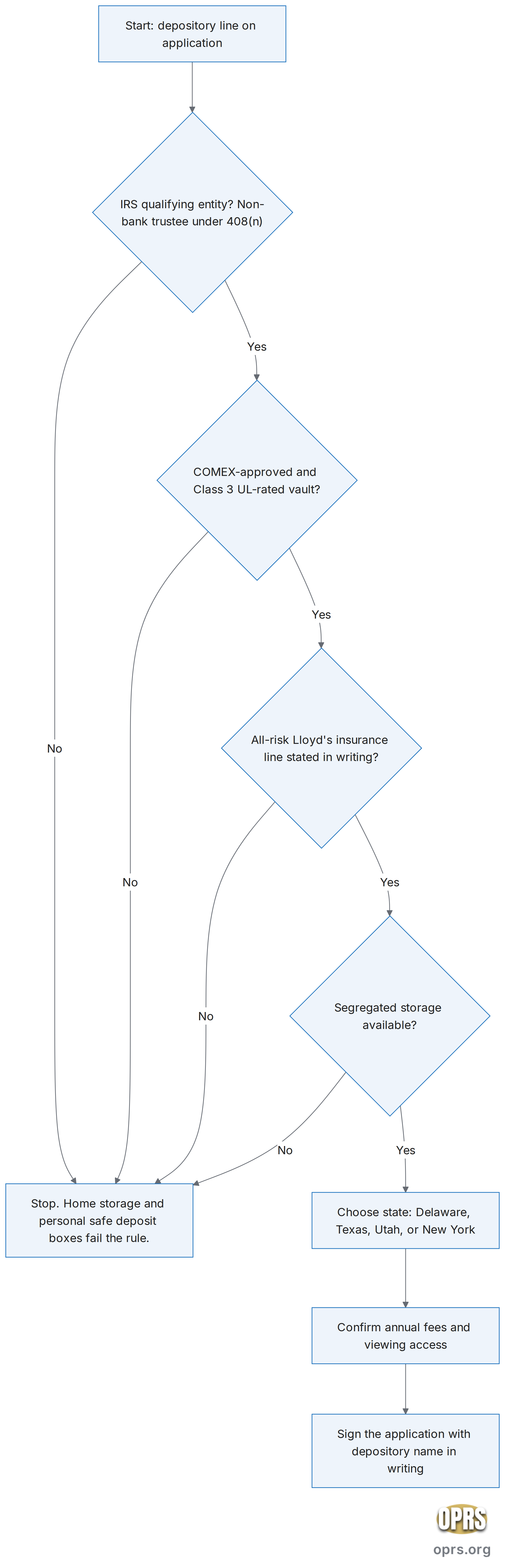
The seven criteria sort into three sequential decisions on the application. First, confirm the qualifying-entity rule. Second, confirm the operational floor on items 1 through 4: COMEX status, Class 3 vault, all-risk Lloyd’s coverage, and segregated availability. Third, sort items 5 through 7 by personal preference: state jurisdiction, fee tolerance, and viewing access. The flow below shows the decision sequence step by step.
Common mistakes in the depository line
Five recurring patterns show up on the depository line of rollover paperwork that should not. The first is the unnamed depository: the application lists “depository to be determined” or a similar placeholder. That language gives the dealer or the custodian room to route the metals to any qualifying facility after the funds clear, without the saver’s written consent.
The second is the home-storage pitch: a marketing claim that an LLC checkbook structure allows the saver to hold the metals at a residence. The McNulty Tax Court ruling closed that door in 2021.
The third pattern is the segregated-or-commingled blank: the storage tier is not specified on the application, and the custodian defaults to commingled at the dealer’s order. The fourth is the missing insurance line: the application references “insured storage” without naming the carrier, the policy line size, or the all-risk language.
The fifth is the depository name with no audit reference: a saver who asks for the most recent audit firm and date receives a delay or a refusal. None of these are illegal on their face. Each one is a paperwork shortcut the saver pays for at the storage layer.
Quick decision matrix
The matrix below maps the most common saver profiles to a recommended starting point on the depository selection. It is a starting point only. The dealer and the custodian named on the rollover paperwork still have to confirm availability and pricing before the application signs.
| Profile | Account band | Reasonable starting point | Why |
|---|---|---|---|
| Federal employee, TSP rollover, segregated preference | $100k to $300k | Delaware Depository | Longest COMEX history, segregated standard, Delaware non-bank trust framework |
| Small business owner, SEP or SIMPLE rollover | $200k to $500k | IDS Delaware or IDS Texas | State-choice flexibility, segregated availability, audit transparency |
| Saver who values the largest single-carrier insurance line | $300k to $1M plus | Brink’s Global Services | Deepest balance sheet behind the insurance line, global logistics integration |
| Texas-jurisdiction preference | any band | IDS Texas or Texas Bullion Depository | Texas non-bank trust framework, Texas Bullion Depository Act |
| Multi-state diversification of the storage layer | $500k plus | Two depository accounts in two states | Splits state jurisdiction risk across two frameworks |
What to take to the consultation
A saver heading into the consultation call with the dealer can shorten the back-and-forth by writing down seven questions in advance. Each maps to one of the seven criteria above.
- What is the depository name on the application?
- Is it COMEX-approved?
- What is the vault class?
- Who is the insurance carrier and what is the policy line size?
- Is segregated storage available and at what annual cost?
- Which state is the depository located in?
- When was the most recent third-party audit?
A dealer who answers all seven in writing is operating at the floor the rest of the industry meets. A dealer who deflects on any of the seven is the signal the OPRS desk treats as a stop-and-verify event.
Sources cited
- IRS Publication 590-A: Contributions to Individual Retirement Arrangements (IRAs)
- IRS Publication 590-B: Distributions from Individual Retirement Arrangements (IRAs)
- 26 U.S. Code Section 408: Individual Retirement Accounts (Cornell Law)
- eCFR 26 CFR 1.408-2: Individual retirement accounts (qualifying entities)
- CME Group: COMEX Gold market and approved depository disclosures
- SEC Investor Bulletin: Self-Directed IRAs and the Risk of Fraud
- FINRA Investor Insights: Self-Directed IRAs and Alternative Investments