

Updated: July 28, 2026
OPRS may receive compensation when readers open an account through partner links on this page. Our analysis is based on independent research, BBB data, and IRS publications.
30-second verdict
- An inherited gold IRA is governed by the beneficiary form on file at the custodian, not by the will. The form selects the exit path before any liquidation question reaches the depository floor.
- Three procedural paths exist for the physical bullion: custodian-to-custodian transfer into an inherited IRA, in-kind distribution of the metals to the beneficiary, or custodian liquidation followed by cash distribution.
- Only one of those paths preserves the IRA tax wrapper. The other two trigger ordinary income tax on the full fair market value in the distribution year under IRS Publication 590-B.
- The October 31 deadline for trustee documentation and the December 31 deadline for separate-account election cannot be missed without collapsing see-through treatment.
- Inherited IRA assets receive no step-up in basis at the parent’s death under IRC Section 1014(c); the income-in-respect-of-decedent rule taxes the full balance as ordinary income to the beneficiary.
The inheritance transfer of physical gold IRA assets is an operational sequence, not a legal abstraction. The custodian holds the metals at a depository. The beneficiary form names who inherits them. The IRS rules at IRC Section 408(m)(3) decide which metals stay eligible inside the inherited wrapper. See the dealers OPRS clears and the ones we warn against before any custodian conversation, because the dealer relationship determines whether the four-step transfer chain runs cleanly or stalls at the depository hand-off.
Element I of the procedure is custodian notification with a certified death certificate and beneficiary inventory. Element II is documentation review of the beneficiary form and any qualifying trust against the post-2024 framework. Element III is exit-path selection: custodian-to-custodian transfer, in-kind distribution, or liquidation. Element IV is the depository coordination layer that physically moves the bullion or registers the in-kind hand-off. Each element has a deadline. Missing one collapses optionality on the next.
Screen the dealer before any transfer paperwork
An inherited gold IRA routed through a dealer with thin operational infrastructure shifts the failure mode from tax leakage to counterparty friction at the worst possible moment for a grieving beneficiary. The dealer screen is the cheapest correction available before any transfer instruction reaches the custodian.
3 of 27+ gold IRA dealers reviewed by OPRS make the 2026 trusted list. Updated July 2026.
What inheritance transfer of physical gold IRA assets actually means
An inherited gold IRA is a traditional or Roth IRA holding IRS-approved bullion at a depository. The original owner has died. The beneficiary form on file triggers the post-death distribution rules at IRC Section 401(a)(9). The custodian and depository do not transfer ownership of the actual coins or bars to a probate court. The IRA wrapper survives the account holder.
The beneficiary inherits a registered position inside that wrapper. The procedural choices that follow decide three outcomes: whether the metals stay inside the wrapper, move out as physical possession, or convert to cash on the way out.
The physical aspect matters because the bullion sits at an approved depository under IRC Section 408(m). The depository tracks specific serial numbers, allocated or segregated positions, and storage fees through the custodian’s books.
An inherited gold IRA hand-off therefore touches three institutional layers at once. The custodian registers the new beneficiary. The depository physically handles the metals. The dealer relationship is the third layer if the beneficiary wants to buy or sell positions inside the inherited account.
Day 0 to 30: custodian notification and physical position inventory
The procedural clock starts the day the custodian receives notice of death. The executor or surviving spouse files a certified copy of the death certificate with the custodian on the gold IRA account, along with a beneficiary claim form. Most custodians require the beneficiary’s government-issued ID, Social Security number, and a copy of the most recent statement.
The custodian then pulls the depository position report, which lists every coin and bar by approved-product code, weight, serial number where applicable, and the current allocation status (allocated, segregated, or commingled). This inventory becomes the operative document for every later procedural step. If multiple beneficiaries are named, the inventory also becomes the basis for share calculations and the December 31 separate-account election.
The 30-day window matters operationally because custodians close out the deceased holder’s account for new transactions once the death notice is filed. The depository freezes incoming buy orders. Outgoing distribution requests pause until a new beneficiary-titled inherited IRA is established. A beneficiary who tries to skip this step and request cash directly from the deceased owner’s account triggers paperwork rejection rather than instant access. The inventory step is mandatory and unskippable.
Day 31 to 180: beneficiary documentation and the qualifying-trust deadlines
The beneficiary form on file at the custodian controls the inheritance. If the form names individuals directly, each named beneficiary opens an inherited IRA in their own name. If the form names a trust, the trustee must satisfy the four-part qualifying-trust test in Treasury Regulations Section 1.401(a)(9)-4.
The four prongs are: valid under state law, irrevocable at death, beneficiaries identifiable from the instrument, and trustee documentation delivered to the plan administrator by October 31 of the year after the original owner’s death.
The SECURE Act 2.0 final regulations at 89 FR 58886 (July 19, 2024) split inherited-IRA beneficiaries into eligible designated beneficiaries and non-eligible designated beneficiaries. The surviving spouse, a minor child of the decedent, a disabled or chronically ill individual, and an individual not more than ten years younger than the decedent qualify as eligible designated beneficiaries. Every other adult-child or non-spouse adult inherits under the 10-year distribution rule.
The December 31 deadline of the year after death is the separate-account election cut-off. If three children inherit equal shares, the election creates three independent inherited IRAs at the custodian. Each child runs their own 10-year window. Without the election, the children share the oldest beneficiary’s life-expectancy calculation, which constrains every later distribution choice. The election is filed at the custodian, not the trust instrument. The deadline is strict.
Three exit paths from an inherited gold IRA
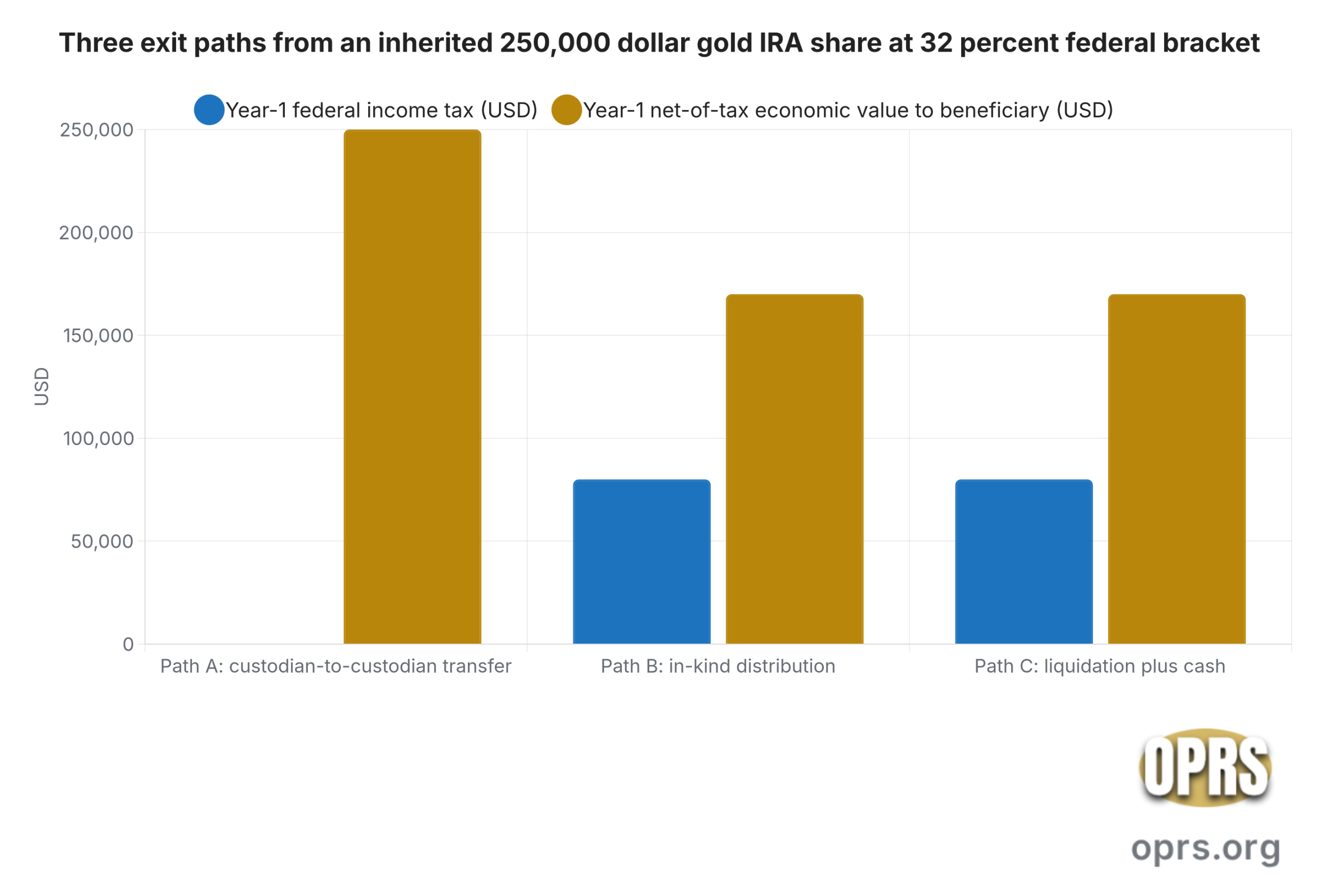
Once the beneficiary IRA is established and the documentation layer is complete, the procedural choice narrows to three exit paths. The chart below shows the year-1 federal income tax cost and the year-1 retained position for a $250,000 inherited gold IRA share.
The beneficiary is a single filer in the 32 percent federal marginal bracket, using the 2025 single-filer schedule in IRS Publication 17. The retained position combines the immediately-available cash, the physical metals retained, and any tax-deferred balance inside an inherited IRA wrapper. State income tax is excluded to isolate the federal effect.
Can you roll your account into a precious metals IRA? Eligibility checker
Most retirement money can move into a precious metals IRA once it qualifies as an eligible rollover distribution. Pick your account type and situation for a general answer. Always confirm specifics with your plan administrator or custodian.
General guidance only, not tax or financial advice. Eligibility depends on your specific plan document and IRS rules; confirm with your plan administrator and a tax advisor. A direct trustee-to-trustee transfer avoids the 60-day rule and 20% mandatory withholding.
The right dealer explains every fee up front. Get Augusta's free precious metals IRA company checklist.
Path A is the custodian-to-custodian transfer of the entire balance into an inherited IRA in the beneficiary’s name. No taxable event in year 1. The full $250,000 stays inside the IRA wrapper. Distributions follow the 10-year window with annual RMDs if the parent died after the required beginning date, or no annual RMDs if before. This is the only path that preserves the IRA tax wrapper.
Path B is in-kind distribution of the physical metals from the IRA to the beneficiary’s personal possession. The full $250,000 fair market value at the date of distribution is ordinary income to the beneficiary in that year. The beneficiary owes federal income tax (roughly $80,000 at 32 percent on this share) and now holds the metals outside any IRA wrapper, where future appreciation is subject to capital-gains treatment rather than ordinary-income deferral.
Path C is custodian liquidation followed by cash distribution. The custodian instructs the depository to sell the bullion to a buyer, often the originating dealer at the buyback bid. The proceeds (roughly $250,000 at fair market value, less any bid-ask spread) distribute to the beneficiary as cash.
Same federal income tax as Path B, no metals retained, and the dealer’s buyback spread becomes the operational variable. The choice between Path B and Path C is operational, not tax-driven. Both trigger the same year-1 tax liability on the full fair market value.
The four-step inheritance-transfer procedural sequence
The procedural workflow that a beneficiary and the custodian run together follows a four-step inventory-to-distribution sequence. Each step has to complete before the next is meaningful. The diagram below shows the operational chain.
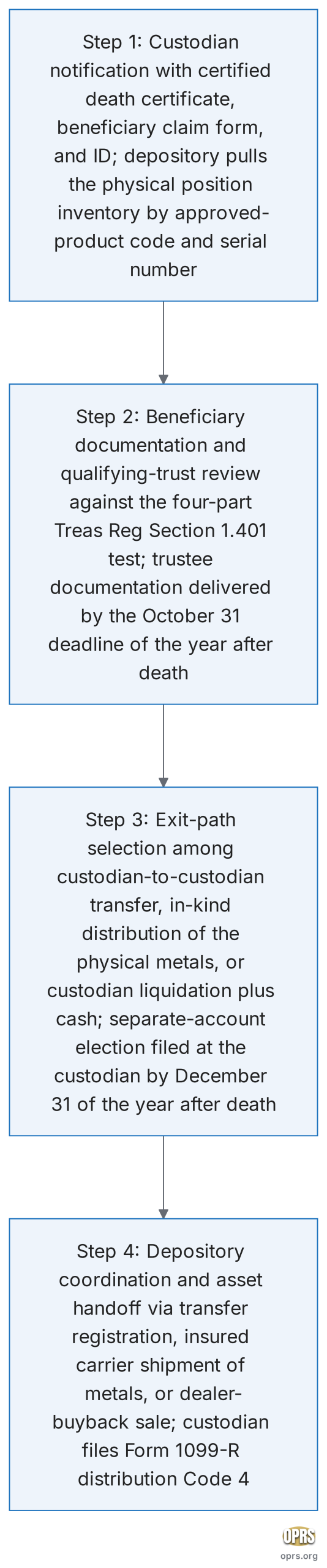
Step 1. Custodian notification and physical inventory. The certified death certificate, beneficiary claim form, and ID documentation reach the custodian. The depository position report is pulled. The deceased owner’s account closes to new orders. Output: a positional inventory tied to specific approved-product codes, weights, and depository allocation status.
Step 2. Beneficiary documentation and qualifying-trust review. Each named beneficiary or the trustee files identification and the inherited-IRA opening paperwork. If a trust is named, counsel confirms the trust satisfies the four-part qualifying-trust test under the post-2024 framework. Trustee documentation reaches the plan administrator by October 31 of the year after death.
Step 3. Exit-path selection. The beneficiary chooses one of three paths: custodian-to-custodian transfer into an inherited IRA, in-kind distribution of the physical metals, or custodian liquidation plus cash distribution. The separate-account election by December 31 of the year after death runs in parallel for multi-beneficiary cases.
Step 4. Depository coordination and asset handoff. The depository executes the chosen path. A transfer registers the new beneficiary as the title holder over the existing position. An in-kind distribution ships the bullion to the beneficiary’s address or releases it for pickup. A liquidation triggers a sale to the dealer-buyback or open market, with cash wired to the beneficiary. The custodian files Form 1099-R for any distribution.
Depository coordination and in-kind transfer mechanics
The depository layer is where physical gold IRA inheritances differ from cash IRAs. The bullion sits at an approved depository (Delaware Depository, Brink’s Global, IDS of Delaware, or similar). Allocated and segregated positions track specific serial numbers and the original product invoice. Commingled positions share a pool of identical-weight bars or coins. The inheritance hand-off respects whichever allocation structure the deceased owner had on file.
An in-kind distribution requires the depository to physically release the bullion. Shipment uses an insured carrier with chain-of-custody documentation. The fair market value at the date of distribution becomes the cost basis for the beneficiary’s later capital-gains calculation, which matters if the metals are sold later at a higher spot price. Custodians publish depository fee schedules for in-kind release, often $50 to $250 per ounce or per shipment depending on the product and the carrier.
The no-step-up-in-basis trap on an inherited IRA
The most expensive misunderstanding in inherited gold IRA planning is the assumption that the metals receive a step-up in basis at the original owner’s death. They do not. IRC Section 1014(c) excludes income-in-respect-of-decedent assets from the step-up rule that applies to a brokerage account at death. The full pre-tax value of the inherited IRA is taxed as ordinary income to the beneficiary when distributed, regardless of how much the gold appreciated during the original owner’s lifetime.
The practical implication is that the inherited gold IRA cannot be treated as a vehicle for stepped-up capital-gains exit. The metals carry the original owner’s deferred ordinary-income tax liability through the inheritance into the beneficiary’s distribution year. The capital-gains step-up that an after-tax brokerage account gets at death is unavailable here. IRS Publication 559 codifies the income-in-respect-of-decedent treatment.
Common procedural errors on an inherited gold IRA
The errors that surface in custodian tickets and beneficiary disputes after an inherited gold IRA opens cluster into six categories. Each one is preventable with the right procedural sequence and expensive to correct after the distribution year closes.
- Treating the will as the controlling document. The will does not direct an IRA distribution. The beneficiary form on file at the custodian does. A reconciliation step in the first 30 days prevents downstream conflict.
- Taking in-kind distribution without an exit-path review. A grieving beneficiary who wants physical possession of the metals may not realize the in-kind distribution triggers ordinary income tax on the full balance, often pushing the beneficiary into the 32 to 37 percent federal bracket in a single year.
- Missing the December 31 separate-account election. Multi-beneficiary inherited IRAs that miss this deadline lose per-beneficiary planning flexibility and share the oldest beneficiary’s life-expectancy calculation for RMD purposes.
- Skipping the October 31 trustee-documentation deadline. A qualifying trust that is otherwise valid collapses see-through treatment if the trustee fails to deliver the documentation to the plan administrator by this date.
- Liquidating at the buyback bid without dealer comparison. The originating dealer’s buyback spread may sit five to ten percent below open-market bid. A second-quote step before liquidation is procedural rather than legal and often preserves meaningful value. Check this dealer against the 2026 OPRS list if the originating dealer is unknown to the beneficiary, before any liquidation order is placed.
- Misclassifying the Form 1099-R distribution code. Code 4 indicates a death distribution. A miscoded 1099-R (Code 1 or Code 7) can trigger a premature-distribution penalty assessment in the beneficiary’s tax filing. The fix is a custodian-issued corrected 1099-R, not a self-help adjustment on Form 1040.
Where Augusta sits for inherited gold IRA scenarios
- Money Magazine Best Overall Gold IRA Company (2022 to 2026)
- Investopedia Most Transparent Gold IRA Company (2022 to 2026)
- BBB A+ Rating with Zero Complaints (accredited since 2014)
- 4,000+ 5-star ratings aggregated across Trustpilot, Google, and Consumer Affairs
The dealer minimum is industry-reported around $50,000, which can constrain a beneficiary inheriting a sub-$50,000 share but rarely binds on a typical full-account inheritance.
The estate-side benefit of an established dealer relationship is documented inherited-IRA distribution handling. The custodian relationship, depository setup, and buyback infrastructure already exist when the beneficiary inherits. The beneficiary’s procedural workload (custodian notification, exit-path selection, depository coordination) runs against a system the original owner already validated, rather than starting from a stalled or unresponsive operator the original owner had not vetted.
Compare the 4-award stack on a company-comparison checklist
The free company-comparison checklist walks through the custodian, depository, fee, and buyback documentation a beneficiary should review before authorizing any exit-path action. Augusta is one of three dealers OPRS currently clears; the checklist is the higher-intent asset for screening any single dealer against the four-marker trust-signal stack.
OPRS may receive compensation when readers proceed. Editorial selection is independent. Updated July 2026.
Can a beneficiary take physical possession of the gold from an inherited IRA without paying tax?
No. An in-kind distribution of the physical metals from an IRA wrapper to a beneficiary triggers ordinary income tax on the full fair market value at the date of distribution. The only tax-deferred path is the custodian-to-custodian transfer into an inherited IRA in the beneficiary’s name, which keeps the metals inside the IRA wrapper subject to the 10-year rule or any eligible-designated-beneficiary exception. Physical possession outside an IRA terminates the wrapper.
What happens if the deceased owner had multiple depositories or multiple custodians for the gold IRA?
Each custodian-and-depository combination runs its own beneficiary notification, inventory, and distribution sequence on its own clock. The beneficiary or the executor files a death certificate with each custodian. The October 31 trustee-documentation deadline and the December 31 separate-account election apply at each plan-administrator level. Coordination is administrative, not legal: a consolidated calendar of deadlines across custodians prevents a missed cut-off at one institution from compromising treatment at the others.
Does the beneficiary get a step-up in basis on the inherited gold IRA balance?
No. IRC Section 1014(c) excludes income-in-respect-of-decedent assets, which include traditional IRA balances, from the step-up rule. The pre-tax balance carries the deferred ordinary-income tax liability through to the beneficiary’s distribution year. The capital-gains step-up that an after-tax brokerage account receives at death does not apply to an inherited traditional IRA. A Roth IRA inheritance, by contrast, distributes tax-free if the five-year holding requirement is satisfied at the original owner’s level.
Sources cited
- IRC Section 401(a)(9), Required Distributions Where Employee Dies Before Entire Interest Distributed
- Final Regulations on Required Minimum Distributions, 89 FR 58886, July 19, 2024
- Treasury Regulations Section 1.401(a)(9)-4, Determination of the Designated Beneficiary
- IRC Section 408(m)(3), Definition of Collectibles and Permitted Bullion in an IRA
- IRC Section 1014(c), Basis of Property Acquired from a Decedent (IRD Exclusion)
- IRS Publication 590-B, Distributions from Individual Retirement Arrangements
- IRS Publication 559, Survivors, Executors, and Administrators
- IRS Publication 17, Your Federal Income Tax (Bracket Schedules)
- IRS Instructions for Forms 1099-R and 5498, Distribution Codes Including Code 4 for Death Distributions