

Updated: July 28, 2026
OPRS may receive compensation when readers open an account through partner links on this page. Our analysis is based on independent research, BBB data, and IRS publications.
Calculating the required minimum distribution on an inherited IRA for a surviving spouse is one of the few retirement computations the IRS has documented in three different ways depending on the election the spouse makes.
The mechanics are governed by IRS Publication 590-B, Chapter 1, and the statutory authority is IRC §401(a)(9), with the surviving-spouse rollover carve-out at IRC §408(d)(3)(C).
A 72-year-old widow who inherits a $500,000 Traditional IRA from a spouse who had already reached the required beginning date is looking at three different annual RMD figures depending on which path she takes. The first is roughly $18,797 under the Uniform Lifetime Table at age 72 (Publication 590-B Appendix B).
The second is roughly $29,070 under the Single Life Table at age 72 (Publication 590-B Appendix B, Table I, recalculated annually for a surviving spouse). The third is a deferred RMD entirely if she is younger than the deceased’s would-have-reached required beginning date and elects to defer.
The election drives the figure. Updated July 28, 2026.
This calculation guide is written for the surviving spouse who has been told by a custodian, dealer, or family member that the RMD figure has already been decided. It has not.
The election is the lever, and the election is still on the table until either the rollover is executed or the deemed-treatment deadline of December 31 of the year after death is passed.
The numbers in this guide are computed from the published 2024 final regulations under 89 FR 58886 and the divisor tables in Publication 590-B Appendix B. They are illustrative, not personalized tax advice; a CPA or enrolled agent should sign off before the final paperwork is filed.
A note for surviving spouses: review our 2026 reality check on the dealers we warn widows against before signing any custodian paperwork. When an inherited account is in play, Element I of the OPRS dealer rubric, the BBB public-record state, is the first filter we run.
Before the first RMD is calculated
A surviving spouse who lets a dealer or a custodian compute the first RMD without first deciding the election is letting the paperwork pick the path. The path drives the divisor, the divisor drives the RMD, and the RMD drives the lifetime tax outcome. The 2026 OPRS reality check names the operators we rule out for cold-calling widows on inherited accounts and the few we currently consider acceptable for a self-directed structure.
3 of 27+ gold IRA dealers reviewed by OPRS make the 2026 trusted list.
Which IRS table governs the RMD calculation
Publication 590-B Appendix B lists three life-expectancy tables a surviving spouse may encounter: the Uniform Lifetime Table (Table III), the Single Life Table (Table I), and the Joint and Last Survivor Table (Table II). Only the first two govern an inherited-IRA RMD calculation for a surviving spouse who is the sole beneficiary. Which table applies is a function of the election under IRC §408(d)(3)(C) and the deemed-treatment rules in Treasury Regulation §1.408-8, Q&A-5.
- Spousal rollover (Option 1). Once the inherited balance is rolled into the surviving spouse’s own IRA, the Uniform Lifetime Table at the spouse’s own age applies. The RMD start date moves to the spouse’s own required beginning date (age 73 under SECURE 2.0 for individuals born 1951 to 1959, age 75 for individuals born 1960 or later).
- Treat as own (Option 2). The Uniform Lifetime Table at the spouse’s own age applies, same as Option 1. The election can be made by retitling, by making a contribution, or by failing to take a required beneficiary RMD by the December 31 deadline of the year after the year of death.
- Inherited (Beneficiary) IRA (Option 3). The Single Life Table applies at the surviving spouse’s age each year, recalculated annually. The recalculation distinction is unique to the surviving spouse; non-spouse beneficiaries on the Single Life Table use the fixed subtract-one method.
- Section 327 election under SECURE 2.0 (Option 4). Added by SECURE Act 2.0 §327, applicable from 2024. The surviving spouse elects to be treated as the deceased for RMD purposes. The Uniform Lifetime Table applies, but the RMD start year is the year the deceased would have reached the required beginning date. This option matters most when the deceased was younger than the surviving spouse.
Calculating the year-of-death RMD
The year-of-death RMD is a trap for surviving spouses who assume the election decides everything. It does not. If the deceased had reached the required beginning date before death, the deceased’s RMD for the year of death must still be taken by December 31 of that year. This obligation runs regardless of which election you make for years going forward.
The amount is the RMD the deceased would have taken, calculated on the deceased’s December 31 balance of the prior year, using the deceased’s Uniform Lifetime Table divisor. If the deceased had already taken the RMD before death, no further distribution is required.
If the deceased had taken only a partial RMD, the surviving spouse must distribute the shortfall by December 31.
Missing the year-of-death RMD triggers the IRC §4974 excise tax. SECURE 2.0 reduced the excise tax to 25% (from the prior 50%) and to 10% if the shortfall is corrected within the correction window, generally the second calendar year after the year of the missed distribution. The shortfall and the request for waiver are reported on Form 5329.
The IRS has historically granted waivers under the reasonable-cause standard for surviving spouses who corrected the shortfall promptly; the waiver is not automatic. Documentation of the death date, the prior-year December 31 balance, and the corrected distribution should be retained.
Worked example: $500,000 inherited IRA, 72-year-old surviving spouse
The clearest way to see the election-driven divergence is a worked example. Here is the setup: the surviving spouse is 72 at the end of the year following the year of death. The inherited Traditional IRA balance at the prior December 31 was $500,000. The deceased had reached the required beginning date before death. Three election paths produce three different first-year RMDs.
The Uniform Lifetime Table divisor at age 72 is 26.6 (Publication 590-B Appendix B, Table III). $500,000 divided by 26.6 yields $18,797 as the annual RMD under Option 1 (spousal rollover) or Option 2 (treat as own).
The Single Life Table divisor at age 72 is 17.2 (Publication 590-B Appendix B, Table I). $500,000 divided by 17.2 yields $29,070 as the annual RMD under Option 3 (Inherited IRA). The gap is $10,273 in the first year, and it widens with age because the Single Life divisor falls faster than the Uniform Lifetime divisor.

Precious metals IRA required minimum distribution (RMD) estimator
Once required minimum distributions begin (age 73 now, 75 starting 2033), you divide the prior year-end balance by an IRS life-expectancy factor. The result is taxed as ordinary income on your federal return and, in most states, your state return. You can take a precious metals IRA RMD in cash or in metal.
Estimate only, not tax advice. Uses the IRS Uniform Lifetime Table (most owners). A spouse more than 10 years younger and sole beneficiary uses a different table. Roth IRAs have no lifetime RMD. Sources: IRS Publication 590-B (Table III); IRS RMD FAQs. Consult a tax advisor.
The right dealer explains every fee up front. Get Augusta's free precious metals IRA company checklist.
The chart isolates the first-year RMD. Over a multi-year horizon, the cumulative drawdown under the Single Life Table runs materially higher because the divisor in Table I falls more steeply than the divisor in Table III.
By age 80, the Uniform Lifetime divisor is 20.2 while the Single Life divisor at the same age is 11.2, a roughly 80% higher mandated annual distribution under the Inherited IRA election.
This choice has a direct cash-flow implication. For a surviving spouse whose only retirement income is the inherited IRA balance and Social Security, it also has a tax-bracket implication. Larger RMDs push more income into higher marginal brackets.
The Single Life Table recalculation method for a surviving spouse
A surviving spouse who keeps the account as an Inherited IRA uses the Single Life Table on a recalculation basis. This is different from the method used by non-spouse beneficiaries.
A non-spouse adult-child beneficiary who was grandfathered onto the Single Life Table before the SECURE Act change uses the fixed subtract-one method: look up the divisor in Year 1, subtract 1 each year thereafter. A surviving spouse instead looks up the new divisor in the Single Life Table each year at the spouse’s actual age that year.
The mechanic is described in IRS Publication 590-B, Chapter 1 (Required Minimum Distributions, sole-spouse-beneficiary rules) and in Treasury Regulation §1.401(a)(9)-5, Q&A-5.
The practical consequence: the surviving spouse on an Inherited IRA never runs the divisor down to zero in the way a non-spouse subtract-one beneficiary eventually does. The Single Life divisor at age 100 is 6.4 under the recalculation method; the subtract-one method would have driven the divisor to 1.0 long before.
Recalculation is a meaningful protection for a surviving spouse who lives well past their actuarial expectation, but it does not reduce the year-over-year RMD figure relative to the Uniform Lifetime Table at the same age. The Single Life RMD remains larger at every age in Appendix B.
The Uniform Lifetime Table calculation under the spousal rollover
After a spousal rollover (Option 1) or a deemed treat-as-own election (Option 2), your RMD calculation is identical to what any other IRA owner runs. You divide the prior-year December 31 balance by the Uniform Lifetime Table divisor at your age that year.
The RMD start date is the spouse’s own required beginning date, which is April 1 of the year following the year the spouse turns 73 (born 1951-1959) or 75 (born 1960 or later).
Consider a surviving spouse who rolls a $500,000 inherited balance at age 65 and reaches the required beginning date at 73. She takes no RMD on that balance for eight years. By that point, the rolled balance may have grown or contracted with investment returns.
This deferral window is a significant benefit relative to the Inherited IRA election, where RMDs begin in the year after death regardless of the spouse’s age.
The Joint and Last Survivor Table (Table II) is generally not used here. It applies only if you name a new spouse who is more than ten years younger as your sole beneficiary. That exception is documented in Publication 590-B Appendix B, Table II. For a surviving spouse in her 70s, the calculation is the Uniform Lifetime Table at her own age, period.
The procedural sequence for calculating the first RMD
The OPRS desk uses a four-step procedural sequence to compute the first inherited-IRA RMD for a surviving spouse, before any election paperwork is signed. The steps are documented for use with a CPA or enrolled agent; they are not a substitute for the advisor’s signoff.
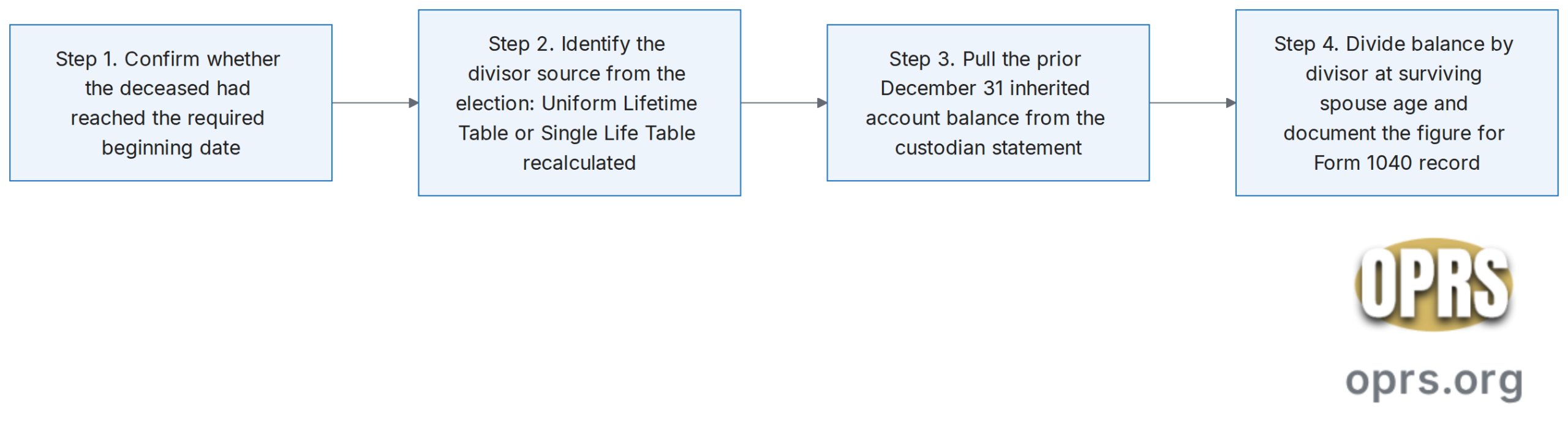
Step 1 anchors the election decision. If the deceased had reached the required beginning date, the year-of-death RMD obligation runs in parallel with whatever the surviving spouse elects for years going forward. Step 2 identifies the divisor source: Uniform Lifetime under Options 1, 2, and 4; Single Life recalculated under Option 3.
Step 3 pulls the prior December 31 balance from the custodian’s year-end statement. Step 4 multiplies through and documents the figure for the Form 1040 record. A surviving spouse who runs all four steps before the dealer paperwork is signed will not be surprised by the figure the custodian reports.
Five common RMD calculation mistakes surviving spouses make
- Using the wrong table. A surviving spouse who elected the Inherited IRA path is sometimes told by a custodian to use the Uniform Lifetime Table. That is wrong for Option 3. The Single Life Table applies, recalculated annually. The error understates the RMD and triggers the §4974 excise tax on the shortfall.
- Missing the year-of-death RMD. If the deceased had reached the required beginning date and had not completed the year-of-death RMD, the surviving spouse must complete it by December 31 of the year of death. Forgetting this is the single most common shortfall the IRS sees on Form 5329 in the surviving-spouse pattern.
- Deemed-election trap. A surviving spouse who intended to keep the Inherited IRA election but failed to take the year-after-death beneficiary RMD by December 31 of the year after death is treated by the IRS as having elected to treat the IRA as their own. The Inherited IRA status is lost, the Single Life Table no longer applies, and pre-59½ access loses the §72(t) penalty exemption.
- Using the deceased’s age. The RMD divisor is looked up at the surviving spouse’s age each year, not the deceased’s age. Custodian systems sometimes default to the deceased’s birthdate on inherited accounts. The error overstates or understates the figure depending on the age gap.
- Confusing the recalculation method with subtract-one. A surviving spouse on the Single Life Table recalculates each year at the new age. A non-spouse beneficiary on the grandfathered Single Life method subtracts one. The mix-up appears when a CPA who routinely handles non-spouse inherited IRAs applies the subtract-one method to a surviving spouse.
How a gold IRA structure interacts with the RMD calculation
The RMD calculation does not change because the inherited IRA holds gold under IRC §408(m). The divisor source and the prior-year balance are the same; what changes is the practical mechanics of taking the distribution.
A gold IRA holding IRS-approved bullion at an IRS-approved depository can settle the RMD in two ways. You can liquidate bullion to cash and distribute cash. Or you can take an in-kind distribution of bullion at fair market value on the distribution date.
The in-kind distribution is reported on Form 1099-R at the bullion’s fair market value, and the recipient takes a cost basis equal to that value.
The dealer and custodian choice matters operationally. You can run the four-step calculation correctly and still hand back several percent of the RMD figure in friction costs. Those costs have nothing to do with the IRS formula; they come from an opaque fee structure or bullion spread.
The OPRS dealer rubric, especially Element I on BBB public-record state, is the operational filter that sits underneath the math. Augusta Precious Metals carries Money Magazine Best Overall Gold IRA Company (2022-2026), Investopedia Most Transparent Gold IRA Company (2022-2026), a BBB A+ rating with zero complaints (accredited since 2014), and 4,000+ 5-star ratings. The industry-reported minimum sits around $50,000.
For a Margaret-profile widow with an inherited balance well above that threshold, the dealer-vetting question is whether the operator has the documentation history to handle the inherited-account paperwork without missteps. The OPRS reality check is the diagnostic.
Frequently asked questions on the inherited-IRA RMD calculation
Does the surviving spouse use the deceased’s age or her own age in the RMD divisor lookup?
The surviving spouse uses her own age at the end of the distribution year for all elections going forward (Options 1, 2, 3, and 4). The deceased’s age is only relevant for the year-of-death RMD, if the deceased had reached the required beginning date and had not yet taken the full year-of-death distribution.
Custodian systems occasionally default to the deceased’s birthdate after a death-event re-titling; the surviving spouse should verify the divisor lookup uses her own age on the first RMD statement.
What divisor table applies if the inherited IRA is a Roth?
Roth IRAs do not have lifetime RMDs for the original owner under IRC §408A(c)(5), so the analysis is different.
A surviving spouse who elects the spousal rollover or treat-as-own on an inherited Roth IRA has no RMD obligation during her own lifetime. The assets pass to her beneficiaries at her death. At that point, the inherited-Roth rules apply to those beneficiaries.
A surviving spouse who elects the Inherited Roth IRA path must take RMDs under the Single Life Table, recalculated annually. RMDs begin in the year after death. Or she may defer to the year the deceased would have reached age 73, under the post-2024 final regulations.
Distributions from an inherited Roth are tax-free if the deceased’s Roth was at least five years old.
Does the RMD calculation change if the surviving spouse remarries?
Remarriage does not change the RMD calculation on the inherited account. The divisor source remains the same table that applied under the original election. If the surviving spouse rolled the balance into her own IRA before remarriage, the Uniform Lifetime Table continues to apply.
The Joint and Last Survivor Table is only triggered if the surviving spouse names a new spouse who is more than ten years younger as the sole beneficiary on that IRA. Tax filing status may shift (married filing jointly versus single), but that affects the tax owed on the RMD, not the RMD figure itself.
Can the RMD be aggregated across multiple IRAs the surviving spouse holds?
Yes, for IRAs the surviving spouse owns in her own name after a spousal rollover or treat-as-own election. The RMD is computed account-by-account but can be aggregated and taken from any combination of those IRAs under Publication 590-B Chapter 1 (Required Minimum Distributions, aggregation).
No for an Inherited IRA kept under Option 3; the RMD on an Inherited IRA must be taken from that account and cannot be satisfied by a distribution from another IRA the surviving spouse owns. The Inherited IRA RMD also cannot be aggregated with RMDs on other Inherited IRAs unless they were inherited from the same decedent.
What if the surviving spouse is younger than 59½ and needs to access the inherited funds?
A surviving spouse younger than 59½ who anticipates needing distributions before reaching that age should generally elect the Inherited IRA path (Option 3). Distributions from an Inherited IRA are exempt from the IRC §72(t) 10% early-withdrawal penalty at any age.
A spousal rollover or treat-as-own election (Options 1, 2, 4) loses that exemption; distributions before the surviving spouse’s own 59½ are subject to the 10% penalty unless a separate exception applies. This is the largest age-driven trap on the spousal election and is the most-cited reason for keeping an Inherited IRA structure rather than rolling over.
Sources cited
- IRS Publication 590-B: Distributions from Individual Retirement Arrangements (IRAs), including Appendix B Uniform Lifetime Table (Table III) and Single Life Table (Table I)
- IRC §401(a)(9): Required distributions from qualified retirement plans, including the Eligible Designated Beneficiary carve-out at (E)(ii)
- IRC §408(d)(3)(C): Rollover by surviving spouse
- IRC §408A(c)(5): No required distributions during life of Roth IRA owner
- IRC §4974: Excise tax on missed required distributions
- 89 FR 58886: Required Minimum Distributions, final regulations (July 19, 2024)
- Public Law 117-328 (SECURE Act 2.0 of 2022, including §327 surviving-spouse election)
- Treasury Regulation §1.408-8: Distribution rules for IRAs (including Q&A-5 deemed treat-as-own election)