

Updated: July 28, 2026
OPRS may receive compensation when readers open an account through partner links on this page. Our analysis is based on independent research, BBB data, and IRS publications.
30-second verdict
- Insurance coverage on IRA gold is private specie insurance, written through the Lloyd’s of London market and attached to the depository, not to the IRA itself.
- The policy covers four named perils: in-vault physical loss and theft, in-transit shipping, employee infidelity, and mysterious disappearance, each with a stated sub-limit.
- It does not cover market price decline, dealer fraud before the bullion reaches the depository, prohibited-transaction penalties, war or nuclear events, or government seizure.
- FDIC and SIPC do not apply to IRA bullion at all. The retiree’s only recoverable layer is the depository specie policy plus whatever supplemental coverage is purchased above the per-claim ceiling.
- The defensible move is to request the certificate of insurance from the depository, read the four named layers, and screen the dealer that sets the chain before signing the custodian agreement.
Most retirees opening a precious metals IRA assume the same federal safety nets that cover their checking account and their brokerage account follow the gold into the IRA wrapper. They do not. The bullion sits in a third-party depository under a private insurance policy whose named perils and dollar ceilings determine what the household actually recovers after a loss.
See the dealers OPRS clears and the ones we warn against before the custodian-to-depository chain locks in. Element I of the insurance picture is the dealer choice, because the dealer sets the custodian, the custodian sets the depository, and the depository sets the policy.
This guide enumerates the covered perils and the excluded perils side by side. It maps each common loss scenario to a payer and to a reader action. The intent is to leave the household able to read a depository certificate of insurance line by line and to know which loss events are recoverable and which are not.
Screen the dealer before the depository
The dealer that opens the account is the same party that defaults the depository, the storage type, and the certificate of insurance the retiree never asks for. Reading the certificate after the wire has cleared is the wrong order.
3 of 27+ gold IRA dealers reviewed by OPRS make the 2026 trusted list. Updated July 2026.
The four named perils a depository policy actually covers
An all-risk specie policy attached to an IRS-approved bullion depository carries four standard coverage layers. Each layer answers a different category of loss. The dollar exposure depends on the layer, not on the aggregate vault headline.
Layer one is in-vault all-risk. This covers physical loss and theft of the bullion while inside the depository. Per the Lloyd’s of London specie line overview, all-risk wording means any cause of loss is covered unless the policy specifically excludes it. The named exclusions matter as much as the named coverage.
Layer two is in-transit. This covers the bullion during shipment from the dealer to the depository, between depositories on a transfer, and from the depository to the retiree on an in-kind distribution. The in-transit limit is usually a separate sub-limit, often well below the in-vault aggregate.
Layer three is employee infidelity. This covers losses caused by dishonest acts of depository employees acting alone or in concert. Industry policy schedules typically list employee infidelity as its own sub-limit, often in the low single-digit millions per occurrence.
Layer four is mysterious disappearance. This covers the case where bullion is found missing on an audit with no traceable cause. This layer almost always carries the most restrictive sub-limit and the shortest claim window. It is the layer most retirees never read.
In practice: the four layers together define the covered universe. A loss outside these layers is uninsured at the depository level. The retiree’s recovery on any specific event is the sub-limit of the matching layer, not the aggregate vault number.
Sub-limits by coverage layer (typical industry bands)
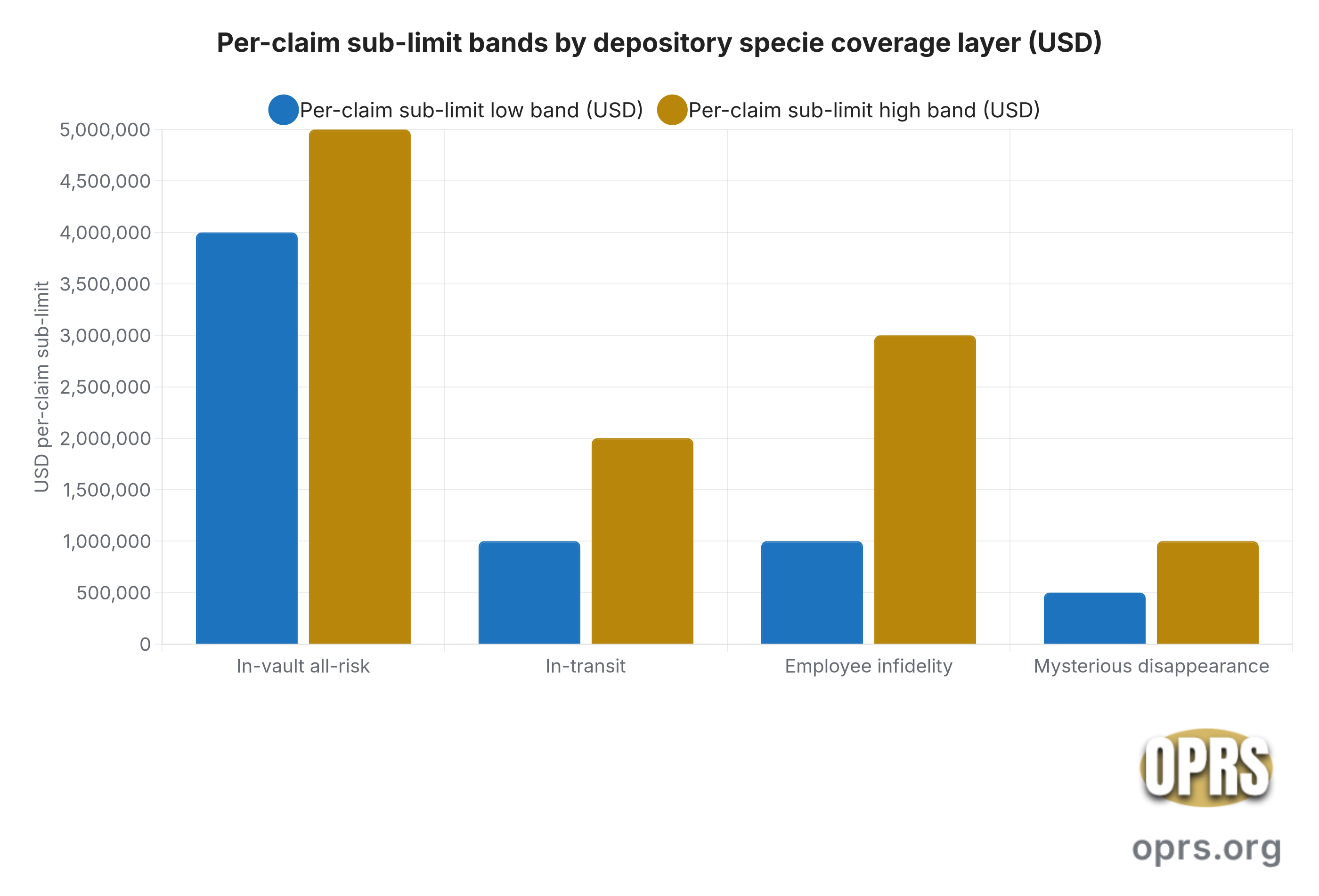
The aggregate vault limit on a major specie policy is published in the high hundreds of millions to roughly $1 billion. The per-claim sub-limit on any single loss event is materially smaller. The chart below shows typical sub-limit bands across the four named coverage layers, as published in industry rate sheets and broker disclosures.
Precious metals IRA fee-drag calculator
Precious metals IRAs charge mostly flat dollar fees (setup, annual custodian, storage). Flat fees take a much bigger bite out of a small account than a large one. Enter your numbers to see the drag.
Estimate only. Fee amounts vary by provider and are often not published; enter figures you confirm in writing. This tool ignores metal price changes and the dealer spread, which also affect returns. Not financial advice.
The right dealer explains every fee up front. Get Augusta's free precious metals IRA company checklist.
The in-vault sub-limit is the highest, because that is where the bullion sits most of the time. The in-transit sub-limit is much lower, because exposure happens only during physical movement. The employee infidelity and mysterious disappearance sub-limits are the most restrictive, because both depend on a forensic conclusion that the loss happened inside the chain.
Where this matters: a household with $400,000 in bullion inside a vault carrying a $4 million per-claim sub-limit is fully recoverable on any single in-vault event. The same household becomes only partially recoverable on a mysterious-disappearance audit finding if the layer sub-limit is $1 million and the loss spans multiple ounces over multiple periods.
The perils matrix: what insurance does and does not cover
The table below enumerates the loss scenarios a 55-to-75 retiree should expect to think through. Each row maps the peril to whether the depository specie policy responds, which other party is responsible, and the reader’s prevention or recovery move.
| Peril or loss scenario | Covered by depository specie policy? | Who actually pays | Reader action |
|---|---|---|---|
| Fire or flood inside the vault | Yes (Covered) | Depository specie policy (in-vault layer) | Confirm in-vault sub-limit covers full position |
| Armed robbery of the vault | Yes (Covered) | Depository specie policy (in-vault layer) | Confirm sub-limit and segregated-storage election |
| Theft during shipment to depository | Yes (Covered) | In-transit sub-limit (often shared with dealer carrier policy) | Verify named-insured chain includes the IRA wrapper |
| Theft during in-kind distribution shipment | Yes (Covered, conditional) | In-transit sub-limit, named recipient | Use insured shipping; verify recipient endorsement |
| Depository employee theft or collusion | Yes (Covered, sub-limit) | Employee infidelity layer | Read the per-occurrence sub-limit on the certificate |
| Audit finds missing bullion, no traceable cause | Yes (Conditional) | Mysterious disappearance layer | Confirm layer presence and claim-window length |
| Dealer never delivers paid-for bullion to depository | No (Not covered) | Dealer bond, civil action, state AG, FTC complaint | Screen the dealer; use escrow; verify depository receipt |
| Counterfeit bars discovered on audit | No (Excluded) | Dealer (warranty + fraud action) | Buy only from dealers with assay-verified inventory |
| Market price of gold falls | No (Not insurable) | Nobody. Market risk is uninsurable. | Position size to allocation plan, not to price hope |
| Custodian bankruptcy | No (Title issue, not insurance) | Segregated storage preserves title; commingled triggers pro-rata | Elect segregated storage; confirm in writing |
| Prohibited transaction tax penalty | No (Excluded) | Account holder pays under IRC Section 4975 | Read the prohibited-transaction rules before any private deal |
| Government seizure or confiscation | No (Excluded) | No civilian insurance recovery | Excluded on all specie policies; accept the residual risk |
| War, nuclear, or terrorism event | No (Excluded) | No civilian insurance recovery | Standard market-wide exclusion; no remediation |
The matrix reframes the question. The right diligence is not “am I insured” but “is this specific peril inside the four covered layers, or is it outside?” Five of the rows above sit outside any insurance layer and require a different control entirely.
What is not covered: the five exclusion categories that matter most
The exclusions on a specie policy fall into five recurring categories. Each demands a different control because no insurance layer responds. Most retiree losses in this niche happen here, not inside the four covered layers.
Market price decline. Insurance covers the physical loss of an ounce of bullion, not the dollar value of a held ounce. A $2,400 spot price falling to $1,800 produces a $600 paper loss on the account that no policy responds to. This is uninsurable market risk by design.
Dealer fraud before delivery. If the dealer sells the retiree bullion that never reaches the depository, the loss happens before the specie policy attaches. Recovery routes are the dealer’s bond, state attorney general complaint, FTC complaint, and civil action. Federal Trade Commission consumer guidance on investment scams documents the typical pattern. The depository policy never enters the picture.
Counterfeit bullion on audit. If the dealer delivered counterfeit bars and the depository accepted them on intake, the loss is a warranty and fraud issue against the dealer, not a specie policy event. Specie policies typically exclude items proven counterfeit, because there was no insurable bullion to lose. The dealer screening choice is what controls this.
Prohibited transaction penalties. If the retiree triggers a prohibited transaction under IRC Section 4975, the entire account is treated as distributed on the first day of the year. The result is ordinary income tax on the full balance, often with a ten-percent additional tax if under age 59 and a half. No insurance responds to a self-inflicted tax event.
War, nuclear, terrorism, government seizure. These are standard global exclusions across the commercial specie market. The civilian insurance market does not write coverage on these perils. The residual risk is accepted, not transferred. The recoverable position is zero.
A common misconception: FDIC or SIPC will backstop the gold IRA if the depository fails. They do not. The FDIC published coverage scope applies to bank deposits up to $250,000 per depositor and explicitly excludes investment products and non-deposit assets. The SIPC published coverage scope applies to securities at brokerages and explicitly excludes commodities and precious metals. A self-directed IRA custodian is not a SIPC member and the bullion is not a security.
Who pays when a loss event happens (decision tree)
The single most useful artifact in this niche is the decision tree that maps a loss event to the responsible party. The flow below answers the operational question a household actually asks after an audit letter or a custodian email: who do we call first?

The tree forces an early branch. The first triage question is whether the loss happened inside the depository chain or before delivery. Each branch routes to a different recovery channel with different documentation requirements and different success rates.
For losses inside the depository, the depository’s specie policy is the recovery vehicle, with the IRA custodian filing on behalf of the IRA owner. For losses before delivery, the dealer bond and civil-action route applies. For tax events, the only recovery channel is the IRS administrative process under IRS Publication 590-A and IRS Publication 590-B.
How to verify what is actually covered before signing
The verification sequence is short. Four steps, all paper-document based, all run before the retiree signs the custodian agreement and wires funds. The depository will provide each item on request to any prospective IRA holder.
- Request the certificate of insurance from the depository in writing. Confirm the carrier syndicate, the aggregate vault limit, and the per-claim sub-limit. A depository that resists this request fails the screen.
- Read the four named layers on the certificate (in-vault, in-transit, employee infidelity, mysterious disappearance). Confirm each is present with a stated dollar sub-limit and a stated claim window.
- Read the exclusions schedule at the back of the policy. Confirm the standard global exclusions (war, nuclear, terrorism, government seizure) and any unusual carve-outs specific to this depository’s policy.
- Elect segregated storage in writing on the custodian agreement. Segregated storage preserves serial-number title on the recovered bullion. Commingled storage triggers pro-rata recovery on the pooled inventory.
Check the dealer against the 2026 OPRS list before the verification sequence begins. The dealer that resists naming the depository or that defaults the retiree onto commingled storage without a written election is the dealer that the four-step check is meant to expose.
Common mistakes on IRA gold insurance coverage
Five mistakes recur across the OPRS dealer reviews and across the public consumer-protection record. Each is preventable at the document-review stage. None requires legal or actuarial expertise to catch.
- Assuming federal coverage applies. FDIC and SIPC do not reach IRA bullion. The published scope of each program excludes precious metals. The retiree’s only recoverable layer is the depository specie policy.
- Treating the aggregate vault limit as personal coverage. The aggregate is shared across every customer in the vault. The personal recoverable on a single event is the per-claim sub-limit, often two orders of magnitude smaller.
- Defaulting onto commingled storage. Commingled storage is the operating default at most depositories. The election to segregated storage is opt-in, in writing, and usually costs $150 to $250 a year above the base storage fee.
- Skipping the certificate of insurance request. Most retirees sign the custodian agreement without ever seeing the policy that backs the bullion. A depository that resists the request before signing will not be more cooperative after a loss.
- Confusing dealer marketing language with policy text. A dealer that says the depository is “fully insured” is not stating the same thing as a policy schedule that lists named perils, sub-limits, exclusions, and claim windows. Read the certificate, not the brochure.
Where Augusta Precious Metals sits on the insurance coverage question
Augusta Precious Metals sits on the OPRS shortlist for a specific operational reason. The depository routing on the company comparison checklist is named. The storage segregation option is documented in writing on the dealer-side paperwork before the wire transfer leaves the bank.
OPRS verifies four trust-signal markers on the operator. Money Magazine Best Overall Gold IRA Company (2022 to 2026). Investopedia Most Transparent Gold IRA Company (2022 to 2026). BBB A+ Rating with zero complaints (accredited since 2014). The Education-First Approach from the Learn-Talk-Decide process. The dealer minimum is industry-reported around $50,000.
The published process fits a household that wants the insurance coverage question answered on paper before any coin order. The free company comparison checklist names the depository, the custodian, the storage segregation option, and the audit firm. The 4-award stack and the documented checklist are what differentiate the operator at the screening step.
Get the depository and storage option named in writing before the wire
The Augusta company comparison checklist names the depository, the storage segregation option, and the audit firm on paper. It is the dealer-side document that lets the household cross-check the insurance posture before the custodian agreement is signed.
OPRS may receive compensation when readers proceed. Editorial selection is independent. Updated July 2026.
The retiree action set is short. Request the certificate of insurance from the depository before signing the custodian agreement. Read the four named layers for the stated sub-limits and the claim window on each. Read the exclusion schedule for any unusual carve-outs.
Elect segregated storage in writing on the custodian agreement. File the certificate and the custodian agreement in the household record alongside the IRA beneficiary form. Run the dealer screen first so the dealer that sets the chain is one that delivers the paper documentation on demand for the spouse or the heirs.
Frequently asked questions
Is IRA gold insured by the federal government?
No. FDIC covers bank deposits up to $250,000 per depositor and SIPC covers brokerage securities up to $500,000 per customer. Neither program reaches IRA bullion. The coverage on IRA gold is the private all-risk specie policy attached to the depository, not any federal backstop.
Does the IRA custodian carry separate insurance on my bullion?
The custodian typically carries errors-and-omissions coverage on the administrative chain, not specie coverage on the bullion. The bullion coverage runs through the depository’s specie policy. Some custodians publish an E&O certificate on request; the depository specie policy is the relevant document for the metal itself.
Does insurance cover a drop in the price of gold?
No. Insurance covers the physical loss of bullion, not the market value. Spot price moves are uninsurable market risk by design. The portfolio control is allocation size and time horizon, not an insurance product.
What if the dealer takes my money and never delivers the bullion?
The depository specie policy does not attach until the bullion reaches the vault. Pre-delivery dealer fraud is recovered through the dealer’s bond, the state attorney general, the FTC complaint channel, and civil action. Dealer screening before the wire transfer is the operative control.
If I take an in-kind RMD, am I insured during the shipment home?
The depository’s in-transit sub-limit applies during the shipment from the vault to the recipient address listed on the distribution form. The named-insured endorsement should list the recipient. After the recipient signs for the package, the depository policy ends and the household’s personal property coverage (if any) begins.
Sources cited
- IRC Section 408, Individual Retirement Accounts (including 408(m)(3) bullion definition)
- IRC Section 4975, Tax on Prohibited Transactions
- Treasury Regulation 1.408-2(e), Nonbank Trustees and Custodians of IRAs
- IRS, List of Approved Nonbank Trustees and Custodians
- IRS Publication 590-A, Contributions to Individual Retirement Arrangements
- IRS Publication 590-B, Distributions from Individual Retirement Arrangements
- FDIC, Deposit Insurance Coverage Overview (statutory $250,000 limit and scope)
- SIPC, What SIPC Protects (statutory scope and precious-metals exclusion)
- Lloyd’s of London, Specie Insurance Line (all-risk specie underwriting overview)
- SEC Office of Investor Education and Advocacy, Investor Alert: Self-Directed IRAs and the Risk of Fraud
- Federal Trade Commission, Investment Scams (consumer guidance)