

Updated: July 30, 2026
OPRS may receive compensation when readers open an account through partner links on this page. Our analysis is based on independent research, BBB data, and IRS publications.
30-second verdict
- Separate trusts win by default for IRA beneficiary purposes in common-law states. Each spouse names a personal revocable living trust as primary beneficiary, the surviving spouse remains the contingent, and the IRC Section 402(c)(9) spousal rollover stays available on first death.
- Joint trusts complicate the spousal rollover. When a single joint trust is named as the primary IRA beneficiary, the surviving spouse no longer receives the distribution directly under IRC Section 402(c)(9), and IRS private letter rulings are required case-by-case to preserve the rollover.
- The 10-year rule under IRC Section 401(a)(9)(H) attaches at first death if the trust is not a see-through. A trust beneficiary that fails the four see-through tests under Treasury Regulation Section 1.401(a)(9)-4 forfeits the surviving spouse’s life expectancy stretch and triggers the SECURE Act 10-year liquidation window on the entire gold IRA balance.
- The dealer choice is upstream of the trust choice. A custodian that cannot code a trust as beneficiary, draft a separated-spouse rollover, or reconcile a Form 1099-R against an accumulation trust’s Form 1041 turns a routine estate-planning question into a tax-reporting reconciliation on the inherited balance.
Consider a dual-income household: one spouse in their late 50s holds a federal contractor 401(k), the other in their early 60s holds a hospital RN 403(b). The beneficiary question that crosses both accounts gets different answers depending on whether you ask an estate-planning attorney or an IRA custodian.
The estate attorney often defaults to a joint revocable living trust as a single consolidated vehicle. It simplifies brokerage account funding, deed re-titling on the primary residence, and disposition of personal property under one trust instrument.
The IRA custodian reads IRC Section 402(c)(9) and Treasury Regulation Section 1.401(a)(9)-4 and reaches the opposite conclusion. Separate revocable trusts as IRA beneficiaries, with the surviving spouse named as contingent direct beneficiary on each side.
See the dealers OPRS clears and the ones we warn against before any beneficiary form is signed. The operator’s ability to record a trust beneficiary, code a Form 1099-R against the trust’s Form 1041, and coordinate the surviving-spouse rollover at first death is the operational gate the trust-structure question depends on.
Element I is the legal distinction between a joint trust and separate trusts as the named IRA beneficiary. Element II is the spousal rollover under IRC Section 402(c)(9), which preserves the surviving spouse’s stretch when the spouse receives the distribution directly.
Element III is the see-through trust test under Treasury Regulation Section 1.401(a)(9)-4 and the SECURE Act 10-year rule that attaches when the test fails. Element IV is the trust income tax bracket compression at IRC Section 1(e) and why an accumulation trust pays 37 percent at $15,650 of retained taxable income for 2025.
Element V is the verdict per household profile and where Augusta sits in the dealer landscape for couples coordinating estate plans across two retirement balances.
Screen the dealer before any trust beneficiary form is signed
A trust named as a gold IRA beneficiary is only as good as the custodian who reads the four see-through tests. That custodian also codes the Form 1099-R after death and reconciles the inherited account against a Form 1041. The few operators we currently trust handle the trust-beneficiary documentation and the surviving-spouse direct-rollover paperwork under IRC Section 402(c)(9). They also carry the inherited-IRA infrastructure that an accumulation trust holding a Roth conversion will need.
3 of 27+ gold IRA dealers reviewed by OPRS make the 2026 trusted list. Updated July 2026.
The legal distinction between a joint trust and separate trusts
A joint revocable living trust is a single trust instrument with both spouses as co-grantors, co-trustees, and co-beneficiaries.
The trust holds assets owned jointly or contributed by either spouse. At the first death, the trust either continues for the surviving spouse alone or splits into two sub-trusts: a survivor’s trust and a decedent’s trust, sometimes called an AB structure.
Joint revocable trusts are common in community property states: California, Texas, Arizona, Idaho, Louisiana, Nevada, New Mexico, Washington, and Wisconsin. State law in those jurisdictions already characterizes assets acquired during marriage as community property, and a single trust mirrors that existing ownership structure.
Separate revocable living trusts are two trust instruments, one per spouse. Each spouse is the sole grantor and primary beneficiary of their own trust during life, and the surviving spouse is typically the primary remainder beneficiary at first death.
Separate trusts are the standard structure in common-law states such as Virginia, Maryland, Pennsylvania, Ohio, New York, Massachusetts, and Florida. In those jurisdictions, assets acquired during marriage are owned by the spouse who earned or titled them. A trust beneficiary form is only as good as the dealer that processes it: the trust label on a paper form does not save a custodian that cannot code the inherited account.
The IRC Section 402(c)(9) spousal rollover problem with joint trusts
The cleanest beneficiary designation on a gold IRA is the surviving spouse, named directly on the IRA beneficiary form.
Under IRC Section 402(c)(9), a surviving spouse who receives a distribution from a deceased spouse’s qualified retirement account can roll it into their own IRA. They may treat the balance as if originally owned and apply their own required beginning date and life expectancy table.
The spousal rollover preserves the deferral on a traditional gold IRA and reopens the contribution window on a Roth gold IRA. No other beneficiary, including children, grandchildren, charitable organizations, or estates, has this election.
Naming a joint revocable trust as the primary IRA beneficiary interposes the trust between the deceased spouse and the surviving spouse. The IRA distribution at death flows to the trust, not to the surviving spouse personally.
The IRS has historically allowed the surviving spouse to perform the IRC Section 402(c)(9) rollover through a trust on a case-by-case basis via private letter ruling. Three conditions must hold: the surviving spouse is the sole trustee, the sole current beneficiary, and has the unconditional right to demand distribution of the IRA balance from the trust.
The IRS published private letter rulings on this question for decades, with PLR 2004-29033 and similar rulings forming the doctrinal baseline. A private letter ruling is a fact-specific determination that costs the requesting taxpayer the IRS user fee and several months of professional time, and it does not bind future rulings.
A separate trust structure with the surviving spouse as the named contingent beneficiary on each IRA avoids the question entirely.
The four see-through tests and the SECURE Act 10-year rule
Whichever trust structure the couple chooses, the trust named as a gold IRA beneficiary must qualify as a see-through trust under Treasury Regulation Section 1.401(a)(9)-4. That qualification is the gate to using the trust beneficiaries’ life expectancy for the post-death distribution period.
Four mandatory tests apply. First, the trust must be valid under state law. Second, the trust becomes irrevocable on the death of the grantor. Third, the beneficiaries entitled to the IRA assets must be identifiable from the trust instrument. Fourth, a copy of the trust document or a trustee certification must be delivered to the IRA custodian by October 31 of the calendar year after the grantor’s death.
A trust that fails any of the four tests is treated as a non-designated beneficiary under IRC Section 401(a)(9). Two adverse consequences follow. First, if the grantor died before the required beginning date, the entire IRA balance must be distributed under the five-year rule, completing distribution by December 31 of the fifth calendar year after death.
Second, if the grantor died after the required beginning date, the distribution period defaults to the grantor’s remaining single life expectancy under the IRS Single Life Table. The entire balance is liquidated by the time the deceased grantor would have reached approximately age 90.
The SECURE Act of 2019 added IRC Section 401(a)(9)(H) and the 10-year rule for most non-spouse beneficiaries. A see-through trust that has only non-eligible designated beneficiaries (typically adult non-disabled children) must complete distribution by December 31 of the tenth calendar year after the grantor’s death, regardless of life expectancy.
A see-through trust with an eligible designated beneficiary (surviving spouse, disabled or chronically ill beneficiary, or minor child of the participant under age 21) keeps the life expectancy method. It must shift to the 10-year rule when the eligible status ends. IRS guidance on required minimum distributions documents the post-death distribution framework.
Trust compressed brackets: why accumulation trusts pay 37 percent at $15,650
The trust income tax brackets under IRC Section 1(e) compress to a degree that surprises first-time trust grantors. For tax year 2025, the 10 percent bracket covers taxable income up to $3,150. The 24 percent bracket runs from $3,150 to $11,450. The 35 percent bracket runs from $11,450 to $15,650. The 37 percent rate applies to taxable income above $15,650.
The 37 percent top rate attaches at a level that a single married-filing-jointly couple does not reach until $751,600 of taxable income under IRC Section 1(j). A conduit trust passes the IRA distributions through to the beneficiaries each year and shifts the tax to the beneficiary’s marginal bracket.
An accumulation trust retains the distributions inside the trust and pays the compressed trust brackets on every dollar above $15,650 of retained taxable income.
The chart below shows the 2025 federal taxable income threshold at which the 37 percent top marginal rate attaches for each filing entity. That bracket compression is the structural reason the conduit-versus-accumulation choice matters more than the joint-versus-separate trust choice for households planning to leave significant IRA balances inside a trust.

Precious metals IRA early-withdrawal penalty estimator
Taking money out of a precious metals IRA before age 59 and a half triggers a 10% federal additional tax on top of ordinary income tax. State add-on taxes vary; check your state. The federal penalty is estimated below.
Estimate only, not tax advice. The 10% federal additional tax applies to early distributions before age 59 and a half; specific exceptions exist. Your state may add its own tax, and ordinary income tax applies separately. Source: IRS Publication 590-B. Consult a tax advisor.
The right dealer explains every fee up front. Get Augusta's free precious metals IRA company checklist.
Side-by-side: joint revocable trust vs separate revocable trusts as gold IRA beneficiary
The table below compares the structural features that drive the joint-versus-separate trust decision for a dual-income couple naming a trust as the beneficiary of a gold IRA. The Status column flags which side typically wins for the 60-year-old federal contractor paired with a 56-year-old hospital RN, the most common variant of the dual-income coordination profile.
| Feature | Joint revocable trust | Separate revocable trusts | Status (couple profile) |
|---|---|---|---|
| Number of trust instruments | One | Two | (Joint simpler during life) |
| Most common state context | Community property states (CA, TX, AZ, ID, LA, NV, NM, WA, WI) | Common-law states (VA, MD, OH, NY, FL, most jurisdictions) | (Driven by state of residence) |
| IRC Section 402(c)(9) spousal rollover at first death | Requires IRS private letter ruling in most fact patterns to preserve direct rollover | Available directly when surviving spouse is the named contingent IRA beneficiary | (Separate trusts win) |
| See-through test under Treas. Reg. Section 1.401(a)(9)-4 | Must be drafted carefully so the trust qualifies and identifies beneficiaries | Each trust drafted independently; tests applied per trust | (Equal, drafting-driven) |
| SECURE Act 10-year rule exposure | Attaches when surviving spouse stops being current beneficiary or trust fails see-through tests | Attaches when surviving spouse dies or stops being EDB | (Equal post-spouse death) |
| Trust compressed brackets under IRC Section 1(e) | Apply to retained distributions in joint trust after first death | Apply to retained distributions in either trust after both deaths | (Equal, conduit vs accumulation choice dominates) |
| Federal estate tax portability under IRC Section 2010(c)(5) | Joint trust may complicate Form 706 deceased spousal unused exclusion election | Separate trusts simplify per-spouse Form 706 reporting | (Separate trusts win) |
| Step-up in basis under IRC Section 1014 | Full step-up on community property in community property states; half step-up on jointly titled common-law assets | Step-up applied per spouse’s separate property at death | (State law driven) |
| Asset funding during life | Single trust receives all joint and separate property contributions | Each spouse funds their own trust with their own property | (Joint simpler operationally) |
| Blended family (children from prior marriage) | Difficult to disinherit a deceased spouse’s children from a prior marriage without sub-trust mechanics | Each spouse names their own children via their own trust | (Separate trusts essential) |
| Above-exemption federal estate tax planning | AB or ABC sub-trust split needed to fund credit shelter at first death | Credit shelter funding mechanics built into each trust independently | (Separate trusts cleaner) |
| Privacy at death | Trust terms apply to both spouses; surviving spouse can amend the survivor’s share only | Surviving spouse’s trust remains amendable in full; deceased spouse’s trust often becomes irrevocable | (Equal, drafting-driven) |
Why the trust compressed brackets matter more than the trust structure
A couple holding a combined $1 to $1.5 million across a federal contractor 401(k) and a hospital 403(b) sits well under the federal estate tax exemption. That exemption stands at $13.99 million per individual for 2025 under IRC Section 2010(c)(3).
The exemption is scheduled to sunset back to the pre-Tax Cuts and Jobs Act level of roughly half the current amount on January 1, 2026, absent congressional action. Even at the post-sunset exemption, a $1 to $1.5 million combined balance is below the threshold for both spouses, and federal estate tax is not the binding constraint on the trust design.
The binding constraint is the trust income tax bracket at IRC Section 1(e). The chart above shows the 37 percent attachment thresholds across filing entities for 2025.
A conduit trust is drafted to require the trustee to distribute the entire IRA distribution received each year to the trust beneficiaries within the same tax year. The conduit pass-through under IRC Section 651 for simple trusts and IRC Section 661 for complex trusts shifts the taxable income to the beneficiaries, where it lands in their personal marginal bracket.
An accumulation trust retains IRA distributions inside the trust corpus. It pays the trust’s own income tax under IRC Section 1(e) plus the 3.8 percent net investment income tax under IRC Section 1411 if the trust threshold is exceeded.
For a $1.5 million gold IRA distributed under the SECURE 10-year rule, the difference between conduit and accumulation tax treatment over the decade is measured in tens of thousands of dollars. That gap exists before the trust-versus-individual rate spread is even calculated.
How to choose joint vs separate trust for a gold IRA beneficiary
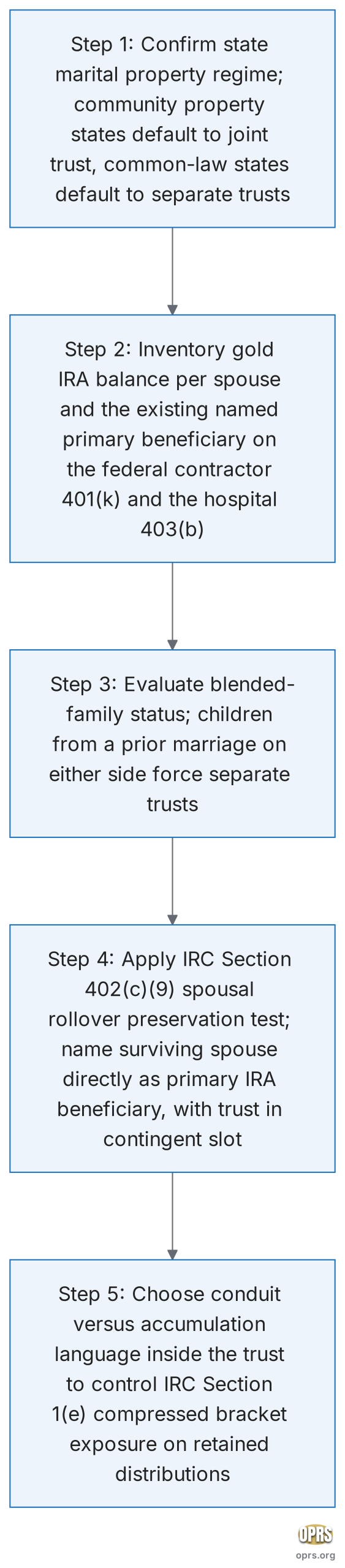
The choice between a joint revocable trust and separate revocable trusts as IRA beneficiary is a five-step decision sequence. It pulls in the couple’s state of residence, the IRA balance per spouse, the blended-family status, and the trust income tax brackets. The Mermaid flowchart below documents the canonical sequence for a dual-income couple in their late 50s and early 60s.
Five steps to set the trust structure before signing the beneficiary form
Step 1. Confirm the state of residence and the state’s marital property regime. A couple residing in a community property state (CA, TX, AZ, ID, LA, NV, NM, WA, WI) starts with the joint trust as the structural default. State law already characterizes earned and acquired marital assets as community. A couple residing in a common-law state starts with separate trusts. The check is a single question for the estate attorney, not a billable analysis.
Step 2. Inventory the gold IRA balance per spouse and the named primary beneficiary on each account. Pull the existing beneficiary designation forms from the federal contractor 401(k) plan administrator and the hospital 403(b) plan administrator. The current named primary beneficiary controls the first death event regardless of what the trust instrument later says. A joint trust drafted in 2020 does not retroactively redirect an IRA that names the spouse personally as primary beneficiary.
Step 3. Evaluate the blended-family status. Each spouse with children from a prior marriage who should inherit a fixed dollar amount or percentage of that spouse’s gold IRA must use a separate trust.
A joint trust can be drafted to accomplish blended-family allocation through sub-trusts, but the drafting complexity multiplies and the see-through test under Treasury Regulation Section 1.401(a)(9)-4 becomes more fragile. The dealer screen applies to whichever structure the couple ends up with: the custodian’s ability to record the trust as beneficiary survives the drafting decision.
Step 4. Apply the IRC Section 402(c)(9) spousal rollover preservation test. The cleanest preservation of the spousal rollover at first death is to name the surviving spouse directly as the primary IRA beneficiary, not the trust.
Separate trusts can sit in the contingent slot to catch the IRA balance if both spouses die in a common accident or in rapid succession. A joint trust as primary IRA beneficiary forces the surviving spouse to rely on private letter ruling precedent to perform the spousal rollover and adds litigation risk.
Step 5. Choose conduit vs accumulation language inside whichever trust ends up as the IRA beneficiary. A conduit trust passes the IRA distributions through to the beneficiaries each year and avoids the compressed trust brackets at IRC Section 1(e). An accumulation trust retains the distributions inside the trust corpus, gains creditor protection on the retained balance, and pays the trust’s own income tax. The decision is not joint-versus-separate; it is conduit-versus-accumulation, and the drafting controls the outcome.
Verdict per household profile
Profile A: federal contractor 62, hospital RN 58, $1.2M combined, Virginia residents, no prior marriage on either side. Separate revocable trusts. Each spouse names the other as the primary IRA beneficiary on the federal contractor 401(k) and the hospital 403(b), with the spouse’s own separate trust as the contingent. The IRC Section 402(c)(9) spousal rollover is preserved on first death. Federal estate tax exemption is not the binding constraint. The trusts hold the IRA at second death.
Profile B: federal contractor 60, hospital RN 56, $1.5M combined, California residents, no prior marriage. Joint revocable trust is the state-default structure, but the IRA beneficiary form names the surviving spouse directly, not the joint trust. The joint trust holds the brokerage accounts, the primary residence, and the community personal property.
The IRA passes outside the joint trust at first death, and the surviving spouse performs the IRC Section 402(c)(9) rollover. The rolled balance is then designated with the joint trust as contingent for the second death.
Profile C: federal contractor 62, hospital RN 58, $1.3M combined, one or both spouses with children from a prior marriage. Separate trusts are required here. The IRA beneficiary form on each side may name the other spouse as primary if the couple wants the surviving spouse to inherit. The spouse’s own separate trust sits as contingent, directing the residual at second death to that spouse’s children.
Alternatively, each spouse names a separate trust directly as the primary IRA beneficiary, sacrificing the spousal rollover to lock in the inheritance path to the prior-marriage children.
Profile D: federal contractor 65, hospital RN 60, $1.5M combined, both with adult children, common-law state, large life-insurance death benefit pushing the combined estate over the post-2026 sunset exemption threshold. Separate trusts with conduit IRA pass-through language.
The federal estate tax exemption sunset in 2026 puts the combined estate within reach of the federal estate tax threshold, and the credit shelter funding at first death is cleaner under separate trusts. The conduit pass-through on the IRA inside the trust shifts the income tax to the adult-child beneficiaries’ marginal brackets rather than the compressed trust brackets.
When the default structure is wrong
The community-property default for a joint trust flips when one spouse has significantly more retirement assets than the other and the goal is to protect the smaller-balance spouse from creditor exposure on the larger balance. A federal contractor 401(k) of $900,000 paired with a hospital 403(b) of $300,000 in a community property state creates a structural asymmetry.
Separate trusts allow the hospital RN’s $300,000 to be protected from the federal contractor’s potential professional liability exposure, while the joint trust commingles the two. 29 USC Section 1056 documents the ERISA anti-alienation protection on the federal contractor 401(k), but the protection drops on rollover into a self-directed gold IRA, where state law controls creditor exposure.
The common-law default for separate trusts flips when the couple is approaching the federal estate tax exemption threshold. In that case, the credit shelter mechanics are easier to draft inside a single joint trust with a clean AB split at first death.
A combined estate above $7 million (the post-sunset 2026 estimated exemption per spouse) and below $27.98 million (the current 2025 joint exemption) creates a window. The AB split inside a joint trust can capture both spouses’ exemptions without separate-trust funding gymnastics. The dealer screen applies regardless of which trust structure is chosen, since the custodian carries the trust beneficiary documentation either way.
Where Augusta sits in the dealer landscape for this scenario
Augusta Precious Metals sits on the OPRS three-dealer shortlist.
The industry-reported around $50,000 dealer minimum fits comfortably below a typical $1 to $1.5 million dual-income couple’s combined balance. The published Learn-Talk-Decide process, run by salaried non-commissioned educators, accommodates the slower-tempo planning conversation a couple coordinating a trust beneficiary structure across two retirement balances requires.
The IRA Processing Department handles the trust-beneficiary documentation with the custodian and reconciles the Form 1099-R distribution coding on inherited accounts.
Compare the 4-award stack on a company-comparison checklist
The free company-comparison checklist walks through the custodian, depository, trust-beneficiary documentation, and Form 1099-R distribution-code mechanics. A joint or separate trust IRA beneficiary structure has to coordinate all of these with two different plan administrators on first death. The checklist is the higher-intent asset for screening any single dealer against the four-marker trust-signal stack at the trust-structure decision moment.
OPRS may receive compensation when readers proceed. Editorial selection is independent. Updated July 2026.
Does naming a joint revocable trust as the primary IRA beneficiary lose the spousal rollover?
A joint trust does not automatically lose the IRC Section 402(c)(9) spousal rollover. But it interposes the trust between the deceased spouse and the surviving spouse. That structure forces reliance on private letter ruling precedent to preserve direct-rollover treatment.
The cleaner path is to name the surviving spouse directly as the primary IRA beneficiary on each plan. For a couple with a $1 to $1.5 million combined gold IRA balance, the joint or separate trust sits in the contingent slot, catching the balance if both spouses die in a common accident.
The spousal rollover at first death stays available without IRS user fees or attorney private letter ruling time.
Can a trust qualify as a see-through trust if the IRA is a self-directed gold IRA?
Yes. The four see-through tests under Treasury Regulation Section 1.401(a)(9)-4 apply equally to traditional cash IRAs and self-directed gold IRAs holding IRS-approved bullion.
The custodian’s role is to record the trust as the beneficiary on the account. It must also accept a copy of the trust instrument or trustee certification by October 31 of the calendar year after the grantor’s death. Then it applies the SECURE Act 10-year rule or the eligible designated beneficiary life expectancy rule to the inherited account.
A custodian that cannot code a trust beneficiary on a self-directed account is the operational disqualifier, not the trust drafting.
Does the SECURE Act 10-year rule apply if the trust beneficiary is the surviving spouse?
The surviving spouse is an eligible designated beneficiary under IRC Section 401(a)(9)(E)(ii)(I) and retains the life expectancy distribution method, regardless of whether the spouse inherits directly or through a see-through trust.
The 10-year rule attaches under IRC Section 401(a)(9)(H) at the second death, when the surviving spouse dies and the remaining trust beneficiaries are non-eligible designated beneficiaries (typically adult children). The 10-year clock starts on December 31 of the calendar year after the surviving spouse’s death, not the first death.
How does the federal estate tax exemption sunset in 2026 affect the trust choice?
The IRC Section 2010(c)(3) federal estate tax exemption is scheduled to revert from approximately $13.99 million per individual in 2025 to roughly half that amount on January 1, 2026, absent congressional action.
A couple with a combined estate of $7 million or more should run the AB-trust credit shelter math under both the current and the post-sunset exemption. That analysis determines whether a joint trust with an AB split or separate trusts with credit shelter language is the cleaner funding vehicle.
A $1 to $1.5 million combined retirement balance with no significant non-retirement estate stays well below either exemption. Here the structural decision is driven by the IRC Section 402(c)(9) spousal rollover and the IRC Section 1(e) trust bracket compression, not the federal estate tax.
Sources cited
- IRC Section 401(a)(9), Required Distributions
- IRC Section 401(a)(9)(H), SECURE Act 10-Year Rule for Designated Beneficiaries
- IRC Section 401(a)(9)(E), Eligible Designated Beneficiary Definition
- IRC Section 402(c)(9), Rollover Where Spouse Receives Distribution After Death of Employee
- Treasury Regulation Section 1.401(a)(9)-4, Determination of the Designated Beneficiary
- IRC Section 1(e), Tax Imposed on Estates and Trusts (Compressed Brackets)
- IRC Section 1(j), Rate Schedules for Married Individuals Filing Jointly
- IRC Section 651, Deduction for Trusts Distributing Current Income Only (Simple Trusts)
- IRC Section 661, Deduction for Estates and Trusts Accumulating Income (Complex Trusts)
- IRC Section 1014, Basis of Property Acquired from a Decedent (Step-Up in Basis)
- IRC Section 1411, Net Investment Income Tax
- IRC Section 2010(c)(3), Federal Estate Tax Applicable Exclusion Amount
- IRC Section 2010(c)(5), Portability of Deceased Spousal Unused Exclusion (DSUE)
- 29 USC Section 1056, ERISA Anti-Alienation of Pension Plan Benefits
- IRS, Required Minimum Distributions for IRAs and Retirement Plans
- IRS, Retirement Plans FAQs Regarding Required Minimum Distributions
- IRS, About Form 706 (United States Estate (and Generation-Skipping Transfer) Tax Return)
- IRS, About Form 1041 (U.S. Income Tax Return for Estates and Trusts)
More on OPRS
- Trust as beneficiary of gold IRA for grandchildren for the see-through trust drafting framework when grandchildren are the contingent beneficiaries.
- Federal contractor 401(k) vs spouse 403(b) rollover order for the sequencing question on the underlying balances before the trust beneficiary form is signed.
- Generation-skipping trust gold IRA mechanics for the GST allocation rules when grandchildren are downstream beneficiaries of either trust structure.