

Updated: July 28, 2026
OPRS may receive compensation when readers open an account through partner links on this page. Our analysis is based on independent research, BBB data, and IRS publications.
30-second verdict
- A non-governmental 457(b) plan generally cannot be rolled into an IRA, a Roth IRA, or a self-directed gold IRA under IRC Section 457(e)(16). The rollover clause applies to governmental 457(b) plans only.
- Plan assets remain the employer’s property under IRC Section 457(b)(6) until distributed. The participant holds an unsecured promise to pay and is exposed to employer creditors during the deferral period.
- At separation, the only structural transfer allowed is to another non-governmental 457(b) of a different tax-exempt employer, and that pathway is rare in practice.
- Distributions follow the plan’s fixed schedule, are taxed as ordinary income, and cannot be redirected to an IRA custodian by the participant’s own action.
- If you also hold a separate eligible plan (traditional IRA, 401(k), 403(b), or governmental 457(b)), that balance can fund a gold IRA on its own terms. Screen the dealer before any custodian conversation.
Non-governmental 457(b) plans are frequently confused with their governmental counterpart. The confusion is expensive when a retired executive of a hospital, university, or 501(c) association assumes that a rollover to a self-directed gold IRA is available at separation. It is not. This guide walks through the statutory rule, the two narrow transfer paths that do exist, and the three practical alternatives at separation.
The stakes are structural, not administrative. A misread of the plan type can trigger a taxable event, a plan disqualification, or a distribution schedule the retiree did not choose. Read the OPRS dealer screen before any rollover paperwork because a thin dealer will not catch a non-governmental 457(b) misclassification at intake and the error surfaces only after the wire has cleared.
Confirm the plan type before any rollover conversation
The non-governmental 457(b) rollover restriction is a hard IRS rule, not a plan-by-plan setting. Screening the dealer first protects you from an operator that would accept a wire it cannot legally rollover on the IRS side.
3 of 27+ gold IRA dealers reviewed by OPRS make the 2026 trusted list. Updated July 2026.
What a non-governmental 457(b) actually is
A non-governmental 457(b) is a deferred-compensation plan sponsored by a tax-exempt employer under IRC Section 457(b). Eligible sponsors include hospitals, universities, charities, and other 501(c) organizations that are not state or local government units. Because the sponsor is tax-exempt but not governmental, these plans are also called top-hat plans or tax-exempt 457(b) plans in practice.
The plan can only cover a select group of management or highly compensated employees. That eligibility rule comes from ERISA Section 401(a)(1) and is what keeps a non-governmental 457(b) unfunded and outside the standard ERISA trust requirements. The narrow-participation design is what triggers the creditor-exposure feature discussed below. IRS guidance on non-governmental 457(b) plans summarizes the framework.
The plan lets the participant defer current compensation into an account, with earnings credited over the deferral period. Contribution limits for the plan mirror the standard 457(b) limits under IRC Section 457(b)(2), and the special final-three-years pre-retirement catch-up under IRC Section 457(b)(3) is available on the same terms as the governmental variant.
Why the rollover to a gold IRA is generally not available
The rollover restriction is codified at IRC Section 457(e)(16). The statute allows a rollover from an eligible deferred compensation plan only if the plan is established and maintained by an employer described in Section 457(e)(1)(A). That subsection lists state and local governments as the qualifying employers.
Non-governmental 457(b) plans, sponsored by tax-exempt employers described in Section 457(e)(1)(B), are outside that carve-out. The list of eligible retirement plans that can receive a rollover under IRC Section 402(c)(8)(B) defines what an IRA custodian is legally allowed to accept. A non-governmental 457(b) balance is not on that list.
The practical consequence is that no IRS-approved gold IRA custodian can accept a direct trustee-to-trustee transfer from a non-governmental 457(b). The participant cannot execute the rollover on their own either. A distribution paid to the participant becomes ordinary taxable income at the moment of the plan-scheduled payout, and the funds land in a taxable brokerage or bank account after tax.
After that taxable distribution, the after-tax proceeds can be invested in any asset, including physical bullion held outside an IRA. That is not a gold IRA. It is a taxable bullion purchase, which forfeits the IRA tax-deferred wrapper permanently for that balance.
The creditor-exposure feature under Section 457(b)(6)
Deferred amounts in a non-governmental 457(b) must remain the employer’s property under IRC Section 457(b)(6). The plan cannot fund a trust that separates plan assets from the employer’s general assets. If the employer files for bankruptcy or faces a general creditor claim, the deferred balances are unsecured claims of the participant.
This is the structural feature that most sharply distinguishes a non-governmental 457(b) from a governmental 457(b), and from a 401(k) or 403(b). A governmental 457(b) is held in trust for the exclusive benefit of participants under IRC Section 457(g). A 401(k) is protected by ERISA fiduciary and trust rules. A non-governmental 457(b) has neither protection.
Some employers hold plan assets in a rabbi trust to manage the accounting and reduce day-to-day risk. A rabbi trust does not defeat the creditor claim. Bankruptcy of the employer collapses the rabbi trust into the general estate. Understanding this feature is a precondition to any rollover conversation because it explains why the IRS built the statute to keep the balance inside the sponsoring employer’s plan.
The two narrow transfer paths that do exist
Under IRC Section 457(e)(10) and the underlying Treasury Regulation 1.457-10(b), a non-governmental 457(b) balance can be transferred to another non-governmental 457(b) plan maintained by a different tax-exempt employer. Both plans must permit the transfer, the participant must be an employee of the receiving employer, and the transfer must be trustee-to-trustee.
This is not a rollover to a gold IRA. It is a plan-to-plan transfer between two tax-exempt-employer plans. The transferred balance stays exposed to the receiving employer’s general creditors under Section 457(b)(6) at the new plan level. The participant does not gain IRA-side flexibility, IRA-side beneficiary rules, or IRA-side self-directed investment options.
The second narrow path applies only to a limited plan-termination event. If the sponsoring tax-exempt employer terminates its 457(b) plan, Treasury Regulation 1.457-10(a) requires distribution of the balance to participants within a set period. Those distributions are ordinary taxable income and cannot be rolled to an IRA under Section 457(e)(16).
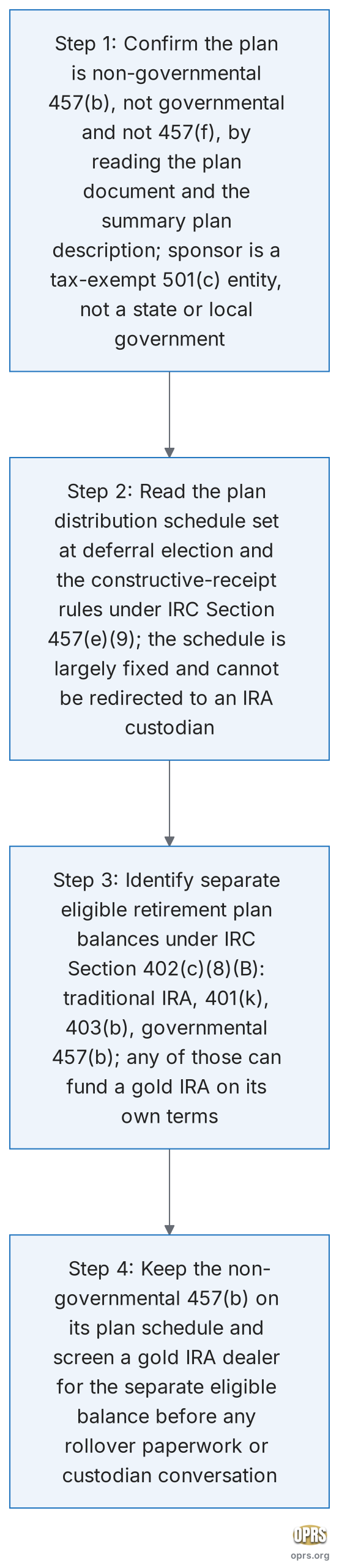
Four-step decision procedure at separation from service
The procedure below applies to any executive-level retiree separating from a tax-exempt employer with a non-governmental 457(b) balance. Steps 1 and 2 confirm the plan type. Step 3 identifies whether any of your other retirement balances is eligible for a gold IRA rollover. Step 4 sets the sequence to avoid the taxable-distribution trap.
Can you roll your account into a precious metals IRA? Eligibility checker
Most retirement money can move into a precious metals IRA once it qualifies as an eligible rollover distribution. Pick your account type and situation for a general answer. Always confirm specifics with your plan administrator or custodian.
General guidance only, not tax or financial advice. Eligibility depends on your specific plan document and IRS rules; confirm with your plan administrator and a tax advisor. A direct trustee-to-trustee transfer avoids the 60-day rule and 20% mandatory withholding.
The right dealer explains every fee up front. Get Augusta's free precious metals IRA company checklist.
Step 1. Confirm the plan is non-governmental 457(b), not governmental and not 457(f). The summary plan description names the sponsoring employer. A hospital, university, foundation, or 501(c) association points to non-governmental. A state, county, or municipality points to governmental. A 457(f) plan is a different vehicle with a substantial-risk-of-forfeiture feature; check the plan document for a vesting cliff.
Step 2. Read the plan distribution schedule and the constructive-receipt rules under IRC Section 457(e)(9). Non-governmental 457(b) distributions must follow a fixed schedule chosen at election. Any attempt to accelerate or defer the distribution outside the plan document can trigger the constructive-receipt doctrine and pull the balance into current taxable income.
Step 3. Identify separate eligible retirement plan balances. If you also hold a traditional IRA, a 401(k), a 403(b), or a governmental 457(b), any of those is on the Section 402(c)(8)(B) list and can fund a gold IRA on its own terms. The non-governmental 457(b) balance stays on its plan schedule. The other balance is the piece that a gold IRA custodian can legally accept.
Step 4. Keep the non-governmental 457(b) on schedule and screen the dealer for the separate eligible balance. The dealer screen is the operative step before any custodian conversation. Confirm the trust markers, the custodian pairing, and the distribution-code capability on the eligible balance you can legally roll. Compare against the OPRS trusted list before any wire.
Rollover eligibility side by side
The table compares rollover eligibility across the four plan types most commonly held by a separated executive at a tax-exempt employer. The rollover-to-gold-IRA column reflects the statutory rule under Section 402(c)(8)(B). The creditor-exposure column reflects the plan-asset ownership rule.
| Plan type | Rollover to gold IRA at separation | Creditor exposure during deferral | Post-separation penalty rule |
|---|---|---|---|
| Non-governmental 457(b) | Not allowed under IRC Section 457(e)(16) | Exposed to sponsor’s general creditors under Section 457(b)(6) | 10% penalty of Section 72(t) does not apply; distributions follow plan schedule |
| Governmental 457(b) | Allowed under IRC Section 457(e)(16) | Protected in trust under Section 457(g) | 10% penalty does not apply on post-separation withdrawals |
| 401(k) | Allowed under IRC Section 402(c)(8)(B) | Protected by ERISA trust rules | 10% penalty applies before age 59.5 unless a Section 72(t) exception fits |
| Traditional IRA | Allowed as trustee-to-trustee transfer | Protected under BAPCPA Section 522(n) up to indexed cap | 10% penalty applies before age 59.5 unless a Section 72(t) exception fits |
| 403(b) | Allowed under IRC Section 402(c)(8)(B) | Protected in custodial account or annuity contract | 10% penalty applies before age 59.5 unless a Section 72(t) exception fits |
The critical row is the first one. The non-governmental 457(b) is the only plan on the list where the rollover to a gold IRA is barred by statute rather than by penalty, and where the balance is exposed to employer creditors during the deferral years.
Three practical alternatives at separation
Alternative 1. Take distributions on the plan schedule and invest after-tax proceeds in physical bullion outside an IRA. This is a taxable bullion purchase, not a gold IRA. The balance permanently loses the tax-deferred wrapper. The buyer holds the physical asset directly and pays capital gains at the collectible rate under IRC Section 408(m) when sold. This is often the only workable path if the participant wants precious metals exposure from this specific balance.
Alternative 2. Roll a separate eligible retirement plan into the gold IRA. A traditional IRA, a 401(k), a 403(b), or a governmental 457(b) held at a prior employer sits on the Section 402(c)(8)(B) rollover list. That balance can fund a self-directed gold IRA on its own terms. The non-governmental 457(b) stays on the plan schedule. If you also hold a governmental 457(b), the governmental 457(b) rollover vs keep guide walks through the keep-versus-roll math.
Alternative 3. Transfer to another non-governmental 457(b) at a new tax-exempt employer. Under Section 457(e)(10) and Treasury Regulation 1.457-10(b), a plan-to-plan trustee-to-trustee transfer is permitted between non-governmental 457(b) plans, subject to both plans permitting it and the participant being an employee of the receiving employer. This preserves tax deferral but keeps the balance under the creditor-exposure rule.
What to do if you are still in service
The election window is the leverage point. The plan document requires the participant to choose the distribution schedule at the time of deferral election, usually with a re-election window that closes at a set point under Section 457(e)(9). A participant who anticipates wanting bullion exposure at retirement can shape the election to align distributions with a taxable bullion purchase timeline.
Reading the plan document at the deferral-election stage is what makes this leverage real. A retiree who first encounters the distribution schedule at separation, and only then reads it, has lost the shaping opportunity. The plan schedule is largely fixed at that point.
The other in-service consideration is contribution allocation. If you have room in a separate governmental 457(b), a 401(k), a 403(b), or an IRA at a related-services role, contributions to those plans preserve the rollover-to-gold-IRA option for those balances at retirement. The 457(b) vs 403(b) vs 401(k) comparison covers the contribution-and-rollover interaction.
Common misreads and how to avoid them
Misread 1. “Any 457(b) can roll to an IRA.” False. The rollover clause under Section 457(e)(16) applies only to governmental 457(b). A tax-exempt-employer 457(b) sits outside that clause. Confirm the sponsoring-employer type before any custodian conversation.
Misread 2. “The rabbi trust protects the balance from creditors.” False. A rabbi trust is a bookkeeping vehicle. The trust assets collapse into the employer’s estate in bankruptcy. The participant remains an unsecured creditor for the deferred balance.
Misread 3. “I can take the distribution, then contribute the after-tax proceeds to a gold IRA.” Partially false. The contribution to an IRA is capped at the annual limit under IRC Section 408(a). A six-figure distribution cannot be recontributed. Only the current-year IRA contribution limit can move into a gold IRA on that path.
Misread 4. “The dealer will figure out the rollover mechanics.” A thin dealer will not catch the plan-type distinction at intake. The intake form typically records “457(b)” without the governmental-versus-non-governmental split. The custodian on the receiving side has no visibility into the sponsoring-employer classification. Screen for a dealer that reads the plan document itself before any custody transfer.
How this connects to the broader retirement plan
A non-governmental 457(b) is one leg of a multi-leg retirement plan for most executives at tax-exempt employers. The plan is designed for high-earner deferral of current compensation, not for post-retirement flexibility. A retiree who understands the leg as a bridge-year income stream, rather than as an asset to reallocate, avoids the mismatch that drives the rollover misread.
Any real gold IRA allocation should come from a Section 402(c)(8)(B)-eligible balance. The full rollover mechanics guide walks through the direct trustee-to-trustee transfer, the 60-day rule, and the mandatory 20 percent withholding trap on indirect rollovers under IRC Section 3405(c). Those mechanics apply to the eligible balance, not to the non-governmental 457(b).
Where Augusta sits when a separate eligible balance is on the table
Augusta Precious Metals sits on the OPRS three-dealer shortlist. The four trust-signal markers OPRS verifies on a public-only basis are the following. Money Magazine Best Overall Gold IRA Company (2022 to 2026). Investopedia Most Transparent Gold IRA Company (2022 to 2026). BBB A+ Rating with Zero Complaints, accredited since 2014. 4,000-plus 5-star ratings aggregated across Trustpilot, Google, and Consumer Affairs.
None of these markers changes the non-governmental 457(b) rollover rule. The rule is statutory and applies to any dealer on the market.
Where Augusta enters the picture is on a separate eligible balance: a traditional IRA, a 401(k), a 403(b), or a governmental 457(b) held at a prior employer. On that balance, the published Learn-Talk-Decide process, run by salaried, non-commissioned educators, is set up to walk through the plan-type distinction, the rollover mechanics, and the custodian-and-depository pairing. The dealer minimum is industry-reported around $50,000, which suits a mid-six-figure separate balance.
Screen the dealer with the 4-award company checklist
The free company checklist walks through the custodian, depository, distribution-code, and plan-type verification mechanics that a rollover has to coordinate with the plan administrator. It is the higher-intent asset for screening any single dealer against the four-marker trust-signal stack when a separate eligible balance is on the table.
Affiliate link. Applies to a separate eligible balance only. The non-governmental 457(b) balance itself cannot fund a gold IRA under IRC Section 457(e)(16).
Frequently asked questions
Can a non-governmental 457(b) ever be rolled into a Roth IRA?
No. Section 457(e)(16) limits the rollover clause to governmental 457(b) plans. The Roth conversion rules under IRC Section 408A require an eligible retirement plan source. A non-governmental 457(b) is not on that source list, so a direct Roth conversion is not available.
Does the 10 percent early-distribution penalty apply to a non-governmental 457(b)?
No. Distributions from any 457(b), governmental or non-governmental, are not subject to the 10 percent early-distribution penalty of IRC Section 72(t). Distributions are, however, taxed as ordinary income when received per the plan schedule.
Can I roll a non-governmental 457(b) into a 401(k) or a 403(b)?
No. The rollover restriction under Section 457(e)(16) applies to any Section 402(c)(8)(B) eligible retirement plan, which includes 401(k) and 403(b) plans. The only transfer permitted is to another non-governmental 457(b) under Section 457(e)(10).
What happens if my employer terminates the non-governmental 457(b) plan?
Treasury Regulation 1.457-10(a) requires distribution of plan balances to participants within a set period after termination. Those distributions are ordinary taxable income and cannot be rolled to an IRA under Section 457(e)(16). Plan the tax year of the anticipated termination distribution against other income sources.
Does state income tax follow the same rule?
Most states conform to the federal treatment of 457(b) distributions as ordinary income at receipt. The federal source rule under 4 U.S.C. Section 114 blocks a former-state claim on retirement income once the participant has established residency in a new state. Confirm state-specific treatment with your plan administrator and a tax adviser.
Sources cited
- 26 U.S. Code Section 457, Deferred compensation plans of State and local governments and tax-exempt organizations
- 26 U.S. Code Section 457(e)(16), Rollover amounts (governmental plans only)
- 26 U.S. Code Section 457(b)(6), Plan assets remain property of the employer
- 26 U.S. Code Section 457(e)(10), Transfers between eligible plans
- 26 U.S. Code Section 457(e)(9), Distribution election rules
- 26 U.S. Code Section 402(c)(8)(B), Eligible retirement plan definition for rollovers
- 26 U.S. Code Section 408(m), Investment in collectibles inside an IRA
- 26 U.S. Code Section 408A, Roth IRAs
- 26 U.S. Code Section 72(t), 10 percent additional tax on early distributions
- 26 U.S. Code Section 3405(c), 20 percent mandatory withholding on eligible rollover distributions
- 4 U.S. Code Section 114, Limitation on state income taxation of pension income
- IRS, Non-Governmental 457(b) Deferred Compensation Plans