

Updated: August 9, 2026
OPRS may receive compensation when readers open an account through partner links on this page. Our analysis is based on independent research, BBB data, and IRS publications.
Precious metals IRA early-withdrawal penalty estimator
Taking money out of a precious metals IRA before age 59 and a half triggers a 10% federal additional tax on top of ordinary income tax. State add-on taxes vary; check your state. The federal penalty is estimated below.
Estimate only, not tax advice. The 10% federal additional tax applies to early distributions before age 59 and a half; specific exceptions exist. Your state may add its own tax, and ordinary income tax applies separately. Source: IRS Publication 590-B. Consult a tax advisor.
An Ohio resident who funds a self-directed gold IRA from a 401(k) rollover, then later takes a distribution, faces two tax layers behind the same Form 1099-R. The federal layer runs first. Ohio picks up the taxable portion from federal adjusted gross income and applies its own bracket schedule, credits, and carve-outs.
The state layer is narrower than most residents assume. Ohio does not tax any distribution that federal law already excludes. A qualified Roth distribution runs tax-free at both levels. A traditional gold IRA distribution is fully taxable in Ohio, but the retirement income credit under Ohio Revised Code 5747.055 and the age-65 senior citizen credit reduce the bill for most retirees.
This page maps the 2026 Ohio treatment for each account event: distributions, Roth conversions, storage-side sales tax, and estate transfers. For the narrower Roth-only question, see does Ohio tax Roth IRA distributions for the qualified versus non-qualified breakdown.
How Ohio starts from federal AGI
Ohio Form IT-1040 line 1 begins with federal adjusted gross income. The Schedule of Adjustments then adds a few items (business-income deduction addbacks, certain interest) and subtracts others (Social Security, military retirement, some pension conversions). The output is Ohio taxable nonbusiness income, which the bracket schedule taxes at the graduated rate.
The taxable portion of a traditional gold IRA distribution reaches federal AGI under the federal exclusion ratio in 26 U.S. Code 408 and IRS Publication 590-B. Ohio picks it up from there without a separate addback. There is no Ohio-side basis worksheet for a gold IRA distribution beyond what Form 8606 resolved at the federal level.
The Ohio Department of Taxation publishes the current bracket schedule and instructions at the Individual income tax landing page. Bracket thresholds and top rates are the two variables an Ohio retiree should re-check each January before running a distribution plan for the year.
The 2026 Ohio graduated bracket schedule
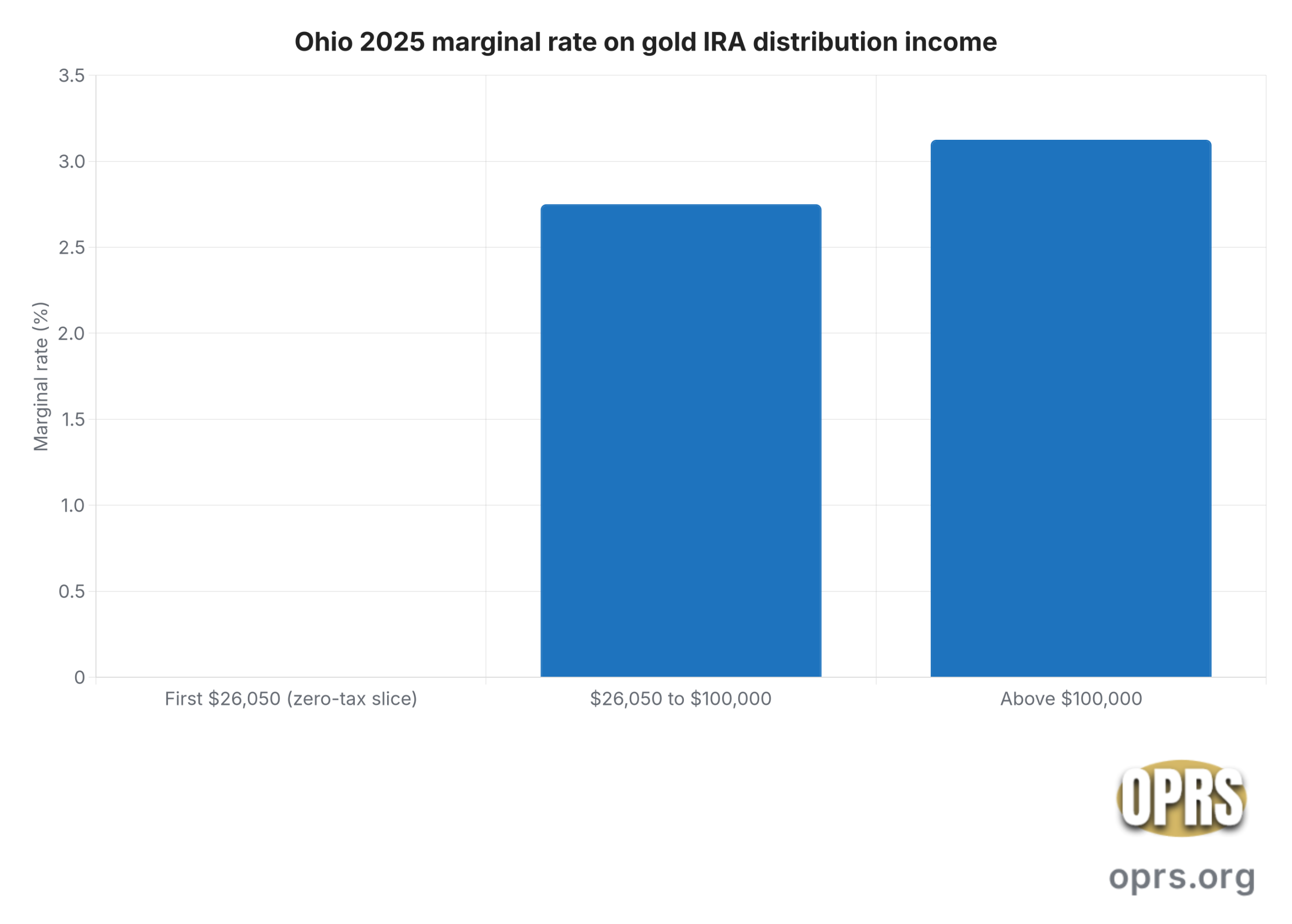
Ohio taxes nonbusiness income at a graduated schedule that has flattened materially under House Bill 33 of the 135th General Assembly. The tax year 2024 top rate stood at 3.50 percent. The tax year 2025 schedule stepped the top rate to 3.125 percent. Ohio residents should read the current-year schedule at the source before planning a distribution.
The tax year 2025 schedule applies zero percent on the first $26,050 of Ohio taxable nonbusiness income. The next slice, from $26,050 through $100,000, is taxed at 2.75 percent. Ohio taxable nonbusiness income above $100,000 is taxed at 3.125 percent. The bracket edges index for inflation each year.
A retired Ohio couple filing jointly with $80,000 of federal AGI (including a $30,000 traditional gold IRA distribution) sits inside the 2.75 percent bracket. The Ohio tax before credits runs roughly $1,483 on the $53,950 of taxable income above the zero-tax slice. The retirement income credit and (at age 65) the senior citizen credit reduce that bill.
Ohio applies the same schedule to a Roth conversion. The converted amount from a pre-tax gold IRA to a Roth IRA is fully taxable at the participant’s Ohio marginal rate on the taxable portion that reached federal AGI in the conversion year.
The retirement income credit under ORC 5747.055
Ohio Revised Code 5747.055 authorizes a nonrefundable retirement income credit against Ohio individual income tax. The credit is scaled by the amount of retirement income included in Ohio adjusted gross income and reported on the IT-1040 Schedule of Credits. The maximum credit per return is $200.
Retirement income for the credit computation includes distributions from a traditional IRA, a 401(k), a 403(b), a 457(b) governmental plan, a self-directed gold IRA, and the taxable earnings portion of a non-qualified Roth distribution. Social Security is already subtracted upstream and does not enter the credit base.
The credit schedule prints in the IT-1040 instructions booklet each January. A distribution below $500 of retirement income produces no credit. The step schedule climbs through five tiers to the $200 ceiling when qualifying retirement income exceeds roughly $8,000 in a year. The IRS publications at Publication 590-A and Publication 590-B control the federal source classification that feeds the Ohio credit base.
The credit is per return, not per spouse. A joint return with two retirees pulling separate IRA distributions still caps at $200. Households modeling a large Roth conversion should not expect the credit to scale with the extra income; the ceiling binds first.
The senior citizen credit at age 65 under ORC 5747.05
Ohio Revised Code 5747.05(C) adds a $50 lump-sum senior citizen credit for any taxpayer age 65 or older during the tax year. The credit is claimed on the same Schedule of Credits as the retirement income credit and stacks against the same Ohio tax liability.
A joint return with both spouses age 65 or older claims one $50 senior credit per taxpayer, for a combined $100. The credit is available in the year the taxpayer first turns 65 and every year after. The credit is nonrefundable; unused amounts do not carry forward.
Together, the two credits cap the Ohio-side reduction at $250 per taxpayer on a joint return (age 65 or older) with sufficient retirement income to hit the retirement income credit ceiling. The Ohio marginal rate then runs against the remaining taxable base with no further source-based offset.
Roth conversions are fully taxable at the Ohio marginal rate
A Roth conversion from a pre-tax traditional gold IRA to a Roth IRA is federally taxable on the entire converted balance minus any prior nondeductible basis. The taxable portion enters federal AGI in the conversion year and flows through to Ohio taxable income at the graduated schedule.
Ohio does not treat a Roth conversion any differently from an ordinary distribution at the state level. There is no Ohio-side spread, no separate exclusion, and no reduced state rate. The retirement income credit still applies to the conversion year, capped at $200 as usual.
An Ohio resident planning a multi-year conversion ladder should model the Ohio marginal rate alongside the federal bracket. Converting a $60,000 slice in a year the household otherwise sits in the 2.75 percent Ohio bracket adds roughly $1,650 of Ohio tax on top of the federal cost. Splitting the conversion across two lower-income years often preserves the retirement income credit each year.
Sales tax on investment bullion: the ORC 5739.02(B)(51) exemption
Ohio exempts investment metal bullion and investment coins from state and local sales and use tax under Ohio Revised Code 5739.02(B)(51). The exemption reinstated in 2021 covers gold, silver, platinum, and palladium bullion valued primarily on the metal content rather than on the coin form.
The exemption applies to physical purchases delivered to Ohio addresses. It applies to gold IRA purchases where the IRA custodian directs the dealer to ship IRS-approved bullion to an approved depository. Ohio does not charge sales tax on the transaction because the good qualifies as investment bullion, not collectible personalty.
The exemption is not universal at the retail level. Coins sold primarily on the numismatic premium (rare coins, graded collectibles) fall outside the definition of investment coin and are taxable at the state and local combined rate. An Ohio dealer applies the exemption at point of sale when the buyer confirms the intended investment use.
No Ohio state estate or inheritance tax since 2013
Ohio repealed its state estate tax effective for decedents dying on or after January 1, 2013. The former Ohio Revised Code Chapter 5731 estate tax no longer applies. Ohio has no separate inheritance tax and no state generation-skipping transfer tax.
A gold IRA held by an Ohio decedent passes to the named beneficiary under the IRA custodial agreement and the federal beneficiary rules. The federal estate tax may apply if the decedent’s gross estate exceeds the federal exemption ($13.99 million per individual in tax year 2025). Ohio does not add a state layer.
A beneficiary who inherits a traditional gold IRA still owes federal income tax on distributions as they occur, under the SECURE Act ten-year rule for non-eligible designated beneficiaries. Ohio taxes the distribution at the beneficiary’s state marginal rate if the beneficiary is an Ohio resident when the distribution occurs.
Side-by-side: Ohio state tax on a $30,000 traditional gold IRA distribution
The scenario below isolates the Ohio state tax on a $30,000 traditional gold IRA distribution for a single Ohio resident with no other income and no federal adjustments. The federal tax and federal early-distribution penalty (if any) run separately.
- Ohio taxable nonbusiness income: $30,000
- Zero-tax slice (0% on first $26,050): $0
- Bracket slice from $26,050 to $30,000 at 2.75%: about $109
- Retirement income credit on qualifying retirement income above $8,000: $200
- Senior citizen credit if age 65 or older: $50
- Net Ohio state tax after credits (age 65+): about $0 (credits fully offset)
The same $30,000 distribution taken by an Ohio resident under age 65 with no other income produces a similar result: the retirement income credit alone still offsets the pre-credit tax in full. The state-side cost only becomes meaningful when the distribution pushes the household above the $100,000 taxable-income threshold into the 3.125 percent top bracket.
A household modeling a larger $150,000 traditional gold IRA distribution (single filer, no other income) faces roughly $2,000 to $2,100 of Ohio state tax after credits. The federal tax cost on the same distribution runs several multiples higher.
Where the Ohio framing breaks down
The Ohio state-tax framing is wrong when the participant is a nonresident of Ohio at distribution but the IRA custodian withholds Ohio state tax anyway. The custodian usually withholds because the address of record was never updated after the participant moved. The custodian’s over-withholding does not change the underlying state-tax liability.
The nonresident participant recovers the over-withholding by filing Ohio Form IT-1040 for the year and claiming the refund. The federal Pension Source Tax Act of 1996 (4 U.S.C. 114) prohibits a former state of residence from taxing retirement income once the participant establishes domicile elsewhere.
The framing is also wrong when the participant assumes Roth distributions are always Ohio tax-free. A qualified Roth distribution is federally tax-free and therefore Ohio tax-free. A non-qualified Roth distribution triggers federal tax on the earnings portion under 26 U.S. Code 408 ordering rules, and that taxable slice flows through to Ohio taxable income.
The framing breaks when the participant relies on the retirement income credit to offset a Roth conversion at Ohio’s marginal rate. The credit caps at $200 per return regardless of the size of the conversion. Multi-year conversion ladders preserve the credit each year; one-shot conversions leave most of the state-side liability uncovered.
Does Ohio tax gold IRA distributions the same way the federal government does?
Ohio conforms to federal adjusted gross income as the starting point on Form IT-1040. The taxable portion of a traditional gold IRA distribution that reaches federal AGI flows through to Ohio taxable income by default. Ohio then applies its own graduated schedule and the retirement income credit under ORC 5747.055.
The base is the same; the rate and the credits are Ohio-specific. The Ohio Department of Taxation at tax.ohio.gov/individual is the authoritative reference for the annual bracket schedule and the current credit table.
Does Ohio impose a state-level early-distribution penalty on a pre-59-and-a-half gold IRA withdrawal?
No. Ohio does not impose a state-level additional tax on early IRA distributions parallel to the federal 10 percent additional tax under 26 U.S. Code 72(t). The only Ohio-side cost on a pre-59-and-a-half distribution is the Ohio marginal rate on the taxable portion.
Federal exceptions that waive the 10 percent additional tax (separation at 55, substantially equal periodic payments, disability, first-home purchase, higher education) do not produce a separate Ohio-side benefit. There is no Ohio penalty to waive.
Do Ohio residents pay sales tax on physical gold purchased for a gold IRA?
No. Ohio Revised Code 5739.02(B)(51) exempts investment metal bullion and investment coins from state and local sales and use tax. The exemption covers IRA-approved gold, silver, platinum, and palladium bullion at the standard fineness thresholds under 26 U.S. Code 408(m)(3).
The IRA custodian directs the dealer to deliver approved bullion to an approved depository. The transaction qualifies as investment bullion under the ORC definition and is not subject to Ohio sales tax. Numismatic and graded collectible coins outside the investment-bullion definition remain taxable.
Sources cited
- Ohio Department of Taxation, Individual income tax landing page (bracket schedule, credit tables)
- IRS Publication 590-A: Contributions to Individual Retirement Arrangements (IRAs)
- IRS Publication 590-B: Distributions from Individual Retirement Arrangements (IRAs)
- 26 U.S. Code 408: Individual Retirement Accounts (Cornell Legal Information Institute)