

Updated: July 28, 2026
OPRS may receive compensation when readers open an account through partner links on this page. Our analysis is based on independent research, BBB data, and IRS publications.
30-second verdict
- A partial direct rollover from a 403(b) to a self-directed gold IRA is statutory under IRC Section 403(b)(8): the plan administrator can wire any portion of the vested balance to the IRA custodian, and the residual stays inside the 403(b) under the same post-separation distribution rules.
- For a single retiring teacher with $80,000 to $150,000 in the 403(b), the kept-versus-rolled split is dominated by two constraints: the industry-reported dealer minimum around $50,000, and the bridge-spending gap between retirement age and the Social Security or pension full-benefit start date.
- The indirect rollover route is a hard trap. Under IRC Section 3405(c), the plan administrator must withhold 20 percent for federal tax on any rollover paid to the participant. The withheld amount must be made whole from outside funds within 60 days for the rollover to remain non-taxable.
- The dealer choice carries the strategy. A custodian that cannot service a sub-$100,000 IRA at a defensible fee schedule, or that defaults Form 1099-R box 7 to code 1 on pre-59-and-a-half distributions, turns a partial rollover into a fee-drag problem and a Form 5329 problem at the same time.
A single retiring teacher in the 60-to-65 band facing a partial 403(b) rollover decision is not solving a strategic question first. The strategic question (keep, roll, or split) has already been decided: split. The harder question is the sizing.
At retirement age 62, a $110,000 403(b) sits at an awkward intersection of three constraints. The pension is already in pay status. Social Security is planned to start at 67. And a single-filer balance sheet has to carry the dealer-minimum floor, the bridge-spending window, and a long-life liquidity buffer without a spouse or second earner to absorb a healthcare shock.
See the dealers OPRS clears and the ones we warn against before any rollover paperwork is signed. A partial rollover that lands below the dealer’s effective minimum either fails outright or sits at the top of the percentage fee schedule.
Three statutes frame the picture. IRC Section 403(b)(8) governs direct rollover authority. IRC Section 3405(c) sets out the mandatory withholding trap. IRC Section 401(a)(9), as updated by SECURE Act 2.0, puts the first required distribution at age 73, which matters greatly for a 62-year-old retiree.
Element II is the bridge-and-floor sizing math that drives the kept-versus-rolled allocation. Element III is the four operational gates at the IRA custodian that must clear for the rolled balance to sit on a defensible fee schedule and a clean inherited-IRA chain. Element IV is the verdict per balance band and the dealer-screen step that gates the whole sequence.
Screen the dealer before the 403(b) plan administrator paperwork
Most of the decisions on a partial 403(b) rollover happen before the plan administrator’s distribution form is signed. A dealer that does not service sub-$100,000 IRAs at a defensible fee, or that defaults Form 1099-R box 7 to code 1, can turn a sound rollover plan into a cash-flow drag in year one. It can also create a tax-reclaim problem at first distribution. Screen the dealer on these two questions before the 403(b) paperwork is signed.
3 of 27+ gold IRA dealers reviewed by OPRS make the 2026 trusted list. Updated July 2026.
The statutory framework for partial 403(b) rollovers
The rollover authority sits at IRC Section 403(b)(8). Any eligible rollover distribution from a 403(b) plan can go to a traditional IRA or a Roth IRA, another 403(b), a 401(a) qualified plan, or a governmental 457(b). A Roth IRA conversion is taxed as ordinary income in the conversion year.
The partial-rollover option is structurally available: Section 403(b)(8) does not require the rollover to be all-or-nothing. The plan administrator’s distribution form generally accepts a dollar amount or a percentage of the vested balance as the rollover quantity, and the residual stays in the 403(b) under the same post-separation rules.
The withholding trap on the indirect rollover route sits at IRC Section 3405(c). Any eligible rollover distribution paid to the participant rather than to the receiving custodian must have 20 percent withheld for federal tax.
The participant has 60 days from the date of receipt to deposit the full amount (including the withheld 20 percent, made whole from outside funds) into the receiving IRA.
If the participant deposits only the net 80 percent received, the missing 20 percent is treated as a taxable distribution. For a participant under age 59 and a half without an exception, the 10 percent additional tax under IRC Section 72(t) also applies.
The direct trustee-to-trustee transfer route avoids the withholding entirely and is the standard mechanic for any planned partial rollover.
The required minimum distribution timeline sits at IRC Section 401(a)(9). The SECURE Act 2.0 raised the applicable age to 73 for participants reaching age 72 after December 31, 2022, and the applicable age rises to 75 in 2033 for participants born in 1960 or later.
The shortfall penalty under IRC Section 4974 was reduced from 50 percent to 25 percent by SECURE 2.0, with a further reduction to 10 percent if corrected within the correction window. For a 62-year-old single retiree, the first RMD year is over a decade out, which makes the partial-rollover decision a long-window planning question rather than an immediate-cash-flow question.
Why teachers in the $80k to $150k band keep more than they roll
Two floors and one ceiling drive the kept-versus-rolled allocation. The first floor is the dealer-minimum constraint: a rolled balance below the industry-reported around $50,000 either does not clear the trusted Augusta tier minimum or sits at the high end of the percentage fee schedule. That structurally degrades the diversification leg.
The second floor is the bridge-spending need. Enough has to stay inside the 403(b), or a parallel traditional IRA, to cover spending between retirement and the Social Security or pension full-benefit start date. You need that cushion to avoid selling metals at the wrong moment.
The ceiling is the long-life liquidity buffer. A single-filer balance sheet without a spouse or a second earner needs a meaningful share of the retirement balance in liquid instruments. That liquid share absorbs a healthcare or long-term-care shock.
The table below shows the kept-versus-rolled allocation for three balance bands at retirement age 62. It assumes bridge spending of $18,000 per year between retirement and full Social Security at age 67, and a long-life liquidity buffer sized to 20 percent of the starting balance.
The bridge spending number assumes a teacher’s pension covers most fixed expenses. The bridge layer is the discretionary plus healthcare-buffer slice between retirement and full Social Security claim age.
| 403(b) balance band | Bridge layer (kept, 5 yrs x $18k) | Liquidity buffer (20 pct kept) | Kept inside 403(b) | Rolled to gold IRA | Status |
|---|---|---|---|---|---|
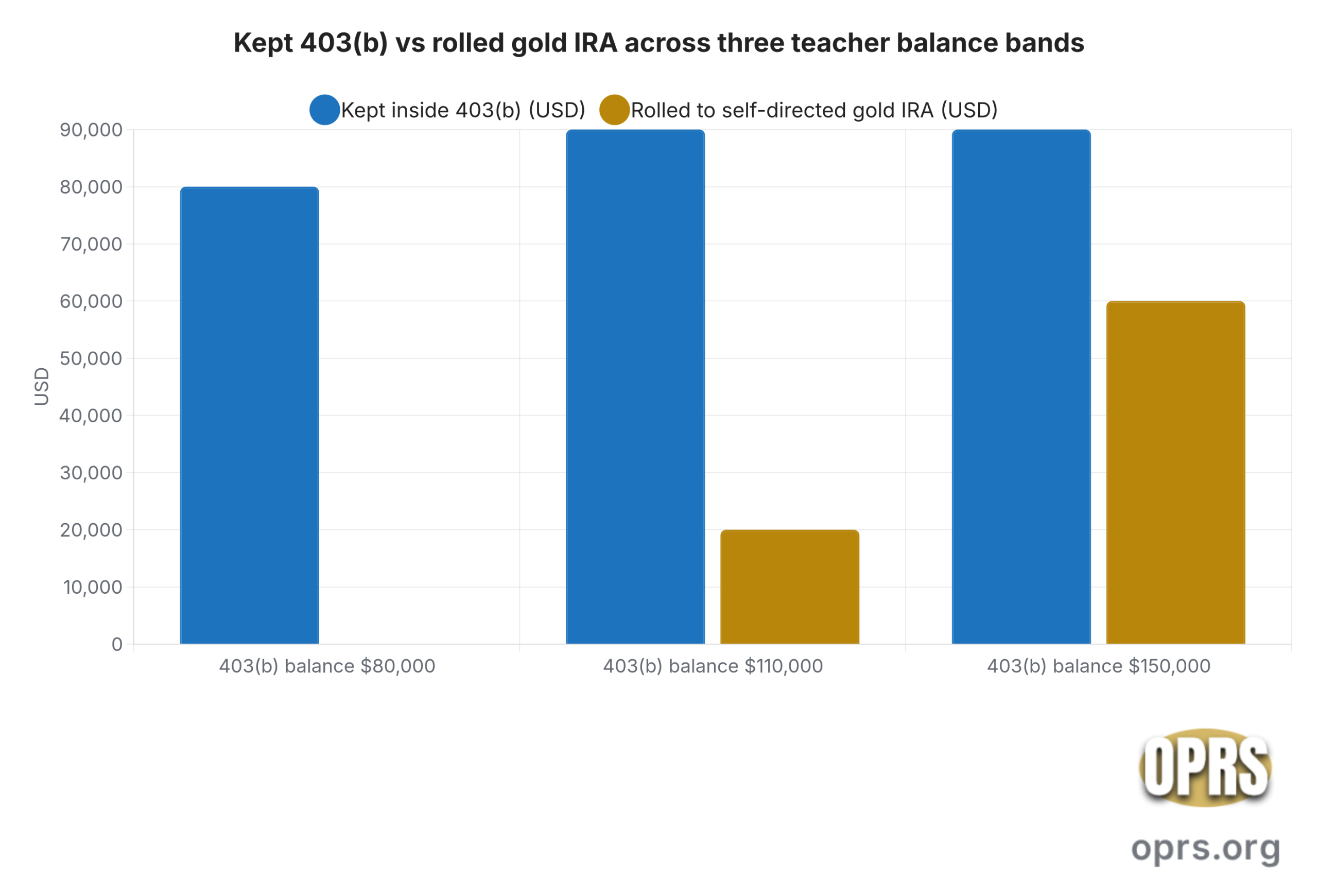
| $80,000 balance | $90,000 (capped at balance) | $16,000 | $80,000 | $0 | (No-roll: below floor) |
| $110,000 balance | $90,000 | $22,000 (in bridge) | $90,000 | $20,000 | (Sub-minimum: dealer screen mandatory) |
| $150,000 balance | $90,000 | $30,000 | $90,000 | $60,000 | (Floor-clear: roll-eligible) |
Can you roll your account into a precious metals IRA? Eligibility checker
Most retirement money can move into a precious metals IRA once it qualifies as an eligible rollover distribution. Pick your account type and situation for a general answer. Always confirm specifics with your plan administrator or custodian.
General guidance only, not tax or financial advice. Eligibility depends on your specific plan document and IRS rules; confirm with your plan administrator and a tax advisor. A direct trustee-to-trustee transfer avoids the 60-day rule and 20% mandatory withholding.
The right dealer explains every fee up front. Get Augusta's free precious metals IRA company checklist.
The $80,000 band is a no-roll outcome in most realistic scenarios. The bridge layer alone consumes the full balance once the liquidity buffer is overlaid.
The $110,000 band is the awkward middle. A $20,000 rolled balance sits below the industry-reported around $50,000 dealer minimum. The partial rollover only works if the dealer waives the minimum or accepts the smaller account on a flat fee schedule that does not eat the diversification benefit.
The $150,000 band is the clean roll-eligible profile: a $60,000 rolled balance clears the trusted-tier minimum and sits comfortably on the percentage schedule.
The chart below visualizes the kept-versus-rolled split across the three bands. The dollar values match the table above.
The four operational gates the IRA custodian must clear
A partial rollover that clears the balance-band floor still depends on the IRA custodian executing four operational gates correctly. A failure on any one gate either kills the diversification benefit or pushes the participant into an annual paperwork loop.
Gate 1: Effective minimum at or below the rolled balance. The advertised account minimum and the effective fee-schedule minimum are not always the same number.
A dealer with a $25,000 advertised minimum and a $200 per year flat custodian fee plus 1 percent storage on a $30,000 account carries roughly 1.7 percent in annual drag. That cost is real. The screen on the rolled balance band confirms the dealer accepts the account AND that the fee schedule does not exceed an annual drag the balance can absorb over the planned holding window.
Gate 2: Form 1099-R box 7 default election on pre-59-and-a-half distributions. For a participant who rolls at age 62, the early-distribution penalty regime is moot at the IRA stage because the participant is past age 59 and a half at rollover.
For a participant who rolls earlier (between separation at age 55 and age 59 and a half), the box 7 coding question matters. The custodian’s default election determines whether the early-distribution exception is auto-coded as code 2, or whether the participant has to file Form 5329, Additional Taxes on Qualified Plans to reclaim it.
Gate 3: Trustee-to-trustee transfer mechanics under IRC Section 403(b)(8). The rollover must be executed as a direct trustee-to-trustee transfer from the 403(b) plan administrator to the IRA custodian. The participant signs the plan administrator’s distribution form with the IRA custodian’s trustee identification and receiving account number.
The plan administrator wires the rollover amount directly to the IRA custodian, avoiding the 20 percent mandatory withholding under IRC Section 3405(c). The 60 day rollover clock does not run on a direct trustee-to-trustee transfer.
Gate 4: Inherited-IRA service infrastructure for a single-filer estate. A single retiree without a spouse will name siblings, nieces and nephews, a charity, or a trust as the IRA beneficiary. Under IRC Section 401(a)(9) and the SECURE Act 2.0 10-year distribution rule for non-spouse, non-eligible-designated-beneficiary inheritors, the inherited-IRA chain handles the rolled balance after the participant’s death.
A custodian without functional inherited-IRA service capacity creates a beneficiary-side problem 15 or 20 years later. The screen is a direct question to the dealer’s onboarding team about the custodian’s inherited-IRA fee schedule and the in-kind distribution mechanics.
Step-by-step procedure for the partial rollover
The procedure below is the sequence a single retiring teacher follows from the bridge-sizing decision through the trustee-to-trustee transfer and the first-statement verification at the IRA custodian.

Step 1. Confirm the 403(b) plan is rollover-eligible at separation. Most public-school 403(b) plans permit a direct rollover to an IRA at separation under IRC Section 403(b)(8). A small number of older 403(b)(7) custodial accounts and 403(b)(9) church plans have plan-document constraints that limit rollover timing or eligibility. The summary plan description identifies the rollover authority. The check is a 10-minute reading of the SPD or a single call to the plan administrator’s participant-services line.
Step 2. Calculate the kept-versus-rolled allocation using the bridge plus buffer math. Bridge years (retirement to full Social Security claim age) times annual bridge need, plus a 15 to 25 percent long-life liquidity buffer on the starting balance, equals the kept-403(b) target. The residual is the rollover candidate.
Apply the dealer-minimum floor. If the residual is below the industry-reported around $50,000 trusted-tier minimum, you have two options. Either cancel the rollover and pursue the diversification leg elsewhere, or find a dealer through the dealer screen that accepts the smaller account on a defensible flat-fee schedule.
Step 3. Screen the gold IRA dealer on the four operational gates. A direct call to the dealer’s onboarding team surfaces the answers: effective minimum at the rolled balance band, Form 1099-R box 7 default election on pre-59-and-a-half distributions, trustee-to-trustee transfer mechanics, and inherited-IRA service infrastructure. Check this dealer against the 2026 OPRS list in parallel: the OPRS dealer screen documents the trust-signal markers (BBB rating, complaint history, third-party recognition) that the dealer’s own onboarding team will not volunteer.
Step 4. Open the receiving IRA account at the chosen custodian. The receiving account must exist before the 403(b) plan administrator’s distribution form can be processed. Account opening typically requires identification, a beneficiary form (single filers list the chosen siblings, nieces and nephews, charity, or trust beneficiary), and the receiving account trustee identification that the 403(b) plan administrator’s form will reference.
Step 5. Elect direct trustee-to-trustee transfer on the 403(b) distribution form. Specify the rollover dollar amount or percentage (the residual stays in the 403(b)). Provide the IRA custodian’s trustee identification and the receiving account number. The 403(b) plan administrator wires the rollover amount directly to the IRA custodian, avoiding the 20 percent mandatory withholding under IRC Section 3405(c). The 60 day rollover clock does not run on a direct trustee-to-trustee transfer.
Step 6. Verify the receiving custodian’s first statement. The first IRA statement after the rollover should reflect the wired amount with no withholding. If the statement reflects only 80 percent of the rollover amount, the plan administrator processed the transfer as an indirect rollover by mistake. Contact the plan administrator immediately and document the trustee-to-trustee election in writing. The 60 day deadline to make the withheld 20 percent whole runs from the participant’s date of receipt of the funds.
State considerations and the long-life single-filer layer
The state-tax treatment of the kept-versus-rolled allocation generally does not change the federal mechanics, but it affects the distribution timing on both legs.
Single retirees in Tennessee, Florida, Texas, or any of the nine no-income-tax states keep the full federal benefit of the 403(b) deferral. There is no additional state tax overlay on either the kept-403(b) distributions or the rolled-IRA distributions.
A single retiree in California, Hawaii, New York, or Oregon faces a meaningful state tax on both the 403(b) draw and the rolled-IRA distribution. The kept-versus-rolled allocation does not avoid the state tax. But the timing and sizing of distributions across the two accounts can shift the state-tax exposure year by year.
The long-life single-filer balance sheet is structurally different from a married couple’s. Women living into their early 90s is a common planning assumption in the actuarial tables. The absence of a spouse means no second income, no second Social Security claim, and no second long-term-care insurance lever.
The liquidity buffer kept inside the 403(b) (or a parallel traditional IRA) carries the healthcare-shock absorption that a married couple typically distributes across two balance sheets. The rolled gold IRA is the diversification leg and the estate-vehicle leg, not the bridge-spending leg. Confusing these two roles is the most common allocation error on a single-filer partial rollover.
The beneficiary designation on both the kept-403(b) and the rolled-IRA is the second structural lever. A single retiree without children typically names siblings, nieces and nephews, a charity, or a trust as primary and contingent beneficiaries.
The SECURE Act 2.0 10-year distribution rule applies to non-spouse, non-eligible-designated-beneficiary inheritors of the IRA balance under IRC Section 401(a)(9); the same 10-year rule applies to the kept-403(b) balance for the same beneficiary class. The kept-versus-rolled allocation does not change the inherited-distribution clock, but the receiving custodian’s inherited-IRA service infrastructure changes the beneficiary experience materially.
Common mistakes on a partial 403(b) rollover
Mistake 1: Sizing the rollover by percentage rather than by floor. A 50-50 split of a $110,000 balance produces a $55,000 rolled balance, which clears the dealer-minimum floor by a thin margin. A 60-40 split produces a $44,000 rolled balance, which does not. The fix is to size the rolled balance to the floor first, not to a target percentage. The kept-403(b) balance absorbs the residual.
Mistake 2: Indirect rollover with no plan to make the 20 percent withholding whole. The participant receives 80 percent of the eligible rollover distribution and deposits 80 percent into the IRA. The missing 20 percent is treated as a taxable distribution. For a participant under 59 and a half without an exception, the 10 percent additional tax under IRC Section 72(t) compounds the error. The fix is to use the direct trustee-to-trustee transfer route in every realistic scenario.
Mistake 3: Rolling the bridge layer. A retiree who rolls the full 403(b) balance to a gold IRA loses access to the 403(b) plan’s institutional share class expense ratios and the plan administrator’s distribution infrastructure.
For the first 5 to 7 years between retirement and full Social Security, the bridge spending then has to come from the gold IRA, which means selling metals at whatever price the market offers. The fix is to keep the bridge layer inside the 403(b) and roll only the residual.
Mistake 4: Skipping the inherited-IRA service screen. A single retiree whose chosen siblings or nieces and nephews will inherit the IRA balance benefits from a custodian that can process an inherited-IRA opening, an in-kind metals distribution, and a 10-year drawdown schedule. It should do this without extraordinary fees or paperwork friction. The screen is a single question to the dealer’s onboarding team. Ask it at the rollover, not at the participant’s passing.
Mistake 5: Treating the rolled gold IRA as a liquidity instrument. The rolled balance is the diversification leg and the long-window estate vehicle. It is not the healthcare-shock buffer.
Liquidating metals on a 30 day timeline at a gold IRA custodian carries a bid-ask spread, a depository release fee, and a custodian distribution fee that the kept-403(b) balance does not impose.
The fix is to keep enough liquid balance inside the 403(b) (or a parallel taxable account) to absorb a 6 to 12 month healthcare shock without touching the rolled IRA.
Where Augusta sits in the dealer landscape for this scenario
Augusta Precious Metals sits on the OPRS three-dealer shortlist.
The dealer minimum is industry-reported around $50,000. That fits the rolled balance in the $150,000 band cleanly. For the $110,000 band, it sits at the floor when the kept-403(b) bridge math allows a larger rolled allocation.
The published Learn-Talk-Decide process, run by salaried non-commissioned educators, fits a partial-rollover conversation that brings a long-window estate question into the same room as the bridge-and-floor sizing math.
Compare the 4-award stack on a company-comparison checklist
The free company-comparison checklist walks through the custodian, depository, fee-schedule, and inherited-IRA mechanics that a partial 403(b) rollover has to coordinate with the plan administrator. The checklist is the higher-intent asset for screening any single dealer against the four-marker trust-signal stack at the kept-versus-rolled allocation moment.
OPRS may receive compensation when readers proceed. Editorial selection is independent. Updated July 2026.
Can I roll only part of a 403(b) to a gold IRA?
Yes, in most cases. IRC Section 403(b)(8) permits a direct rollover of any portion of the participant’s vested 403(b) balance to a traditional IRA, including a self-directed gold IRA. The 403(b) plan administrator’s distribution form generally accepts a dollar amount or a percentage as the rollover quantity, and the residual stays in the 403(b) under the same post-separation distribution rules.
A small number of older 403(b)(7) custodial accounts and 403(b)(9) church plans impose plan-document constraints on partial rollovers; the summary plan description identifies the constraint. IRS guidance on IRC 403(b) tax-sheltered annuity plans documents the rollover authority on the federal side.
What happens if I miss the 60 day deadline on an indirect rollover?
The undeposited amount is treated as a taxable distribution in the year of the original 403(b) payment.
For a participant under age 59 and a half without an exception, the 10 percent additional tax under IRC Section 72(t) applies on top of ordinary-income treatment.
Revenue Procedure 2020-46 provides a self-certification rescue under 11 enumerated qualifying reasons. These include a misdelivered check, a serious illness, or a death in the family. The participant files the self-certification with the receiving IRA custodian within a reasonable time after the qualifying reason ends.
The IRS has discretion to disallow the self-certification on audit. The direct trustee-to-trustee transfer route avoids the 60 day clock entirely.
Does the SECURE 2.0 catch-up contribution apply post-rollover?
Catch-up contributions under IRC Section 414(v) apply at the plan level on participant deferrals from current compensation, not on rolled balances. A separated retired teacher with no current compensation cannot make catch-up contributions to the 403(b) regardless of whether a partial rollover has occurred.
A participant still employed and contributing can use the standard age 50-plus catch-up plus the 15-years-of-service 403(b)-specific catch-up under IRC Section 402(g)(7), independent of any partial-rollover transaction on the existing balance. SECURE Act 2.0 added a separate age 60 to 63 enhanced catch-up that applies to participants still working in the 403(b).
What is the dealer minimum for an under-$100,000 balance?
The trusted-tier minimum is industry-reported around $50,000 across the OPRS three-dealer shortlist. A rolled balance below that threshold either does not qualify for the standard trusted-tier onboarding or sits at the high end of the percentage fee schedule. That structurally degrades the diversification benefit on a sub-$100,000 IRA.
Below the floor, the realistic options are three. The first is to cancel the partial rollover and pursue the diversification leg through a parallel taxable bullion account at a lower fee schedule. The second is to defer the partial rollover until the 403(b) balance grows past the floor through investment returns or additional contributions.
The third is to screen for a dealer that accepts a smaller account on a defensible flat-fee schedule. The dealers OPRS clears and the ones we warn against is the operational starting point for option three.
Should I roll the 403(b) into a Roth gold IRA instead of a traditional gold IRA?
A Roth conversion at the rollover moment is taxable in the year of conversion at the participant’s ordinary-income tax rate on the converted amount. The structural attraction is the elimination of future required minimum distributions under IRC Section 408A. That matters greatly for a long-life single retiree whose RMD obligation under SECURE 2.0 would otherwise begin at age 73.
The arithmetic depends on three factors: your current ordinary-income bracket, the projected RMD bracket starting at age 73, and your appetite to pay the conversion tax from outside funds. Paying from outside funds matters because paying from the converted balance dilutes the conversion benefit.
A Roth conversion at a $60,000 amount adds $60,000 to current-year taxable income; in a 22 percent federal bracket, the conversion tax is roughly $13,200. The conversion is generally not a one-year decision: a conversion ladder across 5 to 10 years staged below bracket-creep thresholds is the standard tax-efficient sequencing tool. Consult your tax advisor before deciding.
Sources cited
- IRC Section 403(b)(8), Rollover Distributions from a 403(b) Plan
- IRC Section 3405(c), Twenty Percent Mandatory Withholding on Eligible Rollover Distributions
- IRC Section 72(t), Additional Tax on Early Distributions
- IRC Section 401(a)(9), Required Distribution Rules
- IRC Section 414(v), Catch-Up Contributions for Participants Age 50 and Over
- IRC Section 408A, Roth IRA
- IRC Section 4974, Excise Tax on Accumulations in Qualified Retirement Plans
- IRS, About Form 5329, Additional Taxes on Qualified Plans
- IRS, IRC 403(b) Tax-Sheltered Annuity Plans
- IRS Publication 571, Tax-Sheltered Annuity Plans for Employees of Public Schools
- IRS Publication 590-A, Contributions to Individual Retirement Arrangements (Rollovers)
- IRS Revenue Procedure 2020-46, Self-Certification for Late Rollover Contributions
- IRS, Retirement Topics: Exceptions to Tax on Early Distributions
More on OPRS
- 457(b) vs 403(b) vs 401(k) rollover rules compared for the structural plan-by-plan comparison across the three employer plans.
- How to rollover a 401(k) plan to a gold IRA for the parallel procedural framework on the 401(k) side.
- The 2026 OPRS dealer screen for the trusted-tier minimum and the four-marker trust-signal stack referenced throughout the partial-rollover steps.