

Updated: July 28, 2026
OPRS may receive compensation when readers open an account through partner links on this page. Our analysis is based on independent research, BBB data, and IRS publications.
30-second verdict
- The IRC Section 72(t)(10) PSO age-50 carve-out survives a rollover from a governmental 457(b) to a traditional or self-directed gold IRA, but only if the IRA custodian codes the first qualifying pre-59-and-a-half distribution as Form 1099-R box 7 code 2 (early distribution, exception applies). A code 1 box 7 entry triggers the 10 percent additional tax at the IRS and forces a Form 5329 reclaim.
- The bridge balance kept in the 457(b) is sized to actual planned pre-59-and-a-half spending plus the HELPS Act direct-pay infrastructure under IRC Section 402(l). For a public safety officer with $20,000 to $40,000 per year of bridge spending and Medicare arriving at age 65, the bridge balance is typically $150,000 to $250,000 for a separated officer at age 52, smaller for an officer at age 57.
- The rollover itself must be direct trustee-to-trustee under IRC Section 457(d)(1)(C). An indirect rollover triggers 20 percent mandatory federal withholding under IRC Section 3405(c) and a 60 day deadline that the participant cannot extend. The withheld amount must be made whole from outside funds for the rollover to remain non-taxable.
- The dealer choice determines whether the PSO exception survives in practice. A custodian that cannot code box 7 correctly, cannot service the inherited-IRA chain, or charges a setup fee out of proportion to the bridge math turns a structurally sound partial-rollover plan into a real Form 5329 problem.
A separated public safety officer in the 50-to-58 band facing a partial-rollover decision on a governmental 457(b) is not solving a strategic question. The strategic question (keep, roll, or split) has already been answered by the bridge-spending math.
The remaining question is operational. How do you size and execute the split so the IRS Section 72(t)(10) PSO age-50 exception still applies on the rolled IRA balance when a pre-59-and-a-half distribution is taken three or six years later?
A 52-year-old retired police lieutenant with $215,000 in a state-level 457(b), a pension already in pay status, and a small S-corp drawing $15,000 per year cannot rely on the theoretical availability of the PSO exception.
The exception applies only when the IRA custodian executes the documentation correctly at distribution time. See the dealers OPRS clears and the ones we warn against before any rollover paperwork: the custodian capability to code a 72(t)(10) distribution survives or breaks the exception on the IRA side.
Element I is the statutory framework: IRC Section 72(t)(10) on the PSO age-50 carve-out, IRC Section 457(d)(1)(C) on the direct rollover authority, and IRC Section 3405(c) on the mandatory withholding trap. Element II is the bridge sizing math that drives the kept-versus-rolled allocation.
Element III is the trustee-to-trustee mechanics and the four operational gates that must clear at the IRA custodian for the PSO exception to survive. Element IV is the verdict per household profile and the dealer-screen step that gates the whole sequence.
Screen the dealer before any 457(b) rollover paperwork
The PSO age-50 exception is statutory. Whether it survives on the rolled IRA balance depends entirely on the IRA custodian’s distribution-coding capability. A custodian that defaults Form 1099-R box 7 to code 1 on every pre-59-and-a-half distribution forces the participant to file Form 5329 and claim the exception manually. Screen the dealer and the underlying custodian on the box 7 coding question before any rollover paperwork is signed.
3 of 27+ gold IRA dealers reviewed by OPRS make the 2026 trusted list. Updated July 2026.
How the §72(t)(10) PSO exception attaches to a rolled IRA balance
The public safety officer age-50 carve-out under IRC Section 72(t)(10) waives the 10 percent additional tax on early distributions from a qualified retirement plan or governmental 457(b). It applies to a qualified public safety officer who separated from service in or after the calendar year of age 50.
The SECURE Act 2.0 expanded the qualifying job categories under IRC Section 72(t)(10)(B) to include private-sector firefighters, corrections officers, and forensic security employees of state and local government, codified at IRC Section 72(t)(10)(B).
The carve-out reaches the IRA side under the same Section 72(t)(10) framework. A distribution from a traditional or self-directed gold IRA to a qualified PSO who separated at or after age 50 also qualifies. The custodian must document the qualification at the distribution event.
The operational hinge is Form 1099-R box 7. The IRA custodian issues Form 1099-R after each distribution to report the taxable amount and the distribution code. Box 7 code 1 is the default for any distribution before age 59 and a half without a qualifying exception, and it carries the 10 percent additional tax through the participant’s Form 1040.
Box 7 code 2 is the code for an early distribution where the exception applies (including the Section 72(t)(10) PSO carve-out). A custodian that reflexively codes every pre-59-and-a-half distribution as code 1 forces the participant to file Form 5329, Additional Taxes on Qualified Plans to reclaim the exception manually.
The reclaim usually works, but the burden shift and audit exposure are non-trivial.
The statutory authority for the rollover from a governmental 457(b) to a traditional or self-directed gold IRA sits at IRC Section 457(d)(1)(C). The partial-rollover option is structurally available: nothing in Section 457(d) requires the rollover to be all-or-nothing on the participant’s plan balance. The plan administrator’s distribution paperwork generally accepts a dollar amount or a percentage of the vested balance as the rollover quantity, and the residual stays in the 457(b) under the same post-separation distribution rules.
Bridge sizing: how much of the 457(b) to keep before any rollover
The kept-457(b) bridge balance is sized to actual planned pre-59-and-a-half spending, not a generic rule-of-thumb percentage. The IRC Section 457(d) post-separation rule waives the 10 percent penalty on any 457(b) distribution after separation, regardless of age. That structural advantage is the reason to keep enough in the 457(b) to cover bridge spending and the HELPS Act direct-pay healthcare premium routing.
The bridge math has four inputs: (1) the years between the participant’s current age and age 59 and a half, and (2) annual pre-59-and-a-half spending need not covered by pension and S-corp income. Also factor in (3) the HELPS Act $3,000 direct-pay healthcare exclusion under IRC Section 402(l), and (4) a contingency buffer of typically 10 to 20 percent for unforeseen draws.
Here is how the bridge math works for a 52-year-old separated PSO with $25,000 per year of bridge spending need and a planned HELPS Act direct-pay election. The calculation is 7.5 years times $25,000, plus 7.5 years times $3,000 buffer, plus a 15 percent contingency. That gives a target kept balance of approximately $175,000 to $195,000.
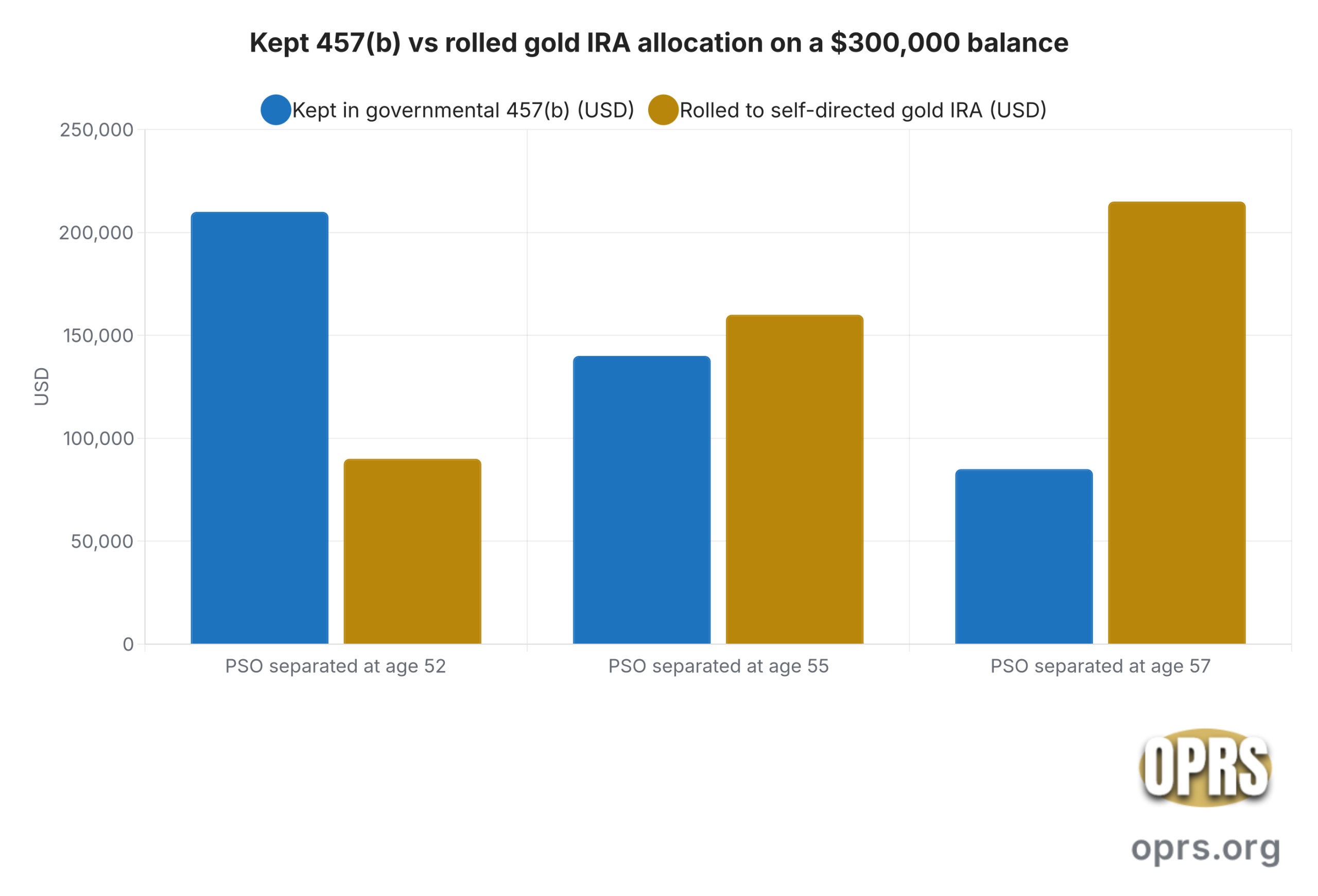
The table below shows the kept-457(b) bridge balance and the corresponding rolled-IRA balance for three Frank-profile retirees across separation ages 52, 55, and 57. The total 457(b) balance is held constant at $300,000 for comparability, and the bridge spending need is varied with age (less time to age 59 and a half means a smaller bridge balance).
| Profile | Bridge years (to 59.5) | Annual bridge need | Kept 457(b) | Rolled to gold IRA | Status |
|---|---|---|---|---|---|
| PSO separated at 52 | 7.5 years | $25,000 | $210,000 | $90,000 | (Bridge-heavy: 70% kept) |
| PSO separated at 55 | 4.5 years | $25,000 | $140,000 | $160,000 | (Balanced: 47% kept) |
| PSO separated at 57 | 2.5 years | $25,000 | $85,000 | $215,000 | (Roll-heavy: 28% kept) |
Precious metals IRA early-withdrawal penalty estimator
Taking money out of a precious metals IRA before age 59 and a half triggers a 10% federal additional tax on top of ordinary income tax. State add-on taxes vary; check your state. The federal penalty is estimated below.
Estimate only, not tax advice. The 10% federal additional tax applies to early distributions before age 59 and a half; specific exceptions exist. Your state may add its own tax, and ordinary income tax applies separately. Source: IRS Publication 590-B. Consult a tax advisor.
The right dealer explains every fee up front. Get Augusta's free precious metals IRA company checklist.
The kept-balance figures include the annual bridge need times the bridge years, a $3,000 per year HELPS Act buffer, and a 15 percent contingency.
A 57-year-old separated PSO rolls a larger share of the balance because the bridge window is short. The rolled balance then has time to capture the diversification benefit before Required Minimum Distributions begin at age 73 under SECURE 2.0.
A 52-year-old separated PSO keeps most of the balance in the 457(b) because the bridge window is long and the 457(d) post-separation rule is the most valuable feature of the plan.
The chart below visualizes the kept-versus-rolled split across the three profiles. The dollar values match the table above.
The bridge-sizing math is not a prescription. It is the framework most Frank-profile retirees use as a first pass before bringing a fiduciary advisor into the conversation. The advisor adds most value when the bridge math interacts with state-income-tax considerations. That includes the ACA premium subsidy threshold under IRC Section 36B and S-corp distribution timing for a public safety officer with a side business.
The four operational gates the IRA custodian must clear
The PSO exception survives the rollover only if the IRA custodian executes four operational gates correctly. A failure on any one gate either kills the exception or shifts the burden to the participant to reclaim it via Form 5329.
Gate 1: PSO status documented at rollover time. The IRA custodian must accept and file the PSO certification with the rollover paperwork, not at first distribution. Typical documentation is the participant’s separation letter from the public-safety employer plus a signed PSO certification on a custodian-provided form.
A custodian that asks for PSO documentation only at distribution time has already made an operational mistake. Filing at rollover is faster, cleaner, and less likely to lose paperwork over a 5-year or 7-year holding period.
Gate 2: Form 1099-R box 7 coded 2 on the qualifying distribution. The IRA custodian must elect box 7 code 2 (early distribution, exception applies) on Form 1099-R for any pre-59-and-a-half distribution from the rolled balance. A custodian that defaults to code 1 forces the participant to file Form 5329 to reclaim the exception. The default behavior varies materially across custodians; the screen is a single question to the custodian’s distribution-operations team before the rollover is signed.
Gate 3: Trustee-to-trustee transfer mechanics under IRC Section 457(d)(1)(C). The rollover must be executed as a direct trustee-to-trustee transfer from the 457(b) plan administrator to the IRA custodian. An indirect rollover via the participant triggers the 20 percent mandatory federal withholding under IRC Section 3405(c) and a 60 day deadline to complete the rollover.
The withheld amount must be made whole from outside funds at the IRA custodian for the rollover to remain non-taxable. Otherwise the withheld amount is treated as a taxable distribution subject to the 10 percent additional tax, unless an exception applies.
Gate 4: Inherited-IRA service infrastructure available for the rolled balance. Under IRC Section 401(a)(9) and the SECURE Act 2.0 10-year distribution rule for non-spouse, non-eligible-designated-beneficiary inheritors, the inherited-IRA chain handles the rolled balance after the participant’s death. A custodian without functional inherited-IRA service capacity creates a beneficiary-side problem 10 or 20 years later. The screen is a question about the custodian’s inherited-IRA fee schedule and distribution mechanics, not a binary capability test.
Step-by-step procedure for the partial rollover
The procedure below is the sequence a Frank-profile PSO follows from the bridge-sizing decision through the trustee-to-trustee transfer and the first 1099-R box 7 verification.

Step 1. Confirm governmental status of the 457(b) plan. The summary plan description identifies the plan sponsor as a state or local government employer for the governmental variant. Non-governmental 457(b) plans (top-hat or tax-exempt) cannot generally roll to an IRA at separation, and the Section 457(d) post-separation rule does not apply the same way. The check is a 10-minute reading of the SPD and prevents the most common upstream mistake. IRS guidance on non-governmental 457(b) plans documents the distinction.
Step 2. Calculate the bridge balance using the four-input math. Bridge years times annual bridge need, plus HELPS Act buffer, plus 10 to 20 percent contingency, equals the kept-457(b) target. The arithmetic is straightforward; the harder part is honest estimation of the bridge spending need separate from pension and S-corp income.
Step 3. Screen the gold IRA dealer and confirm the custodian’s Form 1099-R box 7 default. A direct call to the dealer’s onboarding team usually surfaces the answer. Confirmed code-2 default on PSO-documented distributions is the operational gate. The dealer screen applies before any rollover paperwork: a code-1 default shifts the entire exception burden to the participant for the life of the rolled balance.
Step 4. File the PSO certification with the IRA custodian as part of the rollover paperwork. The certification typically includes a copy of the separation letter from the public-safety employer, the participant’s signed PSO statement, and the custodian’s standard PSO exception form. File once, at rollover; do not wait for the first qualifying distribution.
Step 5. Elect direct trustee-to-trustee transfer on the 457(b) plan administrator’s rollover form. Specify the rollover dollar amount or percentage (the residual stays in the 457(b)). Provide the IRA custodian’s trustee identification and the receiving account number. The 457(b) plan administrator wires the rollover amount directly to the IRA custodian, avoiding the 20 percent mandatory withholding under IRC Section 3405(c). The 60 day rollover clock does not run on a direct trustee-to-trustee transfer.
Step 6. Verify Form 1099-R box 7 coding on the first qualifying distribution. When the first pre-59-and-a-half distribution from the rolled IRA balance is taken, request the Form 1099-R draft from the custodian before the year-end issuance. Box 7 should read code 2 (early distribution, exception applies).
If it reads code 1, request a correction in writing before the IRS issuance. If the custodian refuses, file Form 5329 with the year’s Form 1040 to reclaim the exception. The reclaim usually clears at the IRS but creates audit exposure that the code-2 elected entry avoids.
Verdict per household profile
Profile A: separated PSO age 50 to 54, $200,000 to $300,000 in a governmental 457(b), pre-59-and-a-half bridge spending of $20,000 to $30,000 per year, HELPS Act direct-pay election planned. Keep 60 to 70 percent of the 457(b) balance for the bridge years plus the HELPS Act infrastructure.
Roll the residual 30 to 40 percent to a self-directed gold IRA with PSO documentation filed at rollover. Verify the IRA custodian’s box 7 code 2 default before signing the rollover paperwork. The kept 457(b) is the structurally generous bridge instrument; the rolled gold IRA is the diversification leg and the inherited-IRA estate vehicle.
Profile B: separated PSO age 55 to 58, $250,000 to $400,000 in a governmental 457(b), bridge spending of $15,000 to $25,000 per year, pension and S-corp income covering most current expenses. Keep 35 to 50 percent for the shorter bridge window. Roll the balance to the gold IRA.
The PSO exception remains available on the rolled balance via box 7 code 2. The HELPS Act direct-pay election is still meaningful for the few pre-Medicare years, so the kept 457(b) carries the healthcare-premium routing infrastructure that most gold IRA custodians do not support.
Profile C: separated PSO age 59 and a half or older, balance entirely past the early-distribution penalty regime. The PSO exception is moot at this age band. The partial-rollover decision shifts toward the inherited-IRA flexibility and the diversification benefit on the rolled balance.
The kept 457(b) is the residual maintenance-cost play for governmental plans with strong institutional share class expense ratios. The rolled gold IRA is the broader investment menu and the SECURE 2.0 10-year inherited drawdown vehicle for non-EDB beneficiaries.
Profile D: pre-separation participant under age 50 considering an in-service partial rollover. Most governmental 457(b) plans do not permit in-service distributions outside of an unforeseeable emergency, so the partial-rollover question is technically moot until separation.
The right pre-separation move is to verify the plan’s governmental status, document the qualifying public-safety job category under IRC Section 72(t)(10)(B), and screen candidate gold IRA dealers so post-separation paperwork can move quickly.
When the partial-rollover path is wrong
The partial-rollover path is not the right primary tool when the 457(b) plan administrator does not permit partial transfers. A minority of governmental 457(b) plans still operate as all-or-nothing on distributions; the plan document and the SPD identify the constraint.
When the plan administrator enforces all-or-nothing, you have two alternatives. Keep the full 457(b) balance and address diversification through a parallel Roth IRA or a taxable account. Or roll the full balance to a traditional IRA first, then partial-convert to a gold IRA after a 30 to 60 day settling period.
The partial-rollover path is also wrong when the rolled balance falls below the dealer’s effective minimum. The dealer minimum is industry-reported around $50,000 for the trusted Augusta tier; a rolled balance of $25,000 or $40,000 either does not clear the minimum or hits the high end of the percentage fee schedule.
The bridge-heavy profile A example with $90,000 rolled at separation age 52 clears the minimum and sits comfortably on the percentage schedule. A bridge-heavy profile A example with $50,000 rolled does not.
The path is also wrong when the HELPS Act direct-pay infrastructure on the 457(b) side is structurally unavailable. Some smaller governmental 457(b) plans do not support direct-pay to a health insurance company, which means the participant cannot capture the $3,000 per year exclusion under IRC Section 402(l) regardless of the kept balance.
The bridge-sizing math degrades by the present value of the lost HELPS Act benefit, which typically pushes the rolled allocation higher and the kept allocation lower. The dealer screen applies the same way regardless of which leg of the bridge math degrades.
Where Augusta sits in the dealer landscape for this scenario
Augusta Precious Metals sits on the OPRS three-dealer shortlist.
The dealer minimum is industry-reported around $50,000, which fits the rolled balance in the balanced and roll-heavy profile B and profile C examples and the upper end of the bridge-heavy profile A. The published Learn-Talk-Decide process is run by salaried non-commissioned educators.
That fits a partial-rollover conversation that brings the spouse, and sometimes a fiduciary advisor, into the same room. Together, you fix the kept-versus-rolled allocation, file the PSO certification with the receiving custodian, and verify the box 7 default on the first qualifying distribution.
Compare the 4-award stack on a company-comparison checklist
The free company-comparison checklist walks through the custodian, depository, distribution-code, and PSO documentation mechanics that a partial 457(b) rollover has to coordinate with the plan administrator. The checklist is the higher-intent asset for screening any single dealer against the four-marker trust-signal stack at the partial-rollover allocation moment.
OPRS may receive compensation when readers proceed. Editorial selection is independent. Updated July 2026.
Does the §72(t)(10) PSO exception apply to a self-directed gold IRA?
Yes. The IRC Section 72(t)(10) PSO age-50 carve-out applies to distributions from a traditional or self-directed gold IRA. To qualify, the public safety officer must have separated from service in or after the calendar year of age 50.
The carve-out attaches to the participant, not to the plan vehicle, and survives a direct trustee-to-trustee transfer from a governmental 457(b) under IRC Section 457(d)(1)(C). The operational hinge is the IRA custodian’s Form 1099-R box 7 code election at the first qualifying distribution: code 2 for early distribution with exception, not code 1.
The SECURE Act 2.0 expanded the qualifying job categories under IRC Section 72(t)(10)(B). A private-sector firefighter, a corrections officer, or a forensic security employee of state or local government who separated at age 50 or later also qualifies.
Often not, in practice. IRC Section 402(l) requires the payment to route directly from the plan administrator to the insurer. Most self-directed gold IRA custodians do not support a direct-pay election to a health insurance company. The kept-457(b) bridge balance preserves the direct-pay infrastructure that the 457(b) plan administrator already operates.
A partial rollover keeps a meaningful 457(b) balance and rolls the excess to a gold IRA. That is the standard route to preserve the HELPS Act exclusion while still capturing the diversification leg in the gold IRA.
The annual exclusion is up to $3,000 under IRC Section 402(l)(1)(B). IRS Publication 575, Pension and Annuity Income covers the direct-pay mechanics in the year of the distribution.
What happens if the IRA custodian codes Form 1099-R box 7 wrong?
A box 7 code 1 entry on a qualifying PSO distribution triggers the 10 percent additional tax in the IRS Form 1040 processing. The participant reclaims the exception by filing Form 5329, Additional Taxes on Qualified Plans, with the year’s Form 1040.
Form 5329 part 1 includes a line for exception number 04 (distributions made because of total and permanent disability) and exception number 12 (distributions due to a Section 72(t)(10) public safety officer separation). There is also a general other-exception line. The reclaim usually clears at the IRS, but it creates audit exposure that the box 7 code 2 elected entry avoids.
The reclaim also requires the participant to retain the PSO documentation indefinitely; the IRS audit window on the Section 72(t) additional tax is the standard 3 year window from the filing date.
Can I roll only part of a governmental 457(b) into a gold IRA?
Yes, in most cases. IRC Section 457(d)(1)(C) permits a direct rollover of any portion of the participant’s vested 457(b) balance to a traditional IRA, including a self-directed gold IRA. The 457(b) plan administrator’s distribution form generally accepts a dollar amount or a percentage as the rollover quantity, and the residual stays in the 457(b) under the same post-separation distribution rules.
A minority of governmental 457(b) plans operate as all-or-nothing on distributions; the plan document and the summary plan description identify the constraint.
When the plan administrator enforces all-or-nothing, two alternative routes are available. Option (1): keep the full 457(b) balance and pursue diversification through a parallel taxable account. Option (2): roll the full balance to a traditional IRA first and then partial-convert to a gold IRA after a 30 to 60 day settling period.
What is the SECURE Act 2.0 public safety officer expansion under §72(t)(10)(B)?
The SECURE Act 2.0 amended IRC Section 72(t)(10)(B) to expand the qualifying job categories for the PSO age-50 exception. The expanded list includes private-sector firefighters, corrections officers, and forensic security employees of state and local government. These are in addition to the previously qualifying state and local police, firefighters, and emergency medical service providers under the original IRC Section 72(t)(10)(B).
The exception still requires separation from service in or after the calendar year of age 50 and remains subject to the IRA custodian’s distribution-coding capability on the IRA side after a rollover. IRS guidance on exceptions to tax on early distributions documents the current scope.
Sources cited
- IRC Section 72(t), Additional Tax on Early Distributions from Qualified Retirement Plans
- IRC Section 72(t)(10), Distributions to Qualified Public Safety Employees
- IRC Section 72(t)(10)(B), Qualified Public Safety Employee Defined
- IRC Section 457(d), Distribution Requirements and Trustee-to-Trustee Transfers
- IRC Section 457(d)(1)(C), Direct Transfer Election to an Eligible Retirement Plan
- IRC Section 402(l), HELPS Act Distributions from Governmental Plans for Health and Long-Term Care Insurance
- IRC Section 3405(c), Twenty Percent Mandatory Withholding on Eligible Rollover Distributions
- IRC Section 401(a)(9), Required Distribution Rules for Inherited IRAs
- IRC Section 36B, Refundable Credit for Coverage Under a Qualified Health Plan
- IRS, About Form 5329, Additional Taxes on Qualified Plans
- IRS Publication 575, Pension and Annuity Income
- IRS, Non-Governmental 457(b) Deferred Compensation Plans
- IRS, Retirement Topics: Exceptions to Tax on Early Distributions
More on OPRS
- 457(b) governmental rollover vs keep plus gold IRA for the strategic keep-versus-roll decision before the partial-rollover allocation question is settled.
- 457(b) vs 403(b) vs 401(k) rollover rules compared for the structural plan-by-plan comparison across the three employer plans.
- How to rollover a 401(k) plan to a gold IRA for the parallel procedural framework on the 401(k) side.