

Updated: July 28, 2026
OPRS may receive compensation when readers open an account through partner links on this page. Our analysis is based on independent research, BBB data, and IRS publications.
30-second verdict
- Most construction trades pensions (Carpenters, Operating Engineers, Ironworkers, Laborers, Plumbers, Pipefitters, IBEW) are multi-employer ERISA plans and pay only as an annuity. A rollover to a gold IRA is available only when the plan explicitly offers a lump sum or a small-benefit cash-out.
- For a divorced trades participant rebuilding at age 55 to 60, the QDRO has already split the accrued benefit between the participant and the alternate payee. The rollover amount on the table is the post-QDRO residual, not the pre-divorce projection.
- Multi-employer PBGC backstop tops out around $12,870 per year for a participant with 30 years of service, a small fraction of the single-employer maximum. Underfunded “critical” or “critical and declining” plans materially compress the calculus.
- When a lump sum is on the table and the plan is on a sound funded status, route as a direct trustee-to-trustee transfer to avoid the IRC section 3405(c) twenty percent withholding trap; size the gold IRA sleeve at three to ten percent of the rollover proceeds inside the FINRA concentration framework.
For a divorced project manager or skilled tradesperson rebuilding retirement after a Qualified Domestic Relations Order (QDRO) at age 55 to 60, the construction trades pension is rarely a single decision. It is a sequence of procedural gates, each governed by a different layer of ERISA, IRC, and the plan’s own trust agreement.
The wrong order at any gate produces an irreversible tax event or a default annuity election the household never intended. The gold IRA conversation only becomes relevant after the lump sum (if available) lands inside a direct rollover IRA.
Before any conversation with a precious-metals dealer about the rollover destination, see the gold IRA dealers OPRS currently warns post-QDRO rollover savers against. A small post-divorce rollover landing inside a fresh IRA is one of the highest-pressure call profiles in the industry.
Before you sign
The QDRO is on file before the rollover paperwork is requested. The plan administrator will not process a distribution that conflicts with the alternate payee’s award; the residual benefit (what is left for the participant after the QDRO assignment) is the only amount eligible to roll. The dealer who walks the gold IRA sleeve of the rollover destination should never be the source of advice on the pension election itself.
3 of 27+ gold IRA dealers reviewed by OPRS make the 2026 trusted list.
What a construction trades pension actually is
Skilled trades workers in the United States are typically covered by multi-employer pension plans collectively bargained through their local union and a Taft-Hartley joint board of trustees. The Department of Labor reports approximately 1,360 multi-employer defined benefit plans covering about 11.2 million participants, with the construction sector representing the largest single industry concentration.
Common plans include United Brotherhood of Carpenters and Joiners locals, International Union of Operating Engineers (IUOE) local funds, and Ironworkers (IW) district funds. Also covered are Laborers International Union (LIUNA) local funds, United Association (UA) of plumbers and pipefitters local funds, and International Brotherhood of Electrical Workers (IBEW) local funds.
Here is how a multi-employer plan works. Benefits accrue based on hours worked across all contributing contractors in the plan’s jurisdiction. The formula is usually a flat dollar amount per credited year of service. That figure often runs $50 to $80 per month at normal retirement age, varying by local. It is not a percentage of final pay.
The Form 5500 filed annually with the Department of Labor discloses the plan’s funded status, contribution rate, and zone status under the Pension Protection Act (PPA) of 2006. The Form 5500 public disclosure dataset is the household’s primary source for plan-specific funded-status data; the plan administrator must also provide an annual funding notice to each participant.
The reality is: most construction trades multi-employer plans pay only as an annuity. The normal form of benefit is a single-life annuity for unmarried participants and a qualified joint-and-survivor annuity (QJSA) for married participants under IRC section 401(a)(11).
A lump-sum option is available only when the plan trust document explicitly permits it. Even then, it usually applies only for small accrued benefits or for terminated-vested participants past normal retirement age. The small-benefit threshold is often a present value cash-out floor of $7,000 or less under SECURE 2.0, or a plan-specific threshold higher than that.
The “I want to roll my pension to a gold IRA” framing presumes a lump-sum option that, for most trades participants, does not exist.
The PBGC backstop on multi-employer plans
The Pension Benefit Guaranty Corporation insures private multi-employer DB pension benefits at a much lower ceiling than single-employer plans. The current multi-employer maximum guarantee is $11 per month per year of service for the first $11 of the accrued benefit. Above that, the guarantee is 75 percent of the next $33 per month, capped at $35.75 per month per year of service.
For a participant with 30 years of credited service the annual maximum guarantee is approximately $12,870 per year. The single-employer maximum at the same age and service is several times higher. The PBGC Maximum Monthly Guarantee Tables publish the current figures.
The funded status of a multi-employer plan is classified into four zones under the Pension Protection Act:
| PPA zone | Funded percentage | Status label | What it means for the participant |
|---|---|---|---|
| Green | 80% or higher and projected solvent for the next 7 plan years | Healthy (status: Stable) | Annuity election carries the normal PBGC backstop. No benefit cuts on the horizon. |
| Yellow (endangered) | Below 80% or projected funding deficiency in the next 7 plan years | Endangered (status: Caution) | Plan must adopt a funding improvement plan. Future benefit accruals can be reduced for active participants. |
| Orange (seriously endangered) | Below 80% AND projected funding deficiency | Seriously endangered (status: Caution) | Stricter funding improvement plan required. Active accrual cuts more likely. |
| Red (critical) | Below 65% or projected insolvency in 4 to 5 plan years | Critical (status: At risk) | Plan must adopt a rehabilitation plan. Adjustable benefits (early retirement subsidies, disability benefits) can be cut. |
| Deep red (critical and declining) | Projected insolvency within 15 to 20 plan years | Critical and declining (status: At risk) | Plan can apply for benefit suspensions under MPRA or for Special Financial Assistance under ARPA 2021. |
Can you roll your account into a precious metals IRA? Eligibility checker
Most retirement money can move into a precious metals IRA once it qualifies as an eligible rollover distribution. Pick your account type and situation for a general answer. Always confirm specifics with your plan administrator or custodian.
General guidance only, not tax or financial advice. Eligibility depends on your specific plan document and IRS rules; confirm with your plan administrator and a tax advisor. A direct trustee-to-trustee transfer avoids the 60-day rule and 20% mandatory withholding.
The right dealer explains every fee up front. Get Augusta's free precious metals IRA company checklist.
Sources: ERISA §305 (Pension Protection Act zone status), PBGC Multiemployer Insurance Program overview, and the annual funding notice issued by each plan under ERISA §101(f).
For a participant in a green-zone plan, the annuity election is the conservative path: the PBGC backstop is rarely tested. For a participant in a critical or critical-and-declining plan, the calculus shifts. If a lump-sum option is on the table, taking the lump sum before benefit suspensions are voted in can preserve the full accrued amount.
The American Rescue Plan Act (ARPA) of 2021 Special Financial Assistance program has stabilized many formerly distressed multi-employer plans through 2051, but plan-by-plan verification on the current annual funding notice is the only authoritative answer.
The QDRO layer: what is left after a divorce
Under IRC section 414(p) and ERISA section 206(d)(3), a Qualified Domestic Relations Order is the only mechanism by which an ex-spouse becomes an alternate payee on an ERISA-governed pension. The QDRO must be approved by the plan administrator (or the plan’s QDRO review service) before it has any effect. Once approved, the plan tracks the accrued benefit as split between the participant and the alternate payee; future distributions are paid according to the QDRO formula.
Two common QDRO formulas for trades pensions:
- Shared payment (sometimes called “share of each check”): the alternate payee receives a fixed percentage of every monthly annuity payment for as long as the participant is alive. The alternate payee’s share terminates at the participant’s death unless the QDRO names the alternate payee as the surviving spouse under the QJSA.
- Separate interest (sometimes called “separate account”): the alternate payee’s share is converted to a benefit payable over the alternate payee’s own lifetime (actuarially adjusted). The participant’s residual benefit is paid based on the participant’s own life expectancy. The two streams are independent after the QDRO is approved.
For the rolling-over participant, the procedural question is which formula the QDRO uses and what residual benefit (or lump-sum equivalent) remains. The plan administrator’s QDRO confirmation letter sets out the participant’s post-QDRO benefit in writing. That letter is the source document for any rollover analysis. The “I have a $400,000 pension I want to roll” framing dies at the QDRO confirmation line if half the accrued benefit was assigned to the alternate payee.
Where this matters: the alternate payee can independently elect to roll over the assigned portion to her own IRA under IRC section 402(e)(1)(B) if the plan offers a lump-sum option to alternate payees. That is the alternate payee’s election, not the participant’s, and it does not affect the participant’s residual rollover analysis.
The six-step procedural sequence
The decision flow below is the procedural lever the OPRS desk uses to walk a post-QDRO trades participant through the rollover analysis. The output is either a direct trustee-to-trustee rollover destination (if a lump sum is on the table) or a QJSA / single-life annuity election form (if no lump sum is offered).
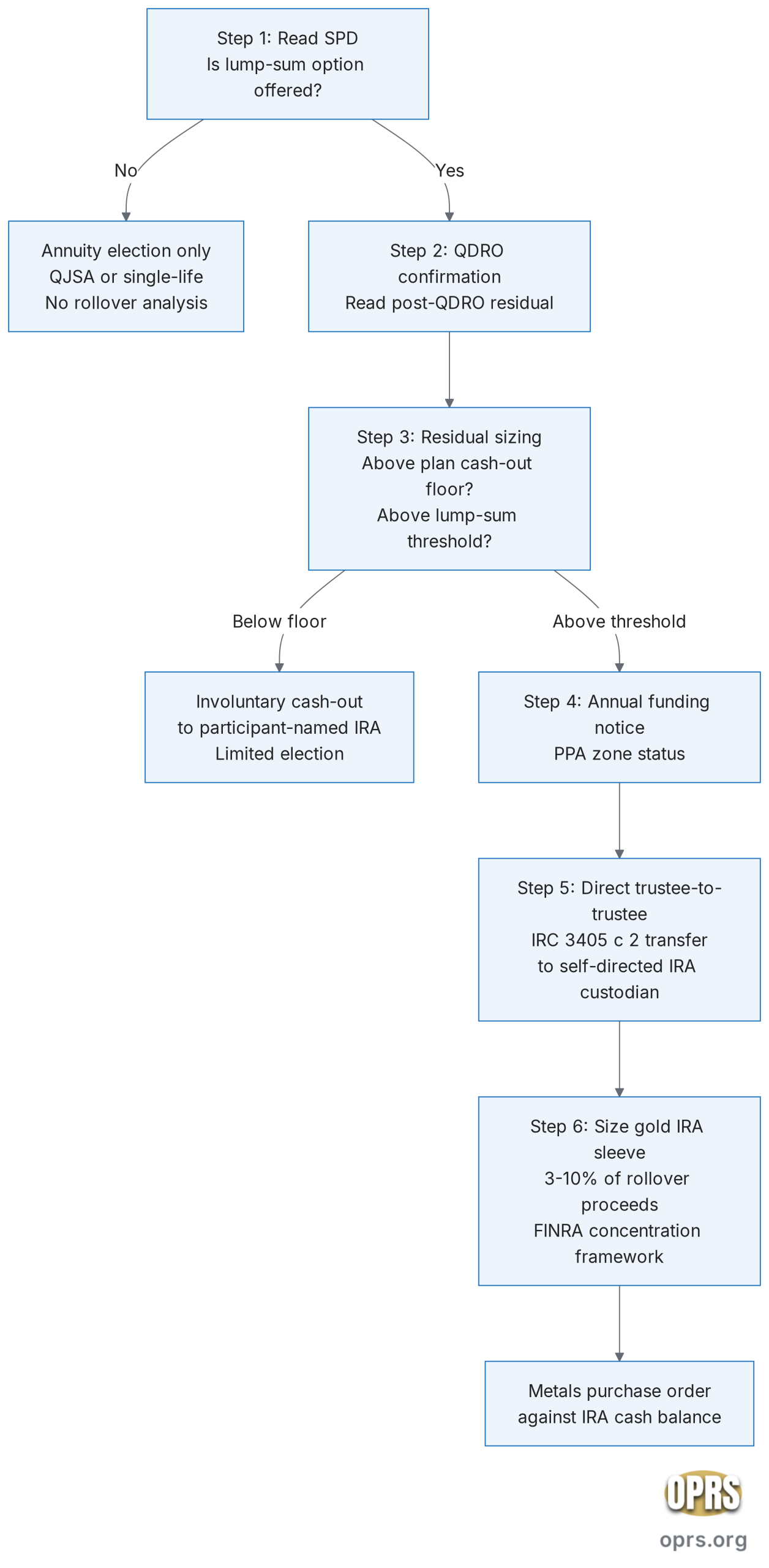
What matters most: steps one through three are gating questions. If the plan does not offer a lump sum, the rollover analysis stops and the household moves to the annuity election. If the post-QDRO residual is too small to meet the plan’s lump-sum cash-out floor, the participant takes the annuity by default. Steps four through six only run when a lump sum is actually on the table.
The post-QDRO residual lump-sum sizing
Consider a 55-year-old construction trades participant with 25 years of credited service under a typical local fund with a $70 per month per year of service benefit formula. The gross monthly accrued benefit at normal retirement age (often 62 or 65 in trades plans) would be approximately $1,750.
A 50 percent QDRO split leaves the participant with a post-QDRO accrued benefit of approximately $875 per month at normal retirement age. If the plan offers a lump-sum option at separation, the present value at age 55 would typically fall in the $90,000 to $160,000 range depending on the plan’s interest assumption and mortality table.
The chart below sets three concrete post-QDRO scenarios for a hypothetical 55-year-old participant against three plan zone statuses. Numbers are illustrative; the participant’s plan administrator publishes the actual present value on the relative-value disclosure mandated by Treasury regulation 1.417(a)(3)-1.

What the scenarios show: the post-QDRO residual is small enough that the gold IRA conversation is bounded. At a $120,000 mid-scenario rollover, the FINRA-framework three-to-ten-percent metals sleeve sits between $3,600 and $12,000. That is the order of magnitude the household is actually allocating to precious metals; it is not the $50,000 to $250,000 range trades-marketing material often implies for “your pension rollover.”
Industry-reported minimums on the major gold IRA dealer platforms sit around $50,000 for Augusta Precious Metals, around $10,000 for Birch Gold, and around $20,000 to $25,000 for Noble Gold.
A post-QDRO trades participant with a $90,000 to $160,000 rollover meets the Augusta minimum. But the sleeve-sizing math (three to ten percent of the rollover proceeds equals $2,700 to $16,000) often pushes the household toward a smaller-minimum dealer or toward not opening a separate precious-metals IRA at all.
The trade-off is a separate $200+ per year custodial fee on a sleeve that may be smaller than the fee drag justifies.
The direct trustee-to-trustee rollover mechanics
When a lump sum is on the table and you have decided to elect it, the rollover must be processed as a direct trustee-to-trustee transfer. This avoids the IRC section 3405(c) twenty percent mandatory withholding. The plan administrator wires the lump-sum amount directly to the IRA custodian, bypassing the participant. No 1099-R box 2 withholding applies, and there is no out-of-pocket advance needed to complete the rollover within the 60-day window.
On paper, in practice: the direct rollover is one election form: the plan’s distribution election plus the IRA custodian’s transfer authorization. In practice, trades pension administrators process fewer lump-sum rollovers per year than corporate single-employer plans do. The paperwork timeline can stretch 45 to 90 days from election to wire.
The plan’s QDRO confirmation must be on file, the participant’s separation-from-service must be documented, and the IRA custodian’s wire instructions must be on the plan-administrator approved form. The IRS rollover chart sets out which plan-to-plan and plan-to-IRA combinations qualify for direct rollover treatment.
The gold IRA conversation begins only after the direct rollover funds settle in the self-directed IRA custodian’s cash account. The metals sleeve is then a separate purchase order against that cash balance. The dealer that handles the metals purchase should not be the dealer that initiated the rollover paperwork; the dealer that does both creates an unmanaged conflict at the rollover destination decision.
Before you pick the destination IRA
The custodian who holds the rollover proceeds is not the same entity as the dealer who sells the metals. Check the 2026 OPRS list against any trades-marketing dealer pitching both roles at once.
Common procedural mistakes and how to avoid them
Mistake 1: Treating a multi-employer plan like a single-employer 401(k). Trades participants sometimes assume the rollover mechanics mirror a corporate 401(k) at separation. The QJSA default, the absence of a lump-sum option in most plans, and the multi-employer PBGC ceiling are all structurally different. The correction: read the Summary Plan Description (SPD) before contacting any dealer. The SPD is mandatory disclosure under ERISA section 102 and sets out the actual distribution options.
Mistake 2: Skipping the QDRO confirmation letter. The plan administrator’s QDRO confirmation sets the post-QDRO benefit in writing. Without it the participant cannot validate the lump-sum present value the plan would actually pay; trades-marketing dealers occasionally pitch rollover amounts based on the pre-divorce projection. The correction: request a written QDRO confirmation and a benefit estimate before any dealer call.
Mistake 3: Indirect rollover instead of direct. Routing the lump sum to the participant first triggers IRC section 3405(c) mandatory twenty percent withholding on the pre-tax portion. The participant has 60 days to deposit the full pre-withholding amount in an IRA; the twenty percent is recoverable only on the following year’s tax return. The correction: process as a direct trustee-to-trustee transfer from the plan to the IRA custodian. Never accept the check made out to the participant.
Mistake 4: Oversizing the metals sleeve relative to the rollover. The FINRA concentration framework caps a single sleeve at the level that does not reintroduce the concentration that diversification was designed to eliminate.
For a $120,000 post-QDRO rollover, a metals sleeve above $12,000 is ten percent of the rollover. But if the trades pension is the household’s primary asset, that sleeve is a larger share of total retirement assets. That over-weights the household materially.
The correction: size the sleeve against total retirement assets across all accounts, not against the rollover balance in isolation. The SEC Office of Investor Education diversification bulletin sets the broader principle.
Mistake 5: Letting the dealer that pitched the rollover also handle the metals purchase. The same dealer doing both creates an unmanaged conflict at the rollover destination decision: the dealer can route the participant to a custodian with high storage fees or to coin products with high spreads.
The correction: separate the rollover paperwork (plan administrator + IRA custodian) from the metals purchase (dealer + IRA custodian) and document the cost comparison on both sides. The FINRA Investor Insight on precious metals covers the conflict pattern.
When the rollover is not the right answer
Two situations argue against the rollover even when a lump-sum option exists.
First, if the post-QDRO residual is small (under the plan’s mandatory cash-out floor, often $7,000, or under the SECURE 2.0 increased threshold), the plan will cash it out automatically. The participant has no election to make. The lump sum lands in a new participant-named IRA or arrives as a check subject to the IRC section 3405(c) withholding.
Setting up a separate gold IRA for a sub-$7,000 cash-out rarely justifies the custodial fee drag.
Second, if the participant is approaching the plan’s normal retirement age in the next few months and the household’s fixed expenses depend on the monthly annuity stream, taking the lump sum is a significant trade. Those fixed expenses include housing, healthcare, and alimony obligations from the divorce decree. Taking the lump sum trades a guaranteed monthly payment for an investment-risk balance that the household may not have the timeline to recover from a market drop.
The annuity election (single-life or QJSA at the elected survivor level if remarried) is the lower-regret path for households that rely on the monthly cash flow. The lump sum keeps the account clean for your heirs only if the household has separate cash flow to cover fixed expenses without the pension stream.
Verdict by reader profile
Divorced trades participant, age 55 to 60, plan offers a lump-sum option, post-QDRO residual $90,000 to $250,000, plan in green or yellow zone. The direct trustee-to-trustee rollover to a self-directed IRA is the right baseline if your household has separate cash flow for fixed expenses.
Size the gold IRA sleeve at three to ten percent of the rollover proceeds (so $2,700 to $25,000) inside the FINRA concentration framework. Read the QDRO mechanics walkthrough before signing the destination paperwork.
Divorced trades participant, plan in critical or critical-and-declining zone, lump-sum option on the table: the lump sum delivered before benefit suspensions are voted in often preserves the full computed amount. The PBGC multi-employer ceiling is $12,870 per year on 30 years of service, which is a fraction of most participants’ accrued annuity. The lump sum locks in the present value at your accrued benefit, not at the PBGC capped amount. Read the most recent annual funding notice before electing.
Divorced trades participant, plan offers annuity only: no rollover analysis is on the table. The election is between the single-life annuity and the QJSA at 50, 75, or 100 percent survivor level (if remarried). The gold IRA conversation moves to whatever IRA or 401(k) balance sits outside the pension; the trades pension itself does not enter the metals allocation question.
Divorced trades participant, post-QDRO residual under plan cash-out floor: the plan will involuntarily cash out to a participant-named IRA. The household has no election to make. The gold IRA sleeve, if elected at all, sits inside that new IRA at the same three-to-ten-percent sizing principle. The late-starter ten-year rebuild walkthrough covers the broader allocation question for participants in this band.
FAQ
Can I roll a construction trades pension to a gold IRA?
Only if the plan offers a lump-sum option. Most multi-employer trades plans (Carpenters, Operating Engineers, Ironworkers, Laborers, Plumbers, IBEW locals) pay only as a monthly annuity, with no lump-sum election available outside small-balance involuntary cash-outs or specific plan-permitted partial cash-out options. The Summary Plan Description issued under ERISA section 102 is the authoritative source for the actual distribution options. The plan administrator’s contact information is on the SPD and on the annual funding notice.
How does a QDRO affect the rollover amount?
The QDRO assigns a portion of the accrued benefit to the alternate payee (typically the ex-spouse). The participant’s residual benefit is the post-QDRO amount; that residual is the only amount eligible to roll.
A typical 50 percent shared-payment QDRO halves the accrued benefit; a separate-interest QDRO converts the alternate payee’s share to a benefit payable over her own lifetime and leaves the participant with the actuarially adjusted residual. The plan administrator’s written QDRO confirmation sets the residual amount in writing. The DOL EBSA QDRO booklet sets out the mechanics.
What is the PBGC backstop on a multi-employer plan?
The multi-employer maximum guarantee is calculated at $11 per month per year of service for the first $11 of the accrued benefit. Above that, the guarantee is 75 percent of the next $33 per month. The ceiling is $35.75 per month per year of service. For a participant with 30 years of credited service, the annual maximum is approximately $12,870 per year.
The single-employer maximum at the same age and service is several times higher. The PBGC Maximum Monthly Guarantee Tables publish the current figures by retirement age and election form.
How is the gold IRA sleeve sized inside the rolled-over balance?
The standard size under the FINRA concentration framework and the broader academic literature is three to ten percent of investable retirement assets. The upper end is appropriate only for households whose remaining portfolio is heavily equity-weighted and whose ordinary-income exposure is concentrated. Size the sleeve against total retirement assets across all accounts, not against the rollover balance in isolation. The SEC investor.gov diversification bulletin sets the broader principle.
What is the difference between direct and indirect rollover for a pension lump sum?
A direct trustee-to-trustee rollover under IRC section 3405(c)(2) moves the lump sum from the plan directly to the IRA custodian, bypassing the participant. No withholding is triggered. An indirect rollover (plan distributes to the participant, who then deposits in the IRA within 60 days) triggers mandatory twenty percent withholding on the pre-tax portion. The participant must advance the withheld amount out of pocket to complete the rollover; the withholding is recoverable only on the following year’s tax return.
Does ARPA 2021 Special Financial Assistance change my plan’s funded status?
For plans that have received Special Financial Assistance under the American Rescue Plan Act of 2021, the funded status is stabilized through 2051 and benefit suspensions previously voted in are typically reversed. Not every multi-employer plan qualifies or has applied; the plan’s most recent annual funding notice discloses whether the plan has received SFA and what the current zone status is. The PBGC Special Financial Assistance program page publishes the list of approved applications and amounts.
The procedural lever that decides the after-tax outcome is the QDRO confirmation letter, read against the Summary Plan Description and the most recent annual funding notice. The rollover analysis runs only if the plan offers a lump-sum option and the post-QDRO residual is large enough to clear the plan’s cash-out floor.
The lump-sum election is irrevocable once the plan distribution form is signed; the gold IRA sleeve sized at three to ten percent of the rollover proceeds inside the FINRA concentration framework sits one layer downstream. The dealer-selection conversation for the precious-metals slice is sequenced after the rollover destination is funded, not before.
Affiliate disclosure: OPRS may receive compensation when readers open an account through partner links on this page. Our comparison framework and dealer notes draw on publicly verified facts, BBB records, FINRA and SEC investor alerts, and IRS publications, not on the partner relationship.
Augusta Precious Metals: free company comparison checklist
For the gold IRA sleeve inside a rolled-over trades pension lump sum, Augusta Precious Metals carries BBB A+ accreditation since 2014 with no complaints on file. It has been named Money Magazine’s Best Overall Gold IRA Company every year from 2022 through 2026. It has also been named Investopedia’s Most Transparent Gold IRA Company 2022 through 2026.
The educator team is salaried and non-commissioned. The free company comparison checklist is available on request. The industry-reported minimum sits around $50,000.
Industry-reported minimum around $50,000. Free company comparison checklist on request.
Sources cited
- IRC §414(p), Qualified Domestic Relations Orders
- IRC §401(a)(11), Requirement of Joint and Survivor Annuity
- IRC §402(e)(1)(B), Alternate Payee Rollover
- IRC §3405, Special Rules for Pensions, Annuities, and Certain Other Deferred Income
- ERISA §206(d)(3), Assignment or Alienation of Pension Benefits (QDRO)
- ERISA §305, Multiemployer Plan Funding Improvement and Rehabilitation Plans
- ERISA §102, Summary Plan Description Requirements
- ERISA §101(f), Annual Funding Notice Requirements
- U.S. Department of Labor, EBSA QDROs booklet
- U.S. Department of Labor, Form 5500 Public Disclosure Dataset
- PBGC Maximum Monthly Guarantee Tables
- PBGC Multiemployer Insurance Program overview
- PBGC Special Financial Assistance program (ARPA 2021)
- IRS Rollover Chart for Retirement Plan and IRA Distributions
- IRS Publication 575, Pension and Annuity Income
- SEC Office of Investor Education, Diversification Bulletin
- FINRA Investor Insight on Precious Metals Investments