

Updated: August 17, 2026
OPRS may receive compensation when readers open an account through partner links on this page. Our analysis is based on independent research, BBB data, and IRS publications.
A retiree looking at an income product wants two clear things: some exposure to market growth, and a floor under how much can be lost. The registered index-linked annuity, or RILA, is the insurance industry’s answer to both. It buffers a portion of any market drop in return for capping the gain.
Unlike a fixed indexed annuity, a RILA can lose principal. Unlike a plain variable annuity, part of that loss is absorbed by the insurer. That middle structure is why the SEC has to register the product, and why the client must receive a prospectus before buying.
This page walks through what a RILA is, how buffers and floors differ, and a labeled worked example. It also covers why the SEC requires a prospectus, and what FINRA and SEC investor bulletins warn about at the point of sale.
What a RILA actually is
A RILA is an insurance contract issued as a variable annuity for federal securities law, then classified by the SEC as an index-linked variable annuity. The insurer credits or debits your account at the end of each crediting term, based on the change in a chosen equity index over that term.
The insurer sets three things that shape every crediting period. First, the reference index (often the S&P 500, Russell 2000, or MSCI EAFE). Second, the crediting term (typically 1, 3, 5, or 6 years). Third, the loss-protection choice (a buffer or a floor).
The upside is capped in a way that pays for the loss protection. That cap is where a RILA differs sharply from a mutual fund or a plain variable annuity.
Buffer vs floor: two ways the insurer limits your loss
The two loss-protection choices sit on opposite sides of the first slice of any drawdown. Under a buffer, the insurer eats the first X percent of any decline for that crediting term. Under a floor, you eat the first X percent, and the insurer covers everything past that mark.
With a 10 percent buffer, if the index falls 5 or 10 percent, you lose zero. If it falls 15 percent, you absorb 5. At a 20 percent fall you absorb 10, and at 25 percent you absorb 15. Every extra point of loss beyond the buffer lands on you.
With a 10 percent floor, you absorb the first 10 percentage points of loss and no more. A 5 percent drop means you absorb 5. A 10 percent drop means you absorb 10. Anything past 10 percent (a 15, 20, or 25 percent drop) is on the insurer.
Neither structure protects the whole downside. A buffer defends the middle range of drawdowns; a floor defends the tail. Which choice fits you depends on your fear pattern (steady erosion or a crash) and the crediting cap the insurer offers alongside each option.
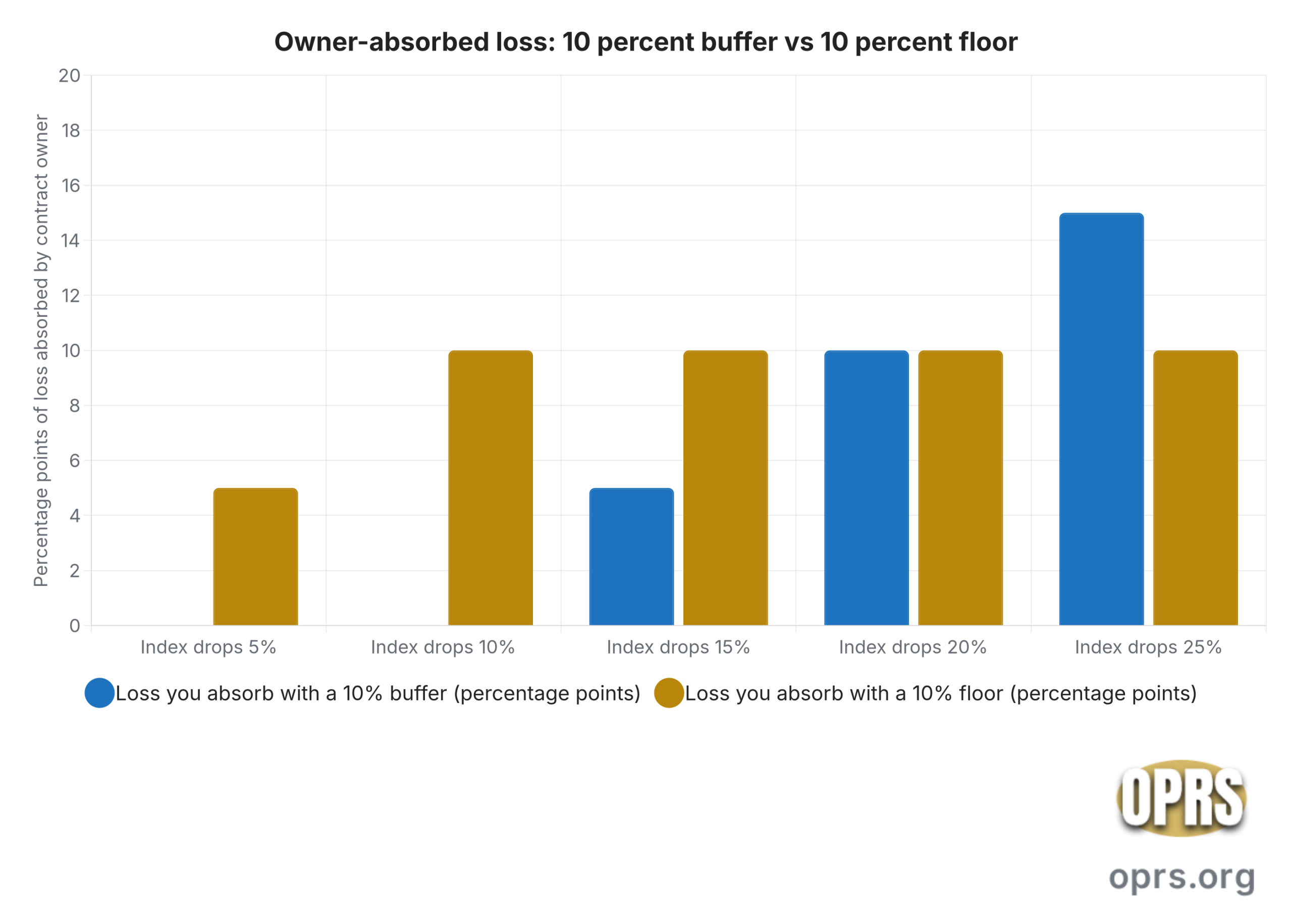
Worked example: index falls 15 percent under a 10 percent buffer
Assume you allocate $100,000 to a RILA point-to-point crediting term with a 10 percent buffer on the S&P 500 and a 15 percent upside cap. At the end of the term, the index is down 15 percent.
The insurer absorbs the first 10 percentage points of that loss. You absorb the remaining 5 points. Your $100,000 becomes $95,000, because 5 percent of $100,000 is a $5,000 loss.
Now assume the same term but the index is up 20 percent. The 15 percent upside cap kicks in: your account is credited with 15 percent, not 20. Your $100,000 becomes $115,000, and the insurer keeps the last 5 percentage points of index growth.
That symmetry (loss buffered, gain capped) is the core deal. The insurer accepts a bounded loss in exchange for a bounded gain. Your outcome depends on whether the crediting term ends in an up market, a middling market, or a deep drawdown.
Caps and participation rates: how the insurer earns the deal
The cap and the buffer or floor are linked. A deeper buffer costs the insurer more, so it lowers the cap. Common caps sit between 12 percent and 25 percent for a 1-year crediting term, and often higher for 3, 5, or 6-year terms where the insurer has more time to hedge.
Some contracts substitute a participation rate for a cap. A 90 percent participation on the S&P 500 credits your account with 90 percent of the index gain, with no upper limit on that gain.
Cap and participation numbers can be reset by the insurer at every renewal after the initial term. That is a moving target the buyer must read in the prospectus before signing, not just in the sales brochure.
Term lengths and index choices
Common crediting terms on active RILA contracts are 1, 3, 5, and 6 years, with a handful of insurers offering longer terms. The 6-year term often carries a higher cap because the insurer can amortize its hedge cost over more time.
Reference indices are usually the S&P 500 Price Return, the Russell 2000, the MSCI EAFE, or a proprietary blended index. Proprietary blends often carry lower caps and can be harder to look up daily, which is one of the confusion points regulators flag.
Why the SEC registers RILAs (and why a prospectus lands in your inbox)
A RILA is an insurance contract, but it is also a security under federal law because the account value can go down when the reference index goes down. That triggers Securities Act registration.
In July 2024, the SEC adopted a final rule tailoring Form N-4 to registered index-linked annuities. The rule created a dedicated registration form for RILAs and set specific disclosure rules for how buffers, floors, caps, and interim value calculations must be shown.
The practical effect for a buyer is the statutory prospectus. Every RILA quote must be paired with a prospectus that describes the crediting method in plain terms. If the prospectus is not delivered, that is a compliance gap on the insurer, and a red flag for the buyer.
Surrender periods and market value adjustment
A RILA is a long-hold contract. Surrender periods commonly run 5 to 10 years, with a declining charge schedule (a common pattern is 8 percent in year one, dropping roughly 1 point per year until it hits zero).
On top of the surrender charge, most contracts apply a market value adjustment (MVA) at early surrender. The MVA can be positive or negative and depends on the direction interest rates have moved since you bought the contract.
If rates have risen since purchase, the MVA typically works against you and reduces the amount you actually receive. Combined with the surrender charge, an early exit from a RILA can strip a meaningful slice of principal, even when the crediting term itself was gain-neutral.
Where state guaranty coverage stops for a RILA
State insurance guaranty associations protect certain annuity balances if the issuing insurer becomes insolvent. Coverage limits vary by state, commonly around $250,000 per annuity contract, sometimes higher.
A RILA sits partly in the insurer’s separate account, which is the pool used to back index-linked liabilities. Separate account assets are shielded from the insurer’s general creditors, but coverage under a state guaranty association can be narrower or excluded, depending on state law and the contract’s structure.
That is a nuance no sales script will lead with. It should be checked against the state guaranty association’s own summary of covered products before the RILA is treated as a savings-account substitute.
RILA vs plain variable annuity: the buffer is the only real defense
A plain variable annuity, sometimes just called a VA, gives you subaccounts that behave like mutual funds inside the annuity wrapper. There is no buffer and no floor. If the S&P 500 subaccount drops 30 percent, your account drops 30 percent, minus any rider protections you paid extra for.
A RILA replaces the raw subaccount exposure with a capped, buffered outcome. That structural buffer is the key difference. It is also the reason a RILA is often marketed to a retiree who would not tolerate the drawdown volatility of a plain VA.
Living benefit riders on a plain VA can approximate a floor, but they usually add 0.75 to 1.50 percent per year in fees on top of subaccount and contract charges. A RILA bakes its loss protection into the crediting structure, at the cost of a capped upside.
What FINRA and SEC investor bulletins flag
Two regulator flags recur in published guidance. The first is confusion between a buffer and a floor. Retail buyers often assume the two words describe the same downside protection, when they in fact allocate loss differently at the first slice of any drawdown.
The second flag is the interim value calculation. If you surrender a RILA mid-term, the insurer computes an interim value that is not the same as the index performance to date. That interim number reflects the insurer’s hedge unwind cost and can be materially lower than the mark-to-market a mutual fund would report.
Both flags argue for reading the prospectus interim value section before signing, not after the first drawdown.
Suitability considerations for a 55 to 75 retiree
A RILA can serve a narrow role in a retirement portfolio. It works best for money the retiree can lock up for the full crediting term, which is three to six years for most contracts. That money should be a slice where the client wants equity exposure without the full drawdown risk.
It is a poor fit for three uses. Emergency reserves. Funds needed inside the surrender period. Money a client would tap during a drawdown, because the interim value reflects the insurer’s hedge unwind cost, not the index’s paper performance.
Before signing, ask three questions in writing. What is the cap for each crediting term and each buffer or floor option? What is the surrender schedule year by year? How is the interim value calculated at any early exit?
If any answer is verbal only, the transaction is not yet ready to sign.
Sources cited
- U.S. Securities and Exchange Commission, Registered Index-Linked Annuities overview page, describing the product structure, disclosure requirements, and links to the July 2024 final rule adopting a tailored registration form for RILAs.
- Financial Industry Regulatory Authority, Registered Index-Linked Annuities investor page, defining buffer and floor mechanics and flagging the interim value calculation as a common point of confusion at the point of sale.
- SEC investor.gov Annuities overview, covering the difference between fixed, variable, indexed, and registered index-linked annuities, plus prospectus delivery requirements for variable insurance products.
- FINRA Annuities index page, definitions of buffer, floor, participation rate, and cap, with the note that RILAs are regulated at the national level by the SEC and FINRA in addition to state insurance commissioners.
- SEC Final Rule, Registration for Index-Linked Annuities; Amendments to Form N-4 for Index-Linked and Variable Annuities, Federal Register publication August 1, 2024, adopting a tailored registration and disclosure framework for RILAs.
- National Association of Insurance Commissioners, Center for Insurance Policy and Research, Annuities topic page, covering the state-level regulatory role that sits alongside SEC and FINRA oversight for RILAs.