

Updated: August 14, 2026
OPRS may receive compensation when readers open an account through partner links on this page. Our analysis is based on independent research, BBB data, and IRS publications.
Most guidance on required minimum distributions treats the age 73 trigger as universal. It is not. An often-overlooked carve-out in the Internal Revenue Code lets an active employee push the first RMD from the current employer’s plan out to actual retirement. The rule is narrow, the paperwork is plan-specific, and it never covers IRAs or plans left at a former employer.
Where the still-working exception comes from
The exception lives in Internal Revenue Code Section 401(a)(9)(C) and Treasury Regulation Section 1.401(a)(9)-2, Q&A-2. Congress inserted it so an active employee is not forced to withdraw balances the employee has not yet chosen to touch. The rule respects the working-payroll status of the participant.
Read plainly: for an employee other than a more-than-five-percent owner, the required beginning date for the employer’s own qualified plan is April 1 of the following calendar year. The trigger year is the later of two events. Either the year the employee reaches the applicable age, or the year the employee actually retires from the plan sponsor.
The applicable age is 73 for participants who reach 73 in 2023 through 2032, and 75 for those who reach 74 after 2032. The SECURE 2.0 age shift does not change the still-working exception itself. It only moves the age at which the second trigger (reaching the applicable age) becomes relevant.
Who qualifies as still working
Two conditions have to be met at the same time. First, the participant must be an active employee of the plan sponsor throughout the year in which the RMD would otherwise be due. Second, the participant must not be a more-than-five-percent owner of the sponsoring employer.
“Active employee” is generally read as remaining on the payroll rather than meeting a full-time-equivalent hours threshold. Treasury Regulation Section 1.401(a)(9)-2 does not define a minimum number of hours. The plan document controls the ground truth. Some plans impose their own minimum service condition, and that plan-defined test can be stricter than the federal one.
A quick retirement followed by a rehire in the same calendar year does not automatically restore the exception. If a plan-defined retirement event has occurred, the plan may treat the participant as separated. That triggers the required beginning date for the covered account. Read the plan’s separation-from-service language before assuming otherwise.
What “more than five percent owner” means
The threshold comes from IRC Section 416(i)(1)(B). A more-than-five-percent owner is a person who owns more than five percent of the employer’s stock (by voting or value) for any plan year ending in the calendar year the participant reaches age 72. Ownership is tested year by year, not once at hire.
Family attribution matters here. Under IRC Section 318 (referenced by Section 416), a participant is treated as owning stock held by a spouse, children, grandchildren, and parents. A closely held family business can therefore push several employees over the five-percent line even if the payroll title is line staff.
A five-percent owner who reaches the applicable age loses the still-working exception permanently for that plan. The required beginning date reverts to April 1 of the year after reaching the applicable age, regardless of whether the person still shows up for work. The rule is meant to prevent owners from indefinitely deferring their own RMDs.
Which accounts the exception can cover
The narrow scope is the single most misread feature. The exception covers the participant’s account in the qualified plan of the current employer only. That means the current employer’s 401(k), 403(b), or 457(b), and only if the plan document actually adopts the still-working delay.
The exception does NOT cover any of the following:
- Any traditional IRA the participant owns.
- Any SEP-IRA or SIMPLE IRA (both are IRAs for RMD purposes).
- A 401(k), 403(b), or 457(b) balance left behind at a former employer.
- Any Roth IRA (never had lifetime RMDs).
- Any designated Roth account inside a 401(k) or 403(b) plan for years after 2023, because SECURE 2.0 Act Section 325 removed lifetime RMDs from those balances.
If the participant owns even one traditional IRA at Fidelity or Vanguard, that IRA generates its own RMD every year once the applicable age is reached. Still-working status at another employer does not change that outcome. The IRA and the covered 401(k) live in separate regulatory buckets.
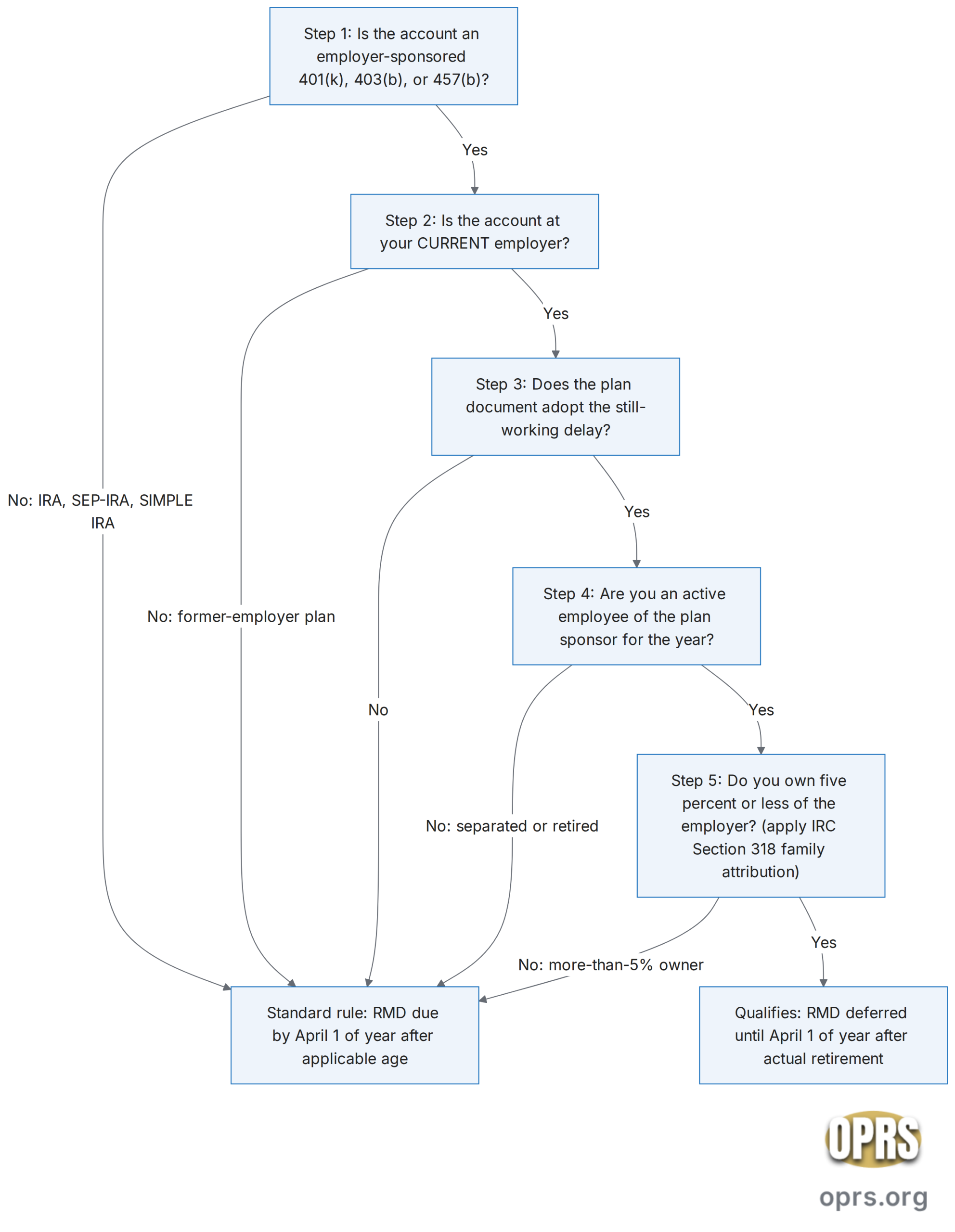
Which accounts qualify: the decision flow
The chart below walks through the six-step test participants can apply to each retirement account they hold. Any “no” answer moves the account back to the standard April 1 required beginning date at the applicable age. Only accounts that pass every step qualify for the deferral.
When the first RMD is finally due
Under the exception, the first required distribution from the current employer’s plan is due no later than April 1 of the calendar year following the year in which the participant actually retires. That date is called the required beginning date for the covered account.
The second RMD, and every subsequent one, is due by December 31 of each year. The plan uses the December 31 prior-year balance and the Uniform Lifetime Table divisor from IRS Publication 590-B Appendix B. The scheduling switches to calendar-year cadence starting the year of actual retirement.
An employee who defers the first distribution until the April 1 grace date takes two distributions in the same tax year. The delayed first RMD lands by April 1 and the current-year RMD by December 31. That collision is the double-tax-year trap. See our first RMD April 1 rule explainer for the modeling.
A worked example: age 73, still working at Employer X
Assume a participant reaches age 73 in the current tax year while remaining employed by Employer X, is not a more-than-five-percent owner, and Employer X’s 401(k) plan document adopts the still-working delay. The participant also holds a traditional IRA and a legacy 401(k) at a former employer.
Under the exception, no RMD is required this year from Employer X’s 401(k). Two RMDs are still required, however. One from the traditional IRA, calculated on the prior December 31 balance. One from the former employer’s 401(k), calculated on that plan’s prior December 31 balance.
If the participant retires from Employer X in a later year, the first RMD from Employer X’s 401(k) becomes due by April 1 of the year after retirement. From that point forward, all three accounts generate RMDs on the standard calendar schedule using the Uniform Lifetime Table divisor.
Reducing hours: part-time and phased retirement
The still-working test looks at employee status, not at full-time-equivalent hours. A participant who drops to part-time but remains on the payroll typically keeps the exception. The plan document may still define phased-retirement events as separation from service, which starts the required beginning date clock.
A common trap: the participant assumes phased retirement preserves the exception. Meanwhile the plan document treats the reduction as a separation event and issues a Form 1099-R for the deemed distribution, or triggers the RMD cadence. Read the summary plan description before agreeing to phased hours.
Rolling a former-employer 401(k) into the current plan
If the current plan accepts incoming rollovers, moving a former employer’s 401(k) balance INTO the current plan can extend the still-working deferral to those dollars. Once the balance sits inside the current plan, it is part of the covered account. It then takes on the plan’s April 1 required beginning date.
The tactic depends on three preconditions. The current plan must accept rollovers from qualified plans. The transfer must be a direct trustee-to-trustee rollover, never an indirect rollover (which triggers 20 percent mandatory withholding under IRC Section 3405). And the rollover has to be completed before the year the RMD would otherwise be due on the old plan.
The tactic does not work for traditional IRAs. An IRA cannot be rolled into an employer plan and then sheltered by the still-working exception. IRAs are outside the scope of the exception even after they arrive inside a qualified plan.
Why aggregation rules do NOT extend the exception across plans
The RMD aggregation rules let a participant compute an aggregate RMD across similar accounts and satisfy it from one account. Traditional IRAs aggregate with each other. 403(b) contracts aggregate with each other. 401(k) plans never aggregate with anything, and they never aggregate with IRAs either.
The aggregation rules do not stretch the still-working exception to accounts that do not qualify for it. See our RMD aggregation rules walkthrough for the mechanics. A participant cannot satisfy the IRA’s RMD by taking an equivalent draw from the covered 401(k). The exception cannot reduce the IRA’s required amount either.
What can go wrong at actual retirement
The most expensive procedural mistake is retiring in December. A December 31 retirement date triggers the required beginning date for the covered 401(k) as if the participant had retired during the full tax year. The first RMD becomes due by April 1 of the very next calendar year.
If the participant defers that first distribution to the April 1 grace date, the current-year RMD is also due by the following December 31. Two RMDs land in the same tax year. That can push the participant into a higher marginal bracket and a higher Medicare IRMAA tier.
Also verify whether the plan requires a waiting period or paperwork before RMDs begin. Verify whether the participant intends to roll the balance to an IRA on separation. A rollover changes which entity issues the 1099-R and which balance the next-year RMD is calculated against.