

Updated: July 28, 2026
OPRS may receive compensation when readers open an account through partner links on this page. Our analysis is based on independent research, BBB data, and IRS publications.
The single-filer bracket bands under IRC Section 1 are reset for inflation each year by the Internal Revenue Service. At every marginal rate from 22 percent through 35 percent, those bands run roughly half the width of the married-filing-jointly bands.
Consider a project-manager-tier earner in the 55 to 60 age band who just rolled a QDRO award into a Traditional IRA. The single-filer bracket compression flips the conversion-ladder math. The same dollar of Roth conversion that fit cleanly inside a joint return’s 24 percent bracket can now spill into the 32 percent band on the single return.
The window that actually matters is the gap between the QDRO event and either Social Security claiming or the IRC Section 401(a)(9) required minimum distribution at age 73. That window is usually 8 to 18 years long, and it is the cleanest stretch of life to run a multi-year ladder.
The QDRO mechanics themselves are covered in our QDRO divorce rollover rules guide; this article is the tax-strategy companion focused on Roth conversion sizing.
30-second verdict
- Run the conversion ladder during the years your single-filer marginal rate is locked at 22 percent or 24 percent. Stop converting in any year your AGI projection lands in the 32 percent band, then resume the next year if the projection is back down.
- Each annual conversion has its own five-year clock under IRC Section 408A(d)(3)(F). Track them separately. A conversion done in tax year 2026 is principal-accessible (no 10 percent additional tax on the converted amount) starting 2031.
- If the Traditional IRA balance includes any nondeductible basis, the pro-rata rule in IRC Section 408(d)(2) and reported on Form 8606 governs the tax-free fraction of every conversion. The basis is not yours to allocate.
- Gold IRA allocation belongs inside the Roth wrapper, not the Traditional one, when the conversion ladder is the strategy. Future appreciation of IRC Section 408(m)(3) eligible metals compounds tax-free; in the Traditional IRA it compounds tax-deferred and lands as ordinary income at distribution.
- State tax conformity matters. Most states piggyback federal AGI; a handful do not. Arizona, for the OPRS divorced-filer audience anchor in Persona 5, conforms to federal AGI but applies state-specific deductions on top.
Why post-divorce changes the conversion math
The IRC Section 1 rate schedule indexes annually and the IRS publishes the bands in an October revenue procedure. For the 2026 calendar year, the relevant guidance is IRS Notice 2024-80 on retirement-plan limits and the contemporaneous bracket revenue procedure.
The bracket width for a single filer is approximately half the width of a married-filing-jointly filer at the 22 percent, 24 percent, 32 percent, and 35 percent levels. A pre-divorce annual conversion of 80,000 dollars that fit inside the joint 24 percent bracket now spills into the single 32 percent bracket for the same target couple.
The marginal cost on the spillover dollars climbs from 24 cents to 32 cents per dollar, an 8 percentage point premium that compounds over a multi-year ladder.
The second shift comes from cash flow. A QDRO settlement under IRC Section 414(p) often resets the recipient’s full-year wage income below the marital baseline. Alimony under the post-2018 TCJA regime is not taxable; see our alimony tax rules pre-2019 vs TCJA guide for the deductible-versus-tax-free split.
The lower wage base widens the room inside the 22 percent and 24 percent bands that can be filled with intentional Roth conversion income without hitting the next band. The strategy is to convert exactly as much as fits inside the target band each year, not a fixed dollar amount.
The third shift is the time horizon. A divorced 55 to 60 year old project-manager-tier earner typically projects 7 to 13 years to Social Security claiming. The RMD age is currently 73, scheduled to step to 75 in 2033 under the SECURE 2.0 Act, per IRC Section 401(a)(9). That window runs 13 to 18 years out.
The conversion ladder operates inside that window. After Social Security starts and RMDs begin, the additional ordinary income narrows the room for conversions and the marginal cost spikes.
Single-filer vs married-filing-jointly bracket bands
The table below shows the approximate 2026 bracket bands for the single and married-filing-jointly filing statuses at the rates that matter for a 200,000 dollar post-QDRO Traditional IRA conversion ladder. Numbers are from the IRS annual revenue procedure cycle and round to the nearest 25 dollars. Verify against the current Form 1040 instructions before any conversion is initiated, because mid-year IRS guidance can adjust thresholds.
| Marginal rate | Single filer (2026 approx) | Married filing jointly (2026 approx) | Single bracket width as percent of MFJ |
|---|---|---|---|
| 12 percent | 11,925 to 48,475 dollars | 23,850 to 96,950 dollars | 50 percent |
| 22 percent | 48,475 to 103,350 dollars | 96,950 to 206,700 dollars | 50 percent |
| 24 percent | 103,350 to 197,300 dollars | 206,700 to 394,600 dollars | 50 percent |
| 32 percent | 197,300 to 250,525 dollars | 394,600 to 501,050 dollars | 50 percent |
| 35 percent | 250,525 to 626,350 dollars | 501,050 to 751,600 dollars | 50 percent |
| 37 percent | over 626,350 dollars | over 751,600 dollars | 83 percent |
Precious metals IRA required minimum distribution (RMD) estimator
Once required minimum distributions begin (age 73 now, 75 starting 2033), you divide the prior year-end balance by an IRS life-expectancy factor. The result is taxed as ordinary income on your federal return and, in most states, your state return. You can take a precious metals IRA RMD in cash or in metal.
Estimate only, not tax advice. Uses the IRS Uniform Lifetime Table (most owners). A spouse more than 10 years younger and sole beneficiary uses a different table. Roth IRAs have no lifetime RMD. Sources: IRS Publication 590-B (Table III); IRS RMD FAQs. Consult a tax advisor.
The right dealer explains every fee up front. Get Augusta's free precious metals IRA company checklist.
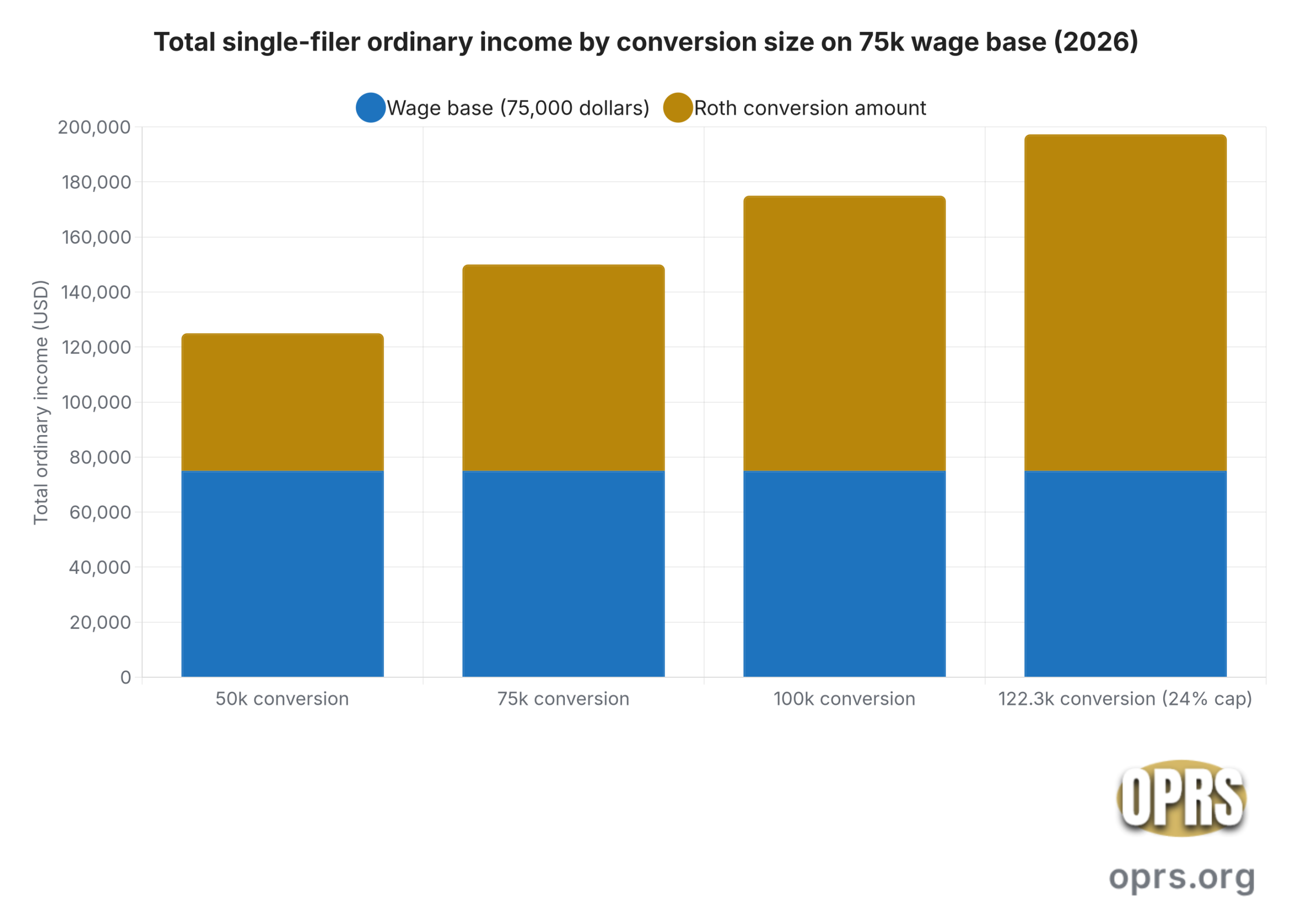
The 50 percent width ratio holds across the middle brackets and is the most important number for sizing a post-divorce ladder. For a 195,000 dollar AGI target on a joint return, the same target on a single return would just barely stay inside the 24 percent bracket. For a 250,000 dollar AGI target on a joint return, the same target on a single return spills into the 35 percent bracket. The ladder rebalances around those new ceilings.
The chart below maps the 2026 single-filer bracket ceilings against three illustrative conversion sizes. The OPRS desk sees these conversion amounts regularly in the divorced 55 to 60 audience: 50,000 dollars, 75,000 dollars, and 100,000 dollars of annual conversion stacked on top of a 75,000 dollar wage base. The visual makes the spillover risk concrete.
Building the ladder: the five-step annual cycle
The ladder is not a one-time decision. It is a repeated five-step cycle run each tax year for the duration of the bracket-arbitrage window. The order matters because steps two and three depend on a projection that cannot be done in December once the year is mostly closed.
Run the cycle by mid-October each year. The IRS deadline for a Roth conversion is December 31, not the April 15 filing date that applies to contributions under IRC Section 408A(c)(7). Once the calendar year closes, the conversion is locked and cannot be unwound; the Tax Cuts and Jobs Act of 2017 repealed the Roth recharacterization option that previously allowed reversal under IRC Section 408A(d)(6).
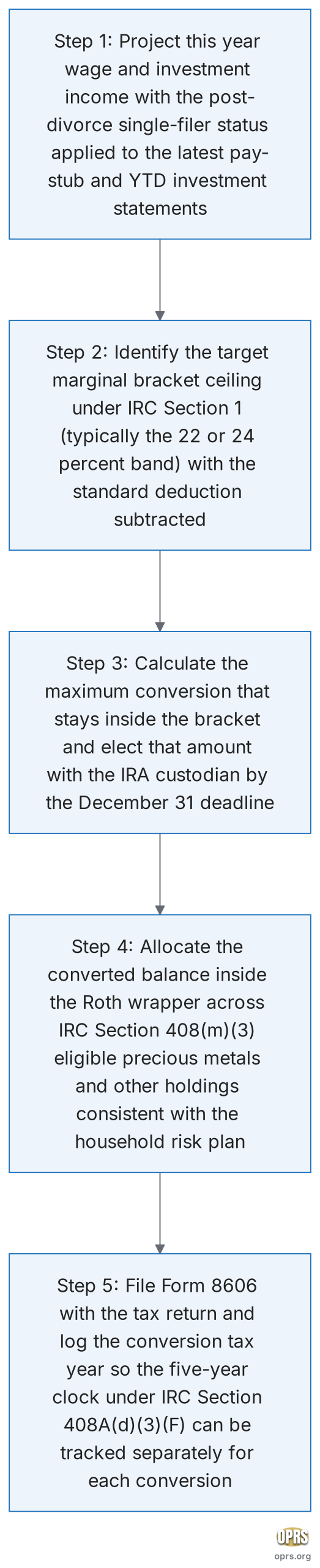
Two operational notes. First, the custodian needs the explicit dollar amount and the source and destination IRA account numbers. A partial conversion does not require liquidating positions if both the Traditional and Roth IRAs are at the same custodian. Second, the conversion amount goes on Form 1040 line 4b as taxable IRA distribution. Any nontaxable basis tracking goes on Form 8606 Part II.
The pro-rata trap on a Traditional IRA with mixed basis
If the Traditional IRA balance includes any nondeductible contribution basis, the pro-rata rule in IRC Section 408(d)(2) applies. Basis typically arises from years when the recipient earned over the deduction phase-out under IRC Section 219(g) and made nondeductible contributions reported on Form 8606 Part I.
The rule treats every Traditional IRA across all IRAs of the same taxpayer as a single account for the conversion basis calculation. The tax-free fraction of any conversion equals the cumulative nondeductible basis divided by the year-end total Traditional IRA balance. The taxpayer cannot designate a specific dollar of basis to convert.
For a divorced filer who received the QDRO carve-out as a Traditional IRA rollover, the basis on the rolled balance is whatever portion of the original Traditional IRA basis was assigned in the QDRO order. If the pre-divorce Traditional IRA had no nondeductible contribution history, the rolled balance has no basis and 100 percent of every conversion is taxable.
If the marital Traditional IRA did have basis, the divorce decree or the QDRO order should allocate it; the default in most state-court QDROs is a pro-rata split of basis with the principal allocation.
A workaround sometimes used by high-income earners is the IRC Section 408(d)(3)(A)(ii) reverse rollover of pre-tax Traditional IRA balance into an employer 401(k) plan, leaving only nondeductible basis in the Traditional IRA. The next conversion is then 100 percent tax-free up to the basis amount. The workaround requires an employer plan that accepts incoming IRA rollovers and that explicitly allows separate-tracking of pre-tax dollars (not all do; check the summary plan description).
IRS-eligible precious metals inside the Roth wrapper
Once the converted dollars land inside the Roth IRA, the allocation decision opens. The same IRC Section 408(m)(3) eligibility rules that apply to a Traditional self-directed IRA apply to the Roth self-directed IRA. That means gold at 0.995 fineness, silver at 0.999, platinum at 0.9995, and palladium at 0.9995, in coins or bars from approved refiners.
The metals must sit with an IRS-approved depository, not in personal storage. The IRC Section 408(m) text governs both the eligibility and the prohibited-transaction perimeter; the IRS Publication 590-A companion text walks through the practical rollover and contribution mechanics.
The Roth wrapper changes the after-tax math on precious-metals appreciation. In a Traditional self-directed IRA, the metals appreciate tax-deferred and any gain is taxed at ordinary rates when distributed.
In a Roth self-directed IRA, the metals appreciate tax-free. Qualified distributions after the IRC Section 408A(d)(2) five-year-plus-age-59-and-a-half test are tax-free at withdrawal. For a divorced 55 year old running a ten-year conversion ladder, the first converted balance becomes principal-accessible at age 60, five years after conversion. The gain inside that balance becomes qualified at age 60 as well, since the Roth IRA was established at age 55 or earlier in this profile.
The five-year clock for qualified distribution of gain runs from the first Roth IRA established, not from each conversion.
For the allocation slice itself, the conservative range for a precious-metals percentage of total Roth IRA dollars is 5 to 15 percent. Anything above 25 percent concentrates currency-debasement risk and reduces optionality for rebalancing into other Roth-held positions; anything below 3 percent does not move the household allocation meaningfully.
The OPRS desk treats 10 percent as the default starting point for a post-QDRO rebuild Roth IRA and adjusts up or down based on the rest of the household balance sheet.
The dealer-side vetting matters before any rollover into a self-directed IRA holds metals. The OPRS list of gold IRA dealers we currently warn against covers the operators whose intake process targets divorced clients during the emotional window around a decree.
Common mistakes the OPRS desk sees in post-divorce ladders
- Converting a fixed dollar amount each year instead of a bracket-fill amount. A 75,000 dollar annual conversion looks consistent but spills into the next bracket in years when wage income is higher or investment income is concentrated in capital-gain realizations. Re-project each year and let the maximum conversion size float with the actual income picture.
- Ignoring the IRMAA Medicare premium thresholds at age 63 and older. A Roth conversion two years before Medicare enrollment lands on the IRMAA lookback for the first Medicare year. The 2026 IRMAA brackets under 42 U.S. Code Section 1395r add a Part B and Part D surcharge for AGI above 106,000 dollars single. The marginal tax cost of a conversion that lifts AGI across an IRMAA tier is the income tax plus the surcharge for two years.
- Routing the conversion through the alimony cash and assuming it is IRA-eligible compensation. Post-2018 TCJA alimony is not IRA compensation under IRC Section 219(f)(1). The conversion itself does not require compensation, but a regular Roth contribution funded with alimony cash does. Do not mix the two mechanics.
- Skipping Form 8606. Every conversion year requires Form 8606 Part II showing the conversion amount, basis fraction if any, and taxable portion. Filing without the form triggers an IRS notice and can extend the statute of limitations on the return.
- Locking metals storage with a dealer who also serves as custodian. The IRC Section 408(m) and IRC Section 4975 prohibited-transaction rules require independent custodial control. A dealer that handles both is a structural conflict and a recurring scam pattern documented by state regulators in past enforcement actions.
- Underestimating the spousal-IRA-to-Roth path for the remarried filer. After remarriage on a joint return, the new spouse’s earned income under IRC Section 219(c) restores spousal IRA contribution capacity that the post-2018 TCJA alimony rule removed, opening a separate Roth contribution lane parallel to the conversion ladder.
The remarriage point matters for the late-starter rebuild specifically. A late-50s or early-60s remarriage, after a 5 to 10 year first-divorce gap, restores a household-level IRA contribution lane. It also keeps the account clean for your spouse or heirs in the eventual estate plan.
FAQ
Does the conversion ladder require a separate Roth IRA for each conversion year?
No. A single Roth IRA holds every annual conversion. The five-year clock under IRC Section 408A(d)(3)(F) is tracked at the conversion level by tax year, not by separate account. The clean tracking method is a household spreadsheet listing each conversion year, dollar amount, and the five-year-clock anniversary.
The IRA custodian’s Form 5498 each year reports each conversion separately. The corresponding Form 1099-R reports the distribution-leg of the conversion.
If I am 56 and convert 50,000 dollars this year, when can I withdraw that converted principal without the 10 percent additional tax?
The five-year clock under IRC Section 408A(d)(3)(F) on the converted principal expires at age 61 (five years from the conversion). At that point the 50,000 dollar principal is accessible without the IRC Section 72(t) 10 percent additional tax even though you are still under age 59 and a half.
The gain on that 50,000 dollar balance is qualified for tax-free withdrawal once the broader Roth-IRA five-year clock under IRC Section 408A(d)(2)(B) and age 59 and a half are both met. For a Roth IRA established at age 55, both tests are satisfied at age 60.
How does the QDRO IRC Section 72(t)(2)(C) penalty waiver interact with the conversion ladder?
The IRC Section 72(t)(2)(C) waiver applies to qualified-plan distributions made directly to the alternate payee under a QDRO. The waiver does not survive a rollover into the alternate payee’s own IRA, and it does not apply to a Roth conversion.
The conversion is a taxable distribution from the Traditional IRA followed by a contribution to the Roth IRA. The 10 percent additional tax on the converted amount before age 59 and a half is governed by the five-year clock under IRC Section 408A(d)(3)(F), not by the QDRO waiver.
Should I convert all 200,000 dollars in one tax year if I can absorb the tax?
Almost never. A single-year 200,000 dollar conversion stacked on a 75,000 dollar wage base for a single filer crosses the 32 percent bracket and likely the 35 percent bracket in 2026. Spreading the same 200,000 dollars over a five-year ladder at 40,000 dollars per year keeps each conversion inside the 24 percent bracket on the same wage base. That saves 8 to 11 percentage points of marginal tax on the upper portion. Compare in advance with a multi-year projection.
Can I hold IRS-approved precious metals in the Roth from day one, or do I have to convert into cash first?
A Roth conversion of a Traditional IRA held as IRC Section 408(m)(3) precious metals can be executed in-kind under two conditions. Both the Traditional and Roth IRAs must be at a custodian that allows in-kind conversion, and the depository agreement must permit the wrapper change without a sale. In practice most divorced filers convert through cash, because the QDRO carve-out typically arrived as cash. The converted dollars are then allocated into precious metals inside the Roth at the dealer-rollover stage.
The first 90 minutes of work on a post-divorce conversion ladder are the most productive 90 minutes a divorced filer in the OPRS audience can spend in the year after the decree. Project this year’s wage income, investment income, and any QDRO-derived rollover balance under the new single-filer status. Pull the IRS revenue procedure that publishes the current-year bracket bands.
Subtract the standard deduction (single, 15,000 dollars approximate for 2026 per IRS Notice 2024-80). Set the conversion size at the dollar amount that fills the 22 percent or 24 percent bracket without spilling into the next band.
Then choose the custodian and dealer for the Roth IRA precious-metals allocation slice. The OPRS list of the gold IRA operators we currently warn against covers the bad actors whose intake process targets divorced clients during the emotional window around a decree.
Once the dealer pool is narrowed, request the free company comparison checklist (compensated link). The intake stays informational; the conversion-sizing decision and the IRC Section 408A(d)(3)(F) clock-tracking stay with you and your tax advisor.
Consult your tax advisor before any Roth conversion is initiated in the year following a divorce, separation modification, or remarriage. The IRC Section 408A conversion is irreversible once the calendar year closes. Past performance of any asset class, including IRS-eligible precious metals, is not a guarantee of future results.
Sources cited
- 26 U.S. Code Section 408A: Roth IRA contribution, conversion, and qualified distribution rules
- 26 U.S. Code Section 408(d)(2) and 408(m)(3): pro-rata rule and IRS-eligible precious metals definitions
- 26 U.S. Code Section 72(t)(2)(C): QDRO exception to the 10 percent additional tax on early distributions
- 26 U.S. Code Section 414(p): qualified domestic relations order definition
- 26 U.S. Code Section 219: deduction for retirement savings, compensation definition, and spousal IRA rule
- 26 U.S. Code Section 4975: prohibited transactions and self-directed IRA control rules
- IRS Publication 590-A: Contributions to Individual Retirement Arrangements, conversion mechanics chapter
- IRS Publication 590-B: Distributions from Individual Retirement Arrangements, qualified distribution test
- IRS Notice 2024-80: 2026 cost-of-living adjustments for retirement plans (IRA limits, catch-up)
- 42 U.S. Code Section 1395r: Medicare Part B income-related monthly adjustment amount (IRMAA) thresholds
- Public Law 115-97 (Tax Cuts and Jobs Act of 2017), Section 13611: repeal of Roth conversion recharacterization
More on OPRS
- QDRO divorce rollover rules: IRC Section 414(p) and the Section 72(t)(2)(C) waiver
- Gold IRA after divorce: the 55-year-old alternate payee rebuild
- Late starter gold IRA strategy: the 55 to 65 ten-year window
- Catch-up contributions for the age 50+ gold IRA saver in 2026
- Alimony tax rules pre-2019 vs TCJA and the retirement impact
- The 2026 OPRS list of gold IRA dealers we warn against