

Updated: July 2, 2026
OPRS may receive compensation when readers open an account through partner links on this page. Our analysis is based on independent research, BBB data, and IRS publications.
The limit is statutory, not a matter of bank policy. A depository institution qualifies as an IRA trustee for conventional assets, but physical metals, farmland, and private notes require a non-bank custodian approved under Treas. Reg. §1.408-2(e). The local relationship that handles the cash side competently simply has no authority over the metals side.
For a retiree who keeps a Traditional IRA at the local bank and wants to add a slice of physical metals, the practical question has three parts. Should you move the whole account, move part of it, or keep both side by side?
The answer turns on what the bank’s custodial agreement actually permits, how the two fee structures compare on a real $400,000 balance, and how the trustee-to-trustee transfer mechanics work without triggering a taxable distribution. See the 2026 OPRS dealer list if a dealer is the next step in that decision, because most failed switches happen at the dealer-selection step, not at the bank-side paperwork step.
The 30-second verdict
- For a farmer or rural retiree who only wants cash, CDs, and mutual funds inside an IRA: keep the local bank as custodian. The fees are low, the in-person service is real, and the IRS allows banks to act as IRA trustees under IRC §408(a)(2)(A).
- For the same retiree who wants to add IRS-approved gold or silver to the IRA: open a self-directed IRA at a non-bank custodian for that slice, leave the cash and CD side at the local bank.
- For a retiree who wants to hold farmland, private notes, or LLC interests inside an IRA: the rural bank cannot do it. A self-directed IRA custodian under Treas. Reg. §1.408-2(e) is the only path.
- Overall: the two are not competitors. They are different tools that often work best together on the same balance.
What a rural bank actually does as an IRA custodian
Under IRC §408(a)(2)(A), an IRA must be held by a trustee or custodian: either a bank, a federally insured credit union, or a savings and loan. Non-bank entities qualify if the IRS has separately approved them under Treas. Reg. §1.408-2(e). A community bank with FDIC insurance qualifies automatically. That is why your local bank can offer an IRA without any additional IRS filing.
The bank acts as the legal account holder and the recordkeeper. It accepts contributions, processes rollovers from a prior 401(k) or another IRA, and issues Form 5498 each May for contributions and Form 1099-R for distributions. It also calculates the required minimum distribution at age 73 under IRS Publication 590-B, and withholds federal income tax when you take a distribution.
The bank does NOT advise on what to invest in. The advice side, if any, sits with a trust officer or a referred broker, and the investment menu is restricted to what the bank itself can hold.
That restriction is the whole point of this comparison. A rural community bank IRA almost always permits four asset types: an FDIC-insured savings account, certificates of deposit issued by the bank, and money-market funds. Through a referral to a broker subsidiary, the bank also offers a basic menu of mutual funds and ETFs.
It does NOT permit physical precious metals, real property, private debt, LLC interests, or alternative assets. The bank’s custodial agreement, the document you sign at account opening, lists the permitted investments in a short paragraph. Pulling that agreement out of the file cabinet is step one of this decision.
What a self-directed IRA custodian actually does
A self-directed IRA (SDIRA) custodian is a non-bank trustee that the IRS has approved under Treas. Reg. §1.408-2(e). The IRS keeps a public list of approved non-bank trustees and custodians. The current 2024 list is published in the IRS Non-Bank Trustees and Custodians Listing. The list runs to roughly 80 firms. Equity Trust Company, STRATA Trust Company, Madison Trust Company, and Kingdom Trust are among the most active on the precious metals side.
Where a rural bank custodial agreement restricts investments to cash, CDs, and mutual funds, an SDIRA custodial agreement opens the menu to anything the IRS does not explicitly prohibit. The prohibitions are listed at IRC §408(m): collectibles, life insurance, S-corporation stock, and a few narrow exceptions.
Within the allowed universe, the SDIRA holder can direct the custodian to hold IRS-approved gold (.995 fineness or higher, with the American Gold Eagle as the statutory exception). Silver (.999 fineness or higher) and platinum and palladium (.9995 fineness or higher) are also permitted. The menu also includes farmland leased to a third party at arm’s length, private mortgage notes, LLC interests in operating businesses the account holder does not control, and similar alternative assets.
The SDIRA custodian does NOT pick the asset, NOT vet the dealer, and NOT advise on suitability. The custodian’s role is to receive the directive in writing, execute the purchase, hold the legal title in the IRA’s name, and report it on Form 5498 each May. The investment direction comes entirely from the account holder.
For IRS-approved metals specifically, the custodian also coordinates with an IRS-approved depository. That coordination is required because home storage was rejected by the Tax Court in McNulty v. Commissioner, 157 T.C. No. 10 (2021). In that case, the entire IRA balance was reclassified as a taxable distribution plus an accuracy-related penalty.
Side by side: rural bank IRA vs self-directed IRA custodian
| Criterion | Rural community bank IRA | Self-directed IRA custodian |
|---|---|---|
| IRS legal basis | IRC §408(a)(2)(A), bank trustee | Treas. Reg. §1.408-2(e), approved non-bank trustee |
| Permitted assets | Cash, CDs, money-market, mutual funds, ETFs | All of the above PLUS IRS-approved metals, real estate, private notes, LLC interests |
| Holds IRS-approved gold or silver | No | Yes (at an IRS-approved depository) |
| Holds farmland or rental property | No | Yes (arm’s-length only) |
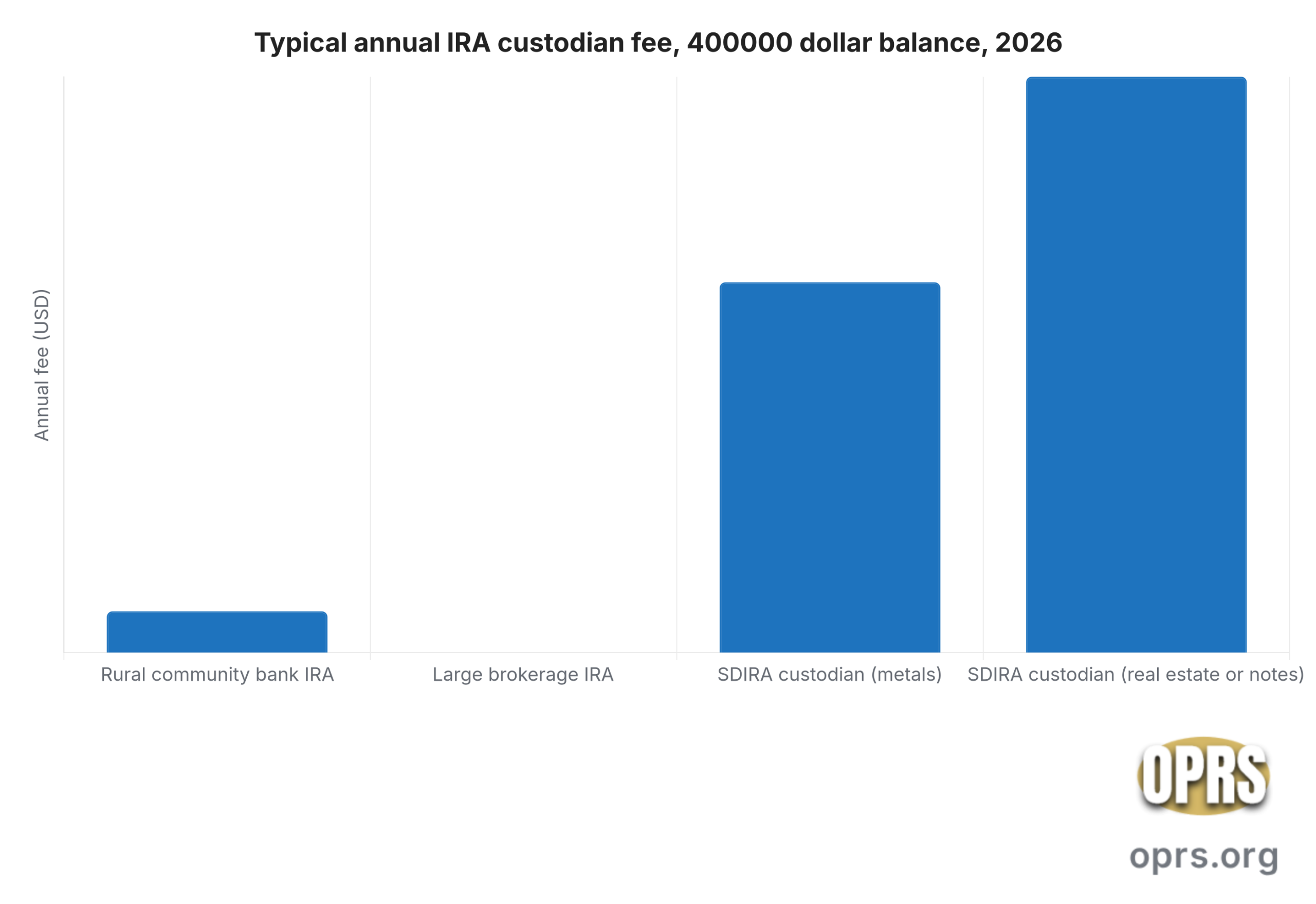
| Typical annual fee, $400k balance | $0 to $50 | $225 to $350 (metals) or $350+ (real estate) |
| Setup fee | Often $0 | $50 to $100 |
| FDIC insurance on cash portion | Yes, up to $250,000 per category | Yes on uninvested cash sweep, varies by custodian |
| In-person service | Yes, at the local branch | Phone or web only |
| RMD calculation and Form 5498 issuance | Yes | Yes |
| Federal withholding on distributions | Yes, default 10% on IRA | Yes, default 10% on IRA |
| Trustee-to-trustee transfer to another custodian | Yes, by signed direction | Yes, by signed direction |
How the fee gap actually behaves on a $400,000 balance
The rural bank fee on a $400,000 IRA is typically $25 to $50 per year, often waived for balances above $50,000.
The self-directed IRA custodian fee for an account holding IRS-approved metals is typically $225 per year, a flat-rate custody fee at Equity Trust or STRATA. Add a depository storage fee in the range of $100 to $150 per year depending on segregated versus non-segregated storage.
The combined SDIRA-plus-depository cost lands near $325 to $400 per year on a $400,000 balance, against the bank’s $25.
On a 20-year retirement horizon the cumulative fee difference is roughly $7,000. That is a real cost.
Whether it earns its keep depends on what you want the metals slice to do. Inflation hedging, portfolio diversification, and an asset that has survived the cycles of the last 50 years of inflation history are all common goals. It also depends on whether the metals slice is large enough to make the fee economical.
A common rule of thumb: an IRS-approved metals position smaller than $50,000 carries a fee drag that often exceeds the diversification benefit.
Above $100,000, the fee drag falls under 0.5% per year, which is in the same range as a typical actively managed mutual fund.
Splitting the balance is usually the cleanest math. Keep the cash, CDs, and mutual funds at the rural bank where the fee is near zero and the in-person service is real. Move the metals slice (say, $80,000 to $150,000 out of a $400,000 retirement balance) to a self-directed IRA at an approved custodian.
Both custodians issue separate Form 5498s each May. RMDs at age 73 can be taken proportionally from either account or aggregated under the IRA aggregation rule at Treas. Reg. §1.408-8 Q&A 9.
How the trustee-to-trustee transfer actually works
A trustee-to-trustee transfer between two IRA custodians is NOT a taxable event under IRC §408(d)(3) and the related rulings. The funds never touch the account holder’s hands. The receiving custodian (the SDIRA) initiates the transfer by sending a written transfer request to the sending custodian (the rural bank).
The sending bank processes the transfer in 5 to 15 business days, depending on whether the funds are in cash or in CDs that have not yet matured. Money in cash transfers immediately.
CDs that have not matured may incur an early-withdrawal penalty from the bank itself, but that bank-side penalty is separate from any IRS distribution rule and is not a taxable event for IRA purposes.
The mechanics are simpler than they look. The decision tree below shows the five steps a rural retiree typically follows.
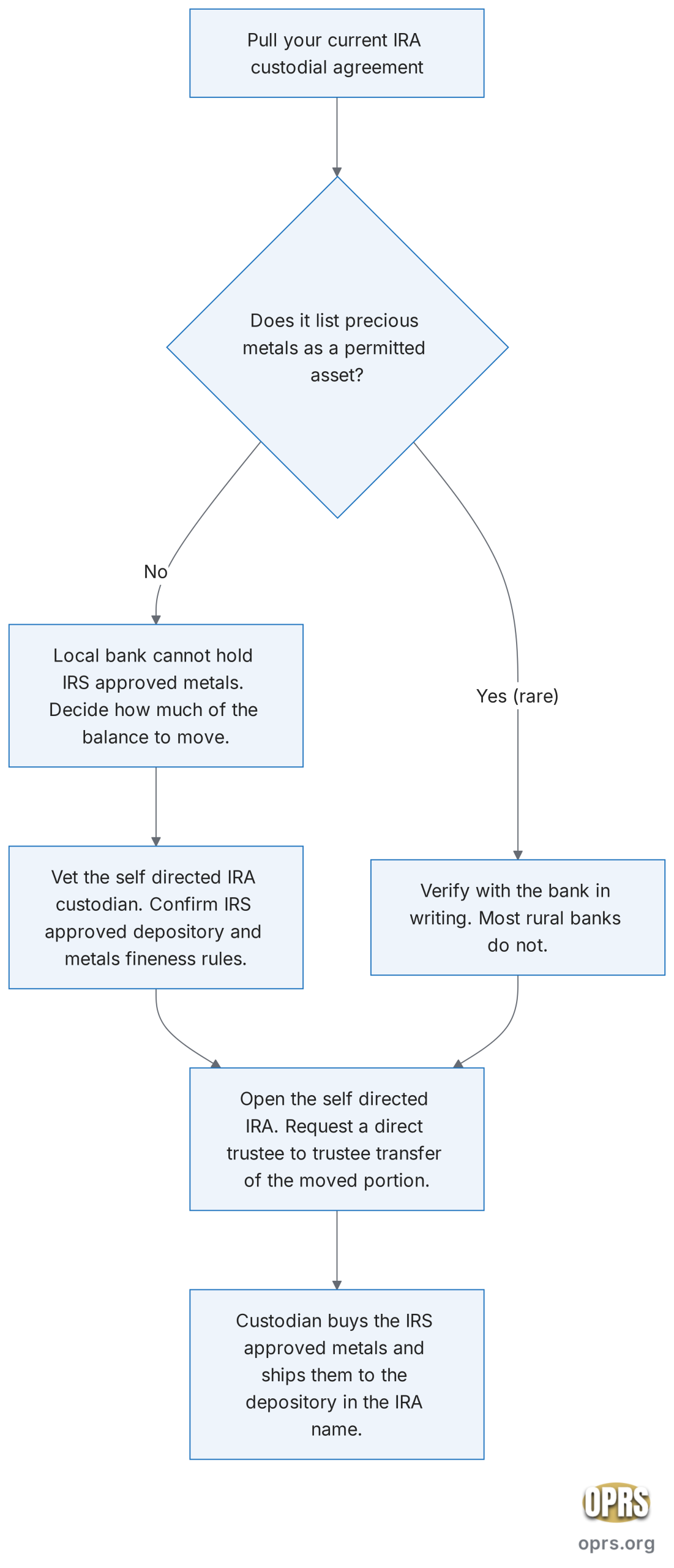
Two practical points keep this clean. First, the request must come from the receiving custodian, not from the account holder writing a check from the bank IRA to the new custodian (that path triggers indirect-rollover withholding rules and a 60-day deadline). Second, the transfer must specify a trustee-to-trustee transfer in writing, NOT a distribution and re-contribution.
The Form 1099-R issued by the sending bank should show a code G (direct rollover) or no 1099-R at all. If the transfer is processed as a true custodian-to-custodian transfer, no 1099-R is required for direct transfers between IRAs of the same type per IRS instructions.
Verdict per profile
Profile A. Rural retiree, $400,000 IRA at the local bank, only wants cash and CDs. Stay with the bank. The fee is near zero, the FDIC coverage runs up to $250,000 per IRA category, and the in-person service at the local branch matters more than any feature the SDIRA adds for this profile. No move is needed.
Profile B. Rural retiree, $400,000 to $700,000 IRA at the local bank, wants to add 15% to 25% in physical gold or silver. Split. Keep $300,000 at the bank in CDs and money-market. Open a self-directed IRA at an approved non-bank custodian and move $80,000 to $175,000 to fund the metals slice.
The combined SDIRA-plus-depository fee runs $325 to $400 per year on the metals slice, which is the cost of adding the asset class. The split keeps the account clean for the surviving spouse, with the bank side handling the spend-down and the SDIRA side handling the inheritance asset.
Profile C. Land-rich rural retiree with $400,000 IRA and $2 million in farmland already outside the IRA. The land is already owned outright. Do NOT bring the existing farmland into the IRA. The IRS prohibited-transaction rules under IRC §4975 disallow the account holder, spouse, parent, or lineal descendant from being the seller of an asset to their own IRA.
For the IRA balance itself, the choice between staying with the bank and moving to an SDIRA turns on whether the retiree wants metals exposure. If yes, follow Profile B. If no, stay with the bank.
Profile D. Retiree near or past RMD age 73, taking the RMD as a burden. The RMD calculation runs the same way at the rural bank, the brokerage, and the self-directed custodian. The Uniform Lifetime Table at IRS Publication 590-B Appendix B sets the divisor. The IRA aggregation rule under Treas.
Reg. §1.408-8 Q&A 9 lets the retiree calculate the RMD across all owned Traditional IRAs and take it from whichever single account is most convenient. Splitting between the bank and an SDIRA does NOT add an RMD calculation step. It does add one Form 5498 each May for tracking.
When neither setup fits
Two situations push the decision outside this comparison. The first is a retiree who wants to hold the farmland or rental property INSIDE the IRA itself (rather than outside it as Profile C describes). Holding real property inside an IRA is technically possible under SDIRA rules, but the prohibited-transaction restrictions at IRC §4975 are unforgiving.
The account holder cannot live on the land, cannot lease it to a parent or child, cannot personally manage it, cannot pay property tax from outside the IRA, and cannot mortgage it with personal credit. Most rural retirees who own farmland already use it personally or lease it to a family member, which puts both arrangements off-limits for inside-IRA ownership.
The second is a retiree whose total IRA balance is below $50,000 and who wants to add metals.
The flat-fee structure of SDIRA custodians, typically $225 per year regardless of balance, creates a fee drag above 0.5% per year on balances under $50,000. That often exceeds the diversification benefit. Our deeper look at the under-$100k threshold walks through the math on a $60,000 balance. It lays out the alternatives: a taxable brokerage allocation to a gold ETF, sovereign coin holding outside the IRA, or simply staying with the rural bank’s cash-and-CD setup.
Frequently asked questions
Can my local bank hold physical gold inside my IRA if I ask?
No. The bank’s IRS approval under IRC §408(a)(2)(A) covers its role as a bank trustee, but the bank’s own custodial agreement almost always restricts the asset menu to cash, CDs, and pooled funds. Pull the agreement out of the file cabinet and read the permitted-investments paragraph.
If physical metals are not listed, the bank cannot hold them inside the IRA regardless of what the account holder requests. A separate self-directed IRA at an approved non-bank custodian is the only path.
Is the trustee-to-trustee transfer a taxable event?
No, when executed correctly. A direct transfer between two IRA custodians of the same type (Traditional to Traditional or Roth to Roth) is not a distribution under IRC §408(d)(3) and the related FAQ in the IRS rollover guidance. The funds move custodian to custodian without ever passing through the account holder’s hands. No 1099-R is required for a direct trustee-to-trustee transfer.
Will the rural bank charge me to transfer the IRA out?
Most rural community banks charge a transfer-out fee of $25 to $75 per outgoing transfer, plus any early-withdrawal penalty on CDs that have not matured. The transfer-out fee is a bank-side fee, not an IRS rule, and varies by bank. The CD early-withdrawal penalty is the bank’s standard schedule (typically 90 days of interest on a short CD, 180 days on a longer CD). Neither fee is a taxable distribution for IRA purposes.
How do I verify a self-directed IRA custodian is actually IRS-approved?
The IRS publishes the current list at IRS Non-Bank Trustees and Custodians Listing. The list is updated periodically and runs to roughly 80 firms. A custodian that is not on the list cannot legally hold IRA assets under Treas. Reg. §1.408-2(e).
Also check the firm’s Better Business Bureau profile, its years in business, and whether it discloses its depository partners. The FINRA Investor Alert on precious metals fraud walks through additional red-flag patterns for the dealer side of the transaction.
If I split between the bank and a self-directed custodian, do I have to take two RMDs?
Under Treas. Reg. §1.408-8 Q&A 9, an IRA owner aggregates the year-end balances of all owned Traditional IRAs and divides by the Uniform Lifetime Table divisor. You then take the resulting RMD from any one or any combination of the accounts. Both the bank IRA and the self-directed IRA contribute year-end balances to that aggregate. Take the RMD from whichever account is most convenient, typically the bank IRA because the cash side has the most liquidity.
The cleanest sequence is to pull the bank custodial agreement first, confirm the permitted-investments list, and decide whether to split the balance before opening any new account. Where most rural retirees stumble is at the dealer-selection step on the metals side, not at the custodian step. The custodian is a recordkeeper.
The dealer is where the actual purchase happens, and dealer-selection mistakes are what convert a clean split into a costly one. See the dealers OPRS clears and the ones we warn against before signing with any dealer that contacts you about a self-directed setup.
Worth knowing before you act: a dealer that pushes a single custodian or a single depository as the only option is a warning sign, because legitimate self-directed setups work with multiple IRS-approved custodians and depositories.
More on OPRS
- RMD you do not need: what to do with the money
- Land-rich, cash-poor: IRA estate planning for rural retirees
- Plain-English RMD rules with no jargon
- Does a gold IRA make sense under a $100,000 balance?
Sources cited
- 26 U.S. Code §408 (Individual retirement accounts)
- Treas. Reg. §1.408-2 (Non-bank trustee approval)
- Treas. Reg. §1.408-8 (Distribution requirements and RMD aggregation)
- 26 U.S. Code §4975 (Prohibited transactions)
- IRS Publication 590-B (Distributions from IRAs)
- IRS Non-Bank Trustees and Custodians Listing
- IRS Rollovers of Retirement Plan and IRA Distributions
- FINRA Investor Insights: Precious Metals Fraud