

Updated: June 27, 2026
OPRS may receive compensation when readers open an account through partner links on this page. Our analysis is based on independent research, BBB data, and IRS publications.
The Securities and Exchange Commission has been publishing investor alerts about precious metals and self-directed IRA fraud since 2011 (source: SEC Office of Investor Education and Advocacy alert archive). The agency’s jurisdiction over physical bullion is narrow. The investor-protection signal in the alerts, however, applies to every retiree evaluating a gold IRA dealer in 2026.
Most retirees searching the SEC site expect a single page labeled “gold IRA scams.” There is no such page. The relevant guidance sits across a joint alert with NASAA and FINRA, recurring bulletins on affinity fraud and Ponzi schemes, and the broader investor.gov library on self-directed retirement accounts. Element I of reading the alerts is knowing which fraud patterns the SEC has actually named. Element II is matching those patterns against a specific dealer’s pitch.
The sections below cover what an SEC Investor Alert actually is, the foundational joint alert on self-directed IRAs, and the recurring fraud patterns the SEC flags. They also map where SEC reach ends and how to apply the alerts when vetting any operator. For broader operator coverage, see the 2026 OPRS list of gold IRA operators we currently caution against.
What an SEC Investor Alert is, and why one applies to gold IRA buyers
An SEC Investor Alert is a public document issued by the Office of Investor Education and Advocacy. Each alert names a fraud pattern, describes the typical pitch, and tells retail investors what to verify before sending money. Alerts are advisory and free to read. They carry no enforcement weight on their own.
The SEC publishes alerts in two formats. Investor Alerts focus on a single emerging scheme. Investor Bulletins explain a product or process at greater length. Both appear in the investor.gov alerts and bulletins library, the public-facing companion to sec.gov.
Gold IRA buyers sit at the intersection of two SEC alert categories. First, self-directed IRA fraud, where the wrapper itself becomes the vehicle for an investment scheme. Second, affinity and Ponzi fraud targeting older Americans, where a trusted-source pitch is wrapped around a precious metals or rare coin product. A 2026 retiree evaluating a dealer should read the alerts in both categories before signing anything.
The 2011 joint Investor Alert that still defines the gold IRA fraud playbook
The foundational document is the joint Investor Alert on Self-Directed IRAs and the Risk of Fraud. The SEC Office of Investor Education and Advocacy published it together with NASAA (the North American Securities Administrators Association) and FINRA (the Financial Industry Regulatory Authority). The alert was first issued in September 2011. It has remained the central retail-facing document on self-directed IRA risk.
The 2011 alert names seven specific risk factors. None of the seven assumes any particular asset class. Gold and silver IRAs map cleanly to several of them because the marketing language used to sell physical metals inside an IRA wrapper often mirrors the patterns the alert flags.
- Lack of public information. Many self-directed IRA assets, including private placements and rare metals, do not file with the SEC. The alert says investors cannot verify them through the regular EDGAR database.
- Higher risk of fraudulent schemes. The structure of self-directed IRAs gives promoters more room to misrepresent assets, valuations, and custodian roles.
- Unregistered or unlicensed sellers. The alert tells investors to check seller registration status at FINRA BrokerCheck and investor.gov.
- Custodians do not vet the investments. A self-directed IRA custodian holds the account but is not legally required to verify the quality of the underlying asset. Retirees often misread the custodian’s role as a quality screen.
- Difficulty valuing the assets. Without an active public market, the price a custodian reports can be the promoter’s stated value, not a true market price.
- Risk of Ponzi-style structures. The alert names self-directed IRAs as a recurring vehicle in Ponzi cases, including precious metals variants.
- Verification gaps. The alert recommends verifying the asset, the seller, the custodian, and any account statements independently before contributing.
The 2011 document remains the authoritative starting point. Any precious metals pitch a retiree hears in 2026 should be tested against these seven risk factors before money moves.
The fraud patterns the SEC has flagged most often in self-directed IRA gold pitches
The investor.gov alert archive describes recurring sales-pitch patterns the SEC sees in fraud cases involving precious metals retirement accounts. None of these patterns describe every gold IRA dealer in the market. Each one is a calibration tool: if the pitch you are hearing matches several patterns, slow down.
- Promises of certain or no-loss outcomes on physical metal. Bullion does not pay yield, and its spot price moves both ways. Any pitch claiming a fixed payoff on a gold coin or bar inside an IRA is, by definition, misrepresenting the asset.
- “Government-approved” framing on specific coins. The IRS approves certain coin types for IRA inclusion under 26 USC 408(m). The IRS does not endorse any seller and does not certify any specific coin’s price.
- Pressure to “act before policy changes.” A common pitch tells the retiree a tax or contribution-limit change is imminent and the call has to close today. Real tax rule changes are public on irs.gov and rarely justify same-day decisions.
- Bundled “exclusive” or “rare” coin upsells. Several SEC and state cases involve dealers selling marked-up numismatic or semi-numismatic coins after the customer asked for bullion. The numismatic premium can run several multiples of the spot value.
- Affinity framing wrapped around a Ponzi structure. The SEC’s affinity fraud page describes pitches using shared faith, military service, or political identity to bypass due diligence. Several precious metals fraud cases have used this wrapper.
- Recommendation that the customer take physical possession of IRA metal. This is a prohibited transaction under 26 USC 4975 and can disqualify the entire IRA. Any dealer suggesting it is either uninformed or steering the customer into a tax disaster.
None of these signals alone proves fraud. Two or more together justify pausing the transaction and verifying every named party against public records. The OPRS list of operators we caution against tracks dealers whose public pattern matches several of these signals at once.
Where SEC reach ends and CFTC, FTC, and state regulators take over
SEC jurisdiction over a standard depository-delivered gold IRA purchase is limited. The agency reaches a transaction when an offering is structured as a security or when a registered broker-dealer is involved. It also reaches metal sold inside a pool, leveraged program, or fractional interest that meets the legal definition of a security. Most physical bullion sold to a customer and delivered to an IRS-approved depository sits outside that scope.
The result is a layered map. SEC alerts educate the retiree. CFTC enforcement covers leveraged retail metals contracts that fail the 28-day actual delivery test under 7 USC 2(c)(2)(D). State Bureaus of Securities and state Attorneys General handle most dealer sales-practice cases. The FTC reaches deceptive advertising and the 2024 fake-reviews rule under 16 CFR Part 465. The IRS oversees the tax structure of the IRA itself.
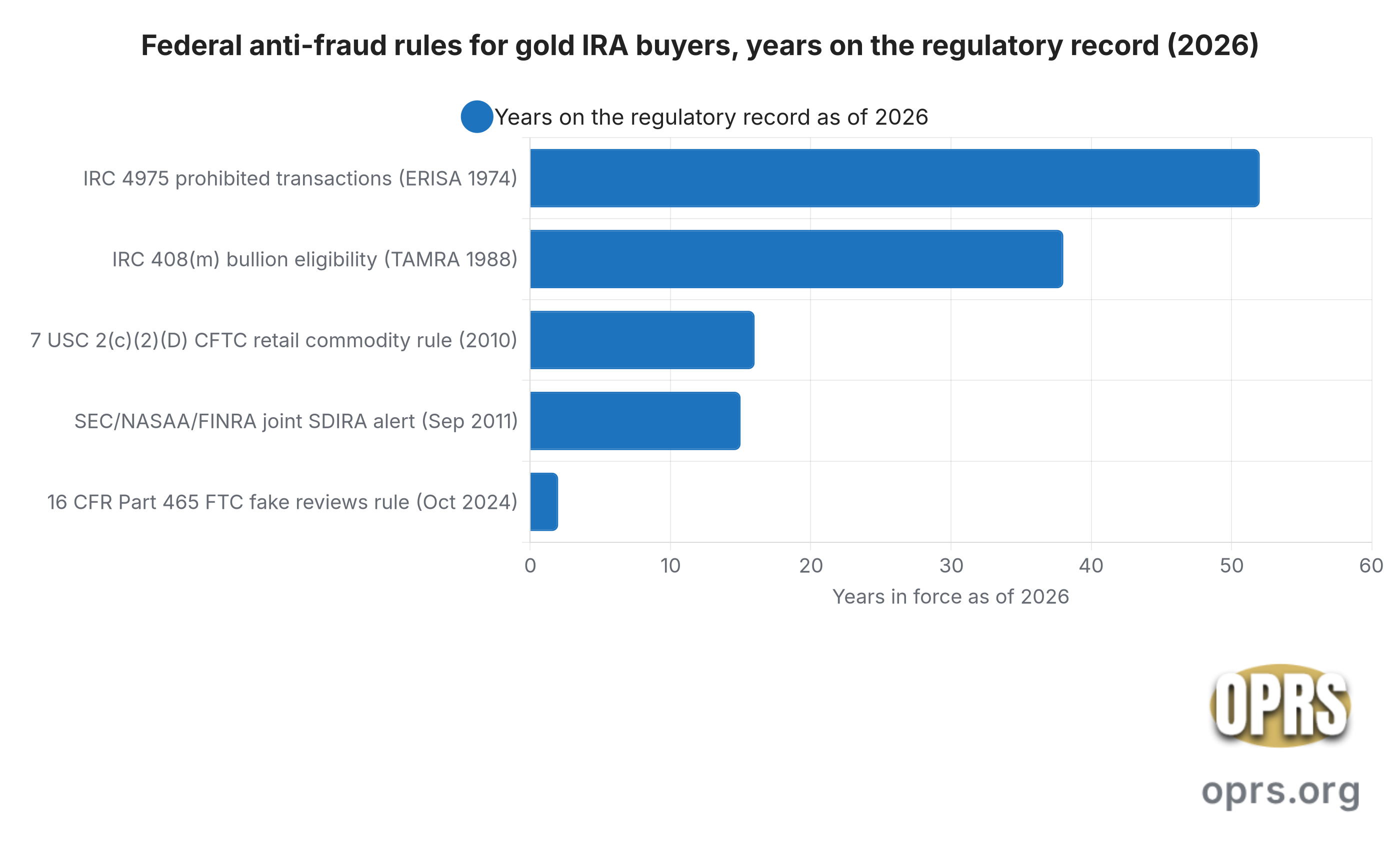
Each layer carries its own statutory vintage. The prohibited-transaction rules at IRC 4975 came in with ERISA in 1974. The IRA bullion-eligibility carve-out at IRC 408(m) was added by TAMRA in 1988 and broadened by later corrections.
The CFTC retail commodity rule arrived with Dodd-Frank in 2010. The SEC joint Investor Alert with NASAA and FINRA was published in September 2011. The FTC fake-reviews rule at 16 CFR Part 465 took effect in October 2024.
| Regulator | Typical role in gold IRA fraud cases | Coverage gap |
|---|---|---|
| SEC OIEA | Investor Alerts, bulletins, affinity-fraud pages, Investor.gov educational tools | Direct enforcement on bullion sold to depository (usually outside SEC reach) |
| SEC Enforcement | Cases where the offering is a security, broker-dealer involvement, or Ponzi schemes wrapped in metals language | Pure dealer markup and physical-coin sales practices |
| FINRA | BrokerCheck records and sanctions on registered representatives selling metals products | Unregistered sellers and pure dealer staff |
| NASAA + state regulators | Most active docket on dealer sales practices, often coordinated multistate filings | Tax structure and federal-preemption areas |
| CFTC | Leveraged retail commodity cases, RED List, customer advisories | Most depository-delivered bullion |
| FTC | Deceptive advertising, fake-reviews rule, Telemarketing Sales Rule | Dealer licensing and IRA structure |
| IRS | Tax rules on IRA structure, prohibited transactions, eligible coin types | Dealer markup and advertising claims |
When a retiree finds a 2025 or 2026 news headline citing an SEC alert about gold IRAs, the first question is which regulator the alert references and which other regulator is doing the active enforcement. The patterns the SEC flags often produce CFTC, FTC, or state-level filings months or years later.
How to read an SEC Investor Alert and apply it to a dealer in front of you
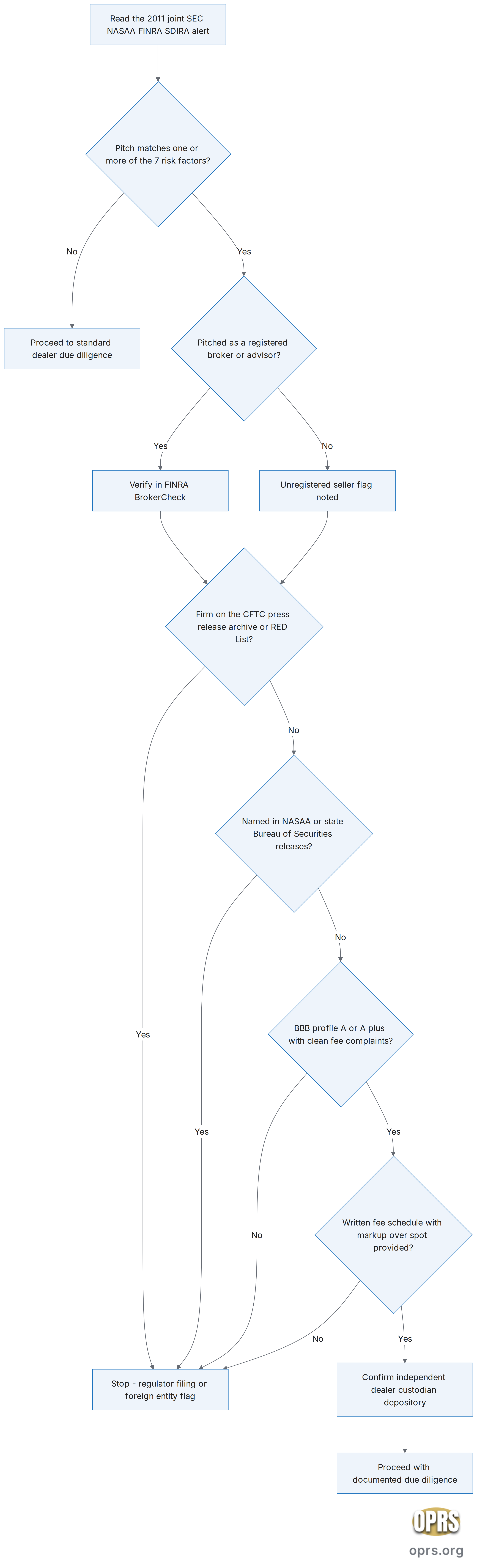
A retiree who reads the 2011 alert in isolation may feel paralyzed by it. The point of the alert is the opposite. It is a checklist to apply to a specific dealer, not a verdict on the asset class. The decision logic below shows how to move from a generic SEC alert to a yes-or-no answer on a specific operator.
Common retiree mistakes after reading an SEC alert
Reading the joint Investor Alert produces several predictable overreactions. Each one costs money or causes a worse outcome than measured vetting would.
- Mistake 1: assuming every gold IRA company is the pattern the alert describes. The alert names risk factors. Several dealers in the market have long-standing A or A+ BBB records, written fee disclosure before purchase, and salaried (not commission-paid) educators. The category label “gold IRA dealer” covers both ends of the spectrum.
- Mistake 2: walking away from precious metals entirely. Reactive avoidance is its own cost. A retiree who wanted a diversification position and now holds none because of generalized distrust has solved the wrong problem. The right response is tighter dealer vetting, not abandonment of the asset class.
- Mistake 3: treating the absence of an SEC case as a clean record. Most dealer sales-practice cases live at the state level. A dealer with no SEC enforcement history can still have state Bureau of Securities consent orders, BBB complaint patterns, or CFTC RED List exposure. The records are independent and need separate checks.
- Mistake 4: trusting a self-directed IRA custodian as a quality screen. The 2011 alert is explicit on this. The custodian holds the account, not the due diligence. Asking the custodian whether a dealer is “okay” is asking the wrong party.
- Mistake 5: misreading a numismatic coin as IRA-eligible. A dealer recommending heavily marked-up rare coins inside an IRA may be steering the customer into both excess cost and IRS-eligibility risk. The IRS coin-eligibility list is narrow. Most semi-numismatic coins fail it.
A 7-step verification using SEC, FINRA, NASAA, and BBB resources
The verification sequence below uses only public data. Each step takes a few minutes. Run them in order. If any step returns a red flag, the dealer is not worth the risk regardless of how persuasive the sales pitch sounds. See the OPRS shortlist of operators we caution against for an applied example of this framework.
- Read the joint SEC/NASAA/FINRA Self-Directed IRA alert end-to-end. Open the 2011 joint alert PDF directly. The seven risk factors are the baseline screening criteria for any dealer pitch.
- Search the investor.gov alerts and bulletins archive for the dealer name. Go to the investor.gov alerts library and search the firm legal name plus any known DBA. A named appearance in an SEC alert is a heavy negative signal.
- Run FINRA BrokerCheck on any registered representative pitching the account. Many dealer salespeople are unregistered. If the pitch invokes a “broker” or “advisor” title, verify the person at brokercheck.finra.org.
- Search the CFTC press release archive and RED List. The CFTC press release archive and CFTC RED List catch leveraged-metals and foreign-entity flags the SEC may not reach.
- Check NASAA state-securities enforcement records. NASAA aggregates state enforcement at nasaa.org enforcement reports. Also search the firm name in your own state Bureau of Securities releases.
- Verify the BBB profile and complaint pattern. Search the firm at bbb.org. Look for an A or A+ rating with a clean fee-related complaint history. Pattern matters more than letter grade alone.
- Request a written fee schedule with markup over spot before any wire. A dealer that refuses, hedges, or quotes only an “all-in” price without a spot reference is signaling the markup is high. Confirm structural independence between dealer, IRS-approved custodian, and IRS-approved depository.
Two related OPRS pages extend this analysis. The map of which regulators cover which slice of a gold IRA transaction details the legal seams the SEC alert sits inside. The CFTC enforcement recap for 2026 shows what an actual court filing looks like when the patterns the SEC named in 2011 produce litigation.
Does an SEC alert mean I should avoid gold IRAs entirely?
No. The alerts are a calibration tool, not a category verdict. Use them to set the minimum bar for any dealer evaluated. The bar covers no named SEC alert match, no FINRA BrokerCheck issues, no CFTC filings or RED List presence, and a clean NASAA state record.
It also covers an A or A+ BBB rating with a clean fee-complaint pattern and structural independence between dealer, custodian, and depository. Dealers that clear those gates operate on a different standard than the firms the SEC and state regulators have flagged.
Some operators in the market lean on the educational side of the funnel. Augusta Precious Metals publishes a free company comparison checklist that walks through dealer-vetting questions a retiree should ask. The firm operates an Education-First process built around learn, talk, and decide.
Augusta has been BBB A+ accredited since 2014. It has been named Money Magazine’s Best Overall Gold IRA Company every year from 2022 through 2026. Investopedia named it Most Transparent Gold IRA Company across the same window. The Augusta program also received Education-First recognition for its salaried, non-commissioned educator model.
Augusta’s industry-reported minimum sits around $50,000 for gold IRA accounts. None of this exempts a reader from running the seven verification steps above. It does help illustrate what a clear public record looks like in 2026. See the OPRS shortlist for the alternative operators with lower thresholds we currently clear.
If you are evaluating a gold IRA dealer right now, apply the verification framework the SEC alerts codify. Run the seven-step check above against any company on your shortlist before opening an account. That single discipline absorbs most of the lesson from the 2011 joint alert and the ongoing investor.gov bulletin archive.
Run the same checklist against a dealer that has cleared the bar
Augusta offers a free buyer-beware checklist that walks through common dealer pressure tactics matching the SEC alert risk factors. (OPRS may receive compensation when readers proceed.)
Augusta’s industry-reported minimum sits around $50,000 for gold IRA accounts. If you have less and want to start smaller, the shortlist names two alternatives with lower thresholds.
3 of 27+ gold IRA dealers reviewed by OPRS make the 2026 trusted list. Updated June 2026.
Sources cited
- SEC, NASAA, FINRA joint Investor Alert: Self-Directed IRAs and the Risk of Fraud (2011)
- SEC Office of Investor Education and Advocacy alert archive
- Investor.gov alerts and bulletins library
- Investor.gov page on affinity fraud
- SEC Office of Investor Education and Advocacy
- FINRA BrokerCheck
- 26 USC 408(m), IRS rules on collectibles in retirement accounts
- 26 USC 4975, IRS prohibited transaction rules
- 7 USC 2(c)(2)(D), CFTC retail commodity rule
- 16 CFR Part 465, the 2024 FTC fake reviews rule
- CFTC press release archive
- CFTC RED List of unregistered foreign entities
- NASAA annual enforcement reports
- Better Business Bureau company search
Consult your tax advisor for your specific situation. Past performance is not a guarantee of future results.