
Updated: August 9, 2026
OPRS may receive compensation when readers open an account through partner links on this page. Our analysis is based on independent research, BBB data, and IRS publications.
The SECURE Act 2.0 was enacted December 29, 2022 as Title I of the Consolidated Appropriations Act, 2023 (Public Law 117-328). It staggered more than ninety retirement-plan changes across a phase-in schedule. That schedule runs from 2023 through 2033.
For a retired corporate executive in the 60-to-65 bracket with a $1-3M qualified balance plus a defined-benefit pension and an RSU or NUA position, several of those changes hit operational planning in 2026 specifically.
The required minimum distribution age, the catch-up contribution rules, the Roth treatment of employer accounts, and the missed-RMD excise tax all moved during the SECURE 2.0 phase-in. Any dealer relationship a retiree opens for a precious-metals component operates inside those new rules for the entire distribution window.
The 2026 OPRS reality check on gold IRA dealers, the dealers we would not pass to an heir, is the operational backdrop against which the rules below get executed.
The seven changes catalogued below are not the full SECURE 2.0 list. They are the changes that meaningfully redirect a 2026 retirement-planning decision for a high-net-worth retiree with pension, RSU, and qualified-plan exposure. For the parallel discussion of how SECURE 2.0 affects an adult-child inheritance scenario specifically, our SECURE Act 2.0 adult-child beneficiary rules covers the 10-year drain mechanics in detail. Updated August 9, 2026.
Before you commit a 2026 rollover to a precious-metals dealer
The dealer relationship a retiree opens in 2026 will sit inside the SECURE 2.0 distribution framework for the full RMD window. A dealer the retiree later cannot reach, that loses BBB accreditation, or that surfaces in a CFTC enforcement action is a dealer the heirs inherit alongside the metals. Our 2026 reality check names the operators we would not pass to an heir, the few we currently consider acceptable, and the public BBB and regulatory actions behind each verdict.
3 of 27+ gold IRA dealers reviewed by OPRS make the 2026 trusted list.
Why 2026 sits at the SECURE 2.0 implementation cliff
The 2026 calendar year is the first full year in which the deferred provisions of SECURE 2.0 operate at scale.
The transitional RMD relief extended through IRS Notices 2022-53, 2023-54, and 2024-35 expired with the 2024 distribution year. The final SECURE regulations were published in the Federal Register on July 19, 2024 (89 FR 58886). Several SECURE 2.0 provisions whose effective date was 2024 or 2025 are now operationally binding.
The retiree who treats 2026 as a pre-SECURE planning year ends up filing under rules that no longer exist.
The changes below are sequenced in the order a $1-3M-balance retiree typically encounters them. The RMD age question comes first. Then the contribution-side rules affecting ongoing deferrals. Then the inheritance and beneficiary mechanics for the estate document. Finally the penalty regime that touches every missed deadline along the way.
Change 1: The RMD age is 73 through 2032, rising to 75 in 2033
SECURE 2.0 §107 raised the required beginning date for required minimum distributions from age 72 to age 73. That increase applies to individuals reaching age 72 after December 31, 2022. A second increase to age 75 is scheduled for individuals reaching age 74 after December 31, 2032. The codified text is in IRC §401(a)(9)(C)(v).
The practical effect for a retiree born between 1951 and 1959 is that RMDs begin at age 73. For a retiree born in 1960 or later, the second-tier age 75 trigger may apply depending on the year of birth. The IRS has issued only narrow technical guidance on the transition population.
The deferred RMD age gives a high-balance retiree an extra year (or three) of Roth-conversion runway before the forced-distribution regime begins.
A retiree who reaches age 73 in 2026 has the entire year to take the first RMD. There is an option to defer the first distribution as late as April 1 of the following year (the required beginning date itself). The cost of that deferral is stacking two distributions in one tax year.
For balances in the $1-3M range, this planning window is often used for partial Roth conversions in the 24% federal bracket. The goal is to act before pension and Social Security income push subsequent years into the 32% or 35% bracket.
Change 2: High earners must use Roth catch-up contributions starting 2026
SECURE 2.0 §603 requires that catch-up contributions to a 401(k), 403(b), or governmental 457(b) plan be made on a Roth basis. This applies if the participant’s prior-year FICA wages from the same employer exceeded $145,000 (indexed for inflation).
The original effective date was January 1, 2024, but the IRS granted a two-year administrative transition period through Notice 2023-62, deferring mandatory compliance until January 1, 2026.
Consider a corporate executive still receiving W-2 income in 2025 from a former employer (severance, consulting retainer, or deferred-comp draw) who exceeds the $145,000 threshold. That executive’s 2026 catch-up must be Roth, or skipped entirely.
The Roth-catch-up rule has a planning consequence for the retiree who still has a 401(k) account at a former employer and is paying down the deferral balance through in-service distributions or a planned rollover. If the catch-up contribution is desired in 2026 but the plan does not offer a Roth account, the employee simply cannot make the catch-up.
The Roth requirement creates a structural reason to roll the legacy 401(k) into an IRA where the contribution rules are governed by the IRA’s own structure. For the parallel mechanics on what a high-net-worth allocation to a self-directed gold IRA looks like at this stage of the planning arc, see our gold IRA allocation framework for pre-RMD high-net-worth retirees.
Change 3: Roth 401(k) balances no longer face lifetime RMDs
SECURE 2.0 §325 eliminated the lifetime required minimum distribution requirement on the Roth-designated portion of a 401(k), 403(b), or 457(b) account, effective for taxable years beginning after December 31, 2023.
Before SECURE 2.0, a participant with a Roth 401(k) faced a choice. They could take RMDs from the Roth balance starting at the required beginning date, or they could roll the Roth 401(k) into a Roth IRA (which had no lifetime RMD) before the RBD.
SECURE 2.0 §325 conformed the Roth 401(k) treatment to the Roth IRA treatment, eliminating the rollover-by-RBD workaround that defined planning practice from 2006 through 2023.
For a retiree who built a Roth 401(k) balance during peak earning years and was planning a Roth-IRA-rollover-by-age-72 sequence to avoid RMDs, that sequence is no longer mechanically required. The Roth 401(k) can sit in the employer plan past the RBD, accumulate tax-free, and pass to the beneficiaries under the 10-year drain rule that applies to all non-spouse Roth inheritances.
The post-death rules still drain the Roth in 10 years, but they skip the annual-RMD-in-years-1-through-9 layer that applies to inherited traditional IRAs of post-RBD decedents.
Change 4: The ages 60-63 super catch-up reaches roughly $11,250 in 2025-indexed dollars
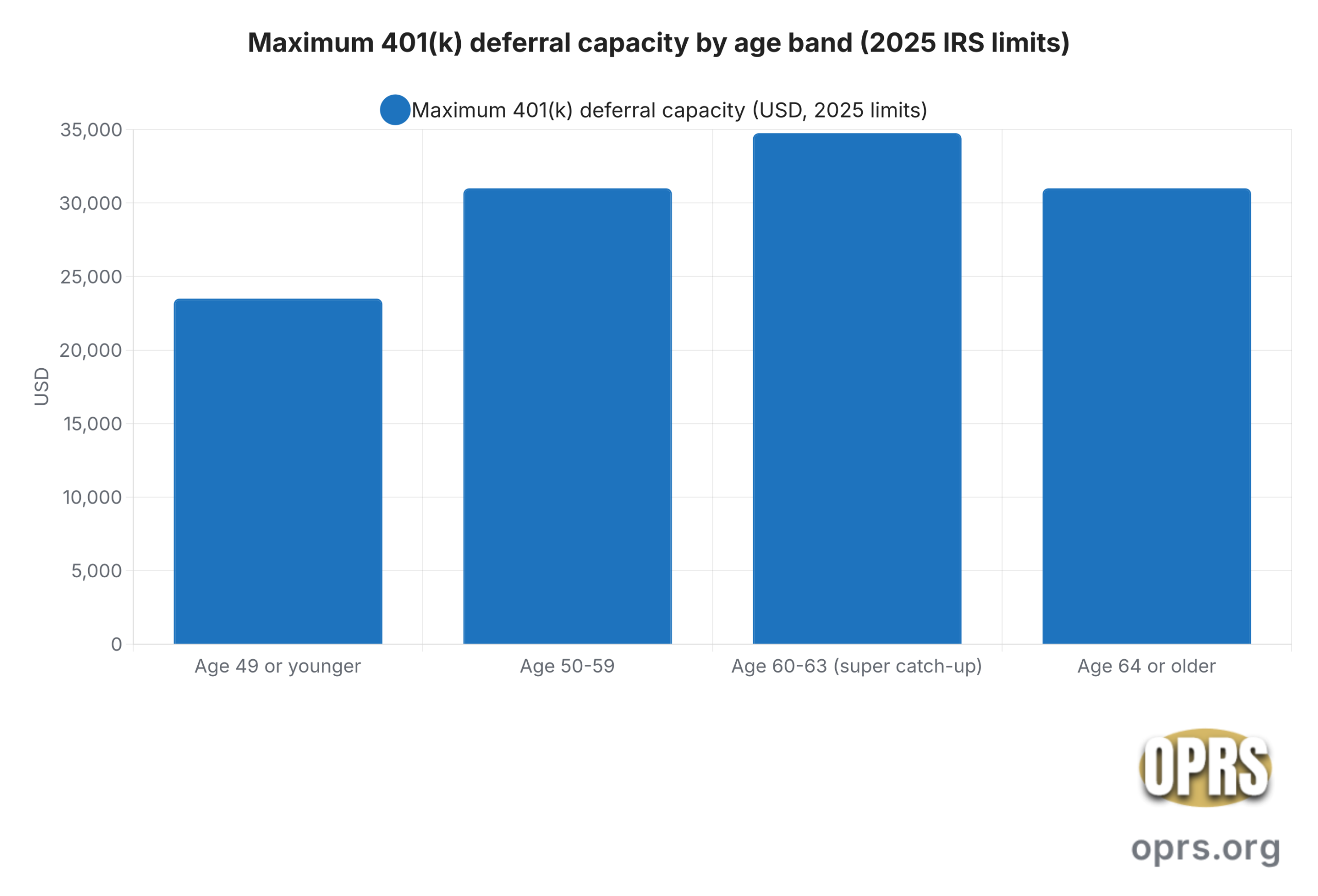
SECURE 2.0 §109 added an enhanced catch-up contribution for participants who attain age 60, 61, 62, or 63 during the taxable year. The enhanced amount is the greater of $10,000 or 150% of the regular age-50 catch-up contribution, indexed for inflation. For 2025, the IRS-published age-50 catch-up is $7,500 (Notice 2024-80), which makes the age 60-63 super catch-up $11,250.
The amounts are indexed annually after 2024, so the 2026 figure will adjust upward modestly when the IRS publishes the year’s limits in late 2025. A participant who reaches age 64 returns to the regular age-50 catch-up.
The four-year window from age 60 through age 63 is a structural opportunity for a retiree who is still drawing W-2 income from a former employer, a board seat, or a consulting practice.
The combined 2025 elective deferral plus super catch-up reaches an annual deferral capacity of roughly $34,750. That figure is $23,500 base plus $11,250 super catch-up under the 2025 limits. For comparison, the limit is $31,000 at age 50-59 and $23,500 at age 49 or younger. The bar chart below makes the gap visible, and that gap is the planning lever the SECURE 2.0 drafters intended.
Precious metals IRA required minimum distribution (RMD) estimator
Once required minimum distributions begin (age 73 now, 75 starting 2033), you divide the prior year-end balance by an IRS life-expectancy factor. The result is taxed as ordinary income on your federal return and, in most states, your state return. You can take a precious metals IRA RMD in cash or in metal.
Estimate only, not tax advice. Uses the IRS Uniform Lifetime Table (most owners). A spouse more than 10 years younger and sole beneficiary uses a different table. Roth IRAs have no lifetime RMD. Sources: IRS Publication 590-B (Table III); IRS RMD FAQs. Consult a tax advisor.
The right dealer explains every fee up front. Get Augusta's free precious metals IRA company checklist.
Change 5: The missed-RMD excise dropped from 50% to 25%, and to 10% with correction
SECURE 2.0 §302 reduced the excise tax under IRC §4974 on a failed required minimum distribution from 50% of the missed amount to 25% of the missed amount. This change is effective for taxable years beginning after December 29, 2022.
Acting within two years of a missed distribution deadline, and pairing the corrective distribution with a Form 5329 carrying a reasonable-cause statement, brings the excise rate down to 10%. That reduction is prospective only: RMDs that should have been taken before 2023 are not eligible and remain subject to the 50% base rate.
The lower excise does not mean a missed RMD is now a minor issue. Consider a retiree with a $2M traditional IRA balance whose age 73 RMD calculates to roughly $75,000 under the IRS Uniform Lifetime Table. A missed RMD generates a $18,750 excise at the 25% rate. With timely correction, that drops to $7,500.
The penalty applies to the amount that should have been distributed but was not, which is recovered separately as a normal taxable distribution at the retiree’s marginal rate when the corrective distribution finally lands. The combination of the corrective distribution at the marginal rate plus the 10% reduced excise can still exceed 50% of the missed amount in cash terms.
Change 6: 529-to-Roth IRA rollover up to a $35,000 lifetime cap
SECURE 2.0 §126 created a new transfer mechanism for 529 plan beneficiaries. It allows unused 529 balances to roll into a Roth IRA in the beneficiary’s name, effective for distributions after December 31, 2023. The provision is codified at IRC §529(c)(3)(E). Four conditions apply.
The 529 plan must have been maintained for at least 15 years for the beneficiary. The rollover must come from contributions and earnings older than 5 years. The annual rollover is capped at the IRA contribution limit for the year. And the total lifetime rollover is capped at $35,000 per beneficiary.
For a retiree who funded 529 accounts for adult children or grandchildren that ended up over-funded, the 529-to-Roth route is a tax-efficient way to convert leftover education capital into retirement capital for the next generation.
The 2026 planning move is to inventory the 529 accounts, check the 15-year clock against each beneficiary, and start the annual rollover sequence at the IRA contribution limit (which is generally $7,000 for 2025, indexed). A four-to-five-year rollover sequence per beneficiary reaches the $35,000 cap.
The rollovers are not subject to the Roth IRA income limits that otherwise cap contributions from high-earning beneficiaries.
Change 7: Surviving-spouse RMD election treats the spouse like the original owner
SECURE 2.0 Section 327 added an optional election for a surviving spouse who is the sole designated beneficiary of a deceased participant’s retirement account. The surviving spouse may elect to be treated as the deceased employee for RMD purposes, codified at IRC §401(a)(9)(B)(iv).
The election allows the surviving spouse to delay RMDs until the year the deceased participant would have reached the RMD age. It also allows the RMD to be computed under the Uniform Lifetime Table rather than the Single Life Expectancy table. The election is operational for the 2024 distribution year and later.
For a couple where one spouse is materially younger than the other and the older spouse is the participant, the election can defer the surviving spouse’s first RMD by several years versus the pre-SECURE-2.0 default.
For the inherited-spouse-IRA-versus-treat-as-own decision more generally, our spousal inherited IRA decision guide covers the conduit, the spousal rollover, and the new §327 election side by side. The §327 election is irrevocable in the year it is made and interacts with the basis tracking on any after-tax or combat-zone basis layer in the inherited account.
Pre-SECURE Act 2.0 versus the 2026 operating ruleset
The table below summarizes the seven changes side by side: the pre-SECURE 2.0 rule, the SECURE 2.0 rule as it operates in 2026, and the statutory citation. Use it as the cross-reference when an advisor or custodian quotes a rule that does not match what your filings show.
| Rule area | Pre-SECURE 2.0 | 2026 operating rule | Citation |
|---|---|---|---|
| RMD age | 72 (post-SECURE 1.0) | 73 (75 in 2033) | IRC §401(a)(9)(C)(v) (Safe if executed) |
| Catch-up basis for high earners | Pre-tax or Roth at participant election | Roth required if prior-year FICA wages over $145,000 | IRC §414(v)(7) (Penalty cash-flow if mis-classed) |
| Roth 401(k) lifetime RMD | Required from RBD | Eliminated | IRC §401(a)(9)(E)(iii) (Safe) |
| Catch-up amount ages 60-63 | $7,500 (2025 level) | $11,250 (2025 level, 150% of base) | IRC §414(v)(2)(E) (Safe if claimed) |
| Missed-RMD excise tax | 50% of missed amount | 25%, reducible to 10% within 2 years | IRC §4974(a) (Penalty if missed) |
| 529-to-Roth rollover | Not available | Up to $35,000 lifetime per beneficiary | IRC §529(c)(3)(E) (Safe if executed) |
| Surviving-spouse RMD election | Spousal rollover or 10-year drain | Optional §327 election to be treated as deceased participant | IRC §401(a)(9)(B)(iv) (Safe if elected timely) |
Where the dealer choice intersects the SECURE 2.0 calendar
The dealer chosen for a 2026 precious-metals rollover sits inside the new RMD age, the new excise regime, and the new beneficiary rules for the full life of the account. A dealer with a thin custodian relationship, an opaque buyback policy, or unresolved BBB and CFTC actions creates downstream friction at every RMD and at the eventual death event. Vet the dealer against the public record before the rollover is signed, not after.
3 of 27+ gold IRA dealers reviewed by OPRS make the 2026 trusted list.
How a $1-3M retiree should sequence the 2026 SECURE 2.0 decisions
The seven changes interact. A Roth conversion done before the new RMD age starts the 5-year qualifying clock on the converted segment, which then interacts with the §325 elimination of Roth 401(k) RMDs on the receiving side.
A 529-to-Roth rollover started for an adult-child beneficiary in 2026 begins building a tax-free balance the child can later inherit under the §325 / 10-year framework. A surviving-spouse §327 election made by the younger spouse pushes the first RMD several years forward and changes the bracket the gold-IRA distributions land in.
The procedural sequence below is the order a planner walks through with a $1-3M retiree in 2026.

Edge cases: SEP-IRA, SIMPLE-IRA, and Roth catch-up for the self-employed
Two SECURE 2.0 provisions hit retirees who maintain a self-employment side practice (board seats, consulting LLC, single-member S-corp). SECURE 2.0 §601 permits SEP-IRA and SIMPLE-IRA accounts to accept designated Roth contributions for the first time, effective for taxable years after December 29, 2022. Before SECURE 2.0, those vehicles were pre-tax only.
Take a retiree consulting at a marginal rate of 24 percent in 2026 who expects RMDs to push them into the 32 percent bracket by 2030. The Roth SEP option turns the consulting income into a tax-free retirement balance, paying tax at the lower current rate.
The Roth catch-up rule of §603 applies differently to a self-employed retiree because the $145,000 prior-year FICA-wages threshold does not engage. Self-employment income is reported on Schedule SE rather than as FICA wages, and the SECURE 2.0 drafters tied the mandatory Roth catch-up specifically to W-2 FICA wages from the catch-up employer.
A retiree drawing only self-employment income in 2025 can continue to make pre-tax catch-up contributions in 2026 regardless of the income level. The IRS confirmed this reading in Q&A guidance accompanying Notice 2023-62.
Frequently asked questions
Do the 2026 SECURE 2.0 rules apply to my pension as well as my IRA?
The RMD age change and the missed-RMD excise reduction apply to defined-benefit pensions in the same way they apply to defined-contribution accounts. The catch-up contribution rules and the 529-to-Roth provision are defined-contribution-only because pensions do not accept participant elective deferrals. The surviving-spouse §327 election applies to pensions only if the plan document is amended to incorporate the optional treatment, which most large corporate pensions had completed by the close of 2024.
If I am 73 in 2026, can I still convert to Roth before taking the RMD?
Yes, but the RMD must be taken first and cannot be rolled into the Roth. Under IRC Section 408(d)(3)(E), the first distribution from a traditional IRA in the RMD year is deemed to satisfy the RMD. An RMD amount cannot be converted to a Roth IRA.
The mechanical sequence is: take the RMD as a regular taxable distribution, then convert any remaining balance segment to a Roth IRA in the same calendar year. The two events are reported separately on Form 1099-R.
Does the elimination of Roth 401(k) RMDs apply to my Roth IRA?
Roth IRAs never had a lifetime RMD on the original owner, so the §325 change does not affect them. The relevant change for Roth IRAs is on the inheritance side, where the 10-year drain rule continues to apply to non-spouse beneficiaries of Roth IRAs without the annual-RMD-in-years-1-through-9 layer.
Is the $145,000 Roth-catch-up threshold adjusted for inflation?
Yes. IRC §414(v)(7)(A) indexes the threshold for inflation after 2024, rounded to the nearest $5,000. The IRS publishes the indexed amount in the annual cost-of-living notice for retirement plans (most recently Notice 2024-80 for 2025 amounts). The 2026 indexed threshold will appear in the late-2025 cost-of-living notice. The threshold is measured against the prior-year FICA wages, so the 2026 catch-up classification is determined by 2025 wages.
Does SECURE 2.0 change the QCD age or the QCD annual cap?
The QCD age remains 70 1/2 under IRC §408(d)(8), unchanged by SECURE 2.0. SECURE 2.0 §307 added inflation indexing to the QCD annual cap, which was a fixed $100,000 since 2006. It also created a one-time $50,000 election to fund a charitable gift annuity or charitable remainder trust from the IRA.
The QCD age is decoupled from the RMD age. A retiree who is 70 1/2 in 2026 but does not start RMDs until age 73 can still make QCDs under §408(d)(8) starting at age 70 1/2.
Sources cited
- Public Law 117-328 (Consolidated Appropriations Act, 2023, Title I: SECURE Act 2.0 of 2022)
- 89 FR 58886: Required Minimum Distributions, final regulations (July 19, 2024)
- IRC §401(a)(9): Required distributions from qualified retirement plans
- IRC §4974: Excise tax on certain accumulations in qualified retirement plans
- IRC §414(v): Catch-up contributions for individuals age 50 or over
- IRC §529(c)(3)(E): Distributions from 529 accounts to Roth IRAs
- IRS Notice 2023-62: Roth catch-up administrative transition relief
- IRS Notice 2024-35: Transitional RMD relief for inherited accounts
- IRS Notice 2024-80: 2025 cost-of-living adjustments for retirement plans
- IRS Publication 590-B: Distributions from Individual Retirement Arrangements
The 2026 planning deliverable is a one-page memo that lists, for each of the seven changes above, the action item (or the explicit no-action decision) that applies to the retiree’s accounts.
The memo names the RMD age and first RMD year, plus the Roth-catch-up election or deferral for any 2026 catch-up. It addresses the Roth 401(k) post-RBD status, the ages 60-63 super-catch-up eligibility window, and the missed-RMD excise procedure if a deadline is missed. It also covers the 529-to-Roth rollover plan for any over-funded education accounts, and the surviving-spouse Section 327 election decision for the estate documents.
Underneath the memo sits the dealer-selection question for any precious-metals component of the rollover plan, where the 2026 OPRS reality check is the public-record starting point.
More on OPRS
- Gold IRA allocation framework for pre-RMD high-net-worth retirees
- Roth conversion ladder for a gold IRA in the pre-RMD window
- SECURE Act 2.0 adult-child beneficiary rules for gold IRA
- Spousal inherited IRA vs beneficiary IRA: what are my options
- QCD from a gold IRA at age 70 1/2: mechanics and limits
- Our 2026 reality check on gold IRA dealers