

Updated: July 30, 2026
OPRS may receive compensation when readers open an account through partner links on this page. Our analysis is based on independent research, BBB data, and IRS publications.
30-second verdict
- A self-directed IRA is a regular IRA under IRC Section 408. The “self-directed” label refers to the custodian’s product menu, not a different tax code.
- The structural difference is the custodian. An SDIRA custodian is an IRS-approved nonbank trustee under Treasury Regulations Section 1.408-2(e), which lets the account hold alternative assets a brokerage cannot.
- Physical gold is held under the statutory exception in IRC 408(m)(3): either a named coin (American Gold Eagle) or bullion at 99.5 percent fineness held by the IRA trustee.
- Three operator roles run the account: a custodian (books and IRS filings), a depository (vaulted storage), and a dealer (sells the metal). The participant never takes possession before a qualified distribution.
- Annual contribution limits, rollover rules under IRC 408(d), and RMD ages under SECURE 2.0 are identical to a brokerage IRA. The asset menu changes, the tax code does not.
- Year-one cost has four lines: setup, custodian annual, depository annual, and the dealer markup on the coin or bar. The dealer markup is the largest and the most variable.
An IRA at Fidelity, Schwab, or Vanguard cannot hold physical gold. The reason is not the tax code. The reason is the custodian’s product menu. A brokerage IRA only supports the securities the brokerage’s clearing infrastructure clears. Stocks, bonds, mutual funds, ETFs, options. Physical metal is not on that menu.
A self-directed IRA fixes this by using a different custodian. The legal structure is the same IRC Section 408 IRA. The custodian is an IRS-approved nonbank trustee that supports a wider asset list, including the four IRS-approved precious metals. our current gold IRA dealer shortlist as you read; the structural picture below explains what the SDIRA does, the dealer is the operator who actually delivers it.
This guide walks through four elements. Element I is why a brokerage IRA cannot hold gold and what the SDIRA structure changes. Element II is the IRC 408(m)(3) bullion exception that legally permits the gold in the first place. Element III is the three operator roles that run the account day to day. Element IV is the year-one cost stack and the dealer-disclosure questions to ask before any purchase order.
The audience is the saver who has read about gold IRAs and wants the plain-English account mechanics before any sales call. The page is not investment advice. It does not predict gold prices. It does not recommend an allocation to gold inside a retirement portfolio. For an allocation conversation, the right people are a licensed financial advisor and a tax advisor.
Why a regular brokerage IRA cannot hold physical gold
The legal definition of an IRA lives in IRC Section 408(a). The statute requires a written trust created in the United States for the exclusive benefit of an individual, with a bank, federally insured credit union, or person who meets certain Treasury requirements acting as the trustee. That trustee piece is the lever.
A brokerage like Fidelity is an IRA trustee through its trust subsidiary. The trust company holds the IRA cash and securities for the participant. The brokerage clears trades on the participant’s behalf.
The asset menu the trust company offers is restricted to what the clearing infrastructure can handle: equities and fixed income on a centralized clearing platform, mutual fund shares through Fund/SERV, ETFs through the same equity pipeline. None of those mechanisms accept a Brink’s truck delivering an American Gold Eagle to a vault in Texas.
The collectibles rule in IRC Section 408(m)(1) is the second reason. The rule treats the acquisition of a collectible by an IRA as a distribution to the participant. That triggers ordinary income tax and, if the participant is under age 59 and a half, the additional 10 percent tax under IRC Section 72(t). The default position for any retirement account holding physical metal is therefore that the metal is a deemed distribution.
The narrow exception in IRC Section 408(m)(3) carves out specific coins and bullion that an IRA may hold without triggering the collectibles rule. The exception is what makes a gold IRA legal at all. The exception only operates if the IRA trustee actually holds the metal, which is the back-office capability a brokerage trust company does not provide.
A self-directed IRA uses a custodian designed for the exception. The custodian’s clearing infrastructure includes wire instructions to bullion dealers, contracts with IRS-approved depositories, and reporting procedures for IRA holdings priced by metal weight rather than CUSIP. The same IRC Section 408 wrapper, a different trustee, a different asset menu.
The four structural elements that make an SDIRA hold gold legally
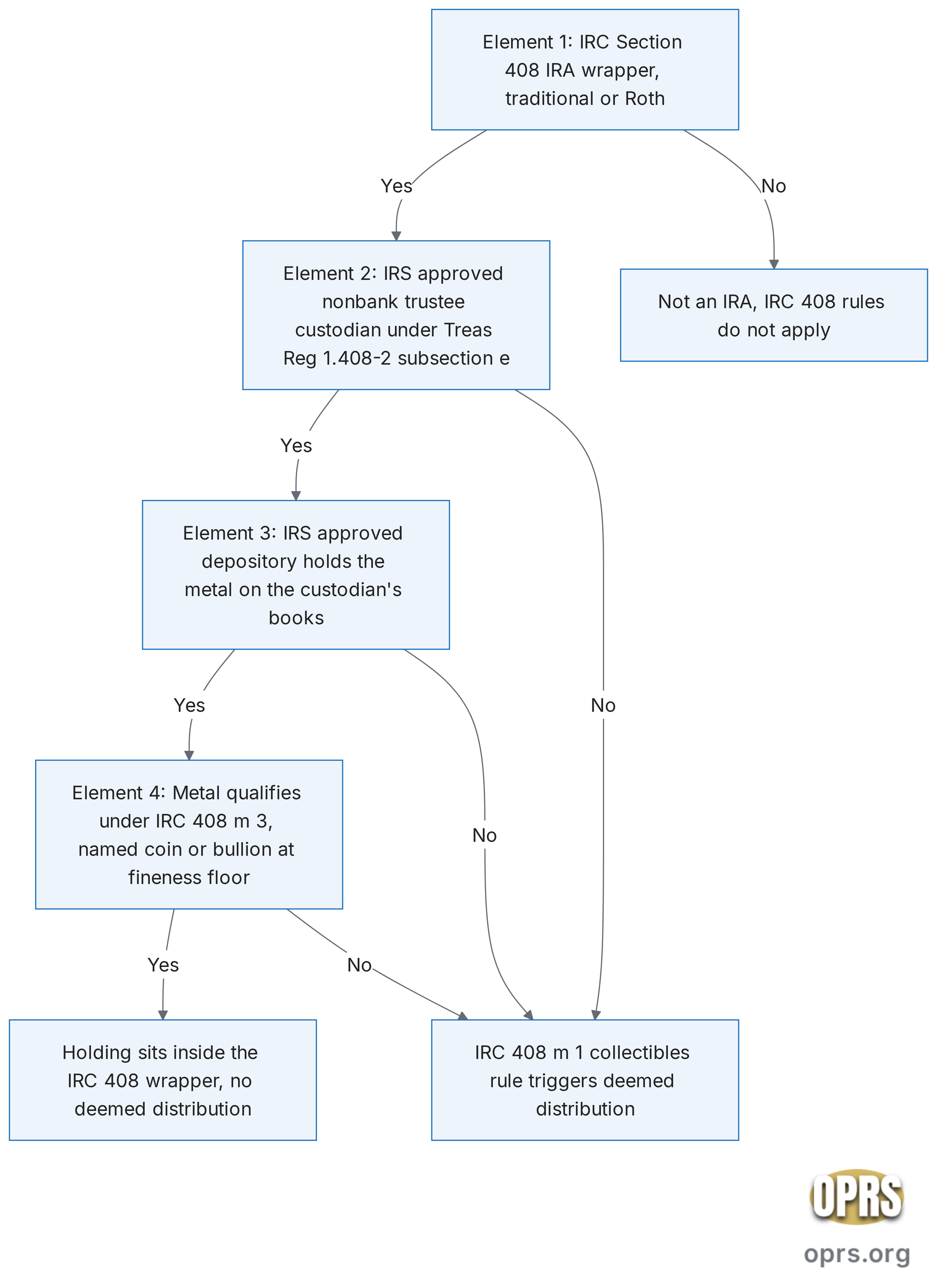
A self-directed IRA holding physical gold has to line up four elements. If any one fails, the IRC 408(m)(1) collectibles rule reasserts itself and the account holding is a deemed distribution.
Element 1: IRC 408 IRA wrapper. The account is a traditional or Roth IRA under IRC Section 408 or 408A. There is no separate statute for “gold IRAs.” The marketing label points at the asset class held inside the account. A gold IRA is just an SDIRA with gold as its dominant holding. The contribution limits under IRC Section 219(b)(5) apply on a per-participant aggregate basis across every IRA the participant owns.
Element 2: IRS-approved nonbank trustee custodian. The custodian must be a bank, federally insured credit union, or a nonbank trustee that has applied for and received IRS approval under Treasury Regulations Section 1.408-2(e). The IRS maintains a public list of approved nonbank trustees and custodians. The application requires the entity to demonstrate fiduciary capacity, net worth, internal controls, and an audit program. The IRS reviews the file before granting approval. The custodian’s status is verifiable.
Element 3: IRS-approved depository. The metal is physically held at a depository that the custodian has a vault contract with. The depository accepts the metal on behalf of the IRA custodian, logs it by serial number or bar lot, and assigns it to the IRA’s holdings ledger. The participant does not have direct access to the metal.
The U.S. Tax Court reinforced this rule in McNulty v. Commissioner, 157 T.C. 10 (2021). A taxpayer who held American Eagle gold coins in a personal safe under a checkbook-control LLC structure received a deemed distribution of the full account balance, plus a 20 percent accuracy-related penalty.
Element 4: IRC 408(m)(3) qualifying metal. The actual coin or bar held must fall inside one of the two branches of the IRC 408(m)(3) exception. The named-coin branch in subsection (A) lists specific U.S. coins by name (American Gold Eagle, American Silver Eagle, and similar issuances). The bullion branch in subsection (B) covers gold, silver, platinum, and palladium bullion at the per-metal minimum fineness held by the IRA trustee.
A Krugerrand or a numismatic rarity is outside both branches. Holding one would trigger the IRC 408(m)(1) collectibles outcome.
The figure below shows the four elements as a decision sequence. A first-time SDIRA gold holder can walk an offer from a dealer through this sequence and identify where it fails, if it does.
Can you roll your account into a precious metals IRA? Eligibility checker
Most retirement money can move into a precious metals IRA once it qualifies as an eligible rollover distribution. Pick your account type and situation for a general answer. Always confirm specifics with your plan administrator or custodian.
General guidance only, not tax or financial advice. Eligibility depends on your specific plan document and IRS rules; confirm with your plan administrator and a tax advisor. A direct trustee-to-trustee transfer avoids the 60-day rule and 20% mandatory withholding.
The right dealer explains every fee up front. Get Augusta's free precious metals IRA company checklist.
For practical setup steps, the OPRS guide on setting up a self-directed IRA walks through the account-opening paperwork. This guide stays on the why and the structure, not the click-by-click custodian onboarding.
The IRC 408(m)(3) bullion exception in plain English
The statutory text of IRC 408(m)(3) reads dense, but the operating rule is short. The IRA may hold gold, silver, platinum, or palladium under two branches.
Branch A is the named-coin exception. The American Gold Eagle is listed by name. The American Silver Eagle is listed by name. Certain other U.S. coins issued under 31 U.S.C. Section 5112 qualify by name. The named-coin branch matters because the American Gold Eagle is 0.9167 fineness (22 karat), below the 0.995 gold bullion floor. The coin only qualifies because Congress listed it.
Branch B is the bullion-fineness exception. Gold bullion at 99.5 percent fineness or higher qualifies. Silver bullion at 99.9 percent or higher qualifies. Platinum and palladium bullion at 99.95 percent or higher qualify. The bullion must be held by the IRA trustee, not the participant. LBMA-approved refiner bars commonly meet the fineness floors and dominate the qualifying inventory most custodians offer. (Fineness floors: IRC §408(m)(3).)
The interaction of the two branches resolves most beginner questions. A Krugerrand at 0.9167 fineness fails the bullion floor and is not listed by name. It does not qualify. A pre-1933 U.S. $20 Saint-Gaudens gold coin at 0.9 fineness fails the bullion floor and is not in the named-coin list. It does not qualify.
A modern 1-ounce gold bar from a Swiss refiner at 0.9999 fineness clears the bullion floor and qualifies, if the custodian’s product list includes the specific bar. A Canadian Gold Maple Leaf at 0.9999 clears the bullion floor. A South African Krugerrand or a “rare coin” pitch does not.
The practical consequence is that the custodian’s product list at account opening tells the participant exactly which coins and bars are available for purchase inside the IRA. A dealer who pitches “rare coins” or “semi-numismatic coins” for the IRA is selling product that either fails the exception (taxable distribution if held) or carries a markup well above standard bullion (year-one cost penalty).
The FTC and the CFTC have brought enforcement actions against dealers in this exact pattern, including the 2022 CFTC and state-regulator action against a precious metals dealer that defrauded largely elderly investors.
For the deeper product walkthrough across all four metals, the OPRS guide on investing in precious metals through a self-directed IRA covers the silver, platinum, and palladium menu. This guide stays on the gold case to keep the structural picture clear.
The three operator roles inside an SDIRA holding gold
An SDIRA holding gold uses three separate parties. The split is mandatory under the rules above. A single party touching all three roles (a dealer that also offers “custodian services” and “storage”) is a structure the IRS and the U.S. Tax Court have ruled against.
The custodian is the legal IRA trustee. The custodian is a bank, a federally insured credit union, or an IRS-approved nonbank trustee under Treasury Regulations Section 1.408-2(e). The custodian files IRS Form 5498 (contribution report) and Form 1099-R (distribution report), tracks contributions, rollovers, and transfers, and maintains the official record of the account.
The custodian does not sell metal. The custodian does not store metal. The custodian wires funds to the dealer once the participant authorizes a purchase, and books the metal as an asset of the IRA once the depository confirms receipt.
The depository is the secured vault. The depository accepts the metal on behalf of the IRA custodian, not the participant. The vault contract is between the custodian and the depository.
Storage may be segregated (the metal is physically separated and identified to the participant’s IRA by serial number or bar lot) or non-segregated (the metal is commingled with other clients’ holdings of the same product). The participant pays the annual storage fee through the custodian, who passes the depository invoice through.
The dealer is the precious-metals merchant. The dealer’s role is to sell the qualifying coin or bar into the IRA. The participant places an order with the dealer, the custodian wires the funds, the dealer ships the metal to the depository.
The dealer is regulated by the FTC for trade-practice and disclosure issues and, for some products, by the CFTC under the Commodity Exchange Act. The dealer has the largest year-one cost variance (markup over spot ranges from 3 to 6 percent at clean-pricing dealers to well into double digits on premium-coin pitches) and the largest enforcement-action surface of the three roles.
This three-role separation keeps the SDIRA inside IRC 408 and out of the deemed-distribution trap. If the participant takes possession of the metal at any point before a qualified distribution, the IRC 408(m)(1) collectibles rule and the prohibited-transaction rules of IRC Section 4975 apply.
The dealer is the role with the most pre-purchase work. Check this dealer against the 2026 OPRS list before any custodian onboarding paperwork is signed. The 27+ dealers OPRS has reviewed range from the BBB A+ end of the market down to operators with FTC consent orders and pending CFTC matters.
Year-one cost structure: SDIRA gold sleeve vs brokerage IRA
A brokerage IRA at Fidelity or Vanguard has essentially zero account-level fees in the asset menu it supports. Trades on equity ETFs are commission-free at the major brokers. Mutual fund expense ratios apply but are paid inside the fund, not as a separate IRA fee. The first-year cost of a brokerage IRA holding a total-market ETF is the ETF expense ratio (commonly 0.03 to 0.10 percent of assets) and zero account fee.
An SDIRA holding gold has four distinct cost lines in year one. The figure below shows the ranges across the U.S. custodian and depository market for a representative $100,000 sleeve.
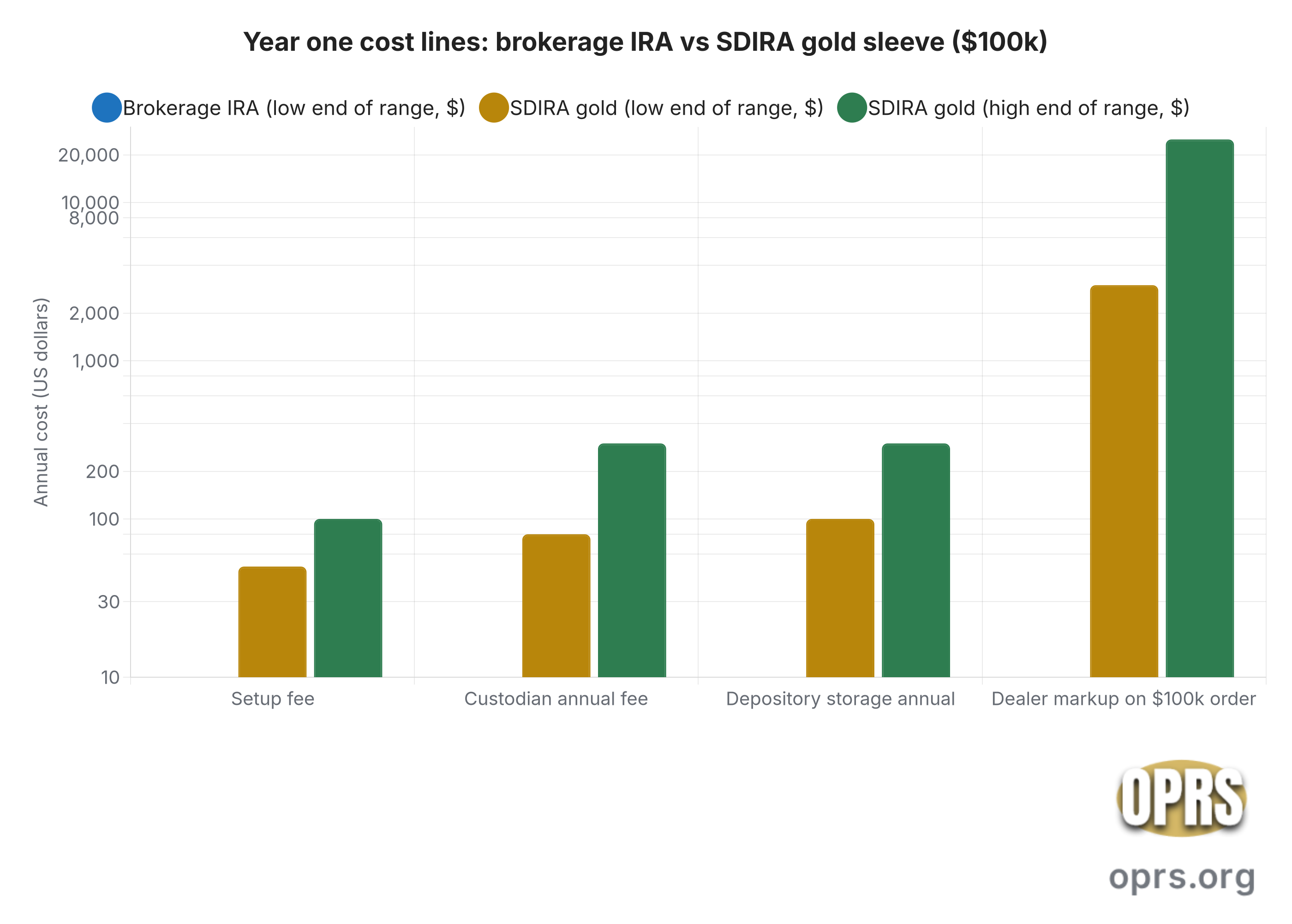
The setup fee is a one-time charge from the custodian to open the SDIRA. The range at U.S. custodians is roughly $50 to $100. Some custodians waive it on accounts above a stated funding threshold.
The custodian annual fee covers the IRA bookkeeping, IRS filings, and statement production. The flat-fee range is roughly $80 to $300 per year. A flat fee is generally cleaner for a six-figure account than an asset-based fee (some custodians charge basis points instead, which can scale faster than flat fees as the account grows).
The depository annual fee covers vaulted storage and insurance. The range is roughly $100 to $300 per year for non-segregated storage of a $100,000 sleeve at IRS-approved depositories. Segregated storage costs more. The fee scales with declared value, not with bar count.
The dealer markup is the variable line and the largest by far. A clean-pricing bullion dealer charges 3 to 6 percent over the spot gold price on standard 1-ounce Eagles, Maple Leafs, or LBMA-approved bars. A premium-coin pitch can carry markups of 20 to 50 percent or more over the equivalent bullion value.
On a $100,000 order, the dealer markup difference between a 4-percent and a 25-percent operator is $21,000 captured at the moment the funds wire. The custodian and depository fees over the first decade do not add up to that gap.
The implication for the SDIRA gold holder is that the structural fees are knowable and small relative to the dealer-markup decision. The largest cost lever in year one is choosing a dealer that prices in single digits over spot for standard bullion and discloses the markup in writing before the wire.
Common mistakes when opening an SDIRA for gold
- Treating “self-directed” as a different tax code. An SDIRA is a regular IRC Section 408 IRA. The contribution limits, rollover rules, RMD ages, prohibited-transaction rules, and tax treatment are identical to a brokerage IRA. The “self-directed” label is about the custodian’s product menu, not a different statute. A participant who treats the SDIRA as a separate tax universe will miss the per-participant aggregate contribution cap or the one-rollover-per-12-months rule in Bobrow v. Commissioner, T.C. Memo. 2014-21.
- Using a checkbook-control LLC for “home storage.” The IRS position, supported by the U.S. Tax Court in McNulty v. Commissioner, 157 T.C. 10 (2021), is that the IRA trustee must hold the metal at all times before a qualified distribution. Holding American Eagle coins in a home safe under an SDIRA-owned LLC was a taxable distribution of the full account balance, plus a 20 percent accuracy-related penalty. The “home storage gold IRA” marketing pitch is the structure that lost in McNulty.
- Buying a non-qualifying coin and assuming the custodian will catch it. The custodian’s product list is the working guardrail, but the dealer is the upstream filter. A Krugerrand, a numismatic coin, a “rare” coin, a sterling silver product, or a pre-1933 U.S. gold coin fails the IRC 408(m)(3) test. The custodian will refuse to book it. The participant who already paid the dealer is on the hook for the markup and has to unwind the transaction with the dealer directly.
- Skipping the dealer-screening step before signing custodian paperwork. Custodian, depository, and fee disclosures are usually documented in writing. The dealer markup and product mix typically are not. The dealer is the role with the most enforcement actions on record (FTC, CFTC, state attorney general). A pre-call screen against the 27+ dealers reviewed by OPRS is the single highest-leverage step a beginner can take.
- Confusing an SDIRA for gold with an SDIRA for real estate or private equity. An SDIRA custodian who supports gold may not support real estate or private placements, and vice versa. Each alternative-asset class has its own custodian product list, its own depository or recordkeeping infrastructure, and its own fee schedule. A participant who plans to hold gold and real estate in the same account should confirm both menus at one custodian or expect to run two SDIRAs at two custodians.
- Triggering the prohibited-transaction rules under IRC Section 4975. The IRA cannot transact with the participant, the participant’s spouse, ancestors, descendants, or controlled entities. Selling personally owned coins into the IRA, leasing IRA-held real estate to a family member, or borrowing IRA assets through a related entity is a prohibited transaction. The penalty is disqualification of the IRA: the entire account is treated as distributed as of the first day of the tax year the transaction occurred.
The reader who finishes this guide has the structural picture. An SDIRA is a regular IRC Section 408 IRA held at an IRS-approved nonbank trustee that supports alternative assets. The IRC 408(m)(3) exception is what legally permits the gold to sit inside the account. Three operator roles run the day-to-day account. Year-one cost is dominated by the dealer markup, which is the most variable and least disclosed line.
The next decision is which dealer to call. The custodian and the depository are downstream choices; many dealers route their clients to one or two preferred custodians by default, and the depository follows from the custodian’s vault contracts. Picking a dealer first, and using that conversation to validate the custodian and depository choice, is the cleanest sequence for an SDIRA gold holder who has not yet picked any party.
The dealer-side trust signal stack OPRS uses to screen any operator includes four markers that travel across all 50 states. The markers are listed below.
- Money Magazine Best Overall Gold IRA Company (2022 to 2026)
- Investopedia Most Transparent Gold IRA Company (2022 to 2026)
- BBB A+ Rating with Zero Complaints (accredited since 2014)
- Education-First Process with non-commissioned customer success agents
Augusta Precious Metals carries all four markers and its industry-reported minimum sits around $50,000. That figure fits a rollover from a 401(k), a TSP, a 403(b), or a transferred prior-employer IRA at retirement. The Learn-Talk-Decide process is run by salaried non-commissioned educators. The free company comparison checklist walks through the custodian, depository, fee schedule, and disclosure questions a first-time SDIRA gold holder should ask before any purchase order.
Get the Augusta company comparison checklist
The free company comparison checklist covers the custodian, depository, fee schedule, and Form 1099-R coding questions a first-time SDIRA gold holder should ask before any purchase order. It also covers the segregated vs non-segregated storage choice, the IRC 408(m)(3) qualifying product menu, and the dealer-markup disclosure questions to bring to any sales call. The checklist is the higher-intent asset for screening a dealer against the four-marker trust signal stack at the pre-purchase planning moment.
OPRS may receive compensation when readers proceed. Editorial selection is independent. Updated July 2026.
Is a self-directed IRA the same legal product as a gold IRA?
Yes. A “gold IRA” is an SDIRA whose dominant asset is IRS-approved gold under IRC Section 408(m)(3). The underlying account is a regular IRC Section 408 IRA. The “self-directed” label refers to the custodian’s broader product menu (alternative assets beyond securities). The “gold” label points at the specific asset class the participant funded. A single SDIRA can hold gold, silver, platinum, palladium, real estate, private placements, or any combination supported by the chosen custodian’s product list.
Do the same IRA contribution limits apply to a self-directed IRA?
Yes. The IRC 219(b)(5) contribution limit applies on a per-participant aggregate basis across every IRA the participant owns, including any SDIRA. The 2025 limit is $7,000 for participants under age 50 and $8,000 for participants age 50 and older. The 2026 figures are released by IRS Revenue Procedure.
A trustee-to-trustee transfer from a brokerage IRA into an SDIRA is not a contribution and is not subject to the annual cap. A rollover from a 401(k) or TSP is also not a contribution and has no annual dollar cap.
Can I roll a 401(k) into a self-directed IRA holding gold?
Yes, under IRC Section 408(d)(3) if the 401(k) participant is eligible for a distribution (separation from service, plan termination, age 59 and a half in-service distribution if the plan allows). A direct rollover (trustee-to-trustee, from the 401(k) plan administrator to the SDIRA custodian) avoids the mandatory 20 percent federal withholding that applies to indirect rollovers. The SDIRA custodian then funds the metal purchase from the rolled-in cash. The 401(k) to gold IRA mechanics guide walks through the eligibility and timing.
Who is on the IRS list of approved nonbank trustees for an SDIRA?
The IRS publishes the list of approved nonbank trustees and custodians as IRS Announcement updates. The list includes trust companies that have applied under Treasury Regulations Section 1.408-2(e) and met the fiduciary, net worth, internal control, and audit requirements.
Common SDIRA custodians for precious metals (Equity Trust Company, STRATA Trust Company, Kingdom Trust Company, GoldStar Trust Company, Madison Trust Company, and similar entities) appear on the list. A participant can verify any prospective custodian against the current published list before signing the account application.
What does “checkbook control” mean and is it legal for a gold SDIRA?
“Checkbook control” refers to an SDIRA structure where the IRA invests in a single-member LLC, the participant is the manager of the LLC, and the participant writes checks from the LLC bank account to make investments. For real estate or private placements, the structure is used (with careful prohibited-transaction analysis).
For physical gold, the U.S. Tax Court ruled in McNulty v. Commissioner, 157 T.C. 10 (2021), that the IRA trustee must hold the metal at all times before a qualified distribution. Holding American Eagle coins in a personal safe under a checkbook-control LLC produced a deemed distribution of the entire IRA. The structure is not legal for storing IRA gold at the participant’s home.
Sources cited
- IRC Section 408, Individual Retirement Accounts (traditional IRA statutory definition)
- IRC Section 408(m), Collectibles Rule and Bullion Exception
- IRC Section 408A, Roth IRA Rules
- IRC Section 219(b)(5), IRA Contribution Limits
- IRC Section 408(d), IRA Distributions and Rollovers (60-day rule)
- IRC Section 72(t), Additional Tax on Early Distributions
- IRC Section 4975, Prohibited Transactions
- Treasury Regulations Section 1.408-2(e), Nonbank Trustee Approval
- 31 U.S.C. Section 5112, U.S. Mint Coinage Program (fineness standards)
- IRS Publication 590-A, Contributions to Individual Retirement Arrangements
- IRS Publication 590-B, Distributions from Individual Retirement Arrangements
- McNulty v. Commissioner, 157 T.C. 10 (2021)
- CFTC Customer Advisory: Beware of Gold and Silver Schemes Designed to Drain Your Retirement Savings
- CFTC and state regulators, 2022 charges against a precious metals dealer in a $68 million fraud targeting the elderly