

Updated: July 30, 2026
OPRS may receive compensation when readers open an account through partner links on this page. Our analysis is based on independent research, BBB data, and IRS publications.
30-second verdict
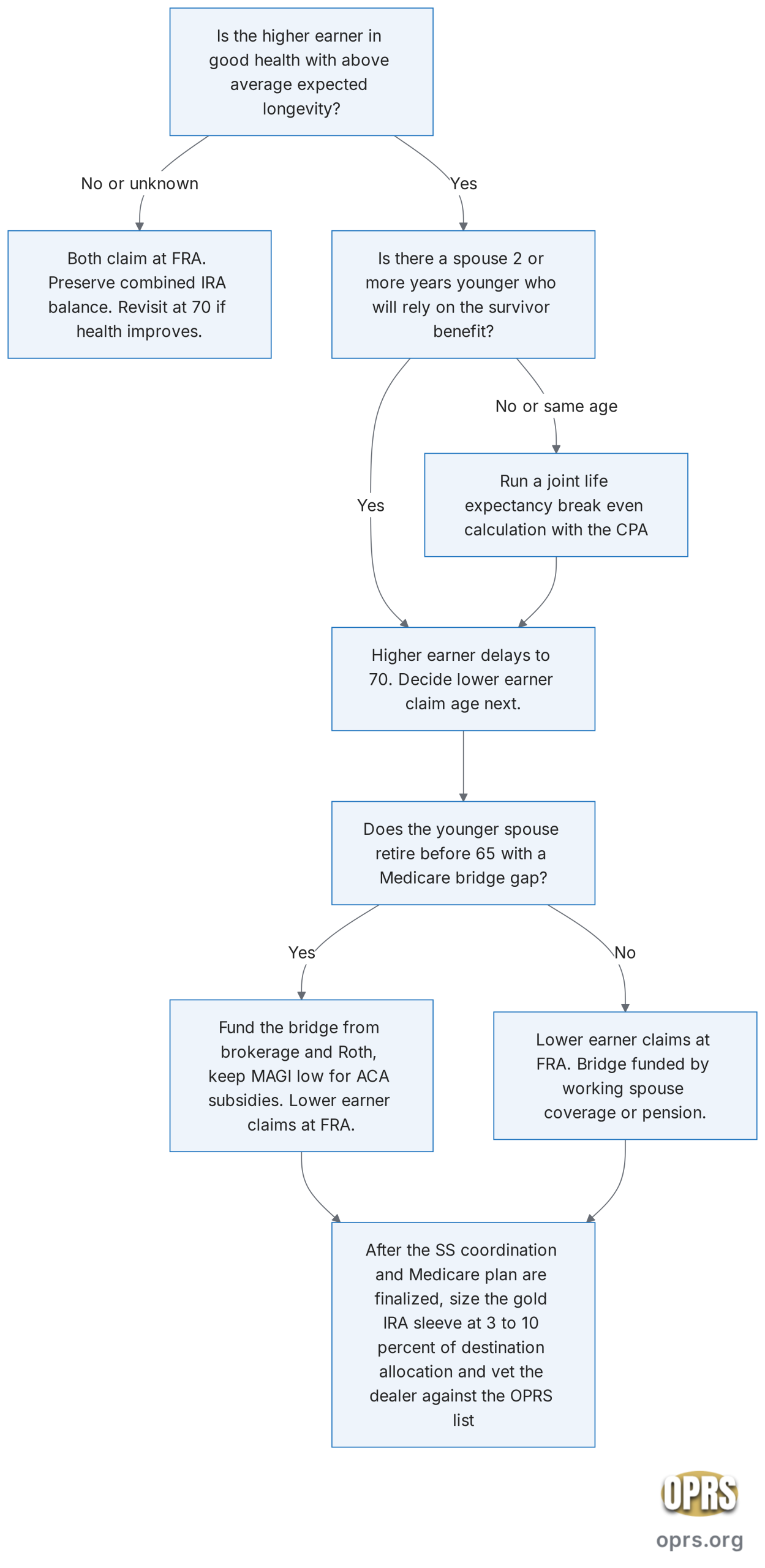
- For most dual-income couples in their late fifties or early sixties with combined retirement assets around $1 million to $1.5 million, the higher earner delays Social Security to 70 and the lower earner claims at Full Retirement Age. The household captures the survivor uplift without delaying both checks.
- The Medicare bridge is the planning gap most couples underestimate. When one spouse retires before 65, ACA Marketplace premium subsidies are governed by household Modified Adjusted Gross Income, and large IRA withdrawals during those years can erase the subsidy entirely.
- Dual IRMAA exposure begins the year the younger spouse turns 65. Both spouses then sit inside the same household income bracket for Medicare Part B and Part D premiums, and a single large Roth conversion can move both surcharges into the top tier for a full year.
- A gold IRA sleeve is a destination allocation question, not a bridge funding lever. A trustee-to-trustee transfer into a self-directed IRA does not create cash flow for the bridge years and should be sized after the claim coordination and Medicare plan are written.
Dual-income couples in their late fifties or early sixties carry one of the most complex retirement-planning windows on the household side.
Two careers wind down on different schedules. One spouse usually qualifies for Medicare earlier. Social Security claim ages can be staggered for survivor-benefit advantage. And Modified Adjusted Gross Income drives both Medicare IRMAA and ACA Marketplace subsidies at the same time.
The Social Security claim coordination, the Medicare bridge for the younger spouse, and the post-bridge destination allocation are one coupled plan, not three independent decisions.
Before any conversation with a dealer about the metals slice of the destination allocation, see the gold IRA dealers OPRS currently warns dual-income couples against. Mid-six-figure to seven-figure household balances are the most-targeted profile for high-pressure metals sales scripts during the claiming-window years.
Before you sign
A bridge-funding rollover into a gold IRA before the household claim-coordination plan is written inverts the planning sequence. The claim ages, the Medicare bridge for the younger spouse, and the IRMAA bracket plan are CPA and fee-only-advisor questions. The metals sleeve is one piece of the destination allocation, not the engine that funds either spouse’s bridge years.
3 of 27+ gold IRA dealers reviewed by OPRS make the 2026 trusted list.
The four claiming patterns dual-income couples use
For workers born in 1960 or later, Full Retirement Age is 67 under current Social Security Administration rules. For workers born between 1955 and 1959, the FRA sits between 66 and 4 months and 66 and 10 months. The four most common claim-coordination patterns are summarized below, with the bridge-funding implications kept separate from the destination-allocation question.
| Pattern | Higher earner | Lower earner | Survivor uplift | Bridge income need |
|---|---|---|---|---|
| Both delay to 70 | Delay to 70 (124 percent of PIA at FRA 67) | Delay to 70 | Highest on the higher-earner record | 3 to 5 years of household spending |
| Higher delays, lower claims at FRA | Delay to 70 | Claim at FRA (66 to 67 depending on birth year) | High: survivor inherits the 124 percent | 3 years of higher-earner gap only |
| Higher delays, lower claims at 62 | Delay to 70 | Claim at 62 (around 70 percent of own PIA) | High: survivor inherits the 124 percent | 3 years, partially offset by lower-earner check |
| Both claim at FRA | Claim at FRA | Claim at FRA | Moderate: 100 percent of higher PIA | None |
| Both claim at 62 | Claim at 62 | Claim at 62 | Lowest: 70 percent of higher PIA | None |
Precious metals IRA early-withdrawal penalty estimator
Taking money out of a precious metals IRA before age 59 and a half triggers a 10% federal additional tax on top of ordinary income tax. State add-on taxes vary; check your state. The federal penalty is estimated below.
Estimate only, not tax advice. The 10% federal additional tax applies to early distributions before age 59 and a half; specific exceptions exist. Your state may add its own tax, and ordinary income tax applies separately. Source: IRS Publication 590-B. Consult a tax advisor.
The right dealer explains every fee up front. Get Augusta's free precious metals IRA company checklist.
Sources: SSA Delayed Retirement Credits, SSA early retirement reduction, SSA Survivors Benefits, and SSA Publication 05-10035.
Pattern 2 has the higher earner delaying to age 70 while the lower earner claims at Full Retirement Age. Fee-only planners most often recommend this pattern for dual-income couples with combined retirement assets between $1 million and $1.5 million.
The household captures the full 24 percent Delayed Retirement Credit uplift on the higher record, which then becomes the survivor benefit for the longer-lived spouse. The lower earner’s check covers a portion of household spending during the higher earner’s bridge years.

The Medicare bridge when one spouse retires before 65
The Medicare bridge is the gap most dual-income couples plan around when one spouse retires before age 65 and loses employer health coverage. The household has three structured options, and each carries a different Modified Adjusted Gross Income consequence that ties straight back to the claim-coordination plan.
- Stay on the working spouse’s employer plan as a dependent. Often the lowest-friction option when one spouse continues working through age 65 or beyond. Premiums are payroll-deducted and household MAGI is unaffected by the coverage choice.
- Elect COBRA from the retiring spouse’s former employer. Covers the gap for up to 18 months under the federal continuation rules at U.S. Department of Labor COBRA guidance. Full premium plus 2 percent administrative cost. Useful when the bridge to Medicare or to the other spouse’s coverage is short.
- Enroll in an ACA Marketplace plan. Premium subsidies are governed by household MAGI per the IRS Premium Tax Credit rules. For a couple, the subsidy phaseout interacts with every dollar of Roth conversion, Traditional IRA distribution, or capital gain harvest. Large pre-65 IRA withdrawals to fund the bridge can erase the subsidy entirely.
- Use a Health Savings Account funded during the working years. HSAs accumulated under high-deductible health plan rules can be drawn tax-free for medical expenses at any age and pair well with COBRA or Marketplace premiums during the bridge. See the IRS Publication 969 rules on HSA distributions.
The MAGI sensitivity of options 3 and 4 is the planning lever that links the Medicare bridge to the Social Security claim coordination. If the lower earner claims at 62 to cover part of the bridge spending, the SS check counts toward household MAGI and shrinks the ACA subsidy. If the household instead funds the bridge from taxable brokerage drawdown and Roth distributions, MAGI stays low and the subsidy holds.
For a couple with a six-figure-plus combined IRA balance entering the claim-coordination window, check any dealer’s name against the 2026 OPRS list before signing self-directed IRA paperwork. The earliest months of the bridge are the highest-pressure window for metals sales scripts targeted at affluent couples.
Dual IRMAA exposure once both spouses turn 65
Once both spouses are enrolled in Medicare Part B and Part D, the household sits inside one Income-Related Monthly Adjustment Amount bracket together. Medicare premiums for both spouses scale up the same bracket curve, based on Modified Adjusted Gross Income reported on the joint return two years earlier. A single oversized Roth conversion in year X lifts the household into a higher IRMAA bracket in year X plus 2, and the surcharge applies to both spouses for the full year.
What the bracket schedule looks like in practice: the Centers for Medicare and Medicaid Services publishes annual IRMAA thresholds and surcharge tables. The premium uplift at the top bracket can exceed $400 per spouse per month for Part B and Part D combined, which translates to roughly $10,000 per household in a single bracketed year.
For a couple coordinating staggered claim ages, the math is unforgiving. The higher earner’s delayed claim and the lower earner’s earlier claim both feed into the same MAGI line. The bridge-funding source choice swings the household by one or two IRMAA brackets.
The reality is: dual IRMAA exposure is the most-missed line item in couples retirement planning. Work through a household-level MAGI ceiling with your CPA, sized to the IRMAA bracket schedule for the relevant year. That input determines how much Roth conversion happens in which year. It also determines how much of the bridge gets funded from Traditional versus Roth versus brokerage. The bracket thresholds are published annually by CMS; IRS notification follows the prior-year tax return.
Verdict per couple profile
Which coordination pattern fits which household
- Dual-income couple, ages 58 to 62, combined $1M to $1.5M across IRA, 401(k), and 403(b), both in good health, similar ages: higher earner delays to 70, lower earner claims at FRA. The household captures the survivor uplift while keeping bridge spending manageable.
- Couple with one spouse working through age 65 plus, the other retiring around 60: the working spouse’s employer plan covers the bridge. Higher earner still delays to 70 if longevity is expected. Lower earner can claim at FRA or earlier without affecting Medicare bridge costs.
- Couple where the lower earner has a defined-benefit pension already in pay status: the pension covers a portion of bridge spending automatically. Higher earner delays to 70. Lower earner often defers SS to FRA to preserve a slightly higher own-record benefit and reduce dual IRMAA exposure in later years.
- Couple with a known health condition shortening one spouse’s life expectancy: the healthy spouse delays to 70 to lock in the survivor benefit. The spouse with reduced expected longevity claims at FRA or earlier and uses the SS check to reduce household IRA drawdown. The destination metals sleeve question is deferred until the health picture clarifies.
How a gold IRA sleeve actually fits inside the post-bridge allocation
The destination allocation in a dual-income couple context is the post-bridge portfolio. That is what you hold once both spouses are on Medicare, Social Security is flowing at the coordinated rates, and Required Minimum Distribution timing under SECURE 2.0 becomes the next planning challenge.
A measured precious-metals sleeve inside a rollover IRA, sized at 3 to 10 percent of the combined IRA balance, fits inside the destination allocation. The same FINRA concentration framework applied to any non-diversified asset class governs the sizing.
On paper versus in practice: on paper, the sleeve can be funded any time a trustee-to-trustee transfer is available. In practice, sequencing the gold IRA setup after the claim-coordination plan is written prevents three planning errors. First, a dealer pitch that frames the SS delay as a “metals bridge” is selling a product, not a plan.
Second, a metals position inside an IRA does not produce cash flow until liquidated, which conflicts with the bridge-funding need. Third, custodian fees and dealer spread on the metals leg only show their real cost over a multi-year hold, which is the post-bridge environment.
Augusta Precious Metals is part of the OPRS-reviewed dealer shortlist. The company has held a BBB A+ accreditation since 2014 with no complaints currently on file. It was named Money Magazine’s Best Overall Gold IRA Company every year from 2022 through 2026, and Investopedia’s Most Transparent Gold IRA Company across the same span.
Augusta’s published process emphasizes Learn, Talk, Decide as a stepwise approach, with salaried, non-commissioned educators handling the call and a free company comparison checklist available to readers. The company’s industry-reported minimum sits around $50,000 for gold IRA accounts.
If the destination metals sleeve is smaller than that or the household coordination plan has not been worked through with a CPA, the conversation is premature.
Common mistakes dual-income couples make
- Treating each spouse’s Social Security decision in isolation. The survivor benefit links the two records. Claiming at 62 on the higher record permanently caps the survivor benefit at 70 percent of the higher PIA. The coordination decision must run at the household level.
- Funding the Medicare bridge with a single large Traditional IRA withdrawal. The withdrawal spikes household MAGI, erases the ACA Marketplace subsidy that may otherwise apply, and can lift the same year’s IRMAA bracket two tiers higher when the surcharge applies at 65.
- Running Roth conversions during both spouses’ Medicare years without modeling dual IRMAA. A conversion sized to the 22 percent or 24 percent federal bracket in a year both spouses are on Medicare can add $4,000 to $10,000 in IRMAA surcharges to the household, wiping out part of the conversion benefit.
- Confusing a gold IRA rollover with bridge income. A trustee-to-trustee transfer between IRAs is not a distribution, generates no cash flow, and changes nothing about the bridge funding plan. A dealer pitch that fuses the two should be reviewed by a fiduciary advisor before signing.
- Skipping the joint-life-expectancy break-even calculation. For couples within a few years of each other, the household break-even on a higher-earner delay to 70 sits much earlier than the single-life break-even of around age 82.5 because the survivor benefit lifts the joint expected payout. Many couples decide “we are not healthy enough to wait” without running the household number.
Each of these errors is reversible only inside narrow windows. The Social Security Administration’s voluntary withdrawal mechanism under Form SSA-521 is a one-time option within 12 months of an initial claim, and the household must repay all benefits received. A Roth conversion can be modeled but not undone after the calendar year closes. An ACA Marketplace subsidy lost to a year-end IRA withdrawal does not retroactively restore.
Frequently asked questions
Should both spouses always delay Social Security to 70?
No. The “both delay to 70” pattern maximizes the higher earner’s monthly check but requires the household to fund 3 to 5 years of bridge spending entirely from IRA, brokerage, or pension sources.
For couples with combined retirement assets near the lower end of the $1 million to $1.5 million range, the bridge cost compresses Roth conversion opportunities. It can also lift IRMAA brackets once both spouses are on Medicare.
The household-level break-even calculation, run with a CPA, typically favors a hybrid pattern where the lower earner claims at Full Retirement Age while the higher earner delays. See the Social Security Administration’s Publication 05-10035 for the spousal and survivor mechanics in plain language.
How does the lower earner’s claim affect Medicare IRMAA brackets?
Social Security benefits count toward Modified Adjusted Gross Income for IRMAA purposes, with up to 85 percent of benefits taxable depending on combined income, per SSA taxation of benefits rules. A lower earner who claims at 62 adds that taxable share to household MAGI for every year of the claim.
When the younger spouse later turns 65 and joins Medicare, that MAGI feeds into the IRMAA bracket determination. The interaction is one reason fee-only planners often suggest the lower earner claim at Full Retirement Age rather than 62, particularly when the household is doing Roth conversions in parallel.
Can a gold IRA hold positions for both spouses in one account?
No. Each spouse’s IRA is an individual account under federal tax law. Spouses cannot hold a joint IRA. A gold IRA inherits the same structure: one self-directed IRA per spouse, with separate custodian agreements, separate annual valuations, and separate Required Minimum Distribution schedules under IRS Publication 590-B.
A couple opening metals positions for both spouses opens two self-directed IRAs, often with the same custodian and depository to simplify administration. The destination-allocation decision still applies per account, sized to each spouse’s own balance and risk tolerance.
Does the survivor benefit step-up apply if my spouse passes before claiming?
Yes, with limits. The surviving spouse can claim a survivor benefit based on the deceased worker’s record, including any Delayed Retirement Credits earned up to the date of death. The survivor benefit is reduced if claimed before the survivor’s own Full Retirement Age.
If the deceased spouse died before claiming at all, the survivor receives a benefit based on the deceased’s earned credits at the date of death. The SSA Survivors Benefits page covers the mechanics and the exact reduction tables for early survivor claims.
Are dealers pitching a “couples gold IRA bridge” running a recognized strategy?
“Couples gold IRA bridge” is a dealer marketing phrase, not a recognized financial planning strategy. The household bridge is a cash-flow question. It is solved by some combination of taxable brokerage drawdown, Roth distributions, Traditional IRA withdrawals sized to fill low brackets, pension or annuity income, and one spouse’s earlier Social Security claim.
The gold IRA is a destination-allocation question solved through a CPA-vetted rollover into a self-directed IRA after the claim coordination is written. A dealer who fuses the two in a single pitch is conflating product sale with planning advice. The Financial Industry Regulatory Authority publishes general consumer guidance on precious-metals sales practices at the FINRA Investor Education center.
We are not financial or tax advisors. Consult a licensed advisor before making retirement decisions.
More on OPRS
- Social Security claiming 67 vs 70 and the gold IRA bridge for the single-earner version of this planning question.
- Can I move my 401(k) to gold without penalty? for the direct rollover mechanics that govern a spouse’s workplace plan during the claim window.
- Our 2026 evaluation of gold IRA dealers, with the operators OPRS clears and the ones we currently warn against.
The household claim coordination, the Medicare bridge for the younger spouse, and the dual IRMAA plan are one connected decision and they reach into the next 20 years of household finances. The 12-month SSA voluntary withdrawal window is the only reversal mechanism on a Social Security claim.
Bring the question to a CPA and a fee-only retirement planner before any dealer conversation. When the destination metals sleeve is the right size and the bridge is funded from non-metals sources, then a single OPRS-reviewed dealer conversation can be added to the plan. Past performance is not a guarantee of future results.
Sources cited
- Social Security Administration, Delayed Retirement Credits
- Social Security Administration, Early Retirement Age Reduction
- Social Security Administration, Publication 05-10035 (Retirement Benefits)
- Social Security Administration, Survivors Benefits
- Social Security Administration, Taxation of Social Security Benefits
- Social Security Administration, Form SSA-521 (Withdrawal of Application)
- Internal Revenue Service, Publication 590-B (Distributions from IRAs)
- Internal Revenue Service, Premium Tax Credit basics
- Internal Revenue Service, Publication 969 (Health Savings Accounts)
- U.S. Department of Labor, COBRA Continuation Coverage
- Financial Industry Regulatory Authority, Concentrated Stock Positions Investor Alert
- Financial Industry Regulatory Authority, Investor Education