

Updated: August 14, 2026
OPRS may receive compensation when readers open an account through partner links on this page. Our analysis is based on independent research, BBB data, and IRS publications.
Every October, the Social Security Administration announces a Cost-of-Living Adjustment (COLA). Most retirees hear the headline percentage and move on. Fewer see the mechanics behind that single number, or why some years post 0 percent while others reach 8.7 percent.
This page walks through the exact formula, the measurement window, the benefits covered, and one Medicare wrinkle that can quietly shrink a monthly check.
Automatic annual COLAs are written into federal law at Section 215(i) of the Social Security Act, codified as 42 U.S.C. Section 415(i). Before 1975, benefit raises required a separate act of Congress each time.
The Social Security Amendments enacted in the early 1970s built the automatic mechanism. The first COLA under the new rules was paid in June 1975 at 8.0 percent. Since then, the raise has arrived without a fresh vote, unless the formula returns zero.
The effective month changed once. From 1975 to 1982, COLAs took effect in June and appeared in July benefit checks. Starting with the 1983 raise, Congress moved the effective month to December, with the higher amount landing in January checks. That cadence has held ever since.
SSA administers the calculation. The Bureau of Labor Statistics (BLS) supplies the underlying price index every month.
The exact formula, step by step
The COLA uses one specific price index: the Consumer Price Index for Urban Wage Earners and Clerical Workers, known as CPI-W. It is not the headline CPI-U you see in most news reports, and it is not the chained CPI sometimes discussed in policy circles.
CPI-W covers households in which at least half of income comes from clerical or wage-based work and at least one earner has been employed 37 or more weeks of the past year. That basket represents roughly 29 percent of the U.S. population, versus about 93 percent for CPI-U. Retirees are, by definition, not in the CPI-W sample.
The measurement window is a third-quarter comparison. SSA takes the average CPI-W for July, August, and September of the current year. It compares that average to the same three-month average from the last year that produced a COLA.
The percentage change, rounded to the nearest one-tenth of 1 percent, is the COLA. If the rounded change is zero or negative, no COLA is paid that year.
SSA published the 2026 calculation with the actual numbers. Third-quarter 2024 CPI-W averaged 308.729. Third-quarter 2025 CPI-W averaged 317.265. The math: (317.265 minus 308.729) divided by 308.729, times 100, equals 2.8 percent.
That is the COLA effective for December 2025 benefits, paid to beneficiaries in January 2026 checks.
How the last 11 COLAs compare
The size of the raise swings hard with inflation. The past decade shows the full range: a flat year in 2015, a barely visible 0.3 percent in 2016, and an 8.7 percent jump in 2022 after the post-pandemic price surge.
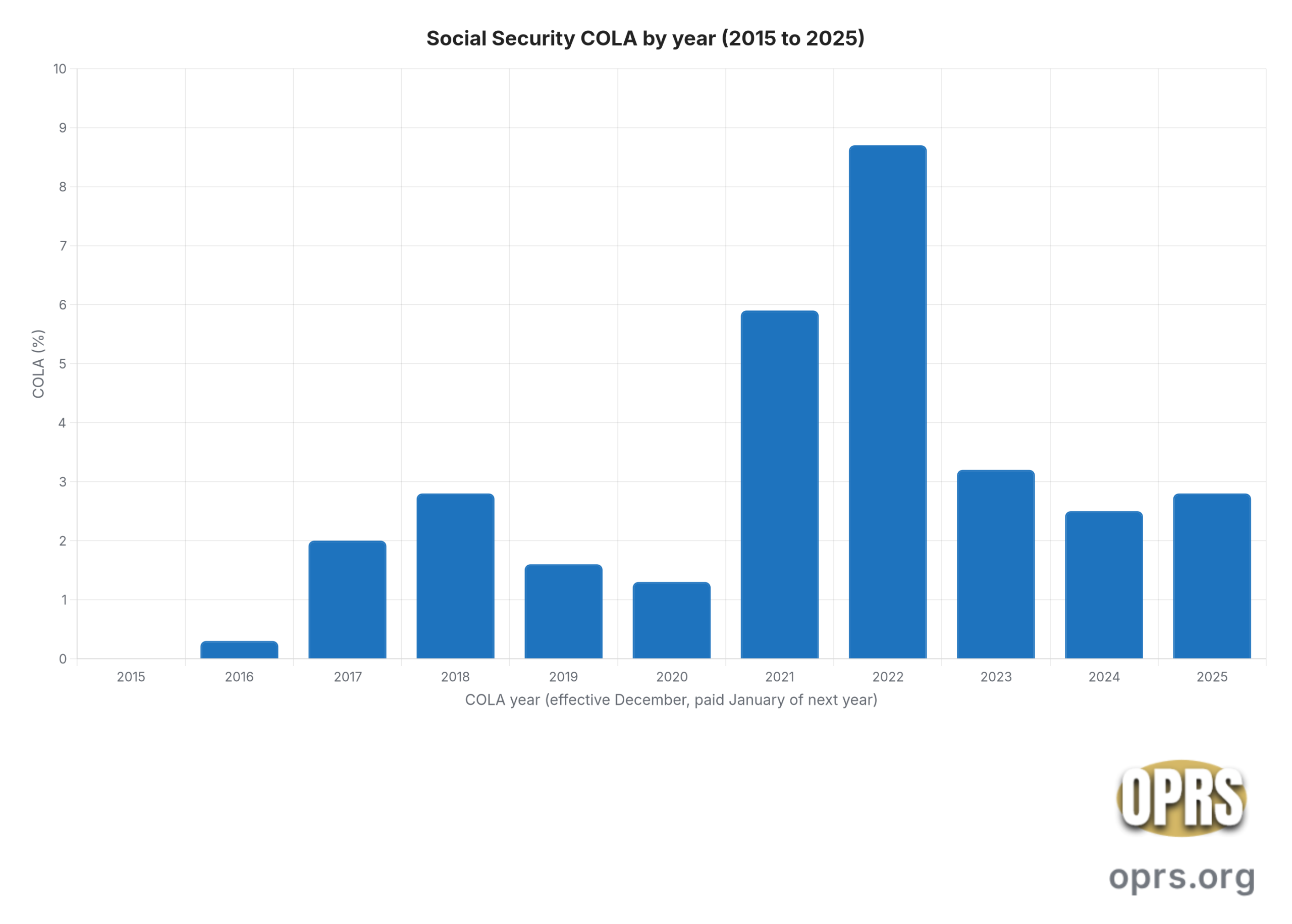
The 2022 COLA of 8.7 percent was the largest since 1981. It reset the base against which future third-quarter comparisons run, which is why the 2023 raise dropped to 3.2 percent even though prices kept climbing in absolute terms.
Why some years post zero percent
The COLA history contains three flat years since automatic adjustments began: 2009, 2010, and 2015. Each followed the same script.
In 2009 and 2010, the third-quarter CPI-W ran below the 2008 base, which had been pushed up by a mid-year oil price spike. Because SSA compares against the last year that produced a COLA (2008), the 2009 and 2010 third-quarter averages never cleared that elevated bar.
The 2015 flat year followed a sharp drop in energy prices during the third quarter of that year. The CPI-W came in slightly below the 2014 base, so the formula returned zero.
The 2016 raise then measured against the last COLA year (2014), not against 2015. That is why 2016 came in at 0.3 percent rather than a smaller residual number.
Congress has never enacted a negative COLA. If the formula produces a decrease, benefits stay flat and the next COLA measures against the last positive year.
Which benefits the COLA touches
The same percentage flows through every benefit computed from a beneficiary’s Primary Insurance Amount (PIA), and to Supplemental Security Income (SSI) at the federal level.
Covered benefit types include retired-worker benefits, spousal benefits, survivor benefits, and Social Security Disability Insurance (SSDI). The percentage is uniform. There is no separate COLA for widows, no larger raise for higher earners, and no smaller raise for early filers.
SSI payments also increase by the same COLA. Because SSI is paid on the first of the month, the January payment is issued at the end of the prior December when January 1 is a holiday.
The COLA is applied by inflating the PIA, then all benefit amounts derived from it inherit the raise automatically. Beneficiaries do not need to file anything, and the SSA sends a notice each December with the new monthly amount.
The Medicare Part B hold-harmless twist
Most retirees have Medicare Part B premiums deducted directly from their Social Security check. The interaction between the annual COLA and the annual Part B premium can cut the net raise.
Federal law includes a “hold-harmless” provision at 42 U.S.C. Section 1395r(f). It says the dollar increase in a beneficiary’s Part B premium cannot exceed the dollar increase in that beneficiary’s Social Security benefit from the COLA.
The rule protects most people whose premiums are deducted from Social Security. It means the net check will not go down because of a Part B premium hike. But three groups fall outside the protection.
New Part B enrollees are not held harmless. Beneficiaries who pay income-related premium surcharges (IRMAA) are not held harmless. And those who pay their Part B premiums directly, rather than through Social Security deduction, are not held harmless.
In years with a small COLA, the hold-harmless provision can absorb most of the raise for a covered retiree. The gross Social Security benefit still rises, but the net deposit into the bank account may barely move.
How wage indexing differs (for those still working)
Workers who have not yet claimed benefits do not receive the COLA. Their future benefit is protected by a separate mechanism called wage indexing.
The Average Wage Index (AWI) is used to adjust past earnings when SSA computes a new claim. It is defined at 42 U.S.C. Section 415(b) and published as a separate SSA series. The AWI tracks national average wages, not consumer prices.
Wage indexing typically runs faster than price indexing over long periods, because wages usually outpace prices. That is a design choice: a worker who reaches full retirement age at 67 sees earnings from age 22 restated in wage-equivalent terms as of two years before benefits begin.
Once benefits are claimed, wage indexing stops. From that point forward, only the annual CPI-W COLA adjusts the monthly payment.
About alternative index proposals
Two other measures have been proposed over the years to replace the CPI-W in the COLA formula: the CPI-E (Experimental Price Index for the Elderly, published by BLS) and the chained CPI-U (C-CPI-U).
CPI-E tracks a market basket weighted toward the consumption patterns of Americans 62 and older. It usually runs slightly higher than CPI-W, because seniors spend a larger share on medical care and housing.
Chained CPI-U runs slightly lower than CPI-W. It accounts for substitution behavior when relative prices change.
Neither has been enacted. The COLA remains tied to CPI-W as written in Section 215(i). Any change would require an act of Congress.
Bottom line for planning
The COLA is a formula, not a decision. It moves with third-quarter CPI-W and no other input. That has three practical implications for retirement income planning.
First, the announced October percentage is knowable in advance by anyone who watches monthly CPI-W releases through September. There are no surprises after BLS publishes the September figure in early October.
Second, the COLA protects nominal purchasing power against the CPI-W basket, not against every household’s actual cost mix. A retiree with heavy medical costs may lose real ground even in a positive COLA year.
Third, the interaction with Medicare Part B is worth checking every December when SSA sends the benefit notice. The gross COLA amount and the net deposit can diverge by a meaningful margin.
A COLA can also push a retiree across a tax threshold. The provisional-income thresholds that decide whether Social Security benefits are federally taxable (currently $25,000 and $34,000 for single filers, and $32,000 and $44,000 for joint filers) are not indexed for inflation. As nominal benefits rise each year, a larger share of the check may become taxable, even when real purchasing power holds flat.
For a broader look at retirement-income mechanics and adjacent decisions, see the OPRS review of gold IRA dealers if inflation-hedge allocations enter the picture.
Sources cited
- Social Security Administration, Latest Cost-of-Living Adjustment
- Social Security Administration, COLA Series (historical table)
- 42 U.S.C. Section 415 (Section 215(i) of the Social Security Act, cost-of-living increases)
- 42 U.S.C. Section 1395r(f) (Medicare Part B hold-harmless provision)
- Social Security Administration, National Average Wage Index series