

Updated: August 15, 2026
OPRS may receive compensation when readers open an account through partner links on this page. Our analysis is based on independent research, BBB data, and IRS publications.
Working retirees who claim Social Security before full retirement age routinely underestimate how much of their monthly check gets withheld under the earnings test. The rule looks simple on paper. In practice, the two annual thresholds, the different withholding ratios, and the special first-year rule catch people off guard every January.
Here is the mechanic in plain arithmetic, with the current-year limits, a labeled worked example, the recomputation SSA does at your FRA, and the way the test interacts with spousal and survivor benefits. Every figure comes from an official SSA page, and each source is linked at the end. Nothing here is investment advice.
Two annual limits, updated by SSA every year
SSA sets two exempt amounts. The first applies in any year before the year you reach full retirement age (FRA). The second, higher amount applies only in the year you reach FRA, and only for the months before your FRA month. From your FRA month forward, earnings no longer count against the test at all.
For 2026 the lower annual limit is $24,480. That works out to $2,040 per month. The higher limit for the year you reach FRA is $65,160 for the year, or $5,430 per month. SSA publishes both figures on its Exempt Amounts Under the Earnings Test page and updates them each October for the following calendar year.
The lower and higher limits track the national average wage index, so they rise most years. The rules attached to them, the withholding ratios and the definition of what counts as earnings, are set in statute and do not change year to year.
How the withholding math actually works
The withholding ratio depends on which limit applies to you. Under the lower limit, SSA withholds $1 in benefits for every $2 of earnings above the threshold. Under the higher limit, which only applies in the year you reach FRA, SSA withholds $1 for every $3 of earnings above the threshold. The higher-limit ratio is gentler on purpose.
SSA does not send you a partial check each month. Once your projected earnings for the year exceed the limit, SSA stops your benefits entirely for as many full months as needed to cover the withholding. When enough months have been skipped to cover the withheld amount, checks resume. This is why the surprise usually arrives in the mailbox, not on a pay stub.
Earnings are counted on a calendar-year basis, from January through December. The check that is withheld is your own retired-worker benefit. If a spouse or child is drawing a benefit on your record, their check can also be reduced by the same test.
What counts as earnings, and what does not
The earnings test is narrow. Only two categories of income count. Wages from a job, gross of income taxes, count from the moment they are earned. Net earnings from self-employment count too. Both figures come straight from your W-2 or your Schedule SE.
Every other kind of retirement income sits outside the test. Pension payments do not count. Traditional IRA and 401(k) distributions do not count. Roth IRA withdrawals do not count. Annuity payments do not count. Interest, dividends, and capital gains do not count. Rental income does not count unless you are in the business of renting real estate as a self-employed person.
Veterans benefits, workers compensation, and other public benefits are also outside the test. This narrow scope is often the biggest single misunderstanding readers bring to the topic. The test only bites when you are still working for wages or running a business.
A worked example against the 2026 lower limit
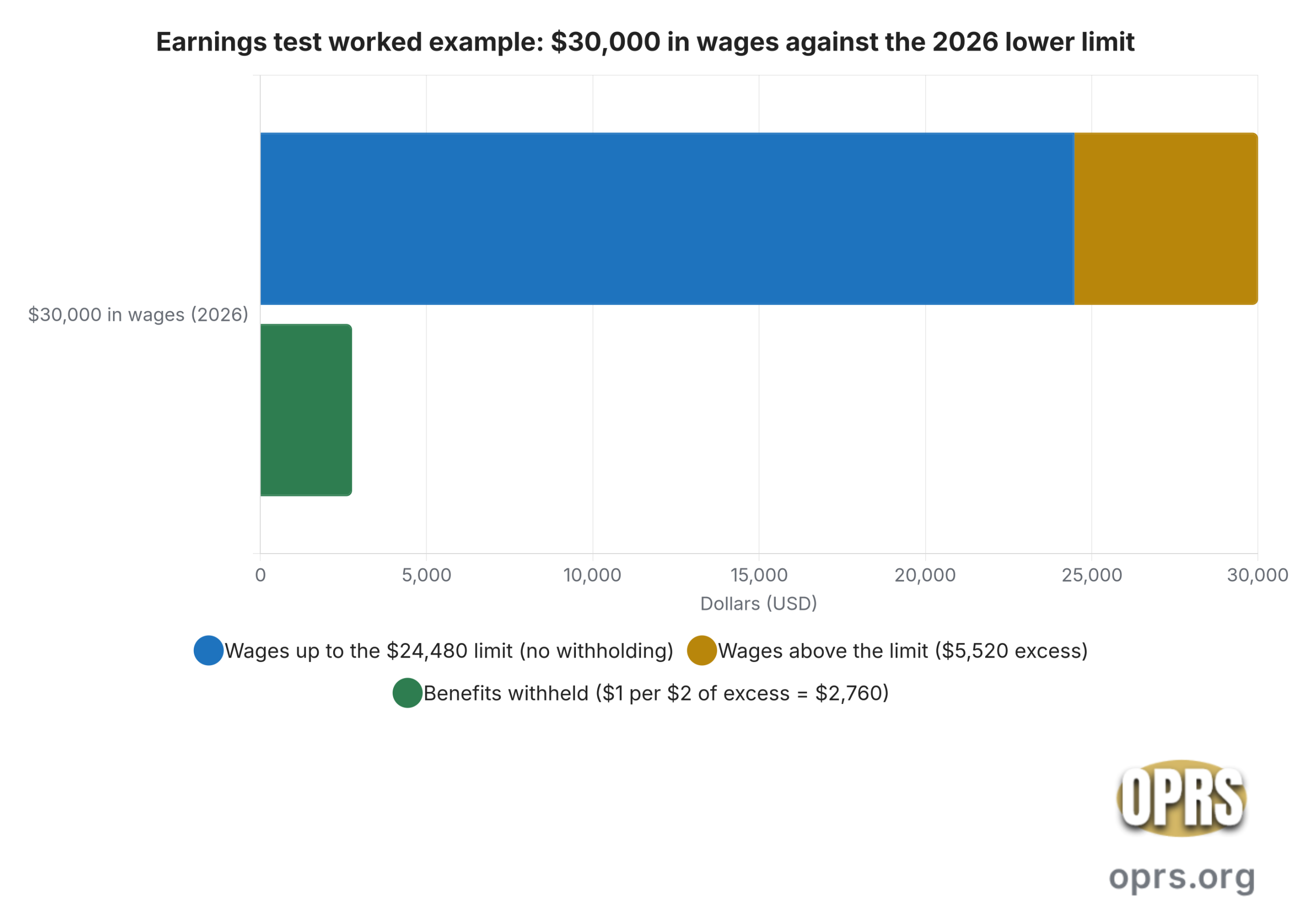
Take a labeled illustrative case. A retiree claims Social Security at age 63, with an FRA of 67, and keeps a part-time job that pays $30,000 in wages for the calendar year. The lower limit applies because the retiree is more than a year away from FRA.
Step one: subtract the limit from the earnings. Wages of $30,000 minus the 2026 lower limit of $24,480 leaves $5,520 of excess earnings. Step two: apply the withholding ratio. SSA withholds $1 for every $2 of excess, so the withheld amount is $5,520 divided by 2, which equals $2,760 for the year.
If the retiree’s monthly Social Security check is $1,400, that $2,760 withholding covers just under two full monthly checks. SSA will stop the January and February checks in full and resume in March. The visual below plots the same math against the 2026 lower limit.
Recent history sits close to the current number. SSA reports the lower limit as $22,320 in 2024 and $23,400 in 2025, moving up to $24,480 for 2026. The higher limit for the year of FRA rose from $59,520 in 2024 to $62,160 in 2025 to $65,160 in 2026. Use the current-year figure for any real planning.
The recomputation at FRA is not a punishment
The single most important thing to understand about the earnings test is that the withheld money is not lost. SSA describes the test as a benefit withholding, not a benefit reduction. Once you reach FRA, SSA recomputes your monthly amount to credit back the months in which benefits were fully withheld.
The mechanism is the same as the delayed-retirement credit. Every full month of benefits that was withheld before FRA counts as a month you did not claim. SSA then uses the actuarial reduction table to raise your monthly benefit as if you had filed that many months later. Over a normal life expectancy, the higher monthly check at FRA and beyond makes up for the years of withheld payments.
This recomputation happens automatically. You do not need to file any form or request. SSA processes it in the year you reach FRA and mails you a notice showing the new monthly amount.
The special first-year monthly rule
The annual test can produce a strange result in your first year of retirement. Someone who earned a full salary from January through June and then retired mid-year could easily be over the annual limit even though they earned nothing in the second half of the year.
SSA solves this with a special monthly rule that applies only in the first year you claim. Under this rule, you get your full benefit for any month in which you are considered retired, regardless of your total annual earnings. You are considered retired in a month when your wages are $2,040 or less in 2026, and you are not performing substantial self-employment.
The monthly self-employment test is not measured in dollars. SSA treats you as retired in a month if you work 45 hours or less in your business and are not doing the same work you did before retirement. From the second year forward, the annual test applies and the monthly rule falls away.
How the test hits spousal and survivor benefits
The earnings test applies to any Social Security benefit paid to a person under their own FRA. That includes spousal benefits paid to a husband or wife, child benefits paid to a minor or disabled adult child, and survivor benefits paid to a widow or widower before their survivor FRA.
Only the earnings of the person receiving the check matter. A widow under her survivor FRA who keeps working sees her own survivor benefit reduced by her own wages, not by anything her late husband ever earned. Spousal benefits work the same way. The working spouse’s own wages count against that spouse’s own check.
Two situations are worth flagging. First, if the wage-earner triggers the test on their own benefit, and a spouse or child draws on that same record, the auxiliary checks can also be withheld. Second, the recomputation at FRA that credits back the withheld months only applies to the retired-worker benefit. Survivor benefits have their own separate rules for the recomputation, described on the SSA planner for survivors.
Practical reading of the rule for anyone still working
If you plan to keep working past your Social Security filing date, three questions decide how much the earnings test will bite. What year is it relative to your FRA year? How much do you expect to earn in wages or self-employment? And is this your first year of claiming?
Anyone squarely under the lower limit in a normal year is unaffected. Anyone earning between the lower and higher limits in a normal year gives back $1 in benefits for every $2 above the lower limit. Anyone in the year of FRA gets the softer $1-in-$3 ratio and the higher limit, and stops being affected entirely from their FRA month forward.
The withheld dollars come back later in the form of a higher monthly check for the rest of your life. That does not make the withholding painless in the year it happens, especially for retirees who counted on both the paycheck and the full monthly benefit at the same time. Planning the first year of claiming around the monthly rule, and later years around the annual limit, keeps the surprise off the mailbox.
Sources cited
- Social Security Administration, Receiving Benefits While Working (earnings test overview, annual and monthly limits, first-year monthly rule, recomputation at FRA).
- Social Security Administration, Exempt Amounts Under the Earnings Test (current-year and historical lower and higher exempt amounts, withholding ratios).
- Social Security Administration, How Work Affects Your Benefits (Publication No. 05-10069) (official pamphlet on earnings test, worked examples, self-employment monthly test).