

Updated: August 15, 2026
OPRS may receive compensation when readers open an account through partner links on this page. Our analysis is based on independent research, BBB data, and IRS publications.
Social Security’s spousal benefit is one of the most misread pieces of the program. Married couples often assume the lower earner receives half of the higher earner’s actual monthly check. That is not how the formula works. The 50 percent figure is a ceiling, and it applies only at full retirement age, with strict conditions on top.
This guide walks the mechanics without any product framing. Every figure below is set in statute or published in the Social Security Administration’s (SSA) own retirement planner. Each source is linked at the end.
The 50 percent rule at full retirement age
The maximum spousal benefit is 50 percent of the higher earner’s primary insurance amount, called PIA. PIA is what the higher earner would receive if they filed exactly at their own full retirement age. That figure does not include any delayed-retirement credits.
This distinction matters. If the higher earner delays past FRA to age 70, and their own monthly check climbs 24 to 32 percent above PIA, the spousal benefit does not follow. SSA calculates the 50 percent cap against the original PIA, not the enlarged retirement check.
Another common misread: a lower earner cannot simply pick between their own benefit and half of the spouse’s benefit. SSA pays the higher of the two figures, and only after the spousal eligibility conditions are met. If the lower earner’s own retired-worker benefit exceeds 50 percent of the higher earner’s PIA, they receive their own benefit and no separate spousal amount.
The actuarial reduction if you file before FRA
The spousal benefit has its own reduction schedule when the lower earner files before their own FRA. Two rates stack. The first 36 months before FRA cost 25 out of 36 of one percent per month. Any additional months before FRA cost five twelfths of one percent per month.
Convert those figures. Twenty-five thirty-sixths of one percent per month equals about 0.694 percent per month, or roughly 8.33 percent per year across the first 36 months. Five twelfths of one percent per month equals about 5 percent per year for any earlier months. Both rates apply to the 50 percent cap, not to the higher earner’s full PIA.
Take a spouse with an FRA of 67 who files at 62. That is 60 months early. The first 36 months trim 25 percent from the spousal cap. The remaining 24 months trim another 10 percent. Total reduction is 35 percent. The lower earner keeps 65 percent of the 50 percent cap, which equals 32.5 percent of the higher earner’s PIA.
A spouse with an FRA of 66 filing at 62 loses only 30 percent of the cap: 25 percent over the first 36 months plus 5 percent across the remaining 12 months. That leaves 35 percent of PIA, higher than the 32.5 percent figure above, because the reduction window is shorter.
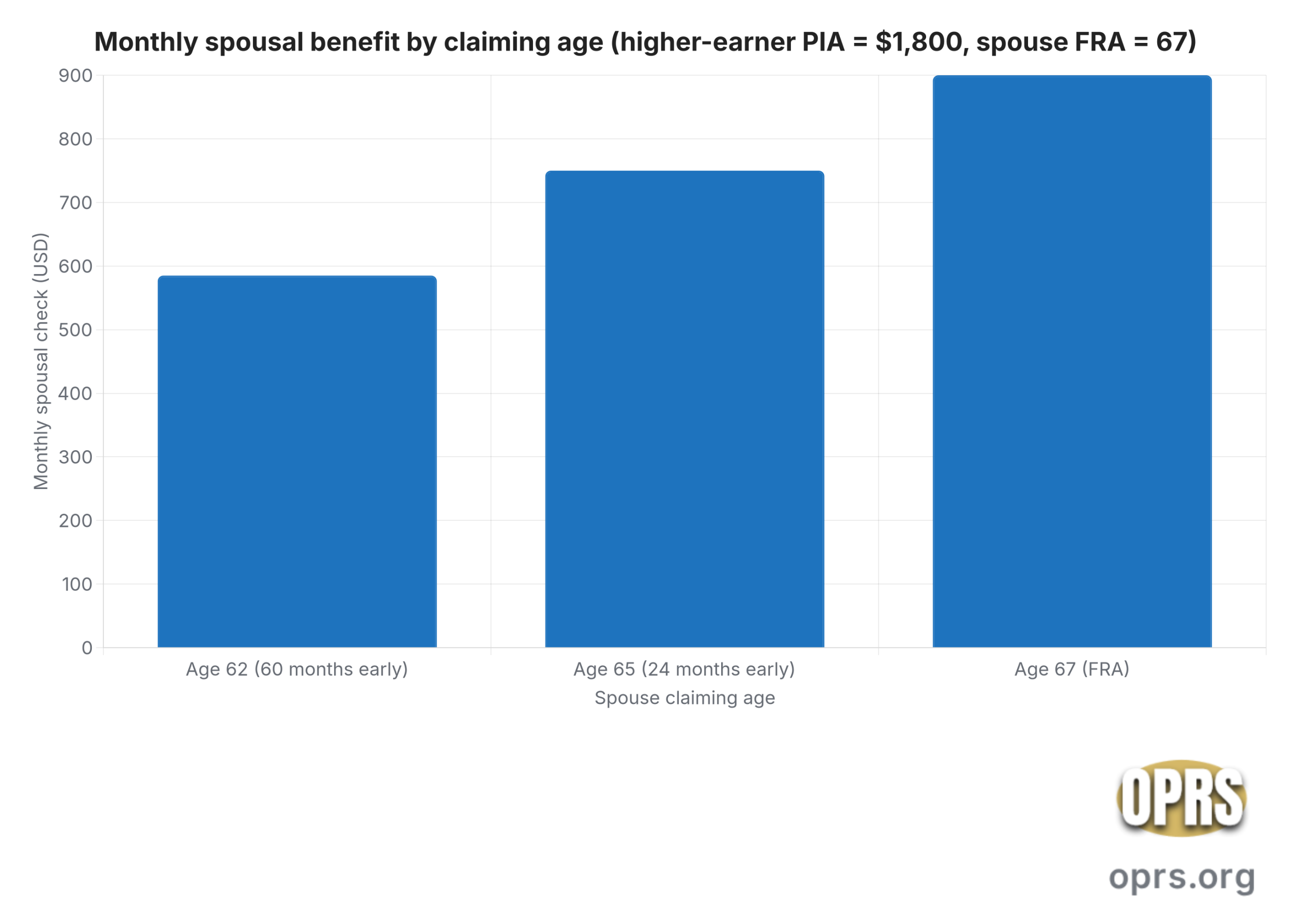
Every intermediate age between 62 and FRA follows the same two-rate schedule. Filing at 63 with an FRA of 67 means 48 months early: 25 percent plus 5 percent, or 30 percent total reduction, leaving 35 percent of PIA. Filing at 65 with an FRA of 67 means 24 months early, or a 16.67 percent reduction, leaving about 41.67 percent of PIA.
A worked example with an $1,800 PIA
Assume the higher earner has a PIA of $1,800 and a full retirement age of 67. The lower earner also has an FRA of 67, is currently married to the higher earner, and has a small work record of their own that computes to a smaller retired-worker benefit.
If the lower earner waits until age 67 to file, the maximum spousal amount is 50 percent of $1,800, or $900 per month. SSA compares that $900 against the lower earner’s own retired-worker check and pays the larger of the two.
If the lower earner files at 62, the 35 percent reduction applies. The spousal share falls to 65 percent of $900, or about $585 per month. That is 32.5 percent of the higher earner’s original PIA, locked in for life before any cost-of-living adjustment.
The dollar gap between $900 at FRA and $585 at 62 is $315 per month, or $3,780 per year. Over a 25-year retirement, that difference compounds to well over $90,000 in nominal dollars, before any cost-of-living increases and before counting the extra months of collection that early filers receive.
The chart below shows the same $1,800 PIA at three key ages for a spouse with FRA 67. The bars are simple arithmetic from the reduction schedule above.
The deemed-filing rule since 2015
Before 2016, a spouse could file a restricted application limited to just a spousal benefit while their own retired-worker benefit kept accruing delayed-retirement credits. That strategy paired well with a working spouse at FRA who wanted to boost their own future check.
The Bipartisan Budget Act of 2015 closed that door for anyone born on or after January 2, 1954. Under the current rule, called deemed filing, applying for either your own retirement benefit or a spousal benefit is treated as an application for both.
SSA then pays a combined amount equal to the larger of the two, not both stacked. The practical effect: workers born after January 1, 1954 cannot decouple the two claims. The only group that can still use restricted application is anyone born on or before January 1, 1954, who is well past FRA in 2026 and represents a shrinking share of new filings.
The higher earner must have filed
A spousal benefit cannot begin until the higher earner has themselves filed for their retirement benefit. This trip-wire used to be avoidable through a maneuver known as file and suspend. The higher earner filed to trigger the spousal claim, then immediately suspended their own check to keep earning delayed credits.
The same 2015 Budget Act ended file and suspend as of April 30, 2016. Suspending a benefit today also suspends any spousal or dependent claims tied to that record. Couples can no longer decouple the higher earner’s suspension from the lower earner’s spousal check.
The consequence for planning is straightforward. If the higher earner wants to delay to 70 for a larger personal check, the lower earner may have to wait too. The exception is a lower earner with enough of their own record to file as a retired worker in the meantime.
Divorced spouse: the 10-year rule
A divorced person can qualify for a spousal benefit on an ex-spouse’s record if four conditions are met. The marriage lasted at least 10 years. The claimant is currently unmarried. The claimant is at least 62 years old. The ex-spouse is entitled to Social Security retirement or disability benefits.
There is one important variant of the “must have filed” rule for divorced spouses. If the divorce was finalized at least two years ago, the claimant does not need the ex-spouse to have already filed. Both parties must simply be 62 or older and otherwise eligible.
Whether the ex-spouse has remarried does not affect the claimant’s entitlement. The rule is about the claimant’s marital status, not the ex’s. The claimant’s own remarriage generally ends the ex-spouse benefit, though a later marriage that itself ends can restore eligibility.
The 50 percent cap and the same actuarial reduction schedule apply. A divorced spouse filing at 62 with an FRA of 67 receives the same 32.5 percent of the ex’s PIA as an intact-couple spouse in the same situation.
The survivor benefit is a separate calculation
When the higher earner dies, the spousal benefit ends and a survivor benefit can begin. Survivor benefits use a different formula and a different reduction schedule. They are not capped at 50 percent of PIA.
A widow or widower who has reached survivor FRA can receive up to 100 percent of the deceased spouse’s actual monthly check, including any delayed-retirement credits earned before death. Filing early cuts that amount on a separate age curve. The reduction is smaller in percentage terms than the retired-worker reduction and follows its own tables.
These two calculations are independent. A widow or widower currently drawing a spousal benefit will typically see a jump when the higher earner dies and the survivor rules take over. This assumes both spouses have filed and their earnings histories are typical.
What this means for a couple’s timing
Three levers move a couple’s spousal-benefit outcome. The first is the higher earner’s PIA, which is fixed by earnings history and the SSA formula. The second is the lower earner’s filing age, which sets the actuarial reduction against the 50 percent cap. The third is the higher earner’s own filing age, which does not change the spousal cap but does control when the spousal benefit can begin.
Because spousal benefits are capped at 50 percent of PIA and do not enjoy delayed credits, there is no arithmetic reason for the lower earner to delay past their own FRA. Every month past their FRA is a month of a check they could have collected with no future increase attached.
The higher earner’s delay decision is different. Delaying builds their own check by 8 percent per year up to age 70 and locks in a larger survivor benefit if they die first. The spousal cap does not follow, but the survivor calculation, using the higher earner’s actual check, does.
Sources cited
- Social Security Administration, Benefits for a Spouse (50 percent cap at FRA, actuarial reduction schedule, higher earner must have filed).
- Social Security Administration, Deemed Filing for Retirement and Spouse’s Benefits FAQs (Bipartisan Budget Act of 2015, January 2, 1954 cutoff, end of file and suspend).
- Social Security Administration, Benefits for a Divorced Spouse (10-year marriage rule, unmarried claimant, two-year post-divorce independent filing).