

Updated: August 15, 2026
OPRS may receive compensation when readers open an account through partner links on this page. Our analysis is based on independent research, BBB data, and IRS publications.
Social Security survivor benefits are not a variant of spousal or retirement benefits. They are their own calculation, with a different earliest filing age, a different reduction schedule, and one strategic freedom that neither of the other two benefits allow. Widows and widowers who read the retirement rules and assume they map across usually leave money on the table.
This guide walks the mechanics without any product framing. Every figure below is fixed in statute or published by the Social Security Administration (SSA). Sources are linked at the end.
Who qualifies as a surviving spouse
A widow or widower generally needs to have been married to the deceased worker for at least nine months before the death. Exceptions apply for accidental death and for military service members who died in the line of duty. The deceased worker must have earned enough Social Security credits to be insured.
A divorced surviving spouse can also qualify. The marriage must have lasted at least 10 years. The claimant must be currently unmarried, or must have remarried after reaching age 60. Whether the ex has remarried since the divorce does not affect the claimant’s own eligibility.
Remarriage timing is one of the sharpest edges in the rules. Remarrying before age 60 usually ends survivor eligibility on the first spouse’s record. Remarrying at or after 60 preserves it. A later marriage that itself ends can restore eligibility that a mid-life remarriage had cut off.
Two earliest filing ages: 60 and 50
A widow or widower can begin regular survivor benefits at age 60. That is two years earlier than the age-62 floor for a retired-worker benefit or a spousal benefit. The trade for starting early is a permanent actuarial reduction discussed in the next section.
A disabled widow or widower can start as early as age 50. The disability must have started before the worker’s death or within seven years of it, and the claimant must meet SSA’s disability standard. Filing at 50 does not carry a deeper reduction than filing at 60: SSA still uses the 60-age reduction floor for the disabled variant.
A surviving parent caring for the deceased worker’s child under 16 can also claim, at any age, without a reduction. That variant is beyond the scope of this page, which focuses on the widow(er) benefit for a claimant filing on their own age.
The survivor reduction schedule
The survivor benefit is capped at 100 percent of the deceased worker’s monthly benefit, including any delayed-retirement credits earned before death. That ceiling is available only at survivor full retirement age (FRA). Filing earlier cuts the amount on a fixed schedule.
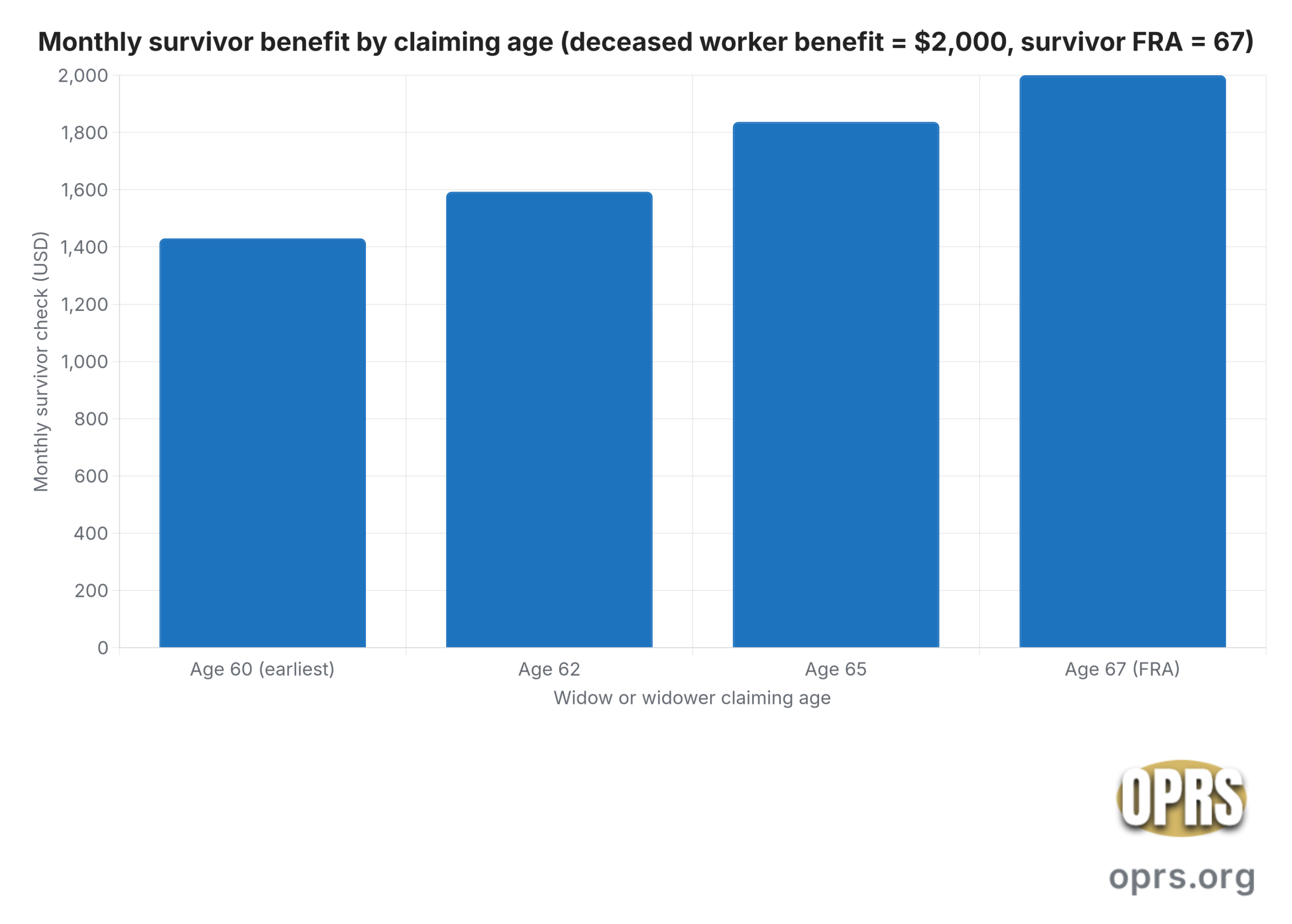
The maximum reduction is 28.5 percent, applied at the earliest age of 60. The remaining 71.5 percent is the floor: no widow or widower filing on their own age drops below it. Between age 60 and survivor FRA, the reduction shrinks in equal monthly steps until it reaches zero.
For most widows and widowers born in 1962 or later, survivor FRA is 67. That is 84 months of ramp from age 60. Each month before FRA costs about 0.339 percent of the deceased worker’s monthly amount. A widow with survivor FRA of 67 who files at 62 loses roughly 20.4 percent, keeping about 79.6 percent.
The chart below uses a deceased worker’s monthly benefit of $2,000 and a survivor FRA of 67. The bars come directly from SSA’s reduction schedule.
Survivor FRA is not identical to retirement FRA for every cohort. For most birth years the two ages match, but SSA publishes separate tables because the survivor schedule was set on a slightly different phase-in. Confirm your own survivor FRA on the SSA site before running any dollar calculation on your record.
Why the higher earner delaying to 70 protects the survivor
Delayed-retirement credits (DRCs) are the extra 8 percent per year that a worker adds to their own benefit by waiting past FRA up to age 70. Those credits do not vanish at death. They carry into the survivor benefit as part of the deceased worker’s monthly amount.
Take a couple where the higher earner has an FRA benefit of $2,000. If that spouse claims at FRA and later dies, the survivor benefit ceiling is $2,000. If instead the higher earner waits to age 70, the check is $2,480 (a 24 percent DRC bump on a 67-year FRA). If death follows, the survivor benefit ceiling is $2,480.
That $480 monthly gap is $5,760 per year. Over a 20-year widowhood, the nominal gap is $115,200 before any cost-of-living adjustment. For couples with one clearly higher earner and reasonable joint life expectancy, delaying that higher earner is often the single biggest surviving-spouse protection lever on the record.
The math flips for the lower earner. Delaying the lower earner’s own retirement past their own FRA does not protect the survivor: the surviving spouse of that lower earner would inherit the higher earner’s check anyway. Only the higher earner’s DRCs matter for survivor protection.
The strategy switch that deemed filing does not block
Widow and widower benefits are exempt from the deemed-filing rule that applies to retirement and spousal benefits since 2016. A claimant can file for a survivor benefit and separately delay their own retirement benefit, or take their own retirement early and switch to a survivor benefit at a later age.
Two common patterns illustrate the freedom. Pattern one: a widow with a smaller own record files at 60 for a reduced survivor benefit, then switches to her own delayed-credit-loaded retirement benefit at age 70 if that becomes the larger figure. Pattern two: a widow with a larger own record takes her own retirement first (early or at FRA), then switches to the survivor benefit at survivor FRA to lock in the full 100 percent.
Either sequence is legal and neither requires the two benefits to start together. SSA pays only one benefit at a time in each month, and the claimant chooses which one to activate first. The best sequence is a dollar-and-time calculation based on both records, life expectancy, and outside income.
Before ordering an application, run the numbers with SSA’s own calculator or a paid planning tool. The decision is reversible only within narrow SSA rules on withdrawal, so the pre-filing choice matters.
The earnings test still applies before FRA
A widow or widower who claims survivor benefits before reaching survivor FRA is subject to the retirement earnings test. Wages above the annual exempt amount trigger a temporary withholding: $1 of benefit is withheld for every $2 of earnings above the lower threshold, in years before the year of FRA.
In the year the widow or widower reaches FRA, the test changes. Only earnings before the birthday month count, and $1 is withheld for every $3 above a higher exempt amount. After the FRA birthday itself, no earnings test applies. The exempt amounts are updated by SSA each year and published under Retirement Earnings Test Exempt Amounts.
Withheld benefits are not lost forever. When the claimant reaches FRA, SSA recalculates the ongoing benefit to credit back the months that were fully withheld. The recomputation is done automatically and does not require a separate application.
The government pension offset is now gone
For decades, the government pension offset (GPO) reduced survivor benefits for widows and widowers who received a public pension from work not covered by Social Security. The reduction was two-thirds of the non-covered pension, and it often zeroed out the survivor benefit entirely for retired teachers, police officers, and firefighters in non-covered states.
The Social Security Fairness Act, signed into law on January 5, 2025, repealed the GPO and the windfall elimination provision. The change applies to benefits payable for months after December 2023, which means many affected widows and widowers were entitled to both a lump-sum retroactive payment and a higher ongoing monthly amount.
SSA has been processing the recalculations on a rolling schedule. A widow or widower whose survivor benefit was previously offset or denied on GPO grounds should confirm that the recalculation has been applied to their record. Details of the recalculation cohorts and timing appear in the OPRS piece WEP and GPO repeal: who gets recalculated.
How to apply: form SSA-10 and the required documents
Survivor benefits cannot be started through SSA’s standard online retirement application. The claimant must call SSA or visit a local field office. The core paper document is form SSA-10, Application for Widow’s or Widower’s Insurance Benefits.
SSA requires proof of the marriage and the death. Typical documents include the deceased worker’s death certificate, the marriage certificate, the claimant’s birth certificate, the Social Security numbers of both spouses, and the most recent W-2 or self-employment tax return of the deceased. Divorced surviving spouses also submit the final divorce decree.
Apply promptly. Survivor benefits can be paid retroactively, but generally no more than six months before the application date. Delays past that window forfeit those months. Contact SSA within a few weeks of the death to lock in the earliest payable date and to request the one-time lump-sum death payment of $255, which is separate from the ongoing survivor benefit.
Sources cited
- Social Security Administration, Survivors Benefits (program overview) (eligibility, ages, application path).
- Social Security Administration, If You Are the Survivor (widow(er) benefit rules, ages 60 and 50, remarriage rules, divorced survivor 10-year rule).
- Social Security Administration, Actuarial reduction and delayed retirement credit tables (28.5 percent maximum survivor reduction, monthly reduction rates by FRA).