

Updated: July 12, 2026
OPRS may receive compensation when readers open an account through partner links on this page. Our analysis is based on independent research, BBB data, and IRS publications.
State securities bureaus and state attorneys general file most of the active enforcement against gold IRA dealer sales practices (source: NASAA annual enforcement reports). The Commodity Futures Trading Commission files only a handful of precious metals cases in a typical year. That gap is the single most useful frame for reading any “gold IRA enforcement” headline in 2026.
Most retirees expect federal regulators to lead. The reality is steadier and quieter. Element I of reading the record is knowing that state Bureaus of Securities and state attorneys general carry the docket. Element II is knowing how a state-led case actually proceeds, what dollar figures it produces, and how to apply the record when vetting a specific dealer in 2026. For the broader operator landscape, see the 2026 OPRS list of gold IRA dealers we currently caution against.
Why state attorneys general and Bureaus of Securities lead gold IRA dealer enforcement
The federal jurisdictional map has a coverage gap that state regulators fill. The CFTC oversees futures, options, swaps, and a narrow category of leveraged retail commodity transactions. Most physical bullion sold outright and delivered to a depository within 28 days falls outside the agency’s reach under 7 USC 2(c)(2)(D).
The SEC treats pure physical bullion as a commodity, not a security, unless the offering carries pooled or managed investment features. The FTC reaches deceptive advertising and the 2024 fake reviews rule, but rarely the underlying coin pricing.
State Bureaus of Securities operate inside the Office of the Attorney General in most states. They have two statutory hooks that federal regulators do not. The first is state securities law, which often treats a self-directed IRA paired with marked-up coins as an unregistered investment program. The second is the state Consumer Fraud Act or Unfair and Deceptive Acts or Practices statute, which reaches misleading sales conduct regardless of whether the underlying product is a security.
The result is a structural division of labor. The CFTC handles leveraged precious metals programs and a small docket of foreign-entity matters. The SEC handles pooled offerings and broker-dealer registration issues. State attorneys general and Bureaus of Securities handle the sales-practice cases against dealers that target retirement-age customers with cold calls and undisclosed markups.
The major state attorney general actions on the public record
Three filings sit at the center of the recent state docket. Each one was a Bureau of Securities or Attorney General action, not a federal filing, and each one continues to shape what state-led enforcement looks like in 2024 through 2026.
New Jersey Bureau of Securities v. Lear Capital (April 2021, multistate framework)
The New Jersey Bureau of Securities filed against Lear Capital on April 8, 2021 under then-Acting Attorney General Andrew Bruck. The complaint alleged commissions averaging approximately 33% on customer purchases, undisclosed to the retiree at the point of sale (source: New Jersey Office of the Attorney General April 2021 press release). Roughly 30 other state securities regulators coordinated parallel actions through the NASAA multistate framework.
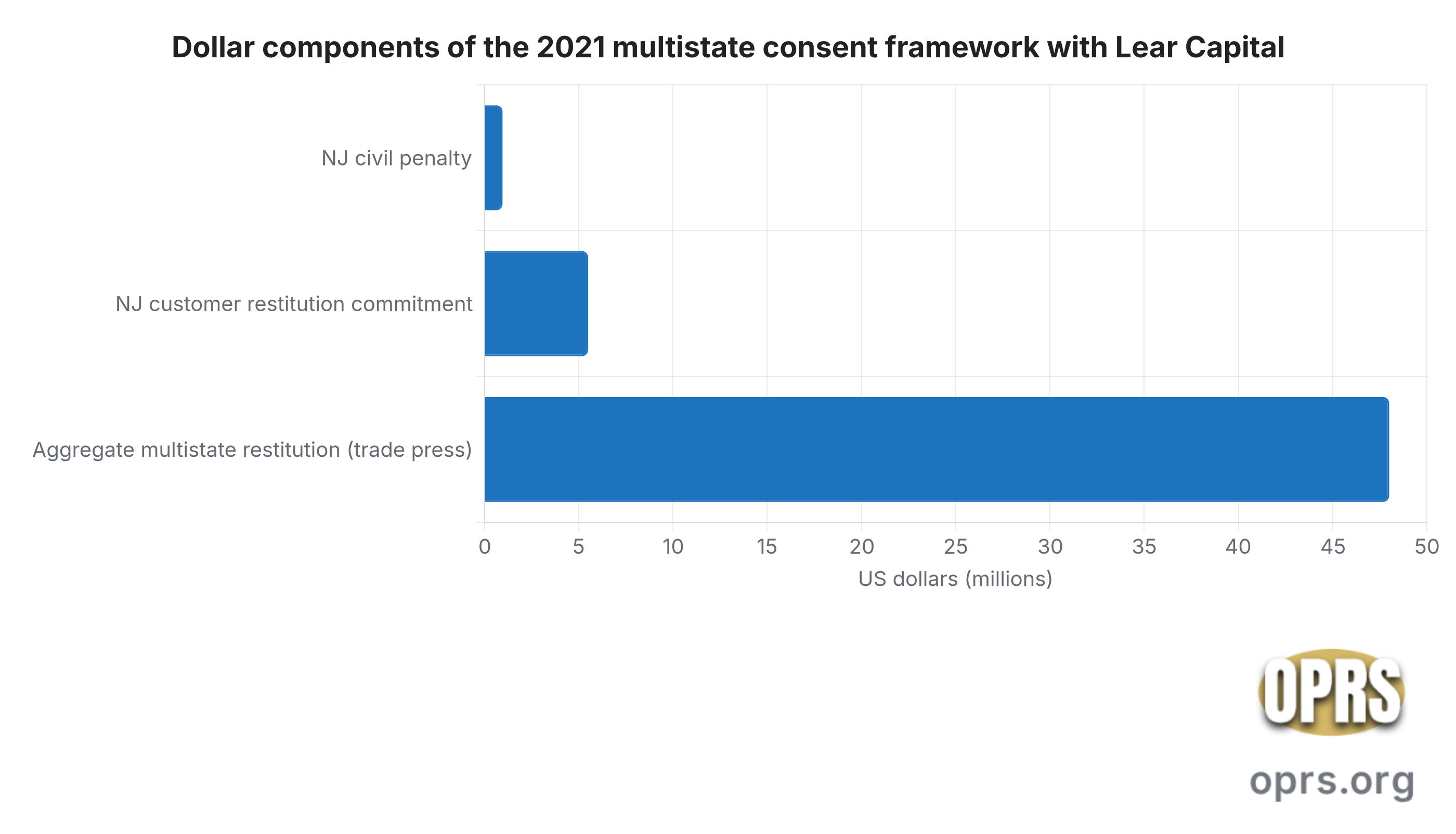
The remedy in the New Jersey leg of the consent: up to $955,000 in civil penalties to the state and up to $5.5 million in restitution to affected New Jersey customers.
Aggregate restitution across all participating states was reported in trade press at roughly $48 million. That figure adds the companion state agreements and the later Chapter 11 claim register together. Lear Capital filed for bankruptcy protection in 2022, which placed the consent obligations inside the priority structure of the federal court receivership.
California, Minnesota, and parallel state actions on Safeguard Metals
The Safeguard Metals matter started as a CFTC filing in February 2022 in the Central District of California, but the parallel state file is the part most retirees miss. The California Department of Financial Protection and Innovation pursued its own theory under state securities and broker-dealer rules. The Minnesota Department of Commerce filed under that state’s consumer protection statute, citing elder financial abuse provisions that the federal complaint did not invoke.
The pattern matters. A retiree who reads only the federal docket sees one case. The state record shows three. Each state filing carried its own consent terms and customer restitution mechanics. The state record is where the elder-abuse statutes carry the heaviest weight, because federal commodity law has no parallel provision targeting age-based vulnerability.
Texas, California, and the state companion record on TMTE / Metals.com
The TMTE matter (doing business as Metals.com, Chase Metals, and Barrick Capital) drew a state response that mirrored the 2020 CFTC filing. Roughly 30 state securities regulators joined a multistate task force coordinated through NASAA. The Texas State Securities Board, the California DFPI, and parallel offices in additional states filed their own administrative cease and desist orders against the named entities and individual principals.
The state record produced its own restitution and disgorgement requirements. It also produced an industry bar provision in several states preventing the named individuals from offering securities or financial products to residents in the future. Federal receivership distributions continue, but the state record is what defines whether a named principal can return to the dealer market in a given state at all.
How a state attorney general action actually moves from intake to consent order
The procedural path is consistent across states. Knowing the path lets a retiree read a press release with the right framing and lets a customer file a complaint at the right office when something looks wrong.
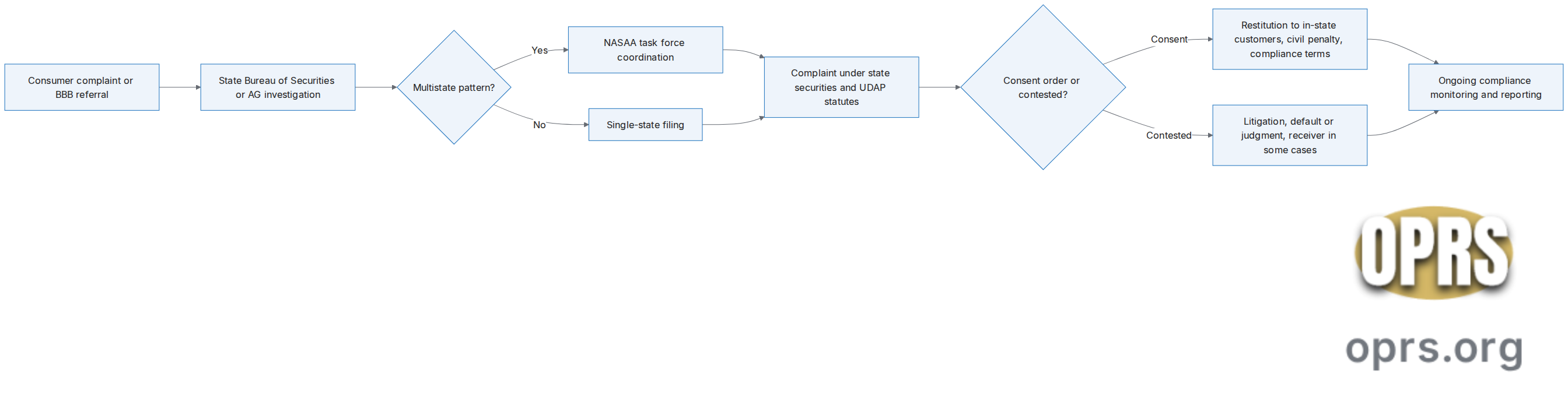
In practice: a single-state filing rarely produces national restitution. The multistate pathway, coordinated through NASAA, is what turns a New Jersey or California complaint into a 30-state consent framework with aggregate restitution in the tens of millions. The TMTE and Lear Capital records are the two clearest illustrations of that mechanic since 2020.
What state-led enforcement actually produces: penalty, restitution, and industry bars
A state consent order typically contains four kinds of obligations. The first is a civil monetary penalty paid to the state treasury or a related consumer fund. The second is restitution to in-state customers, often capped at a published dollar figure and distributed through a claims process. The third is structural change: improved fee disclosure, registration requirements, sales-script controls. The fourth is an industry bar in some cases, prohibiting named individuals from operating in the dealer market.
The dollar columns matter for different reasons. The penalty is what the firm pays. The restitution is what affected customers can claim. The aggregate multistate figure, which trade press often headlines, is the sum of restitution commitments across all participating jurisdictions. Each component is a different signal. A high penalty paired with low restitution can indicate a thin claimant pool. A high restitution paired with a low penalty can indicate a deferred-judgment framework. Read all three before forming a view.
| Statutory hook | What it reaches | Typical remedy |
|---|---|---|
| State Securities Act (Blue Sky statutes) | Unregistered offerings, unregistered agents, securities-like investment programs | Cease and desist, registration order, civil penalty, restitution |
| Consumer Fraud Act / UDAP | Deceptive sales conduct, misrepresentation of fees or value, omitted material facts | Restitution, civil penalty, conduct injunction |
| Elder financial abuse statutes | Sales practices targeting customers 60 or 65 and older with age-based vulnerability | Enhanced penalty multipliers in some states, expedited investigation |
| Telephone solicitation rules | Cold-call and lead-magnet follow-up patterns in states with stricter telephone laws | Civil penalty, sales-script controls |
| Industry bar provisions | Named individuals or affiliated entities operating in the state dealer market after a finding | Permanent or term-limited bar, no return without re-registration |
The verification value of state AG records when evaluating a 2026 dealer
The state record is the highest-value vetting filter for a retiree picking a dealer in 2026. It catches conduct the CFTC will not reach. It catches firms the BBB has not yet downgraded. It catches sales-practice patterns months or years before they appear in trade press. The verification work takes about five minutes per state and applies to any dealer on the shortlist before a wire transfer moves.
Run the search against three states at minimum. Your state of residence is the obvious first stop, since that is where any consent order’s restitution claim would be filed. The dealer’s stated home state is the second, since that is where the registration record sits.
California, New Jersey, Texas, and Minnesota are useful national bellwethers. Their securities and consumer protection offices have been most active on precious metals matters since 2020. Check this dealer against the 2026 OPRS list after the state record check is clean.
Common mistakes retirees make when reading state AG records
Reading enforcement coverage produces several predictable overreactions. Each one costs money or causes a worse outcome than measured vetting would.
- Mistake 1: assuming the federal docket tells the full story. A clean CFTC and SEC record is necessary but not sufficient. The state Bureau of Securities is where most dealer sales-practice findings live. Skipping the state search misses the docket where most actual findings sit.
- Mistake 2: treating an old consent order as ancient history. The 2021 Lear Capital consent framework remains active in 2024 through 2026 because the bankruptcy claim register, customer restitution distribution, and the industry-bar provisions in several states continue to apply. A firm that emerged from a state action three years ago is operating under terms a retiree can verify on the state register.
- Mistake 3: searching only the firm’s current legal name. Precious metals dealers frequently operate under multiple DBAs. The TMTE record covers Metals.com, Chase Metals, and Barrick Capital under the same parent. A search must include every DBA on the dealer’s marketing material to catch the full record.
- Mistake 4: assuming a settlement means the customer is whole. Restitution caps are not the same as customer recovery. The claims process can take years and pay cents on the dollar depending on the distribution. A $48 million aggregate restitution figure does not mean every claimant collects in full.
- Mistake 5: dismissing the warning when the named principals reappear under a new entity. Several individuals in the 2020 through 2022 enforcement record have been associated with successor firms. The state industry-bar provisions vary by jurisdiction. A principal barred in New Jersey may operate in a state that did not join the original consent framework, which is a structural reason to check the state register for the specific salesperson, not just the firm.
How to check a gold IRA dealer against state attorney general records
The verification sequence below uses only public data. Each step takes a few minutes. Run them in order. If any step returns a flag, the dealer is not worth the risk regardless of how persuasive the sales pitch sounds.
- Search NASAA enforcement reports for the firm name and every DBA. The NASAA annual enforcement reports aggregate state securities actions across the year. Search the firm’s legal name plus each DBA. A direct hit is the strongest signal.
- Search the state Bureau of Securities or AG office in your state of residence. Each state publishes its enforcement releases. For New Jersey customers, start at the Bureau of Securities. For California, the DFPI publishes its enforcement actions. For Texas, the State Securities Board does the same.
- Search NAAG announcements for multistate frameworks. The National Association of Attorneys General publishes multistate enforcement announcements. A multistate framework against a dealer is a high-signal event because it survives any single-state political turnover.
- Verify the BBB profile and complaint pattern. Search the dealer at bbb.org. The letter grade matters less than the unresolved-complaint pattern. A high rating with dozens of fee-related complaints is a state-record yellow flag.
- Check the CFTC RED List and press release archive. The CFTC RED List catches foreign entities that often appear alongside state-level patterns. Cross-check the firm name in the CFTC press release archive as well.
- Request a written fee schedule with markup over spot. Ask the agent to email a per-coin price quote plus the current spot price of the underlying metal. The 2021 New Jersey filing against Lear Capital centered on undisclosed markups. A dealer that refuses, hedges, or quotes only “all-in” pricing without a spot reference is signaling the markup is high.
- Confirm structural independence between dealer, custodian, and depository. A reputable self-directed IRA setup uses three separate parties (see IRS Publication 590-A). Structural overlap is a fraud-prevention red flag that has shown up across multiple state filings.
- Use a 24-hour cooling-off period before signing. A reputable dealer expects this. A pressure-sales dealer pushes back, which is the answer.
Two related OPRS pages extend this analysis. The CFTC enforcement recap for 2024 through 2026 sits next to the state record and shows where the federal docket actually reaches. The breakdown of the Lear Capital action covers the framework in detail.
Does the state AG record mean I should avoid all gold IRA companies?
No. The record is a calibration tool, not a category verdict. Use it to set the minimum bar for any dealer evaluated.
That bar means no state Bureau of Securities consent orders, and no NASAA-coordinated action. It means no industry bar against any individual principal. It means written markup disclosure before purchase, an A or A+ BBB rating with a clean unresolved-complaint pattern, and structural independence between dealer, custodian, and depository.
Dealers that clear those gates operate at a different standard than the firms the state record has reached. A clean record across the public registers is what a retiree owes the next generation before committing a retirement balance.
Some operators in the market lean on the educational side of the funnel. Augusta Precious Metals publishes a free company comparison checklist that walks through dealer-vetting questions. It operates an Education-First process built around learn, talk, and decide, with salaried, non-commissioned educators.
Augusta has been BBB A+ accredited since 2014 with no complaints on file. It has been named Money Magazine’s Best Overall Gold IRA Company every year from 2022 through 2026, and Investopedia’s Most Transparent Gold IRA Company across the same window. Augusta’s industry-reported minimum sits around $50,000 for gold IRA accounts. None of this exempts a reader from running the state-record verification steps above. It does help illustrate what a clear public register looks like.
If you are evaluating a gold IRA dealer right now, apply the same framework the state record codifies. Run the eight-step check above against any company on your shortlist before opening an account. That single discipline absorbs most of the lesson from the 2020 to 2026 state docket.
Run the same checklist against a dealer that has cleared the state-record bar
Augusta offers a free company comparison checklist that walks through dealer-vetting questions before a wire moves. (OPRS may receive compensation when readers proceed.)
Augusta’s industry-reported minimum sits around $50,000 for gold IRA accounts. If you have less and want to start smaller, the shortlist names two alternatives with lower thresholds.
3 of 27+ gold IRA dealers reviewed by OPRS make the 2026 trusted list. Updated July 2026.
Sources cited
- New Jersey Office of the Attorney General April 2021 press release on the Lear Capital consent framework
- New Jersey Bureau of Securities, Division of Consumer Affairs
- NASAA annual enforcement reports
- National Association of Attorneys General
- CFTC press release archive
- CFTC RED List of unregistered foreign entities
- 7 USC 2(c)(2)(D), the retail commodity rule
- 26 USC 408(m), IRS rules on collectibles in retirement accounts
- IRS Publication 590-A on IRA contributions and rollovers
- 16 CFR Part 465, the 2024 FTC fake reviews rule
- Better Business Bureau company search
Consult your tax advisor for your specific situation. Past performance is not a guarantee of future results.