

Updated: July 28, 2026
OPRS may receive compensation when readers open an account through partner links on this page. Our analysis is based on independent research, BBB data, and IRS publications.
Form 1099-R, Distributions From Pensions, Annuities, Retirement or Profit-Sharing Plans, IRAs, Insurance Contracts, etc., is the year-end information return a governmental defined-benefit or defined-contribution plan issues to a separated qualified public safety officer. It is issued for every distribution event during the tax year.
The figure that determines whether the IRS sees a clean transaction or a flagged early withdrawal is the one-character code in box 7. Two statutory carve-outs apply almost exclusively to retired police, firefighters, EMTs, paramedics, corrections officers, and chaplains: the IRC Section 72(t)(2)(A)(v) age-50 separation exception and the IRC Section 402(l) HELPS exclusion.
Both depend on the plan administrator coding the 1099-R correctly. If you are about to choose a gold IRA custodian for the rollover surplus, see the 2026 OPRS dealer list before you sign anything.
What box 7 actually reports
Box 7 of Form 1099-R carries a one or two character code that classifies the distribution event for federal tax purposes. The codes are defined in the IRS Instructions for Forms 1099-R and 5498.
The plan administrator selects the code when the distribution is processed. That code travels with the gross amount in box 1, the taxable amount in box 2a, and the federal withholding in box 4.
Once filed with the IRS by January 31, the code is the primary classifier the matching engine uses. It decides whether the participant owes income tax, the 10 percent additional tax on early distributions, or neither.
Three details matter for a separating PSO. First, box 7 can contain up to two codes when the distribution event meets two classifications (for example, code G combined with code 4 for a direct rollover by a non-spouse beneficiary).
Second, the participant has no direct ability to set the code; the plan administrator codes it based on the rollover or distribution paperwork submitted. Third, an incorrect code is not silently penalty-free: the IRS Automated Underreporter program (CP2000) compares the 1099-R against the 1040 and issues a notice if the codes do not reconcile with the reported tax treatment.
The five box 7 codes a separated PSO sees most often
The IRS publishes more than twenty distribution codes for box 7, but only a handful surface in a typical PSO retirement file. The table below lists the five codes that recur, plus the IRC reference that controls how each is taxed and the action item for the participant.
| Code | Plain-language meaning | Controlling section | What the participant does |
|---|---|---|---|
| 1 | Early distribution, no known exception | IRC Section 72(t)(1) (10 percent additional tax) | If a Section 72(t) exception applies (PSO age-50, HELPS, disability, medical expense), request a corrected 1099-R or file Form 5329 to claim the exception independently. |
| 2 | Early distribution, exception applies, no 10 percent additional tax | IRC Section 72(t)(2), including (A)(v) for qualified PSO age 50+ | Confirm box 1 gross matches plan records. Report the distribution on Form 1040 line 5a and 5b. No Form 5329 needed. |
| 7 | Normal distribution, participant age 59 1/2 or older | IRC Section 72(t)(2)(A)(i) (age 59 1/2 exception) | Report on Form 1040 line 5a and 5b. If the distribution funds qualified health or LTC insurance premiums, claim up to 3000 dollars under Section 402(l) on line 5b with the letters PSO. |
| G | Direct rollover of a distribution to a qualified plan, IRA, or 457(b) | IRC Section 402(c)(4) and Section 3405(c) | Report the gross on Form 1040 line 5a, enter zero on line 5b, write Rollover next to line 5b. No tax due. |
| 4 | Death distribution to a beneficiary | IRC Section 402(c) (rollover by surviving spouse) and Section 401(a)(9)(B) (non-spouse 10-year rule) | Report on Form 1040 line 5a and 5b. If a surviving spouse rolls the inheritance to her own IRA, the receiving 1099-R is coded 4 with G as a combination code. |
Precious metals IRA early-withdrawal penalty estimator
Taking money out of a precious metals IRA before age 59 and a half triggers a 10% federal additional tax on top of ordinary income tax. State add-on taxes vary; check your state. The federal penalty is estimated below.
Estimate only, not tax advice. The 10% federal additional tax applies to early distributions before age 59 and a half; specific exceptions exist. Your state may add its own tax, and ordinary income tax applies separately. Source: IRS Publication 590-B. Consult a tax advisor.
The right dealer explains every fee up front. Get Augusta's free precious metals IRA company checklist.
A clean PSO separation file with a partial rollover and an annual HELPS draw generates two distinct 1099-Rs in the first tax year, and one each subsequent year through Medicare eligibility. Check this dealer against the 2026 OPRS list before you accept rollover paperwork that determines which code your 1099-R will carry.
Why code 2 (not code 1) is the PSO before-59 1/2 default
The IRC Section 72(t)(2)(A)(v) exception removes the 10 percent additional tax on early distributions from a governmental defined-benefit or defined-contribution plan. Two conditions must be met: the participant is a qualified public safety employee, and the participant separates from service in or after the calendar year of attaining age 50.
SECURE 2.0 Act Section 308, enacted December 2022, broadened the definition of qualified public safety employee to include private-sector firefighters and corrections officers of state or political subdivision employers.
The 10 percent additional tax is not the same as ordinary income tax. Code 1 in box 7 tells the IRS the participant owes both ordinary income tax and the Section 72(t)(1) additional tax of 10 percent of the gross. Code 2 tells the IRS the participant owes only ordinary income tax, because a statutory exception applies.
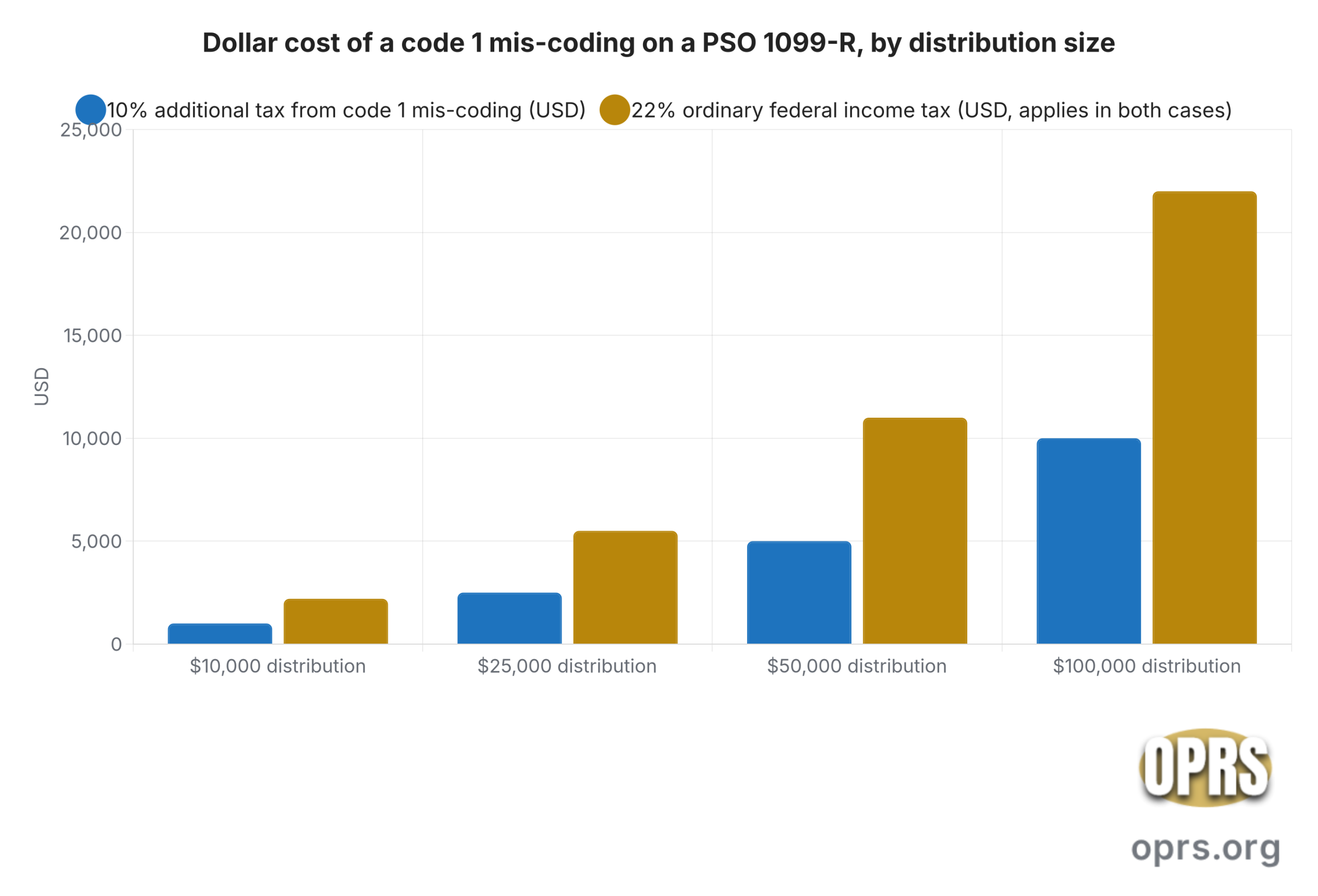
The difference on a 25000 dollar distribution to a 56 year old lieutenant is 2500 dollars: the additional tax that disappears when the plan codes correctly.
The mechanic that breaks most often is that the plan administrator’s processing system does not always pick up the PSO classification from the human resources data feed. Many state and municipal pension systems default to code 1 and rely on the participant to correct mis-codings after the fact. Some systems require a separate PSO-status certification at separation.
A participant who does not check the 1099-R against the controlling section can owe an extra 10 percent on every distribution until Medicare. For deeper coverage of the age-50 exception’s scope and edge cases, see our public safety officer age 50 exception guide.
How HELPS distributions appear on the 1099-R
The IRC Section 402(l) HELPS Act exclusion allows a retired qualified public safety officer to exclude up to 3000 dollars per year of pension distributions from gross income. Those distributions must be used to pay qualified health, accident, or long-term care insurance premiums. SECURE 2.0 Act Section 328, enacted December 2022, broadened the rule. The participant can now self-certify the exclusion on Form 1040 instead of requiring the plan administrator to send the premium payment directly to the insurer.
The 1099-R coding for a HELPS distribution is straightforward and does NOT depend on the exclusion itself. The plan administrator codes the distribution based on the participant’s age and the distribution event type. If the participant is 59 1/2 or older when the distribution is paid, the 1099-R carries code 7 (normal distribution).
If the participant is under 59 1/2 and the PSO age-50 exception applies, the 1099-R should carry code 2 (early distribution, exception applies).
The HELPS exclusion is claimed by the participant on Form 1040 line 5b. The participant reduces the taxable amount in box 2a (which the 1099-R reports as the full gross distribution) by up to 3000 dollars, then writes the letters PSO next to line 5b.
For deeper coverage of the 3000 dollar HELPS mechanics, see our HELPS Act exclusion explainer and the companion direct-pay-to-insurer custodian mechanics walkthrough.
The 1099-R for the rollover surplus to a gold IRA
When a separating PSO directs the governmental plan to roll a portion of the balance to a self-directed gold IRA, the plan administrator issues a 1099-R for the rollover portion. That 1099-R carries code G in box 7. Code G has two protective effects.
First, it tells the IRS no income tax is due on the gross distribution, because the dollars moved trustee-to-trustee into another tax-deferred plan. Second, it exempts the distribution from the 20 percent mandatory federal withholding that IRC Section 3405(c) imposes on every eligible rollover distribution paid to the participant rather than direct-rolled.
The 20 percent withholding trap is the most expensive procedural mistake on a 457(b) to gold IRA rollover. If the participant takes an indirect rollover (the plan cuts a check to the participant, who then has 60 days to redeposit), the plan MUST withhold 20 percent for federal tax.
To complete a tax-free indirect rollover, the participant must source the missing 20 percent from other funds and deposit the full gross into the IRA within 60 days. The withholding is recovered the following year on the 1040 refund. A direct rollover with code G avoids the whole problem.
The chart below shows the dollar penalty incurred when four common PSO distribution scenarios are mis-coded as code 1 (early distribution, no known exception) instead of the correct code. The correct codes are: code 2 for the age-50 exception, code G for a direct rollover, and code 7 for a post-59 1/2 normal distribution. Each scenario assumes a federal marginal rate of 22 percent for the ordinary income calculation.
How to read your 1099-R and verify the coding
The verification routine is a five step pass through the 1099-R the plan administrator mails (or posts to the participant portal) by January 31 of the year following the distribution. Each step checks one box against the controlling section.

- Confirm box 1 (Gross distribution). Box 1 should equal the sum of every distribution event during the tax year. Compare against the plan administrator statement.
- Confirm box 2a (Taxable amount). For a direct rollover (code G), box 2a should equal zero. For code 7 or code 2, box 2a typically equals box 1 unless the participant had after-tax basis. A code G 1099-R with box 2a equal to box 1 means the plan mis-flagged the transaction and needs correction.
- Confirm box 4 (Federal income tax withheld). For code G, box 4 equals zero. For code 7 or code 2 on a cash distribution, box 4 reflects whatever withholding the participant elected (default 10 percent on cash distributions, 0 percent on rollovers).
- Confirm box 7 (Distribution code). Verify against the four pillars: code G for trustee-to-trustee rollover, code 2 for PSO age-50 separation before 59 1/2, code 7 for normal distribution at or after 59 1/2, code 4 for death distribution to a beneficiary.
- Confirm boxes 14 to 16 (State withholding). Some states (Wisconsin, Pennsylvania, Illinois) exempt all or part of governmental retirement plan distributions. Boxes 14 to 16 should reflect whatever the participant elected, with the state exemption then claimed on the state return.
Requesting a corrected 1099-R or filing Form 5329
If box 7 is incorrect, the participant has two remedies. The first is a corrected 1099-R from the plan administrator.
The participant calls the plan’s distribution services line, describes the mis-coding (with the section reference: Section 72(t)(2)(A)(v) for PSO age-50, Section 402(c)(4) for code G direct rollover), and requests a corrected 1099-R. The plan issues a Form 1099-R marked CORRECTED, files it with the IRS, and mails a copy.
Lead time runs from two weeks (responsive plan) to four months (partial-distribution complexity).
The second remedy applies when the plan declines or delays past the tax filing deadline: the participant files Form 5329, Additional Taxes on Qualified Plans, with the 1040 and claims the exception independently. On Form 5329 Part I, the participant enters the gross on line 1 and the same amount on line 2 with the exception number.
The exception number for the PSO age-50 separation distribution is 11 under the IRS Form 5329 Instructions. The IRS accepts the self-certification and the 10 percent additional tax disappears.
Combination codes that recur for PSO files
Box 7 can carry a second code when the distribution event spans two classifications. Three combinations recur often enough on separated PSO files to merit recognition. Code G with code 4: a surviving spouse beneficiary rolls the inherited governmental balance to her own IRA, with G coding the trustee-to-trustee transfer and 4 coding the death-distribution origin.
Code 2 with code B: a 56 year old firefighter who participated in a governmental Roth 457(b) takes an early distribution, with 2 reflecting the PSO age-50 exception and B identifying the Roth source.
Code 7 with code A: a retired police chief born before January 2, 1936 receives a lump-sum eligible for the IRC Section 402(d) 10 year averaging election. Each combination changes the downstream Form 1040 treatment; the underlying box 7 verification routine remains the same.
Common mistakes that misclassify a PSO 1099-R
- Treating code 1 as final. A code 1 in box 7 is the plan administrator’s classification, not the IRS’s final determination. If a Section 72(t) exception applies, the participant either obtains a corrected 1099-R or files Form 5329 to claim the exception independently. The 10 percent additional tax is not owed on a properly excepted distribution, even if the plan coded it as code 1.
- Indirect rollover with intent to redeposit. An indirect rollover triggers the 20 percent mandatory withholding under IRC Section 3405(c). The participant has 60 days to redeposit the gross amount (including the withheld 20 percent, sourced from other funds) into the gold IRA or owes income tax on the shortfall. A code G direct rollover avoids the withholding entirely.
- Skipping the PSO notation on Form 1040 line 5b. The HELPS Section 402(l) exclusion is claimed by reducing the taxable amount on line 5b by up to 3000 dollars and writing the letters PSO next to the line. The plan administrator does NOT show the exclusion on the 1099-R. Omitting the PSO notation can trigger a CP2000 notice for underreported income matching the gross distribution.
- Assuming the gold IRA custodian issues a rollover 1099-R. The 1099-R is issued by the SENDING plan (the governmental 457(b) or defined-benefit plan), not the receiving IRA custodian. The custodian issues a separate Form 5498, IRA Contribution Information, reporting the rollover as a contribution in box 2. The two forms should reconcile to the same gross dollar amount.
- Filing the 1040 without checking box 7. The IRS matching engine compares box 7 against the 1040 entries. A code G 1099-R generates a zero on line 5b with Rollover next to it. A code 2 1099-R generates the gross on line 5b without Form 5329. A code 7 1099-R that funds HELPS-qualified premiums generates a reduced line 5b with the letters PSO. Each mismatch generates a CP2000 notice within 18 to 30 months.
- Failing to coordinate with the gold IRA dealer. The dealer that sells the precious metals into the rollover IRA has no role in the 1099-R coding, but the dealer’s onboarding paperwork can introduce delays that push the direct rollover past plan-administrator deadlines. which gold IRA dealers passed our 2026 audit before you let dealer paperwork delays force an indirect rollover.
Does the 1099-R show the HELPS exclusion?
No, the 1099-R does NOT show the HELPS exclusion in any box. The plan administrator reports the gross distribution in box 1 and the taxable amount in box 2a as if no exclusion applies. The participant claims the exclusion on Form 1040 line 5b by reducing the taxable amount by up to 3000 dollars and writing the letters PSO next to the line. The IRS will not reduce the box 2a amount automatically.
What if my plan refuses to issue a corrected 1099-R?
If the plan administrator declines to issue a corrected 1099-R, the participant files Form 5329 with the 1040 and self-certifies the Section 72(t) exception. The exception number for the qualified public safety officer age-50 separation distribution is 11 under the IRS Form 5329 Instructions. The IRS accepts the self-certification as the controlling treatment, and the 10 percent additional tax disappears.
The participant retains the right to pursue the corrected 1099-R through the plan administrator’s grievance process, which can run six to 24 months, but the tax position is protected in the meantime.
Can I roll a 1099-R coded 1 to a gold IRA after the fact?
Yes, a distribution coded 1 in box 7 can still be rolled to a gold IRA if the participant deposits the gross amount into the IRA within 60 days of the distribution date. The 60 day window in IRC Section 402(c)(3) applies regardless of the box 7 code.
If the distribution was paid as cash (with 20 percent withheld under IRC Section 3405(c)), the participant must source the missing 20 percent from other funds to make the rollover whole. The participant reconciles on Form 1040 line 5a (gross) and line 5b (zero or the unrolled portion) with Rollover next to line 5b.
The IRS matches the 1099-R against the 5498 (the IRA custodian’s rollover contribution report) to confirm.
Your next step
More on OPRS
- Public safety officer age 50 exception + gold IRA: who qualifies, what code 2 unlocks, and where SECURE 2.0 expanded the carve-out
- HELPS Act 3000 dollar health insurance exclusion + gold IRA: how sequencing decides whether a retired PSO keeps the carve-out
- HELPS Act direct-pay-to-insurer + custodian mechanics: the split-retain handoff a separating qualified public safety officer runs
- Partial 457(b) rollover preserving the 72(t) PSO exception
- which gold IRA dealers passed our 2026 audit
Sources cited
- IRC Section 72, Annuities; certain proceeds of endowment and life insurance contracts (Cornell LII), subsection (t)(2)(A)(v) qualified public safety employee age-50 separation exception.
- IRC Section 402, Taxability of beneficiary of employees’ trust (Cornell LII), subsections (c)(4) direct rollover and (l) HELPS exclusion for governmental plans.
- IRC Section 3405, Special rules for pensions, annuities, and certain other deferred income (Cornell LII), subsection (c) 20 percent mandatory withholding on eligible rollover distributions.
- IRC Section 401, Qualified pension, profit-sharing, and stock bonus plans (Cornell LII), subsection (a)(9)(B) post-death distribution rules for non-spouse beneficiaries.
- IRS Instructions for Forms 1099-R and 5498, including the box 7 distribution code reference table and the combination-code rules.
- IRS Form 5329, Additional Taxes on Qualified Plans (Including IRAs) and Other Tax-Favored Accounts, with exception code 11 for the qualified public safety officer age-50 separation distribution.
- IRS Publication 575, Pension and Annuity Income, including the qualified public safety officer exclusion and the Form 1040 line 5b PSO reporting instructions.
- Consolidated Appropriations Act of 2023, Public Law 117-328 (congress.gov), Division T (SECURE 2.0 Act), Section 328 amending IRC Section 402(l) and Section 308 amending IRC Section 72(t)(10) for qualified public safety officers.