

Updated: July 30, 2026
OPRS may receive compensation when readers open an account through partner links on this page. Our analysis is based on independent research, BBB data, and IRS publications.
30-second verdict
- The pro-rata rule in 26 U.S.C. section 408(d)(2) is computed per individual taxpayer, on each spouse’s own Form 8606. A non-deductible contribution by one spouse is poisoned only by that spouse’s other pre-tax IRA balances, not by the other spouse’s.
- The taxable fraction of a Roth conversion equals the spouse’s aggregate pre-tax IRA balance divided by the total IRA balance, measured as of December 31 of the conversion year. A small rollover IRA full of pre-tax dollars can make a $7,000 backdoor Roth contribution roughly 95 percent taxable.
- Isolation of basis is the standard correction. Each spouse rolls their pre-tax IRA balances into the current employer 401(k), 403(b), or TSP if the plan accepts rollovers from IRAs. After the rollover settles, only basis remains in the IRA, and the conversion is nearly tax-free.
- A self-directed gold IRA counts in the same pro-rata aggregate as any traditional IRA. Opening one with pre-tax rollover dollars before completing a backdoor Roth conversion is the most common dealer-driven sequencing error in this scenario. We are not financial or tax advisors. Consult a licensed advisor before making retirement account decisions.
This page works through the pro-rata math under 26 U.S.C. section 408(d)(2) for married-filing-jointly couples planning a backdoor Roth. The worked example is based on a dual-income household: one spouse is a federal contractor with a 401(k), the other is a hospital RN with a 403(b).
The mechanics come from IRS Publication 590-A, IRS Form 8606 instructions, and the conversion rules in 26 U.S.C. section 408A.
Before any conversation with a self-directed IRA dealer about adding metals to a backdoor Roth conversion, see the 27+ dealers OPRS clears and the ones we warn dual-income couples against. The backdoor Roth window is a high-pressure month for unsolicited metals sales scripts targeting affluent households with concentrated rollover IRA balances.
Before you contribute
A backdoor Roth conversion routed into a new self-directed gold IRA is a sequencing trap. The metals dealer typically opens the IRA, accepts the contribution, and processes the conversion. If pre-tax balances exist in the contributing spouse’s other IRAs at year-end, the pro-rata rule applies regardless of where the converted dollars land. The dealer is paid on the metals sale, not on the tax outcome.
3 of 27+ gold IRA dealers reviewed by OPRS make the 2026 trusted list.
What the pro-rata rule actually computes
Internal Revenue Code section 408(d)(2) treats all of a single taxpayer’s traditional IRA, SEP IRA, and SIMPLE IRA accounts as one combined account for purposes of any distribution or conversion.
The taxable fraction of a Roth conversion is the pre-tax portion of that combined balance divided by the total balance, measured as of December 31 of the year the conversion occurs. The fraction applies to every distribution and every conversion in that year, regardless of which specific IRA the converted dollars came from.
The mechanics are reported on IRS Form 8606. Line 6 captures the year-end value of all of the spouse’s traditional, SEP, and SIMPLE IRAs. Line 2 captures the cumulative basis from prior non-deductible contributions. Line 1 adds the current year’s non-deductible contribution.
The taxable fraction for the year’s conversion equals (line 6 + line 7 + line 8) minus the basis, divided by (line 6 + line 7 + line 8). Each spouse files a separate Form 8606. The IRS never aggregates the two forms for MFJ purposes.
A backdoor Roth contribution by the federal contractor spouse is unaffected by the RN spouse’s pre-tax 403(b)-rollover IRA, and vice versa.
The rule does not apply to Roth IRAs themselves, to 401(k) accounts, to 403(b) accounts, or to TSP accounts. It applies only to traditional IRA, SEP IRA, and SIMPLE IRA balances owned by the converting taxpayer. This is the conceptual hinge: pre-tax dollars sitting in an employer-sponsored plan are invisible to the pro-rata calculation, but the same dollars rolled into an IRA become visible to it.
The MFJ phase-out that makes the backdoor route relevant
Direct Roth contributions are limited by Modified Adjusted Gross Income under 26 U.S.C. section 408A(c)(3). For married filing jointly, the contribution amount phases down across an MAGI band published each year in IRS Publication 590-A.
Here is the household this example is built around. The federal contractor earns around $185,000; the RN earns around $115,000. That puts the couple in or near the phase-out for direct Roth contributions. They use the backdoor route to keep the contribution path open.
The contribution itself is non-deductible because both spouses are active participants in a workplace plan under 26 U.S.C. section 219(g), and the deduction phase-out for active participants begins at a much lower MAGI than the Roth phase-out.
Each spouse contributes up to the annual IRA contribution limit, plus the age-50 catch-up if eligible. For a couple both above age 50, the combined non-deductible contribution can reach roughly $16,000 per year before catch-up adjustments, depending on the year’s published limits. The conversion to Roth then happens shortly after the contribution, ideally within the same calendar quarter, to minimize taxable earnings on the contribution before conversion.
Worked example: Bob the federal contractor and Carol the hospital RN
Bob is 60, works as a federal contractor with a Thrift Savings Plan balance of $620,000 and no current traditional IRA balances. Carol is 58, works as a hospital RN with an active 403(b) holding $380,000, plus a rollover IRA holding $95,000 in pre-tax dollars from a previous employer’s 401(k).
Their combined MAGI sits in the upper end of the Roth contribution phase-out for MFJ. They want to contribute $8,000 each to a Roth IRA for the year, using the backdoor route.
Bob’s pro-rata math. Bob has no traditional IRA balances. His Form 8606 line 6 is zero. He makes an $8,000 non-deductible contribution to a new traditional IRA and converts the full $8,000 to Roth a week later. The taxable fraction is zero. The entire $8,000 lands in Roth tax-free. Bob’s TSP balance is invisible to the calculation because TSP is an employer-sponsored plan, not an IRA.
Carol’s pro-rata math, no isolation of basis. Carol has $95,000 in her rollover IRA, all pre-tax. She makes an $8,000 non-deductible contribution. Her Form 8606 line 6 is $103,000 at year-end ($95,000 plus $8,000). The taxable fraction is $95,000 divided by $103,000, or approximately 92.2 percent.
Of the $8,000 conversion, roughly $7,380 is taxable as ordinary income, and only $620 is treated as a return of basis. At a 24 percent marginal federal rate, Carol owes approximately $1,771 in additional federal tax on what she expected to be a tax-free contribution.
Carol’s pro-rata math, with isolation of basis. If the hospital’s 403(b) plan accepts incoming rollovers from IRAs, Carol rolls the $95,000 rollover IRA into the active 403(b) before December 31 of the conversion year. Most plans accept this, but verification with the plan administrator is required. Her Form 8606 line 6 then equals only her $8,000 non-deductible contribution.
The taxable fraction drops to zero. The conversion is fully tax-free. The household saves approximately $1,771 in federal tax for the year and preserves the same outcome in every subsequent backdoor Roth year.

Precious metals IRA early-withdrawal penalty estimator
Taking money out of a precious metals IRA before age 59 and a half triggers a 10% federal additional tax on top of ordinary income tax. State add-on taxes vary; check your state. The federal penalty is estimated below.
Estimate only, not tax advice. The 10% federal additional tax applies to early distributions before age 59 and a half; specific exceptions exist. Your state may add its own tax, and ordinary income tax applies separately. Source: IRS Publication 590-B. Consult a tax advisor.
The right dealer explains every fee up front. Get Augusta's free precious metals IRA company checklist.
Why a gold IRA changes the math
A self-directed gold IRA is, for purposes of section 408(d)(2), simply a traditional IRA whose assets happen to be IRS-approved physical metals held at a depository. The custodian reports the year-end Fair Market Value on Form 5498. That value enters Form 8606 line 6 alongside any cash-and-securities IRA balances the same spouse owns.
A dealer who opens a gold IRA funded by a $95,000 rollover from a former 401(k) has not, in tax terms, changed anything about the spouse’s pro-rata exposure. The pre-tax balance simply moved from one IRA wrapper to another.
The sequencing trap appears when a dealer recommends opening a gold IRA in the same calendar year as a planned backdoor Roth contribution by the same spouse.
The metals destination does not change Carol’s pro-rata math at all. If Carol opens a new gold IRA funded by her $95,000 rollover in October, contributes $8,000 non-deductibly in November, and converts in December, her year-end Form 8606 line 6 still equals $103,000. Her conversion is still 92 percent taxable.
The dealer’s commission was earned on the metals trade, not on the tax outcome.
The defensible sequence is the reverse. Check any dealer against the 2026 OPRS list before any account is opened. Then complete the isolation of basis through the active employer plan. Only then is a self-directed gold IRA worth opening, and only with cash that originated as a non-deductible contribution or as a properly converted Roth balance.
The procedural sequence that works
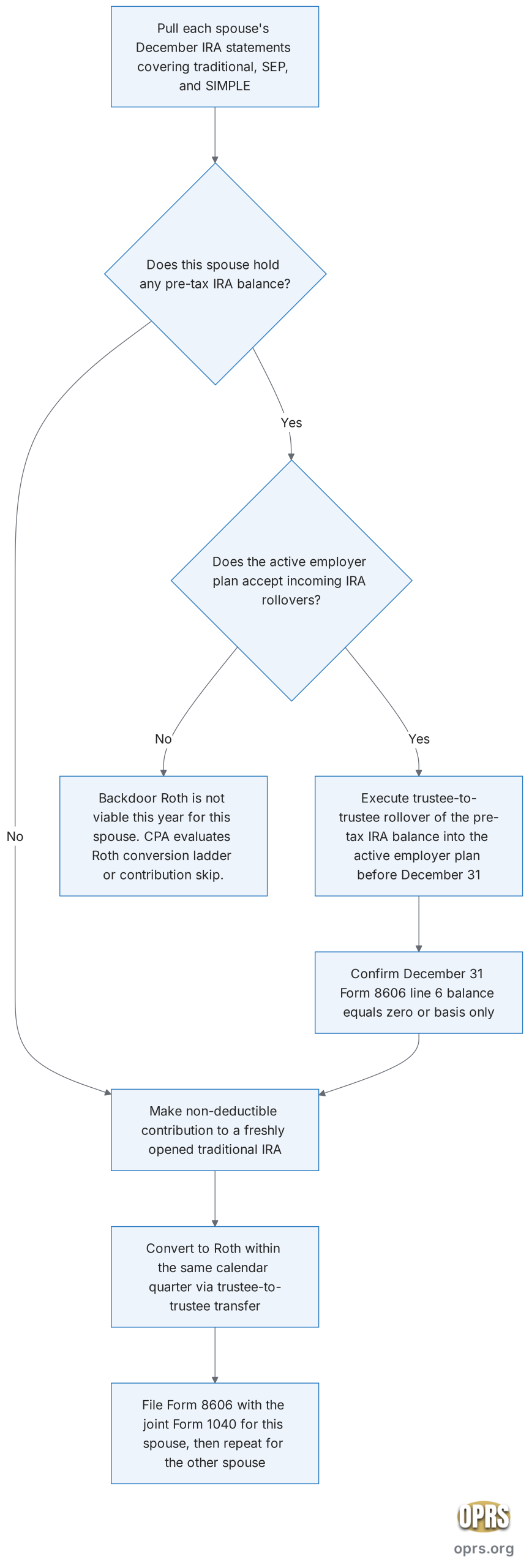
- Pull last year’s Form 8606 for each spouse. The CPA confirms any existing basis carry-forward. A spouse who has never made a non-deductible contribution has zero basis. A spouse with a long history of small non-deductible contributions has accumulated basis on prior 8606 line 14.
- Identify each spouse’s traditional, SEP, and SIMPLE IRA balances. Pull December statements from every custodian. A forgotten SEP IRA from a side-business year, a SIMPLE IRA from a former employer, or a small rollover IRA opened a decade ago all count.
- Confirm the active employer plan accepts rollovers from IRAs. Federal TSP accepts incoming IRA rollovers under 5 U.S.C. section 8432(j). Most 401(k) and 403(b) plans accept incoming IRA rollovers but verification with the plan administrator is required in writing. A plan that does not accept incoming IRA rollovers blocks the isolation-of-basis path for that spouse.
- Execute the rollover before December 31 of the contribution year. A trustee-to-trustee transfer is the cleanest mechanic. The IRA custodian sends the full pre-tax balance to the active employer plan. The receiving plan confirms receipt and reports the rollover on the next year’s Form 5498.
- Make the non-deductible contribution. Each spouse contributes up to the annual limit. The contribution must be designated as non-deductible on Form 8606 line 1. A spouse who silently treats the contribution as deductible and later discovers the deduction was disallowed will have double-counted basis.
- Convert to Roth within the same calendar quarter. A trustee-to-trustee conversion moves the contribution to a Roth IRA. Most custodians complete the conversion within five business days of the request. Earnings between contribution and conversion are taxable, so the time window matters.
- File Form 8606 with the year’s joint return. Each spouse files a separate Form 8606. The forms are attached to the joint Form 1040. Missing a Form 8606 is the second most common backdoor Roth mistake after pro-rata mis-application.
The five-year clock on each conversion
Each Roth conversion starts its own five-year clock under 26 U.S.C. section 408A(d)(2)(B).
A converted amount withdrawn before the end of the fifth tax year after conversion is subject to the 10 percent early withdrawal penalty if the converting spouse is under 59 and a half at withdrawal. The clock starts on January 1 of the conversion year, not on the conversion date. That gives a small first-year head start.
Each annual backdoor Roth conversion starts a separate five-year clock, tracked by the IRS through ordering rules in 26 U.S.C. section 408A(d)(4).
For Bob and Carol, both above age 59 and a half, the five-year clock does not affect penalty exposure on the converted amount. The 10 percent penalty under section 72(t) does not apply after age 59 and a half.
Earnings on the conversion, however, are tax-free only after the first Roth IRA the spouse owned has been open for five years and the spouse is at least 59 and a half.
A spouse who opens their first Roth IRA at age 58 to start a backdoor sequence reaches the five-year mark on January 1 of the year they turn 63. Prior Roth IRA ownership shortens that runway.
Verdict per couple profile
Which couples benefit, and how to sequence the conversion
- Both spouses have only employer-plan retirement balances, no IRAs: the backdoor Roth is the simplest case. Each spouse contributes non-deductibly and converts within the same quarter. Form 8606 line 6 is zero for each. The full contribution lands in Roth tax-free.
- One spouse has a rollover IRA with pre-tax balance, the other does not: isolation of basis is required for the spouse with the rollover IRA, before any non-deductible contribution. The other spouse can proceed normally. Each spouse files a separate Form 8606.
- Both spouses have rollover IRAs with pre-tax balances, and both active plans accept incoming rollovers: both spouses execute isolation of basis in the same calendar year. The household coordinates the timing with the CPA so neither rollover gets caught in a year-end reporting gap.
- One spouse’s active plan does not accept incoming IRA rollovers: the backdoor Roth is not viable for that spouse without paying significant pro-rata tax. The household considers a Roth conversion ladder strategy instead, or limits the backdoor contribution to the spouse who can isolate basis.
- Either spouse plans to add a gold IRA sleeve: the metals decision comes after the basis isolation and the conversion. A self-directed gold IRA opened with pre-tax rollover dollars in the same year as a backdoor Roth attempt converts a tax planning move into a taxable event for that spouse.
How a gold IRA fits the post-isolation structure
Once basis isolation is complete and the backdoor Roth conversion is settled, a couple can add a metals sleeve to the Roth balance without re-triggering the pro-rata calculation in future years. A self-directed Roth IRA holding IRS-approved metals is treated identically to any other Roth IRA for distribution and tax purposes.
The metals leg adds custodial and depository fees. Model those fees against the long-term post-tax compounding benefit. The size of the metals position relative to total retirement assets should match the household’s broader asset allocation discussion with a fee-only advisor.
Augusta Precious Metals is part of the OPRS-reviewed dealer shortlist. Augusta has held a BBB A+ accreditation since 2014 with no complaints currently on file. It was named Money Magazine’s Best Overall Gold IRA Company every year from 2022 through 2026, and Investopedia’s Most Transparent Gold IRA Company across the same span.
For a couple whose combined Roth balances are still building under the backdoor sequence, the metals conversation belongs after the contributing spouse has reached the dealer minimum on the relevant account. Do not have it in the same week as the first conversion.
Common mistakes couples make
- Treating the pro-rata rule as joint for MFJ. The most common conceptual error. Each spouse’s pro-rata math is independent. A husband with zero IRA balances can complete a clean backdoor Roth even if the wife has a six-figure pre-tax rollover IRA. Confusing the two leads couples to either skip a viable backdoor for the unaffected spouse or pay unnecessary tax for the affected one.
- Forgetting to file Form 8606 for the non-deductible contribution. A non-deductible contribution that is not reported on Form 8606 leaves no basis record. The eventual conversion is then taxed on the full amount, and the basis is lost permanently unless reconstructed via amended returns within the IRS statute of limitations. The $50 penalty per missed 8606 is the smaller cost; the lost basis is the larger one.
- Rolling 401(k) to IRA in the same year as a planned backdoor Roth. A late-year rollover from a former employer 401(k) to an IRA lands the pre-tax balance in the spouse’s Form 8606 line 6 at December 31. Even if the rollover occurred in November and the backdoor contribution occurred in February, the year-end balance is what matters. The two transactions should not share a tax year for the same spouse.
- Counting employer plan balances toward pro-rata. A spouse with a $620,000 TSP and zero IRA balance has a Form 8606 line 6 of zero. TSP, 401(k), and 403(b) balances are not aggregated under section 408(d)(2). The mistake usually appears when a couple sees a $1 million combined retirement balance and assumes the backdoor Roth is partly taxable. It is not, if the IRA component is zero.
- Layering a gold IRA into the wrong year of the sequence. Opening a self-directed gold IRA with pre-tax rollover dollars before completing isolation of basis blocks the backdoor route for that spouse until the gold IRA is itself rolled back into an employer plan. Most plans accept rollovers in cash only, so the gold position must be liquidated first, which can crystallize gains or losses inside the IRA wrapper.
Each of these errors compounds. A missed Form 8606 in year one creates a phantom taxable balance in year five. A same-year 401(k) rollover plus backdoor attempt costs the household several thousand dollars in tax that a January-versus-December timing shift would have eliminated. The CPA review before December 31 is the cheapest insurance on the entire sequence.
Frequently asked questions
Does my spouse’s pre-tax IRA balance affect my backdoor Roth conversion?
No. Each spouse files a separate Form 8606 and computes pro-rata on their own pre-tax IRA balances only. A husband with no traditional IRA balances can complete a clean backdoor Roth regardless of what his wife has in her rollover IRA. This is one of the few areas where MFJ status does not aggregate the two spouses for tax purposes. The Form 8606 instructions from IRS Form 8606 are explicit on this point.
Can I do a backdoor Roth in a year I also rolled over a 401k to an IRA?
Yes mechanically, but the pre-tax balance from the rollover is in your Form 8606 line 6 at year-end. The conversion is then taxable in proportion to that balance. Most planners advise either delaying the 401(k) rollover to the next year, or rolling the IRA balance into the current employer plan before December 31 to clear the year-end aggregate.
The decision depends on the size of the pre-tax balance, the marginal tax rate, and the plan administrator’s willingness to accept the incoming rollover. The CPA review before December 31 is required.
Does a SEP IRA from a prior side business count in the pro-rata aggregate?
Yes. 26 U.S.C. section 408(d)(2) explicitly aggregates traditional IRA, SEP IRA, and SIMPLE IRA balances for the same taxpayer. A small SEP IRA opened a decade ago for a freelance year, then forgotten, can poison the pro-rata math for a current-year backdoor Roth.
The fix is the same as for any rollover IRA: roll the SEP balance into the active employer plan before December 31, leaving only basis behind. Some active plans accept SEP IRA rollovers and some do not, so plan administrator confirmation is required.
How is a self-directed gold IRA treated in the Form 8606 calculation?
Identically to any other traditional IRA. The custodian reports the year-end Fair Market Value on Form 5498, and that value enters Form 8606 line 6. The wrapper makes no difference. A spouse who holds $80,000 of physical gold inside a self-directed traditional IRA has $80,000 added to their pro-rata aggregate at year-end. The metals destination is invisible to the tax calculation. See IRS Publication 590-A for the underlying contribution and conversion rules that apply uniformly across IRA wrappers.
What happens if I miss filing Form 8606 for the non-deductible contribution?
The basis from the unreported contribution is not recognized by the IRS. The conversion in that year, and any future conversion drawing on that basis, is taxed on the full amount.
A late Form 8606 can be filed standalone for a prior year subject to the IRS statute of limitations, generally three years from the original return due date for purposes of preserving the basis claim.
A $50 penalty per missed 8606 applies under 26 U.S.C. section 6693, but the larger cost is the permanent loss of basis if the statute of limitations expires before the form is filed. The CPA review on every year’s joint return is the standard preventive measure.
Does the gold IRA dealer have any role in the backdoor Roth sequence?
No. The dealer is a metals supplier and account introducer, not a tax advisor or fiduciary. The backdoor Roth sequence is a CPA and plan administrator question. A dealer who recommends opening a self-directed gold IRA as the receiving account for a backdoor Roth conversion during the planning window is providing tax advice without a license.
General guidance on the boundary between selling activity and advisory activity in retirement account contexts is published by the Financial Industry Regulatory Authority Investor Education center. We are not financial or tax advisors. Before making any retirement account decisions, consult a licensed advisor on your specific circumstances.
More on OPRS
- Dual RMD coordination after age 73 for couples for the household-level RMD bracket math that follows the conversion years.
- Federal contractor 401(k) versus spouse 403(b) rollover order for the sequencing of dual-employer-plan rollovers.
- Spousal beneficiary rollover versus inherited IRA election for the surviving-spouse retitling choice after a death.
- Our 2026 evaluation of gold IRA dealers, with the operators OPRS clears and the ones we currently warn against.
The backdoor Roth is one of the few areas of the tax code where getting the sequence wrong is concentrated in a single quarter. But the consequences run for the rest of the contributing spouse’s life.
Pull both spouses’ Form 8606 history first. Identify every traditional, SEP, and SIMPLE IRA balance under each spouse’s name. Confirm the active employer plan accepts incoming IRA rollovers. Then execute isolation of basis before December 31 of the contribution year.
The metals conversation, when it belongs in the household’s plan, comes after the Roth balance has reached a meaningful size and only with an OPRS-reviewed dealer. Past performance is not a guarantee of future results.
Sources cited
- 26 U.S.C. section 408(d)(2), Pro-rata aggregation of traditional, SEP, and SIMPLE IRA balances
- 26 U.S.C. section 408A, Roth IRAs and conversion rules including the five-year clock
- 26 U.S.C. section 219(g), Active participant deduction phase-out for traditional IRA contributions
- Internal Revenue Service, Publication 590-A (Contributions to Individual Retirement Arrangements)
- Internal Revenue Service, About Form 8606 (Nondeductible IRAs)
- Internal Revenue Service, About Form 5498 (IRA Contribution Information)
- 26 U.S.C. section 6693, Failure to provide reports on IRAs and the Form 8606 penalty
- 5 U.S.C. section 8432(j), Thrift Savings Plan acceptance of incoming IRA rollovers
- Financial Industry Regulatory Authority, Investor Education center