

Updated: July 28, 2026
OPRS may receive compensation when readers open an account through partner links on this page. Our analysis is based on independent research, BBB data, and IRS publications.
A dual-income couple approaching 73 often arrives with two parallel pre-tax balances. One sits in a former employer plan or rollover IRA on the older spouse’s side. The other sits in a current or recent 403(b) or 401(k) on the younger spouse’s side.
A four-year age gap is common in this audience. Think of a federal contractor spouse between 62 and 65, paired with a hospital RN or 403(b)-eligible spouse between 58 and 61. The older spouse hits the first RMD year while the younger spouse is still inside the pre-RMD planning window.
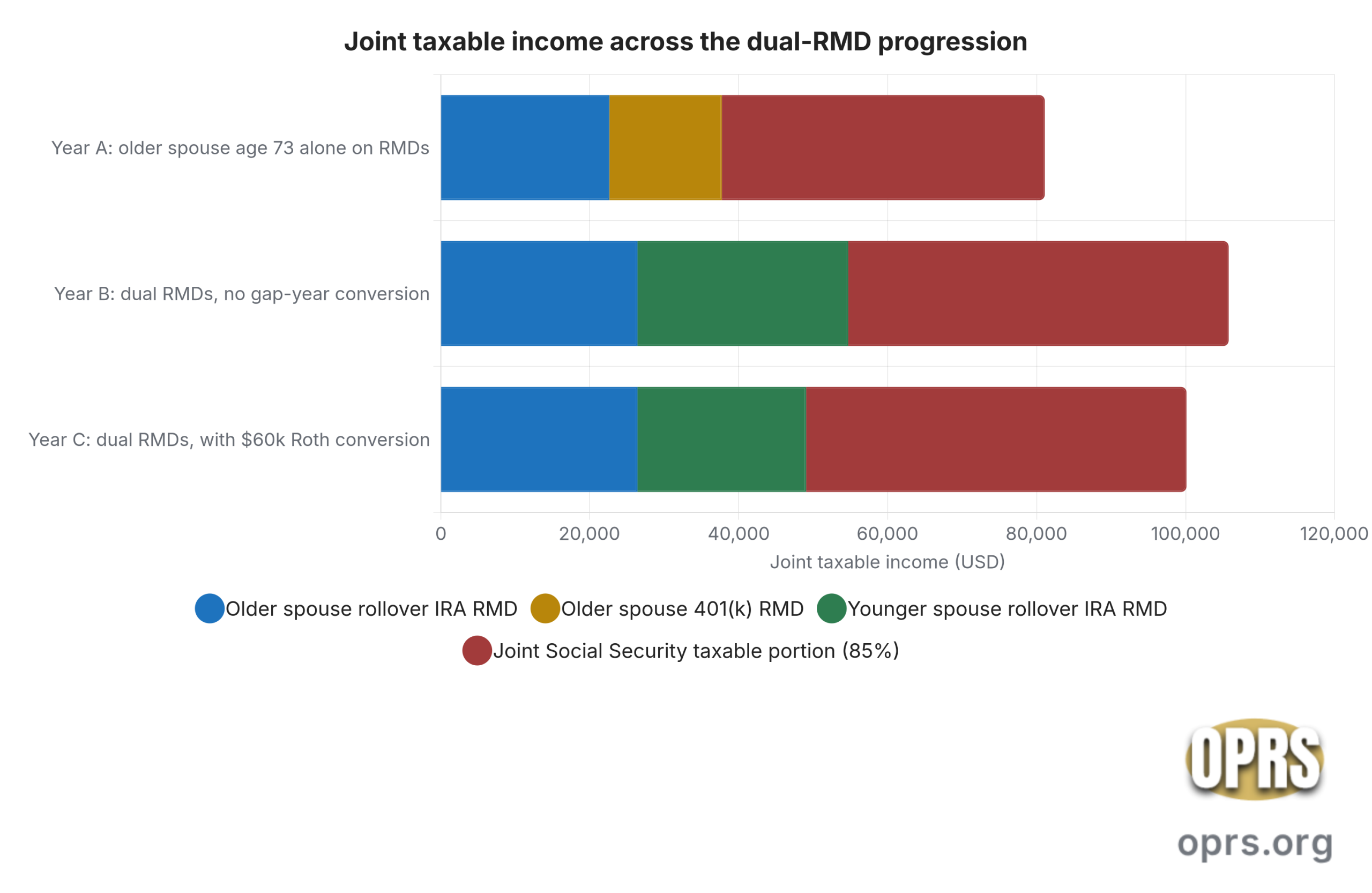
Four tax years later the second wave arrives and the joint return now absorbs two concurrent RMDs computed under IRC §401(a)(9), two Medicare IRMAA tier lookups under 42 U.S.C. §1395r, and (in most cases) two Social Security benefits at the 85% inclusion rate under IRC §86. The marginal-bracket exposure is permanent once both RMD streams are flowing.
Element I of the planning is the pre-RMD inventory of each spouse’s accounts by IRS account category. Before any rollover, conversion, or precious-metals reallocation is initiated, both spouses need to know which account types they hold, because the aggregation rules below split sharply along account-type lines.
For the upstream rollover mechanics that determine which balance is held where on the day the first RMD computes, see our dual-income couples gold IRA coordination guide and the younger-spouse Medicare bridge analysis.
The dealer you choose for any gold IRA allocation sets the bid-ask spread and storage fee that surfaces in every future RMD year. That is why a look at the 27+ dealers OPRS clears and the ones we warn couples against belongs in the inventory step itself.
Before either spouse picks a gold IRA dealer
The dealer a couple picks for a precious-metals reallocation determines the spread embedded in the cost basis of every coin the IRA holds. That spread surfaces again at every RMD year, when the custodian sells or distributes in kind to satisfy the annual requirement.
A spread that looked acceptable at the front of a 15-year horizon can quietly compound into five-figure lifetime drag if the dealer was wrong. Before either spouse signs paperwork, see the dealers OPRS clears and the ones we warn against.
3 of 27+ gold IRA dealers reviewed by OPRS make the 2026 trusted list. Updated July 2026.
Why dual RMDs do not aggregate across spouses
The single most common misconception couples bring to the planning conversation is that an RMD is computed once at the household level and divided. It is not. Each retirement account is owned by a single individual, and Treas.
Reg. §1.401(a)(9)-5 requires each account owner to compute the RMD off their own December 31 prior-year balance using their own age and divisor. The joint return absorbs both calculations, but the calculations themselves are individual and the distributions must come from the named owner’s account.
Within one spouse’s accounts, the aggregation rules split sharply by account category. Multiple traditional IRAs owned by the same individual aggregate: the RMD is computed for each IRA separately and the total can be taken from any one IRA or any combination, per IRS Publication 590-B.
Multiple 403(b) accounts owned by the same individual also aggregate among themselves under the same publication. But 401(k), governmental 457(b), and Thrift Savings Plan accounts never aggregate with anything, including with the participant’s own other 401(k) plans at different employers. Each plan computes and distributes separately.
Where this matters: a couple in which the older spouse holds a $600,000 rollover IRA plus a $400,000 401(k) at a former federal contractor employer cannot aggregate.
The first-year RMD on the IRA at age 73 is approximately $22,642. That is $600,000 divided by the Uniform Lifetime Table divisor of 26.5. The first-year RMD on the 401(k) is approximately $15,094, or $400,000 divided by 26.5. Both distributions must be processed by the respective custodians in the same calendar year.
If the older spouse later rolls the 401(k) into the IRA, future years aggregate; the rollover itself does not retroactively eliminate the current-year separate RMD if the rollover happens after January 1.
The age-gap window: one spouse on RMDs while the other is not yet
For couples with a meaningful age gap, the years between the older spouse’s first RMD and the younger spouse’s first RMD are the planning window most often missed.
The older spouse begins distributing on January 1 of the year they turn 73 (born 1951 through 1959) or 75 (born 1960 or later), per SECURE 2.0 Act §107 amendment to IRC §401(a)(9)(C).
The younger spouse continues to compound untouched in their own accounts, can still contribute to a workplace plan if employed, and can still convert from traditional to Roth at chosen amounts.
Consider a couple where the older spouse is born 1957 and reaches 73 in 2026. The younger spouse is born 1961 and reaches the SECURE 2.0 adjusted RMD age of 75 in 2036. The gap window spans approximately 11 calendar years.
Each year of that window the joint return absorbs the older spouse’s RMD but the younger spouse’s pre-tax balance keeps compounding at gross rate. The longer the gap, the larger the second wave at the back end becomes, and the larger the dual-RMD bracket and IRMAA exposure once both streams flow concurrently.
In practice: every gap year is a Roth conversion candidate year for the younger spouse. The marginal cost of a conversion in that window is the joint marginal bracket plus any IRMAA tier crossing the conversion triggers on the older spouse’s Medicare premiums two years later. The marginal benefit is the permanently reduced second-wave RMD denominator at the back end.
The math is comparable to the police-pension scenario in our military pension RMD tax stacking analysis but for two parallel balances rather than pension-plus-IRA on one spouse.
Precious metals IRA required minimum distribution (RMD) estimator
Once required minimum distributions begin (age 73 now, 75 starting 2033), you divide the prior year-end balance by an IRS life-expectancy factor. The result is taxed as ordinary income on your federal return and, in most states, your state return. You can take a precious metals IRA RMD in cash or in metal.
Estimate only, not tax advice. Uses the IRS Uniform Lifetime Table (most owners). A spouse more than 10 years younger and sole beneficiary uses a different table. Roth IRAs have no lifetime RMD. Sources: IRS Publication 590-B (Table III); IRS RMD FAQs. Consult a tax advisor.
The right dealer explains every fee up front. Get Augusta's free precious metals IRA company checklist.
Dual IRMAA: each Medicare-enrolled spouse gets a separate tier lookup
The Income-Related Monthly Adjustment Amount under 42 U.S.C. §1395r uses modified adjusted gross income from two tax years prior to set both spouses’ Part B and Part D premiums for the current year. The MAGI is computed at the household level on the joint return, but the surcharge is then applied to each enrollee’s premium separately.
A couple that crosses the first IRMAA tier therefore pays the surcharge twice (once on Bob’s Part B and once on Carol’s Part B, once on each Part D plan) for the same MAGI overage.
The 2026 IRMAA tier thresholds for married-filing-jointly couples (lookback from 2024 income) are documented in the Social Security Administration’s POMS HI 01101.020. The first tier begins at $212,000 MAGI and adds roughly $74 per month to each enrollee’s Part B premium and roughly $13 per month to each enrollee’s Part D premium.
For a dual-enrolled couple that is approximately $2,088 in additional annual premiums for crossing the first tier by $1. The next tier roughly doubles the surcharge again. A dual RMD calculation that crosses MAGI from $211,000 to $213,000 costs the couple meaningfully more than the $2,000 of income suggests, because the cliff is hard and applies twice.
A common misconception: couples often assume Medicare enrollment dates determine IRMAA timing. They do not. Once a spouse is enrolled in Part B, the IRMAA lookup is on the joint return’s MAGI from two prior years, regardless of whether one spouse is still on employer coverage. The doubled surcharge applies the moment the second spouse enrolls. The planning lever is the MAGI in the relevant prior tax year, not the Medicare enrollment date itself.
The QCD pathway under IRC §408(d)(8) and how couples apply it
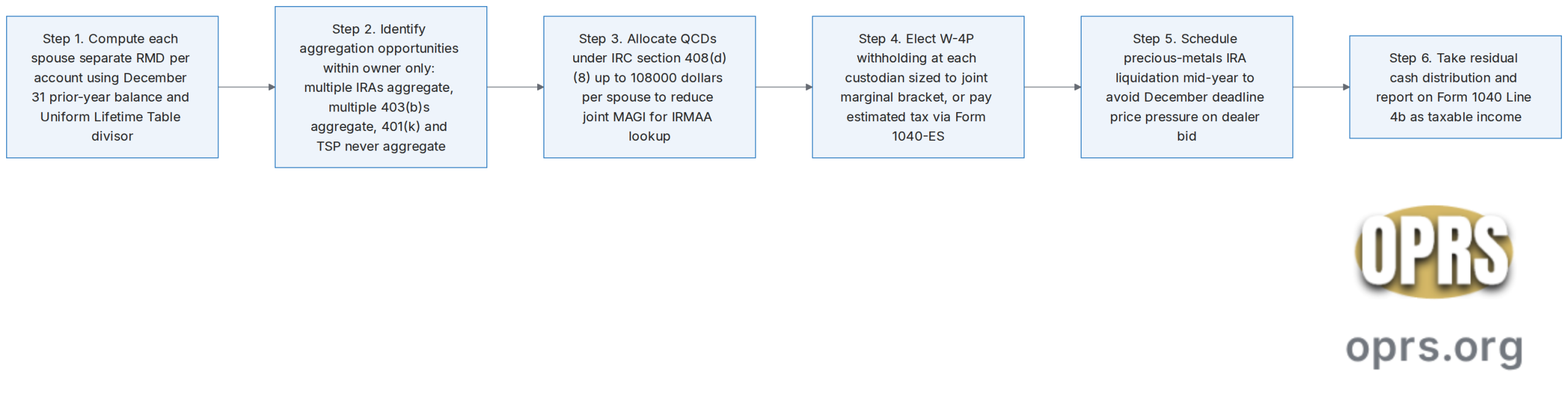
The qualified charitable distribution under IRC §408(d)(8) allows an IRA owner who has reached age 70½ to direct up to $108,000 in 2026 from a traditional IRA to a qualifying 501(c)(3) public charity. That $108,000 is inflation-adjusted from the original $100,000 baseline. The distributed amount counts toward the RMD requirement and is excluded from MAGI.
For an itemizing couple, the QCD substitutes for a charitable deduction. For a couple using the standard deduction, the QCD is the only mechanism that converts an RMD dollar into a charitable dollar without first running it through gross income.
The mechanics for couples have two consequential features. First, the $108,000 limit applies to each IRA owner individually, not to the household. A couple that both have IRAs and both want to make QCDs can collectively distribute up to $216,000 of QCDs per year, applied across their respective RMDs, without any of it landing in joint MAGI.
Second, the QCD is available only from IRAs, not from 401(k), 403(b), TSP, or governmental 457(b). A spouse whose only pre-tax balance is in a workplace plan must roll the balance to an IRA first if the couple wants to use QCD on that side of the household.
The rollover itself is a non-taxable event under IRC §402(c) for an eligible distribution.
For our example couple, a single-tier IRMAA crossing avoidance can be engineered with a $5,000 QCD by one spouse if the dual RMD overshoots the tier by $4,000 of MAGI. The same couple targeting a 22% marginal-bracket avoidance might QCD $12,000 to $15,000 between the two spouses. Where this matters: the QCD is one of the few planning levers still available after age 73, when most pre-RMD tools (Roth conversions, employer contributions, basis decisions) are either expensive or unavailable.
Distribution-in-kind versus cash distribution from a precious-metals IRA
A traditional IRA that holds precious metals must satisfy the same annual RMD under IRC §401(a)(9) as a cash IRA. The custodian has two operational mechanisms.
The first is a cash distribution: the custodian sells coins from the depository at prevailing dealer-bid, transmits cash to the IRA owner, and reports the gross distribution on Form 1099-R. The second is distribution-in-kind: the custodian transfers physical coins out of the depository and delivers them to the owner at their fair market value on the distribution date, also reported on the 1099-R. Both are equivalent for income-tax purposes; the in-kind delivery does not avoid the income inclusion.
Here is where the in-kind path adds friction. Once the coins are delivered to the owner outside the IRA, any subsequent sale to a dealer is a personal collectibles transaction. That sale is subject to the 28% maximum collectibles capital gains rate under IRC §408(m) and IRC §1(h)(4). The cost basis is the fair market value on the distribution date.
For a couple satisfying dual RMDs from two metals IRAs, the cash distribution path is simpler to manage. The in-kind path is useful only if the couple intends to hold the coins personally for an extended period, or plans to gift them under the annual exclusion of IRC §2503(b).
A practical note: when a couple holds metals at the same depository under two separate IRA accounts (one per spouse), the custodian satisfies each RMD by selling from the named owner’s segregated holdings. Couples sometimes assume the depository can rebalance between the two IRAs to optimize spread; it cannot. Each account is its own IRS-recognized entity. Check this dealer against the 2026 OPRS list before assuming custodial flexibility you may not actually have.
Common mistakes in dual-RMD years and how to avoid them
Mistake 1: assuming RMDs can be netted at the household level. They cannot. Each spouse’s accounts compute and distribute independently. The correction is to maintain a per-spouse, per-account RMD schedule with the custodians’ deadlines marked separately. The 50% (now 25% under SECURE 2.0 Act §302) excise tax under IRC §4974 applies to the shortfall on each individual account that did not satisfy its own RMD, not to a household total.
Mistake 2: rolling a 401(k) into an IRA mid-year and assuming aggregation applies that year. The RMD for the calendar year in which a rollover occurs must be satisfied from the source plan before the rollover under IRC §402(c)(4)(B), which excludes the RMD from the eligible rollover amount.
A rollover that sweeps the entire 401(k) balance (RMD included) into an IRA creates an excess IRA contribution under IRC §408(d)(4), correctable only by withdrawal plus the 6% excise per year of non-correction. The fix is to take the source-plan RMD before the rollover paperwork is processed, every time.
Mistake 3: under-withholding on dual RMDs because each custodian withholds independently. Both custodians apply default 10% federal withholding on IRA distributions per IRC §3405(b) unless the owner elects otherwise. For a couple whose dual RMDs push them into a 22% or 24% marginal bracket, default withholding leaves an underpayment penalty exposure under IRC §6654.
The correction is to either elect higher withholding (W-4P) at each custodian or pay estimated tax quarterly through Form 1040-ES, sized to the actual marginal bracket the dual RMDs produce.
Mistake 4: deferring the first RMD to April 1 of the following year. The first RMD may be deferred to April 1 of the year following the 73rd birthday year, per IRC §401(a)(9)(C).
Couples sometimes defer thinking they save a tax year. In practice, the deferral produces two RMDs in the second calendar year: the deferred first-year RMD and the on-schedule second-year RMD. That combination compounds the bracket and IRMAA exposure for that year.
The fix is to take the first RMD in the 73rd birthday year. The exception is when the deferral is part of a deliberate Roth conversion or QCD plan that uses the rest of that year for bracket management.
Mistake 5: treating the precious-metals IRA RMD as an opportunity to time the gold price. The RMD deadline is hard (December 31 each year, or April 1 of the year following the 73rd birthday year for the first year only).
A custodian that sells coins on December 28 to satisfy the RMD does so at whatever the spot price is that day. Couples who delayed liquidation hoping for a price move sometimes get worse fills under deadline pressure than they would have at any unconstrained mid-year window.
The fix is to align the RMD liquidation with a pre-planned mid-year window where the custodian has time to work the bid.
Coordination with a younger non-RMD spouse: the contribution path
For a couple in the gap window where the older spouse is on RMDs and the younger spouse is still working, the younger spouse can continue to contribute to an IRA or workplace plan. IRC §219, as amended by SECURE Act 1.0, removed the age limit for traditional IRA contributions. The contribution remains available at any age, provided the contributor has earned income equal to the contribution amount.
A spousal IRA contribution under IRC §219(c) allows the working younger spouse to contribute to a traditional or Roth IRA on behalf of the non-working older spouse. The limit is the same annual cap: $7,000 in 2026, or $8,000 if the contributing spouse is age 50 or older.
The contribution counts against the household’s joint earned income but does not require the older spouse to have earned income. For couples in the dual-RMD window where the older spouse is fully retired, the spousal IRA mechanism is the only path that keeps the older spouse’s Roth balance growing without triggering a future RMD computation.
Roth IRAs are not subject to RMDs during the original owner’s lifetime under IRC §408A(c)(5).
For a couple’s long-term planning, the Roth side of the household balance becomes the structural shock absorber. Every dollar in a Roth account is a dollar that does not contribute to a future RMD denominator. It does not appear in MAGI for IRMAA. And it passes to the surviving spouse free of further RMD obligations during their lifetime.
Here is the corollary. The pre-tax balance, including any precious-metals IRA, generates ordinary income on distribution and is subject to RMD. Allocation decisions between Roth and traditional should account for the lifetime RMD exposure on the traditional side.
Surviving-spouse transitions and the inherited-IRA rollover election
When the first spouse dies after both have begun RMDs, the surviving spouse has the right under IRC §408(d)(3)(C) to roll the deceased spouse’s IRA into their own IRA.
That election converts the inherited balance to the surviving spouse’s own balance, subject to the surviving spouse’s RMD schedule. The Uniform Lifetime Table divisor is often longer than the inherited-account divisor under the Single Life Table. This election is generally favorable when the surviving spouse is younger than the deceased, because the longer divisor reduces the future RMD.
The alternative election is to keep the account as an inherited IRA under IRC §401(a)(9)(B), which can be advantageous if the surviving spouse is under 59½ and needs penalty-free access to the funds. The inherited-IRA election allows withdrawals without the 10% early-withdrawal penalty under IRC §72(t)(2)(A)(ii) but uses the (potentially less favorable) Single Life Table divisor.
For couples planning the dual-RMD years with an eye on first-death timing, the framework in our surviving-spouse inherited IRA RMD calculation guide walks the divisor math in detail.
Two distinct planning questions face couples managing dual RMDs before the next custodian deadline. First, which spouse’s RMD reduces taxable income through QCDs, and in what amount. Second, whether the precious-metals allocation across both accounts is held with a dealer whose spread can absorb the annual RMD-driven liquidations without dragging on long-run after-tax return.
Augusta Precious Metals is part of OPRS’s reviewed dealer shortlist. The company was named Money Magazine’s Best Overall Gold IRA Company every year from 2022 through 2026 and Investopedia’s Most Transparent Gold IRA Company across the same span. Augusta has held BBB A+ accreditation since 2014 with no complaints on file, alongside more than 4,000 5-star customer ratings on Trustpilot, Google, and Consumer Affairs.
The Augusta minimum is industry-reported around $50,000 for gold IRA accounts; couples with combined balances below that threshold typically use one of the other names on the shortlist with lower minimums.
Sources cited
- IRC §401(a)(9): Required minimum distributions, SECURE 2.0 Act §107 amendments
- Treas. Reg. §1.401(a)(9)-5: Required minimum distributions from defined contribution plans
- IRS Publication 590-B: Distributions from Individual Retirement Arrangements (IRAs)
- IRC §408: Individual retirement accounts (rollovers, QCD, collectibles)
- IRC §402: Taxability of beneficiary of employees’ trust (rollover mechanics)
- 42 U.S.C. §1395r: Medicare Part B IRMAA tier thresholds
- IRC §86: Social Security benefits inclusion rules
- IRC §4974: Excise tax on accumulations in qualified retirement plans (RMD shortfall)
- IRC §219: Retirement savings contributions (spousal IRA contributions)