

Updated: July 12, 2026
OPRS may receive compensation when readers open an account through partner links on this page. Our analysis is based on independent research, BBB data, and IRS publications.
The Better Business Bureau publishes its grading rubric in plain text: an A+ rating requires a numerical score of 97 to 100 on a 100-point scale (source: BBB grade overview). A separate accreditation status sits on top of the letter grade. Most retirees who shortlist a gold IRA dealer in 2026 read the letter grade and stop. The accredited badge, the complaint pattern, and the BBB profile age each carry their own signal.
Three components define a BBB profile: the letter grade, the accredited status, and the complaint pattern. Element I is knowing what each of those three signals actually measures. Element II is applying the result against a specific dealer in 2026, including how the BBB record sits next to the state Bureau of Securities, NASAA, CFTC, and FTC records. For the broader operator landscape, see the 2026 OPRS list of gold IRA dealers we currently caution against.
What BBB accreditation actually means (and what it does not)
BBB accreditation is a separate badge from the letter grade. A business that applies for accreditation pays an annual fee and agrees to abide by the eight Standards of Trust published by the International Association of Better Business Bureaus (source: BBB Standards of Trust). The standards cover advertising honesty, transparency, responsiveness to customer complaints, and a commitment to privacy.
Accreditation is not earned automatically with a high letter grade. A dealer can hold an A+ rating and not be accredited. Another dealer can be accredited and carry a C rating because the complaint resolution pattern weakened over time. The two signals are independent.
The label “BBB Accredited Business” carries a specific contractual meaning. The dealer paid to participate. The dealer agreed to respond to BBB-mediated customer complaints within a defined window. The dealer agreed to truthful advertising practices reviewable by BBB staff. None of that proves product quality or fair pricing. It does prove the dealer cared enough about the BBB channel to pay for it and to respond when contacted.
For a gold IRA shortlist, the accredited badge functions as a procedural floor. A dealer that refuses to pay BBB accreditation fees signals one of two things: either the customer-complaint pattern would not survive accreditation review, or the firm operates outside the channels most retirees check. Neither outcome favors the dealer.
How BBB scores a gold IRA dealer: the three independent signals
A BBB Business Profile shows three pieces of data side by side. Each one comes from a different process. Read all three before forming a view on any dealer.
Signal one: the letter grade (A+ through F)
BBB calculates a 100-point score that converts to a letter grade. The published rubric weights 13 factors. Complaint volume relative to business size carries the heaviest weight. Complaint resolution pattern, the type of business, time in business, transparent business practices, failure to honor BBB mediation, government action against the business, and advertising review findings each contribute.
The letter is calculated, not negotiated. A dealer cannot pay to raise its letter. A dealer can lose its letter through poor complaint handling regardless of how long it has paid for accreditation. The independence between accreditation status and letter grade is the structural protection in the BBB system.
Signal two: the accredited status (yes or no)
Accreditation is binary. A dealer is either accredited (paid the annual fee, signed the Standards of Trust commitment, responsive to BBB-mediated complaints) or not accredited. The BBB profile shows the accreditation start date when applicable. A long accreditation history paired with a clean complaint pattern is a stronger signal than a recent accreditation with no track record.
Signal three: the complaint pattern
The complaint section breaks complaints into closed in the last three years and closed in the last twelve months. Each complaint shows the nature (billing/collection, product issues, advertising/sales practices, delivery, refund or exchange) and whether it was resolved.
A dealer with hundreds of resolved complaints is a different signal from a dealer with dozens of unresolved complaints. Volume alone is not a verdict. The resolution rate and the nature of the complaints matter more.
Sales-practice complaints are the highest-signal category for gold IRA work. A pattern of complaints about misleading sales pitches, undisclosed markups, or pressure tactics aligns with the conduct that state Bureaus of Securities have pursued against named dealers since 2020 (see our state attorney general enforcement record).
The BBB rating scale: what each letter actually requires
BBB publishes the numerical thresholds for each letter grade. The chart below maps the published scale. A retiree shortlisting a gold IRA dealer should expect every operator on the shortlist to fall at A or A+ on the published scale.
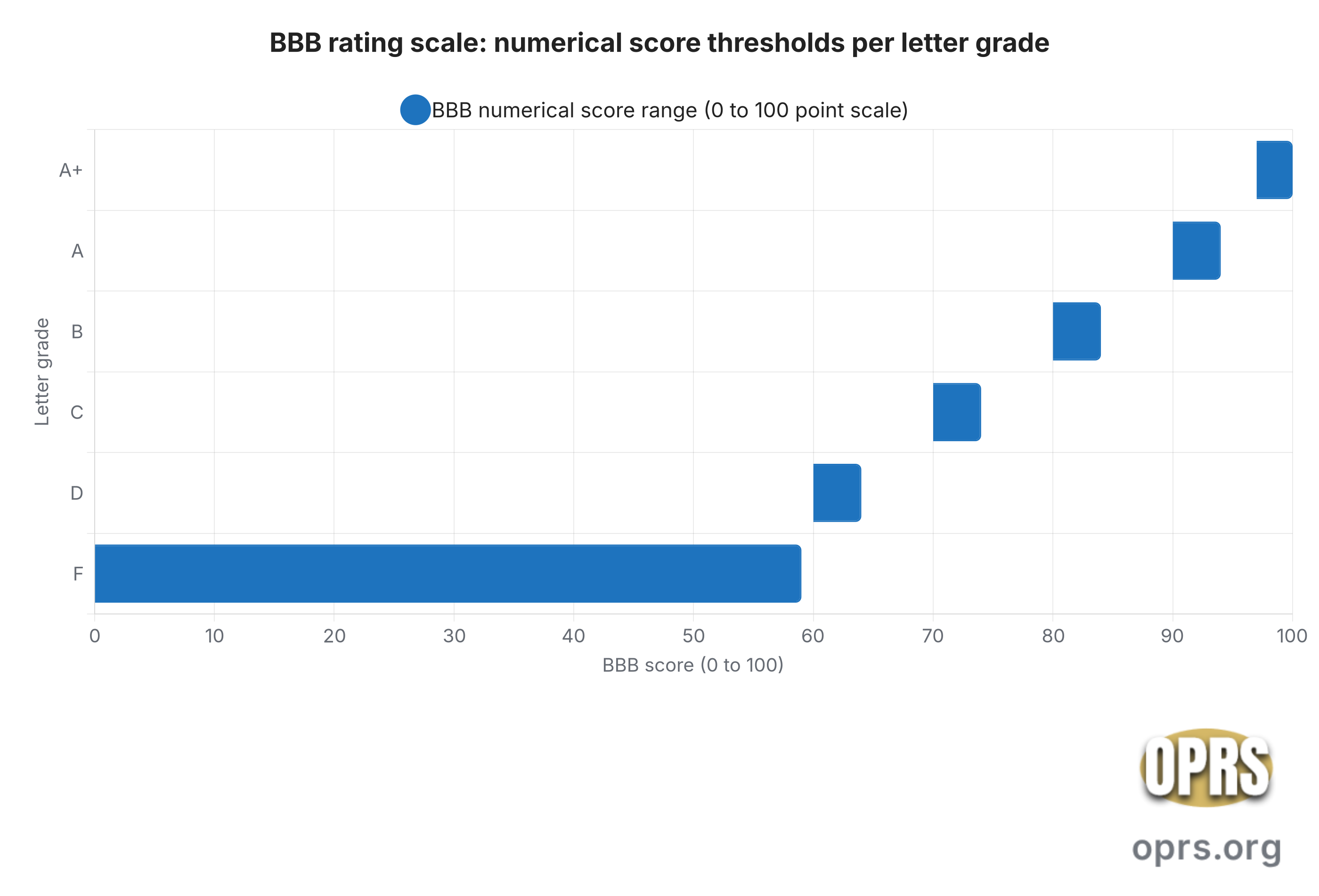
The gap between A+ and A looks small on paper. In practice, the gap reflects an additional 3 to 7 points of cumulative complaint resolution and advertising review. For a dealer that books a $100,000 rollover from a retiree, the difference between a 95-point dealer and a 98-point dealer often shows up as one or two unresolved sales-practice complaints in the prior 36 months.
What the BBB record cannot tell you about a gold IRA dealer
The BBB record has known limits. Reading the profile without understanding those limits produces false comfort.
BBB does not regulate coin pricing or markup over spot. A dealer can quote a 33 percent markup on a single-source proof coin, disclose the markup buried in a contract, and avoid a BBB complaint because the customer signed. The April 2021 New Jersey-led Lear Capital matter centered on average commissions reported around 33 percent (source: New Jersey Office of the Attorney General press release). The state record reached that conduct. The BBB letter grade alone did not.
BBB does not verify storage facility independence. A dealer can route customer metals to a depository in which the dealer or an affiliate holds an interest. The IRS rules on self-directed retirement accounts require independence between dealer, custodian, and depository (source: IRS Publication 590-A). Structural overlap is a fraud-prevention red flag the BBB profile does not surface.
BBB does not verify product authenticity. The Producer of the coin, the assay quality, and the actual metal content sit outside the BBB review. State consumer protection statutes and the FTC’s deceptive advertising authority reach those questions, not the BBB rubric.
BBB does not catch enforcement actions in real time. The state Bureau of Securities can file a consent order against a dealer in March and the BBB letter grade can lag the change by months. A retiree reading only the BBB profile in April can miss the consent order entirely. Check this dealer against the 2026 OPRS list as a separate step.
How to verify a gold IRA dealer’s BBB profile yourself
The verification sequence is short. It uses only public data on bbb.org. Run all five steps before forming a view. Skipping the complaint-pattern step is the single most common mistake.

- Search the firm and every DBA on bbb.org. Precious metals dealers frequently operate under multiple brand names. The TMTE matter covered Metals.com, Chase Metals, and Barrick Capital under the same parent. A single-name search misses the full record.
- Confirm the letter grade and read the accredited status separately. Both signals appear at the top of the profile. A dealer can hold A+ without accreditation, or accreditation with a B rating. The combination matters more than either signal alone.
- Open the complaint pattern by category. Filter for sales practice and advertising complaints in the last three years. The complaint count alone is less useful than the resolution rate and the nature of the complaints.
- Cross-reference the BBB record against the state Bureau of Securities in your state and the dealer’s home state. The state record can carry a consent order that BBB has not yet absorbed.
- Apply the result before any wire transfer moves. A clean BBB profile is necessary but not sufficient. Pair it with a written fee schedule that shows markup over spot, and confirm structural independence between dealer, custodian, and depository.
How the BBB record fits next to state regulators, NASAA, the CFTC, and the FTC
The BBB record is one of five public layers a retiree can check. Each layer reaches different conduct.
| Public layer | What it reaches | What it misses |
|---|---|---|
| BBB Business Profile | Complaint pattern, advertising review, accredited status, time in business | Coin pricing, depository independence, real-time enforcement actions |
| State Bureau of Securities | Securities law violations, sales-practice findings, industry bars (Safe state record) | Conduct outside the state register; non-securities-framed complaints |
| NASAA multistate actions | Coordinated state filings against named operators | Single-state administrative matters not aggregated |
| CFTC RED List + press releases | Leveraged-metals fraud, foreign-entity solicitation patterns (Cautionary) | Most physical-bullion sales (outside CFTC jurisdiction under 7 USC 2(c)(2)(D)) |
| FTC enforcement | Deceptive advertising, fake reviews under 16 CFR 465 | Underlying coin pricing decisions; non-advertising sales conduct |
The implication is structural. A dealer with a clean BBB record can still carry a state Bureau of Securities consent order. A dealer with no CFTC matter can still carry an FTC fake-reviews finding. See the 2026 OPRS dealer list after running each public register check.
Where gold IRA dealers actually fall on the BBB scale in 2026
The current public BBB profiles for the operators most often shortlisted by retirees cluster at A or A+ with accreditation. The variation shows up in the complaint pattern and the accreditation date, not in the headline letter grade.
| Operator | BBB letter | Accredited | Public complaint signal |
|---|---|---|---|
| Augusta Precious Metals | A+ | Since 2014 | Zero complaints on file (verified public record) |
| Birch Gold Group | A+ | Yes | Standard complaint volume for an 11-year operator |
| Noble Gold Investments | A+ (industry-reported) | Yes (industry-reported) | Lower complaint volume, smaller customer base |
The three operators sit on the OPRS shortlist because each one clears the BBB letter and accreditation bar described above. The shortlist is the result of the framework, not a substitute for the framework. A retiree should still run the five-step BBB check on any dealer before opening an account, including a shortlist operator. The framework keeps the account clean for your spouse or heirs by surfacing the public signals before they become a problem.
Common mistakes retirees make reading a BBB profile
- Mistake 1: treating the letter grade as the whole signal. The letter grade summarizes a 13-factor calculation. The accredited status and the complaint pattern are separate signals on the same profile.
- Mistake 2: assuming a high letter grade implies clean pricing. The BBB rubric does not measure coin markup over spot. A dealer can hold A+ and quote 30 percent markups buried in a contract.
- Mistake 3: ignoring the DBA list. A dealer operating under three brand names will have three BBB profiles or one profile with the DBAs cross-listed. Searching only the legal name misses the broader pattern.
- Mistake 4: confusing review aggregators with the BBB profile. Trustpilot, Google Reviews, and Consumer Affairs each carry their own ratings. None of those scores feeds into the BBB calculation. Read each register on its own terms.
- Mistake 5: assuming a long accreditation history alone proves trustworthiness. Accreditation requires fee payment and Standards of Trust compliance. It does not measure pricing fairness or product authenticity. Pair the accreditation with the complaint pattern before forming a view.
Does BBB accreditation alone mean a gold IRA dealer is safe?
No. BBB accreditation is a procedural floor, not a verdict. A dealer that clears the BBB bar still requires verification against the state Bureau of Securities, the NASAA enforcement register, the CFTC RED List, and a written fee schedule with markup over spot disclosed in writing before purchase.
The framework supports the next generation by surfacing the public signals before a wire transfer moves. A retiree who builds the habit of running all five public-register checks against any dealer before opening an account absorbs most of the lesson from the 2020 to 2026 state and BBB record.
Apply the five-step BBB check to every operator on your shortlist before opening an account. Pair the BBB review with the state Bureau of Securities check and a written fee schedule that names markup over spot. That discipline carries most of the protective weight in any dealer evaluation.
Run the BBB check against a dealer that already clears the bar
Augusta Precious Metals publishes a free company comparison checklist that walks through dealer-vetting questions before a wire moves. The Augusta BBB profile shows A+ accreditation since 2014 with zero complaints on the public record. (OPRS may receive compensation when readers proceed.)
Augusta’s industry-reported minimum sits around $50,000 for gold IRA accounts. If you have less and want to start smaller, the shortlist names two alternatives with lower thresholds.
3 of 27+ gold IRA dealers reviewed by OPRS make the 2026 trusted list. Updated July 2026.
More on OPRS
Two OPRS pages extend the verification framework beyond BBB. The state attorney general enforcement record covers the consent-order history that BBB letter grades can lag. The regulator map across FTC, CFTC, and state offices shows where each public layer sits in the broader oversight chain.
Sources cited
- BBB grade overview and numerical scoring methodology
- BBB Standards of Trust for accredited businesses
- Better Business Bureau company search
- New Jersey Office of the Attorney General April 2021 press release on the Lear Capital consent framework
- NASAA annual enforcement reports
- CFTC RED List of unregistered foreign entities
- IRS Publication 590-A on IRA contributions and rollovers
- 7 USC 2(c)(2)(D), the retail commodity rule
- 16 CFR Part 465, the 2024 FTC fake reviews rule
Consult your tax advisor for your specific situation. Past performance is not a guarantee of future results.