

Updated: July 30, 2026
OPRS may receive compensation when readers open an account through partner links on this page. Our analysis is based on independent research, BBB data, and IRS publications.
A dual-income household where both spouses still work full-time often carries two layers of single-employer concentration at once: each paycheck, each workplace retirement plan, and any vested equity all anchor on one company per spouse.
The FINRA Investor Alert on concentrated stock positions treats a single security above ten percent of investable net worth as the point where idiosyncratic risk begins to dominate market risk. For a household where one spouse’s federal-contractor career and the other’s hospital 403(b) both fall under that umbrella, the question is rarely whether to diversify.
It is which channel to address first and where a gold IRA sleeve actually fits.
30-second verdict
- Concentrated employer risk in a dual-income household stacks across four channels: salary, workplace retirement plan, employer stock or equity awards, and sector correlation across both spouses’ industries.
- A precious metals IRA sleeve does not solve the salary leg or the employer-stock leg. It addresses the retirement-plan leg by adding an asset whose price drivers are not tied to either employer’s revenue or either sector’s earnings cycle.
- The FINRA ten-percent threshold sets the ceiling for any single channel; the three-to-ten-percent precious metals sleeve commonly cited in dealer education materials sits inside that ceiling, not above it.
- Sequencing matters. The spouse with the largest in-service rollover window goes first; the other follows when employment terminates or an in-service rollover provision opens.
Before any conversation with a precious metals dealer about the gold IRA sleeve of the destination allocation, see the 2026 dealers OPRS clears and the ones we warn against. Mid-six-figure rollover balances attract the most aggressive sales scripts in the niche.
Before you sign
A precious metals dealer is not the right party to size a household’s overall concentration exposure. That work is a CPA-plus-fiduciary conversation that maps salary, retirement plan, and equity-award concentration across both spouses before any rollover paperwork is filed. The dealer enters the conversation once the sleeve size and custodian path are already set under IRC §408(m).
3 of 27+ gold IRA dealers reviewed by OPRS make the 2026 trusted list.
What concentrated employer risk looks like in a two-earner household
Concentrated employer risk is usually framed for a single executive sitting on one company’s restricted stock. The dual-income version is quieter and far more common. Both spouses still work, both fund a workplace retirement plan, and both rely on one employer’s revenue for cash flow.
If a federal contractor and a hospital RN each have ten to fifteen years remaining before full retirement, the household’s near-term economic engine sits on two distinct employer P&Ls. That means exposure to two industry cycles: federal procurement and US healthcare.
The two cycles are not perfectly uncorrelated. A material federal budget reconciliation can hit contractor billings and Medicare reimbursement at the same time. A household that thinks of itself as diversified because the two paychecks come from different sectors can still see both income streams compress in the same calendar year. The retirement-plan leg of that exposure is the one a gold IRA sleeve can actually address.
The four channels of employer concentration
Most dual-income households carry employer concentration through four distinct channels. The size of each channel and the ability of any single tool to address it are independent. Mapping them before any rollover decision separates the question of whether to add precious metals from the question of whether the household is actually diversified.
| Channel | How it concentrates | Can a gold IRA sleeve address it? |
|---|---|---|
| Salary income | One employer accounts for one spouse’s full earned income until retirement or separation | No (status: Human-capital risk, outside tax-deferred accounts) |
| Workplace retirement plan | 403(b), 401(k), TSP, or 457(b) balance grows in target-date funds whose holdings often correlate with the employer’s broader sector | Partial (status: Addressable through rollover when allowed) |
| Employer stock + equity awards | ESPP shares, RSUs, performance shares, or company-stock options in a 401(k) | No (status: Requires sale or NUA election under IRC §402(e)(4)) |
| Industry-sector correlation | Both spouses’ target-date funds, equity awards, and salary respond to overlapping macro drivers (federal spending, healthcare reimbursement, regulated industries) | Partial (status: Sleeve provides one non-correlated leg, not a full hedge) |
Precious metals IRA fee-drag calculator
Precious metals IRAs charge mostly flat dollar fees (setup, annual custodian, storage). Flat fees take a much bigger bite out of a small account than a large one. Enter your numbers to see the drag.
Estimate only. Fee amounts vary by provider and are often not published; enter figures you confirm in writing. This tool ignores metal price changes and the dealer spread, which also affect returns. Not financial advice.
The right dealer explains every fee up front. Get Augusta's free precious metals IRA company checklist.
The retirement-plan leg is the one most amenable to a precious metals sleeve. The salary leg requires changes in the household’s labor structure (a second income source, consulting work, a phased reduction). The equity-award leg follows the rules in IRC §402(e)(4) for net unrealized appreciation if company stock sits inside a 401(k), or the rules in IRC §83 for vested RSUs outside it.
How a gold IRA sleeve maps to the diversification mandate
The gold IRA sleeve is governed by IRC §408(m), which sets the approved coin and bar list and the requirement that the metals be held by an IRS-qualified non-bank trustee. IRS Publication 590-A covers the rollover and contribution mechanics; Publication 590-B covers distributions and required minimum distributions on the sleeve once both spouses reach the applicable RMD age under IRC §401(a)(9).
The sleeve does one job inside a concentrated household. It introduces an asset whose price is not driven by either employer’s revenue, either sector’s earnings cycle, or the broad equity market that a federal-contractor 401(k) and a hospital 403(b) both ride. The sleeve does not generate income. It does not appreciate in step with wage inflation. It does not protect against either spouse losing their job. It diversifies the retirement-plan leg of the household’s concentration exposure, and only that leg.
The reality is: the sleeve is a long-dated portfolio leg, not a short-term hedge. A household that adds a five-to-seven-percent gold IRA sleeve to a $1 to $1.5 million combined retirement balance is not protecting against a specific event. It is restructuring the long-tail composition of the retirement-plan leg so the household is less dependent on both employers’ sectors performing in step.

Sizing the sleeve inside the FINRA concentration framework
The FINRA concentrated-stock alert defines a single security above ten percent of investable net worth as the threshold at which idiosyncratic risk begins to dominate market risk. The corollary on the destination side is that no alternative-asset sleeve should breach the same ceiling. A precious metals sleeve at three to ten percent of investable net worth fits cleanly inside that threshold; a sleeve above ten percent introduces a new concentration where the prior one was reduced.
For a household with $1.2 million in combined retirement balances, that ceiling sets the sleeve at $36,000 to $120,000 in IRC §408(m)-approved metals at the upper bound. Most dealer education materials cite the lower half of that range (three to seven percent) as the working figure.
The choice between four percent and seven percent depends on how concentrated the rest of the retirement-plan leg already is. Consider target-date fund overlap, sector ETFs, and company stock inside the 401(k). Also factor in whether the household intends to take the sleeve as a final-year RMD or hold it through to the surviving spouse.
Sequencing the rollover when both spouses are still working
The mechanics get specific here. Both spouses still working means neither has triggered a separation-of-service event.
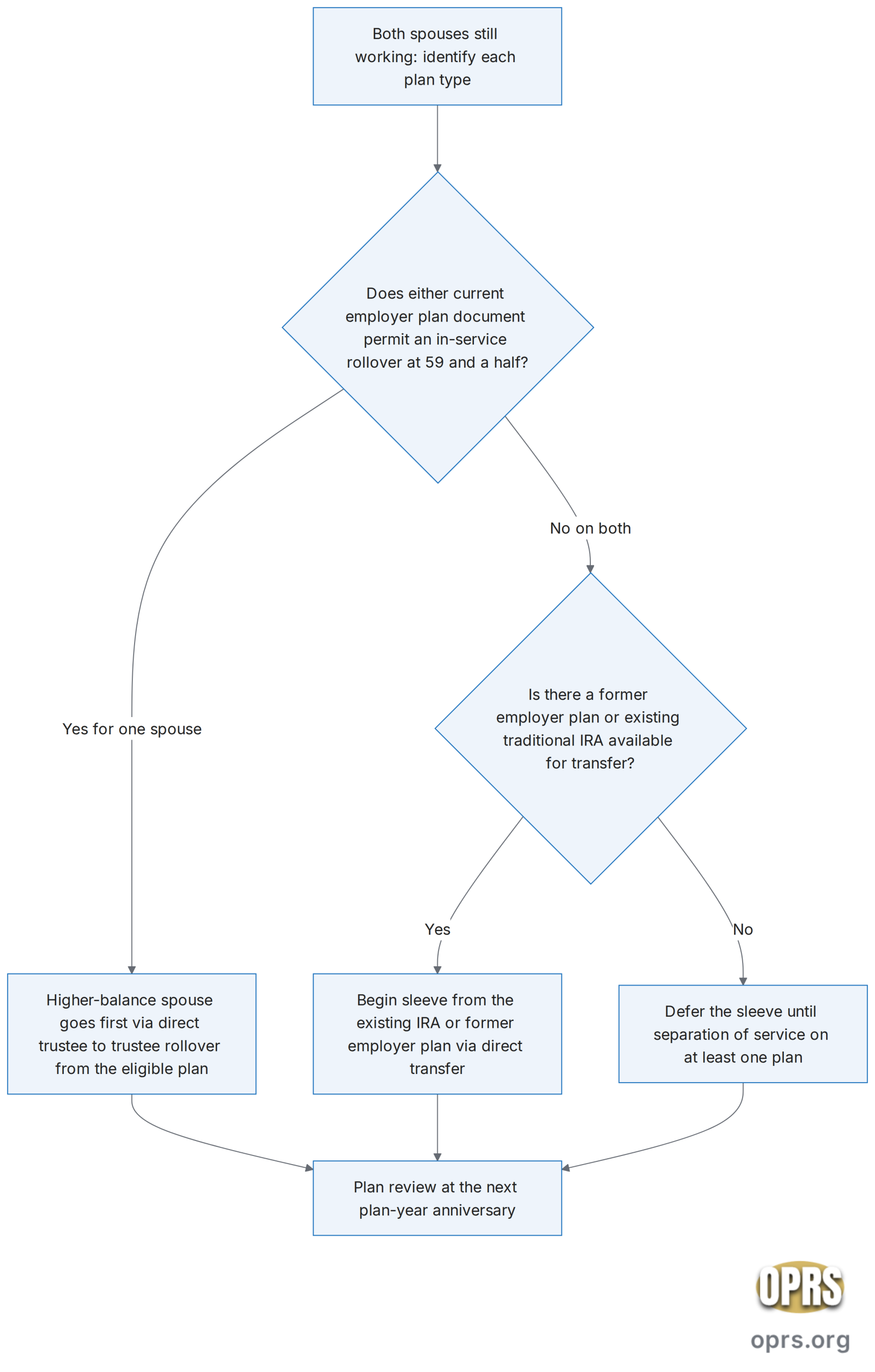
Three paths exist for funding a precious metals sleeve. The first is an in-service rollover from a current 403(b) or 401(k) if the plan document allows it (commonly limited to participants over 59½). The second is a partial rollover from a former-employer plan held in an old 401(k) or 403(b). The third is a direct transfer from an existing traditional IRA. IRS Publication 590-A covers each path; the 60-day indirect-rollover rule and the one-rollover-per-12-month limit in Bobrow v.
Commissioner apply on the indirect path.
For a federal-contractor spouse over 59½ whose current-employer 401(k) plan document permits in-service rollovers, the cleanest path is a direct trustee-to-trustee rollover of a partial balance to a self-directed IRA at a qualified custodian.
For a hospital RN spouse still under 59½, or working under a 403(b) plan document that does not permit in-service rollovers, the available path is usually a partial transfer from a separate traditional IRA. That is often the rollover account from a prior employer’s plan.
The two spouses do not need to act simultaneously; the household allocation can be reached in stages over two to four calendar years.
Tax mechanics across the rollover sequence
A direct trustee-to-trustee rollover from a 401(k) or 403(b) to a self-directed IRA holding IRC §408(m) metals is not a taxable event. It does not trigger ordinary income, the ten-percent early-withdrawal penalty under IRC §72(t), or the 3.8 percent Net Investment Income Tax under IRC §1411 on the rollover amount.
The household’s combined modified adjusted gross income is unchanged in the year of the rollover. That matters because two-earner couples already approach or exceed the $250,000 NIIT threshold for married filing jointly, without adding a taxable event.
The mechanics flip on the indirect path. A check made out to the participant from a 401(k) or 403(b) triggers mandatory 20 percent federal withholding. The household then has 60 days to redeposit the gross amount, using outside cash to cover the withheld 20 percent. The transaction also counts against the one-indirect-rollover-per-12-month limit. IRC §408(d)(3)(B) and the holding in Bobrow v.
Commissioner 152 T.C. 32 (2014) define the limit. The direct path avoids all three frictions and should be the default unless plan administration genuinely makes it unavailable.
Consult your tax advisor for the specific application of these rules to your household. Federal and state tax treatments interact in ways that depend on residency, plan type, and the calendar year of the rollover. Past performance is not a guarantee of future results, and the figures above are statutory thresholds, not projected returns.
Mid-page check
The dealer chosen for the metals leg drives most of the all-in cost of the sleeve. The spread between the dealer’s bullion quote and the prevailing spot reference on the order day swamps the custodial and storage line over any reasonable holding period. Check this dealer against the 2026 OPRS list before scheduling the first call on either spouse’s rollover.
Common mistakes when adding gold to an employer-concentrated household
Mistake 1: sizing the sleeve off household net worth instead of investable net worth. Net worth includes primary residence equity, which is illiquid and rarely available to rebalance. The FINRA concentration framework references investable net worth (retirement plans, taxable brokerage, cash above the household’s emergency reserve).
A seven-percent sleeve of total net worth in a household with $700,000 of home equity can be a twelve-percent sleeve of the investable side, which breaches the same threshold the household was trying to honor.
Mistake 2: treating both spouses’ retirement plans as one decision. Plan documents differ. A federal-contractor 401(k) that permits in-service rollovers after age 59 and a half is on a different mechanical path than a hospital 403(b) that does not. Treating both as one rolling decision often steers the household toward the indirect path on the plan that should have stayed put. That triggers the 20 percent withholding and the 60-day clock that the direct path avoids entirely.
Mistake 3: skipping the sector-overlap check. A federal-contractor 401(k) target-date fund and a hospital 403(b) target-date fund will each hold large-cap US equity. The overlap is real and rarely measured. Adding a gold IRA sleeve while leaving twin large-cap equity overweights in both spouses’ plans does not address the concentration that drove the conversation. The fixed-income side, the international equity side, and the sector-tilt side should all be reviewed at the same time the sleeve is sized.
Mistake 4: rolling on a sales-call timeline rather than a plan-document timeline. The 16-page application some dealers fast-track does not change when the household’s plan administrator can process a direct rollover.
A January call that promises March delivery often slides to May or June once the receiving plan administrator confirms paperwork, the sending plan administrator releases funds, and the metals custodian opens the self-directed account. Build in eight to twelve weeks per spouse and do not stack two rollovers in the same calendar quarter on the same household.
Mistake 5: confusing the sleeve with a hedge. Precious metals do not move inversely to either employer’s revenue cycle on any reliable horizon. Treating the sleeve as insurance against a contractor layoff or a hospital-system reimbursement squeeze sets up an expectation the asset class does not meet. The sleeve is a long-dated diversifier of the retirement-plan leg; the salary leg requires a different tool (typically term life insurance, disability insurance, and a household emergency reserve sized in months not weeks).
Coordinating the sleeve with other household priorities
The gold IRA sleeve interacts with three other coordination decisions that dual-income couples in the 58 to 62 age band typically face at the same time. The first is the Medicare bridge for the younger spouse if one retires early and the other carries health coverage to age 65.
The second is the Income-Related Monthly Adjustment Amount (IRMAA) bracket once both spouses begin Medicare; a rollover does not affect IRMAA but a subsequent Roth conversion of the same balance does. The third is the spousal beneficiary election under IRC §401(a)(9)(B)(iv), which lets a surviving spouse roll the inherited sleeve into their own IRA and restart the RMD clock.
These three coordination items rarely align to the same calendar year. A rollover in year one, a Roth conversion of a different balance in year three, and a Medicare bridge decision in year five are the kind of staggered plan that keeps the retirement-plan leg working. It avoids compressing every coordination decision into one tax filing.
The sleeve sizing locked in year one does not need to be revisited in year three; the conversion does. See our coverage of dual-income coordination on a gold IRA and the Medicare bridge for the younger spouse for the full sequencing.
Is the household actually a fit for a precious metals sleeve?
Not every concentrated-employer household needs a gold IRA sleeve. The sleeve is one tool among several. A household with $250,000 in combined retirement balances, two ten-year horizons before retirement, and no employer stock concentration is usually better served first by a fixed-income rebalance and an international equity tilt.
The sleeve enters the conversation when the household sits above the threshold where the rest of the diversification toolkit has already been deployed.
For a household where the smaller spouse’s balance is under the $50,000 mark that most established gold IRA dealers treat as the working minimum, the sleeve at the upper-spouse level may make sense. The lower-spouse plan stays in standard funds until separation of service.
Augusta Precious Metals, for example, sits at an industry-reported minimum around $50,000 for gold IRA accounts. Lower-balance households can either start with one spouse’s plan or wait until a plan rollover at separation lifts the combined sleeve-eligible balance above that floor.
Can both spouses open a separate self-directed IRA for the sleeve?
Yes. Each spouse can open and hold their own self-directed IRA under their own taxpayer identification number, and each spouse’s IRC §408(m)-approved metals are held in their own account at the qualified custodian. The two accounts are not commingled, the RMDs (when they begin) are calculated on each account separately under IRC §401(a)(9), and the beneficiary designations are independent.
This is the standard structure for any married couple in a dual-income household; the alternative (one spouse holding the entire sleeve) compresses the household’s flexibility on RMD timing and beneficiary planning without any tax benefit.
Does adding a gold IRA sleeve affect the IRMAA bracket?
Not directly. A direct rollover from a 401(k) or 403(b) to a self-directed IRA holding metals is not a taxable event and does not appear in modified adjusted gross income. The IRMAA bracket calculation under 42 U.S.C. §1395r(i) uses MAGI from two years prior.
The interaction surfaces later, when distributions from the sleeve are taken as ordinary income in retirement. It also shows up when a Roth conversion of any traditional IRA balance lifts MAGI in the conversion year and bumps the household into a higher IRMAA tier two years out. Consult your tax advisor before pairing a sleeve with a near-term Roth conversion.
What happens to the sleeve if one spouse passes away?
The surviving spouse is treated as an eligible designated beneficiary under IRC §401(a)(9)(E)(ii) and can roll the inherited IRA into their own IRA. The metals remain in the IRC §408(m)-approved form at the same custodian unless the survivor elects to liquidate.
Required minimum distributions on the inherited-then-rolled balance follow the survivor’s own RMD age, not the decedent’s. The beneficiary designation on each self-directed IRA should be updated alongside the rest of the household’s estate documents at the same review cycle.
For a dual-income household above the FINRA concentration threshold on its retirement-plan leg, the cleanest first move is a structured comparison of qualified custodians and a dealer-evaluation pass before any sales call. Augusta Precious Metals is one of three operators on the OPRS 2026 reviewed shortlist.
The published process is Education-First (Learn, Talk, Decide), run through salaried, non-commissioned educators, and the entry asset is a free company comparison checklist.
Augusta’s industry-reported minimum sits around $50,000 for gold IRA accounts. Households below that floor on the working-spouse plan can either wait for the plan rollover at separation of service or begin with the higher-balance spouse’s plan first. Check any proposed dealer against the 2026 OPRS list before either spouse signs.
Sources cited
- FINRA Investor Alert: Concentrated Stock Positions
- 26 U.S.C. §408 (Individual Retirement Accounts, including §408(m) approved metals)
- IRS Publication 590-A (Contributions to Individual Retirement Arrangements)
- IRS Publication 590-B (Distributions from Individual Retirement Arrangements)
- 26 U.S.C. §402(e)(4) (Net Unrealized Appreciation on employer stock in qualified plans)
- 26 U.S.C. §1411 (Net Investment Income Tax)
- 26 U.S.C. §72(t) (Ten-percent additional tax on early distributions)
- 26 U.S.C. §401(a)(9) (Required minimum distribution rules)
- 42 U.S.C. §1395r(i) (Medicare IRMAA calculation)