

Updated: July 28, 2026
OPRS may receive compensation when readers open an account through partner links on this page. Our analysis is based on independent research, BBB data, and IRS publications.
About 8 percent of Medicare beneficiaries paid an IRMAA surcharge in calendar year 2025, per the CMS, 2025 Medicare Parts A & B Premiums and Deductibles fact sheet. The highest tier added $443.90 per month per beneficiary to the standard Part B premium.
The two-year MAGI lookback under 42 U.S.C. §1395r(i) means a 2026 rollover or conversion drives the 2028 surcharge, and on a joint return both spouses pay the same tier once enrolled. Element I of any dual-IRMAA decision is the per-spouse premium tier projection across the conversion window before the paperwork moves.
Before the dealer-side allocation is sized, screen any candidate gold IRA operator against the 2026 OPRS list of operators we caution against.
This guide is written for the dual-income couple in their late fifties or early sixties. They hold a combined $1 million to $1.5 million across a federal contractor 401(k), a hospital or non-profit 403(b), and any rollover IRA balances. The arithmetic uses the published 2025 IRMAA schedule and the 2026 inflation-adjusted federal income-tax brackets for married filing jointly. The mechanics carry forward year over year; only the dollar thresholds adjust.
Before the conversion is signed
An IRMAA tier change driven by a dual-spouse Roth conversion lasts twelve months and applies to both Medicare-enrolled spouses for the same plan year. The dealer-side of any subsequent gold IRA decision compounds the IRMAA hit if high markup or weak buyback posture forces a future taxable exit. The 2026 OPRS dealer list names the operators we warn six-figure savers against and the small set we currently consider acceptable.
3 of 27+ gold IRA dealers reviewed by OPRS make the 2026 trusted list. Updated July 2026.
The married-filing-jointly mechanic is the part most planning calculators miss. SSA pulls a single MAGI off the joint tax return and assigns the same IRMAA tier to both spouses once each is enrolled in Medicare.
The premium itself is billed per beneficiary, so the household exposure is the per-spouse surcharge multiplied by two whenever both spouses are simultaneously on Part B and Part D. The rule lives at 42 U.S.C. §1395r(i) for Part B and at the parallel Part D provision, administered against IRS tax-return data forwarded to SSA.
The lookback is two calendar years. A 2026 joint return filed in spring 2027 drives the 2028 IRMAA determination. By the time the November 2027 SSA premium notice arrives, the underlying conversion or rollover has already been recognized.
The structure is a cliff schedule: a single dollar over a tier threshold lifts the household into the higher tier for the full year. The MAGI definition for IRMAA is Adjusted Gross Income from Form 1040 line 11 plus tax-exempt interest from line 2a (SSA, Medicare and MAGI program explainer).
Roth conversions, IRA distributions, RMDs, capital gains, and pension income all flow through AGI. Qualified Roth distributions, Health Savings Account distributions for qualified medical expenses, and Qualified Charitable Distributions under 26 U.S.C. §408(d)(8) do not.
CMS published the 2025 schedule in November 2024 (CMS, 2025 Medicare Parts A & B Premiums and Deductibles fact sheet). The standard Part B premium is $185.00 per month per beneficiary.
The MFJ tier ceilings are double the single-filer ceilings. Tier 1 ends at $212,000 of MAGI. Tier 2 ends at $266,000, Tier 3 at $334,000, and Tier 4 at $400,000. Tier 5 ends at $750,000, and Tier 6 begins above that.
The surcharge added to the standard premium is identical to the single-filer surcharge per beneficiary; the difference for a dual-Medicare household is that the surcharge is paid twice each month.

Precious metals IRA early-withdrawal penalty estimator
Taking money out of a precious metals IRA before age 59 and a half triggers a 10% federal additional tax on top of ordinary income tax. State add-on taxes vary; check your state. The federal penalty is estimated below.
Estimate only, not tax advice. The 10% federal additional tax applies to early distributions before age 59 and a half; specific exceptions exist. Your state may add its own tax, and ordinary income tax applies separately. Source: IRS Publication 590-B. Consult a tax advisor.
The right dealer explains every fee up front. Get Augusta's free precious metals IRA company checklist.
The annual household cost at the top tier is approximately $530 per month per beneficiary including Part D stacking, or about $12,720 per year for a couple both enrolled at Tier 6.
The Tier 2 step is the most consequential for the audience in scope here. Crossing from Tier 1 into Tier 2 adds roughly $1,776 per beneficiary annually for Part B alone, or about $3,552 per year for a dual-Medicare couple. Crossing into Tier 3 adds about $4,440 per beneficiary, or $8,880 per year for two.
The arithmetic compounds across multi-year conversion windows in ways that single-spouse projections systematically underweight.
The Bob and Carol baseline: contractor 401(k) plus hospital 403(b) at ages 60 and 58
The reference household for this guide is one we see frequently in dual-income planning. One spouse is a federal contractor age 60 with a $720,000 401(k) balance under a custodian-administered plan. The other spouse is a hospital registered nurse age 58 with a $480,000 403(b) under a parallel custodian arrangement.
Combined household balance is approximately $1.2 million across the two qualified plans, plus modest taxable savings and a primary residence. The contractor’s plan is eligible for in-service rollover at age 59 and a half under the plan document; the RN’s 403(b) is eligible under 26 U.S.C. §403(b)(8) at separation or hardship.
Both spouses intend to work to age 65, when the elder spouse becomes Medicare-eligible.
The IRMAA exposure window spans roughly ages 63 to 75. The two-year lookback means the joint return at age 63 controls the elder spouse’s first Medicare year IRMAA tier at age 65.
The conversion window is therefore tighter than couples typically assume: Roth conversions executed in the elder spouse’s age-63 and age-64 tax years carry directly into the first two years of Medicare IRMAA.
The companion analysis for the household’s sequencing decision sits in our dual-income couples gold IRA coordination guide, and the laddered conversion sizing arithmetic is covered in our spousal Roth conversion ladder coordination piece. The standalone Medicare-side mechanics are in our Medicare IRMAA surcharge from IRA distributions explainer.
The age-gap mechanic: pre-Medicare bridge years and the staggered enrollment problem
A two-year or three-year age gap creates a planning window most couples underuse. Before the elder spouse reaches 65, no IRMAA applies to either spouse.
After the elder spouse enrolls but before the younger spouse reaches 65, IRMAA applies only to the elder spouse. The younger spouse is on private insurance, an Affordable Care Act marketplace plan, or an employer plan.
Once both spouses are on Medicare, the surcharge is paid twice each month for as long as the joint MAGI stays in the higher tier. The window where only one spouse pays IRMAA can run two to four years depending on the gap.
The MAGI lever is shared regardless of who is enrolled. A Roth conversion routed through the younger spouse’s 403(b) lifts the same joint MAGI and the same IRMAA tier as one routed through the elder spouse’s 401(k).
The benefit of the staggered window is timing, not attribution. The household pays one IRMAA premium instead of two for the gap years. Completing a higher-MAGI conversion before both spouses are on Medicare keeps the IRMAA exposure at half of what the same conversion would cost in the dual-Medicare years.
The arithmetic argues for front-loading the conversion ladder during the elder-only IRMAA window when the household can stomach the income-tax hit. The detailed bracket-by-bracket sizing logic for the conversion side lives in our IRMAA cliff at age 63 and Roth conversions guide.
The five-step OPRS sequence to coordinate dual IRMAA exposure
The sequence below is what we see executed cleanly when a dual-income couple has both a conversion ladder and a gold IRA allocation on the planning calendar. Each step has a documented deliverable that the household keeps in the same file as the tax return and the SSA notices.
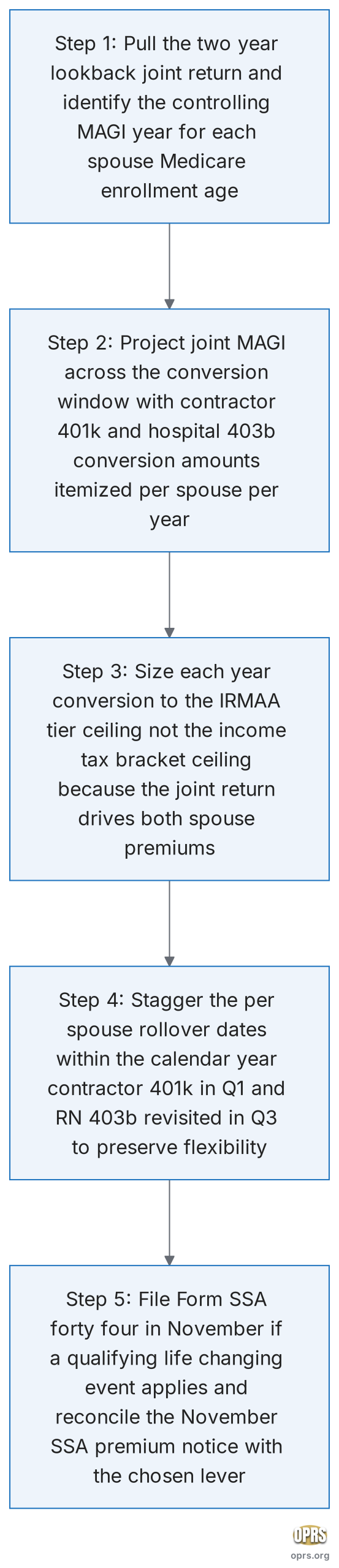
- Pull the two-year lookback tax return and identify the controlling MAGI year for each spouse. The elder spouse’s age-63 return controls the age-65 IRMAA. The younger spouse’s age-63 return controls the same enrollment year only if both spouses turn 65 in the same two-calendar-year window; otherwise the joint return controls both, but the younger spouse’s tier only applies once enrolled.
- Project joint MAGI across the conversion window with each spouse’s contribution itemized. Build a five-year row-and-column model: rows are tax years, columns are the contractor 401(k) Roth conversion amount, the RN 403(b) Roth conversion amount, base wage income, capital gains, and projected joint MAGI. Mark the IRMAA tier ceiling on each row.
- Size each year’s conversion to the tier ceiling, not to the income-tax bracket ceiling. The MFJ 22 percent tax bracket ceiling in 2026 is $206,700; the IRMAA Tier 1 ceiling is $212,000. The two ceilings are close but not identical, and the IRMAA cliff is the binding constraint in most dual-income late-fifties households because it bills both spouses.
- Stagger the per-spouse rollover dates within the calendar year to preserve flexibility. Execute the contractor 401(k) conversion in Q1 to lock the income, then revisit the RN 403(b) conversion size in Q3 based on actual MAGI components. This holds optionality on the bracket-sizing decision until Q4 instead of committing in January.
- File Form SSA-44 in November if a qualifying life-changing event applies. Marriage, divorce, death of a spouse, work stoppage, work reduction, loss of income-producing property, loss of pension income, and employer settlement payment are the eight qualifying events under Form SSA-44. A planned Roth conversion is not one of them. A 50-percent or greater work reduction for the elder spouse during the IRMAA year often is.
Where the gold IRA fits the dual-IRMAA coordination decision
A direct rollover from a 401(k) or 403(b) to a self-directed gold IRA is not a taxable event under 26 U.S.C. §402(c) and does not enter MAGI. The IRMAA exposure on a gold IRA appears later, when a distribution is taken in or after retirement.
The relevance to a dual-income couple in their late fifties is that the gold IRA allocation should be sized against the future distribution schedule, not the rollover year cash flow.
Pulling 20 percent of the combined balance into a precious metals IRA at age 60 has zero immediate IRMAA impact. The IRMAA decision arrives at the first required minimum distribution in the older spouse’s age-73 year, under the SECURE 2.0 amendment to 26 U.S.C. §401(a)(9).
A gold IRA also interacts with the conversion-window plan in two ways. First, an in-kind Roth conversion of the precious metals position is taxable in the conversion year at the fair-market value of the metals on the conversion date, not the original purchase price.
This means the conversion size depends on the spot price on that day and can be hard to fine-tune against the IRMAA tier ceiling.
Second, the dealer markup on the original purchase reduces the effective Roth conversion basis if the position is later sold inside the Roth. High markup compresses the long-run tax-free growth that justified the Roth conversion in the first place. Both reasons argue for screening the dealer carefully before the allocation is opened.
Before the dealer paperwork is opened
Markup and buyback posture compound the IRMAA exposure that arrives at first RMD. A weak buyback obligates a future taxable cash distribution at a worse markup; a strong buyback preserves the in-kind option that keeps the bracket-sizing lever in the household’s hands. Check this dealer against the 2026 OPRS list before signing the custodian paperwork.
Editorial cautionary list. Not a paid placement. Updated July 2026.
Five common mistakes dual-income couples make on IRMAA coordination
Mistake 1: Modeling IRMAA as a single-spouse cost. The default planner output usually shows the per-beneficiary surcharge as a single line. The household reality is that the same tier is paid twice each month once both spouses are enrolled. Correction: multiply every surcharge cell by two in any year where both spouses are projected to be on Medicare. The Tier 2 to Tier 3 cliff costs the household twice what the planner output suggests.
Mistake 2: Ignoring the age-gap window. A two-year gap between spouses creates a two-year window where only one IRMAA premium applies. Couples often spread conversions evenly across the pre-Medicare years and dilute the window’s benefit. Correction: front-load the larger conversion year into the elder-only IRMAA window so the household pays one surcharge instead of two on the consequence.
Mistake 3: Sizing conversions to the income-tax bracket ceiling rather than the IRMAA tier ceiling. The 22 percent MFJ tax bracket ceiling and the Tier 1 IRMAA ceiling are close but not identical, and the IRMAA cliff is the binding constraint in dual-income households because both spouses pay the surcharge. Correction: build the conversion sizing model with the lower of the two ceilings as the cap each year.
Mistake 4: Filing SSA-44 for a planned conversion. A scheduled Roth conversion is not one of the eight qualifying life-changing events. SSA routinely denies these applications and the denial creates a paper trail that can complicate later legitimate appeals. Correction: file SSA-44 only when an actual life event qualifies, and document the event with the contemporaneous record SSA requires.
Mistake 5: Treating the gold IRA allocation as IRMAA-neutral forever. The rollover year is IRMAA-neutral; the distribution year is not. A 20 percent precious metals allocation that arrives at first RMD as an in-kind distribution or a taxable cash distribution moves MAGI on the distribution year basis. Correction: model the gold IRA distribution year alongside the income-tax projection in the same row-and-column file the household maintains for the conversion ladder.
Frequently asked questions
Does each spouse get a separate IRMAA tier based on individual income?
No. On a joint return, SSA assigns the same tier to both spouses based on the single joint MAGI. The surcharge is then billed per beneficiary, so a dual-Medicare couple at Tier 2 pays the Tier 2 surcharge twice each month. The only way for spouses to end up in different tiers is to file separately, which carries other tax consequences and a much steeper IRMAA tier schedule for married-filing-separately filers under 42 U.S.C. §1395r(i)(3).
Can a 403(b) to gold IRA rollover trigger an IRMAA tier change in the rollover year?
A direct trustee-to-trustee rollover from a 403(b) to a self-directed gold IRA is not a taxable event and does not enter MAGI in the rollover year. An indirect rollover handled within the 60-day window under 26 U.S.C. §402(c) is also non-taxable if completed correctly.
The IRMAA event is the distribution from the gold IRA in a later year, not the rollover. The distinction matters because a Roth conversion of the rolled balance, even in a later year, does enter MAGI and does drive IRMAA two years forward.
What is the cost difference between Tier 1 and Tier 2 for a dual-Medicare couple?
The 2025 Part B Tier 2 surcharge is $74.00 per beneficiary per month, or $1,776 per year for a couple both enrolled. The Part D Tier 2 surcharge adds approximately $13.70 per beneficiary per month, or about $329 per year for a couple, for total dual-Medicare Tier 2 exposure around $2,105 annually above the Tier 1 baseline.
Crossing the Tier 1 to Tier 2 cliff by one dollar of MAGI costs the household roughly $2,100 for the affected year. The companion analysis on Roth conversion sizing against this cliff lives in our spousal Roth conversion ladder coordination piece.
If we move one spouse’s Roth conversion to the elder-only IRMAA window, does that lift the joint MAGI just as much?
Yes. The joint MAGI lifts identically regardless of which spouse’s account is converted, because the return aggregates both spouses’ income. The benefit of the elder-only window is that the resulting IRMAA surcharge is paid by one beneficiary instead of two for that plan year. The conversion is identical from the income-tax side; the IRMAA side is half. For households with a meaningful age gap, this is the single largest dollar lever inside the conversion-window plan.
Does Form SSA-44 work for work reduction by one spouse but not the other?
Yes, when properly documented. A 50-percent or greater work reduction by one spouse, including reduction to part-time hours or move to consulting, is a qualifying life-changing event for that spouse’s enrollment. The SSA-44 application must be filed by the affected beneficiary and supported by the employer’s contemporaneous record.
SSA reviews each application individually; the determination affects the applicant spouse’s premium and, indirectly through the joint MAGI projection, the household’s overall IRMAA picture once the work-reduction year flows into the lookback two years later.
The IRMAA exposure for a dual-income couple in their late fifties is the second-largest cost to model after the income-tax exposure on the conversion ladder itself. The setup is one hour with the most recent joint return, the projected wage income through age 65, and each spouse’s plan-document rollover eligibility.
The deliverable is a five-year MAGI projection that names the IRMAA tier two years out for every conversion year, identifies the elder-only and dual-Medicare windows, and documents the per-spouse rollover timing inside each calendar year.
The same file supports a later Form SSA-44 application if a qualifying event occurs and supports the household’s gold IRA allocation sizing against the future distribution calendar.
The Education-First option to compare against any dealer pitch
For a dual-income household coordinating a contractor 401(k) and a hospital 403(b) across a multi-year IRMAA window, the dealer-side benchmark is worth holding alongside the conversion projection.
Augusta’s industry-reported minimum sits around $50,000 for gold IRA accounts, which puts the combined $1 million to $1.5 million in this article’s scope well inside the eligible range. The educator team is salaried and non-commissioned, and the public process framing is Learn, Talk, Decide.
Industry-reported minimum around $50,000. Free company comparison checklist on request.
Sources cited
- 42 U.S.C. §1395r(i), Medicare Part B income-related monthly adjustment amount
- Social Security Administration, Medicare and MAGI program explainer
- CMS, 2025 Medicare Parts A & B Premiums and Deductibles fact sheet
- Form SSA-44, Medicare Income-Related Monthly Adjustment Amount Life-Changing Event
- 26 U.S.C. §408(d)(8), Qualified Charitable Distributions from IRAs
- 26 U.S.C. §402(c), Direct rollover of eligible rollover distributions
- 26 U.S.C. §403(b)(8), Section 403(b) plan rollover treatment
- 26 U.S.C. §401(a)(9), Required minimum distributions and SECURE 2.0 amendment