

Updated: July 30, 2026
OPRS may receive compensation when readers open an account through partner links on this page. Our analysis is based on independent research, BBB data, and IRS publications.
The Bureau of Labor Statistics 2024 Current Population Survey reports that about 58 percent of married-couple households retire on different calendar dates. Both spouses are age 55 to 64. The median gap between the first and second retirement is 2.4 years.
For a household with a combined seven-figure balance split across two workplace plans plus one or two existing IRAs, the gap is not idle time. It is a window during which the joint marginal tax bracket usually drops, Roth conversion headroom appears, and IRMAA exposure shifts from a dual-income MAGI profile to a single-earner-plus-distributions profile.
The same window also drives when each spouse’s eligible balance rolls to a self-directed gold IRA. The rollover taxable amount (if any) and the receiving custodian’s onboarding paperwork both interact with the joint return for the year the rollover lands. Before either spouse signs a partial-rollover form, see the 2026 OPRS dealer list for the operators we rule out and the few we currently trust.
Why staggered retirement dates change the joint tax math
Federal tax brackets and IRMAA tiers attach to the joint return as a whole, but the income that lands on that joint return is per-spouse and per-source. The household marginal rate in any year is a function of the sum of both spouses’ wages, self-employment income, pension distributions, Social Security benefits, IRA withdrawals, and Roth conversion taxable amounts.
When the first spouse retires, that spouse’s wage drops to zero (or to a smaller pension or part-time number). The joint marginal bracket usually falls one or two tiers under the 2024 Married Filing Jointly schedule in IRS Publication 17. That bracket drop is the planning window.
The Roth conversion or rollover that would have triggered a 32 percent or 35 percent marginal hit in the dual-earner year often clears at 22 percent or 24 percent in the staggered window.
Multiplied across a multi-year ladder, the bracket arbitrage on a partial Traditional-to-Roth conversion or a partial rollover to a self-directed gold IRA can run into five figures of avoided federal tax over the planning horizon.
The same logic cuts the other way. A conversion timed in the dual-earner year costs more than the same conversion 12 or 24 months later. The same is true in the year of a large severance payout or when both spouses still receive year-end bonuses.
The IRMAA two-year lookback adds a second arithmetic layer. IRMAA brackets are set by SSA POMS HI 01101.020 and published annually at medicare.gov’s Part B costs page. The brackets use modified adjusted gross income from two tax years prior to set Part B and Part D premium tiers.
A spouse who turns 65 in year Y enrolls in Medicare in year Y, and the IRMAA tier is set from the joint MAGI of year Y minus two.
A conversion or rollover taxable amount in the year either spouse turns 63 or 64 can push the IRMAA tier upward two years later. That means higher Part B and Part D premiums by hundreds to thousands of dollars per spouse per year. The elevated MAGI controls for as long as it remains on the return.
The first-spouse-retires year: four immediate tax effects
The calendar year the first spouse stops working creates four tax effects that the second spouse’s continued employment cannot offset and the joint return must absorb. Each has a planning response that runs through to the gold IRA rollover decision and the Roth conversion ladder.
Effect 1. Earned income drops by the first spouse’s wage share. The joint W-2 wage line on Form 1040 line 1 typically falls 40 to 60 percent in a dual-income household when the first spouse retires.
The drop is real income and reduces both the marginal bracket and the household’s MAGI for IRMAA, ACA marketplace premium tax credit, and capital loss limitation purposes. The planning response: identify the gap between current MAGI and the next IRMAA bracket ceiling, then size the Roth conversion or taxable rollover to use the gap without crossing it.
Effect 2. The first spouse’s eligible workplace plan becomes rollable. Most 401(k), 403(b), and 457(b) plans require separation from service before the participant can roll the balance to an IRA. The first spouse’s eligible balance becomes available for a direct rollover under IRC Section 401(k)(10) or Section 403(b)(11) the day separation closes.
A portion of that balance can move trustee-to-trustee to a self-directed gold IRA under IRC Section 408 in the same calendar year, taking the bracket arbitrage that year. The second spouse’s plan stays locked until their own separation date.
Effect 3. Spousal IRA contributions remain available through the second spouse’s wages. Under IRC Section 219(c), a working spouse can contribute to a Traditional or Roth IRA on behalf of the non-working spouse up to the annual limit, provided the joint return reports enough earned income.
A dual-income household that becomes a single-earner household in the first-retires year retains the spousal contribution channel for as long as the second spouse keeps W-2 wages. The contribution can land in the retired spouse’s existing IRA (Traditional or Roth) or in a new self-directed IRA destined to receive precious metals.
Effect 4. Social Security claiming becomes a per-spouse decision, not a joint one. The retired spouse can claim Social Security starting at age 62 or wait to full retirement age (FRA) or to age 70 for the delayed retirement credit.
The earner-credit interaction with the second spouse’s continued wages does not affect the second spouse’s own benefit, but does affect joint MAGI in the claim year. The Social Security Administration’s age reduction tables show the exact monthly reduction for each early-claiming month.
A first-retired spouse who claims at 62 adds taxable Social Security to the joint return that crowds the Roth conversion headroom the bracket drop just opened.
Bridge financing the 2 to 5 year gap between retirements
The years between the first retirement and the second are the lowest-marginal-rate years most dual-income households see between age 55 and age 73. Pension income (if any) is starting; Social Security has not yet started or is partial; RMDs are not yet running.
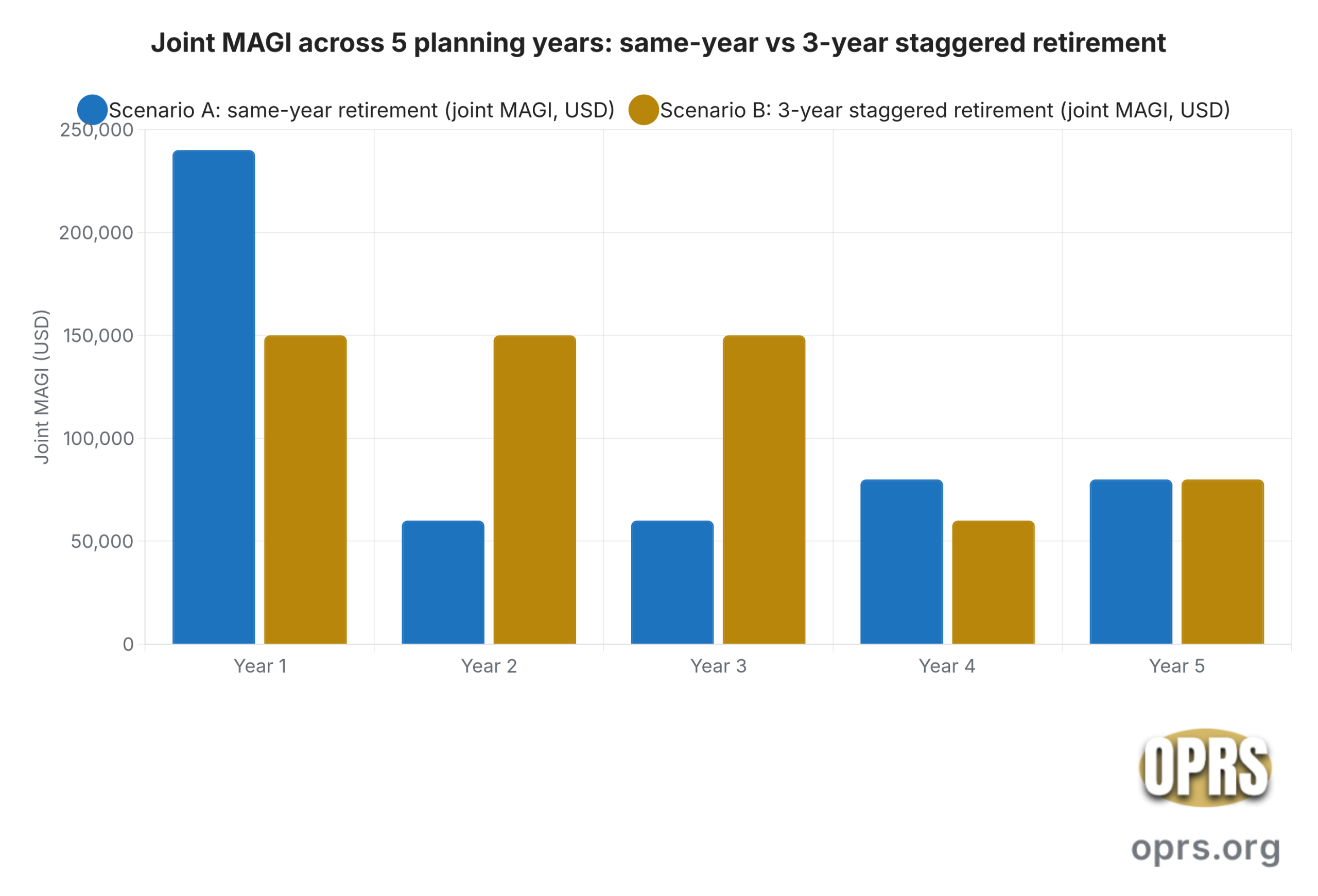
The chart below shows the joint MAGI profile for two stylized 5-year planning windows. The first is a same-year retirement scenario; the second is a 3-year staggered scenario. Both assume a household with combined pre-retirement wages of 240,000 dollars and a planned Roth conversion ladder.
Precious metals IRA early-withdrawal penalty estimator
Taking money out of a precious metals IRA before age 59 and a half triggers a 10% federal additional tax on top of ordinary income tax. State add-on taxes vary; check your state. The federal penalty is estimated below.
Estimate only, not tax advice. The 10% federal additional tax applies to early distributions before age 59 and a half; specific exceptions exist. Your state may add its own tax, and ordinary income tax applies separately. Source: IRS Publication 590-B. Consult a tax advisor.
The right dealer explains every fee up front. Get Augusta's free precious metals IRA company checklist.
The intermediate years in scenario B are where the bracket arbitrage lives. One spouse is still working at 150,000 dollars while the retired spouse draws limited income. The household sits inside the 22 to 24 percent marginal bracket and well below the IRMAA tier 1 ceiling, which is 212,000 dollars MFJ for the 2024 plan year per the SSA POMS table.
A planned Roth conversion or partial Traditional-to-gold-IRA rollover of 30,000 to 50,000 dollars per year moves 90,000 to 150,000 dollars of taxable balance into the lower-rate bracket over three years. It does so without crossing the IRMAA tier. The second spouse’s continued wages protect that headroom.
The scenario A same-year retirement collapses the headroom into two years (the year both retire, with a partial-year wage; and the following year, fully retired). That window is shorter and the marginal cost of overshooting it is higher. A 50,000 dollar conversion in scenario A consumes 25 to 33 percent of the available headroom; the same conversion in scenario B consumes 10 to 15 percent. Same dollars, very different tax outcome.
Roth conversion windows during the lower-earner-only year
The IRC Section 408A(d)(3) Roth conversion mechanic works like this. A participant takes a taxable distribution from a Traditional IRA or qualified plan and recharacterizes those dollars as a Roth IRA contribution. The usual contribution limit does not apply, because conversions are not contributions.
The taxable amount hits the joint return as ordinary income in the conversion year. The household pays the federal and state tax in cash from other funds. The converted balance then grows tax-free under the Roth rules.
The five-year holding rule and the qualified-distribution definition at Treasury Regulation Section 1.408A-6 control when withdrawals from the new Roth balance are tax-free.
In the staggered window, the conversion plan should be a multi-year ladder, not a single-year lump. A multi-year ladder of 30,000 to 75,000 dollars per year, sized to the gap between current MAGI and the IRMAA tier 1 ceiling, often fills the available headroom without triggering tier upgrades.
A single-year 200,000 dollar conversion in the same period crosses multiple tier ceilings. It raises Part B and Part D premiums for both spouses two years later. It may also push the conversion year into the 32 percent or 35 percent federal bracket, where the marginal cost is materially higher.
The same ladder logic applies to a partial rollover from a Traditional IRA to a self-directed gold IRA. This comes up when the receiving SDIRA is funded with taxable Traditional dollars and the participant elects to recognize income on the rollover. That election is uncommon, but possible for purposes of starting the Roth five-year clock on a new SDIRA-Roth account.
The taxable amount is treated as the conversion amount and follows the same ladder logic. Check this dealer against the 2026 OPRS list before you let a sales script accelerate the conversion ladder into one calendar year.
Coordinating the Medicare bridge and the IRMAA lookback
The younger spouse in a couple with a 3-year-plus age gap goes through a coverage bridge between the older spouse’s Medicare enrollment and their own age-65 enrollment. The bridge is funded from one of four sources: an employer plan if the younger spouse is still working, COBRA (typically 18 months), the ACA marketplace, or out-of-pocket coverage. The choice affects joint MAGI and therefore the IRMAA tier the older spouse pays.
The ACA marketplace, in particular, uses MAGI to set the advance premium tax credit (APTC) under IRC Section 36B. A high-MAGI year (driven by a large Roth conversion or rollover taxable amount) reduces or eliminates the APTC for the younger spouse’s bridge coverage, raising out-of-pocket premium cost.
The same high-MAGI year, two years later, pushes the older spouse into a higher IRMAA tier on Medicare Part B and Part D. The two effects stack: paying the ACA premium-credit clawback today plus the IRMAA surcharge tomorrow on the same conversion dollars.
The 2024 ACA Section 9661 expanded subsidy rules under the Inflation Reduction Act (extending the Section 36B(c) APTC eligibility through 2025 plan year) and the IRMAA tier structure both attach to the joint return.
A coordinated plan starts with a single calendar. It maps (a) the older spouse’s Medicare enrollment year, (b) the younger spouse’s Medicare enrollment year, and (c) the IRMAA lookback years for each. It also covers (d) the ACA bridge years for the younger spouse and (e) the Roth conversion ladder years.
The overlap pattern usually rules out one or two specific years for large conversions and identifies one or two safer years for them.
Sequencing the gold IRA rollover across two retirement dates
The gold IRA rollover sequence in a staggered-date household follows the retirement-date sequence, not the calendar-age sequence and not the account-balance sequence. The first-retired spouse’s eligible workplace plan becomes rollable on the separation date; the second spouse’s plan stays locked. The flowchart below shows the typical 6-step decision sequence for the first rollover and the position the second rollover takes once the second spouse separates.

Three sequencing details deserve direct attention. The 60-day rule in IRC Section 402(c)(3) requires that any indirect rollover (where the participant receives the check) be redeposited into the receiving IRA within 60 days of the distribution date.
An indirect rollover triggers the 20 percent mandatory federal withholding under IRC Section 3405(c), which the participant must source from other funds to redeposit the full gross amount. A direct trustee-to-trustee rollover (code G on the resulting 1099-R) avoids both the 60-day clock and the withholding.
The once-per-12-month indirect rollover limit in IRS Announcement 2014-15 applies to each spouse individually. It does not apply to direct rollovers or Roth conversions. The staggered window’s larger sequencing decisions usually use direct rollovers anyway.
The precious metals selection inside each spouse’s SDIRA must meet the IRC Section 408(m)(3) purity standards for gold (.995 minimum fineness), silver (.999), platinum (.9995), and palladium (.9995). The IRS-approved coin list and the segregated-versus-commingled storage decision at the depository attach to each SDIRA separately. Each spouse’s SDIRA is single-owner; the Internal Revenue Code does not allow joint-ownership IRAs, regardless of the joint tax filing or the couple’s coordinated planning.
Common mistakes in staggered-date coordination
- Mistake 1. Rolling both plans in the same calendar year because the first-retired spouse pressured the second to “match” the timing. The second spouse’s plan is locked until their own separation date; an in-service rollover under the plan’s hardship or age-59 1/2 provisions is rarely available for the full balance. Trying to time both rollovers to the same calendar year often forces the second spouse to take a partial distribution from a still-active plan, with the 10 percent additional tax on the under-59 1/2 portion and the 20 percent mandatory withholding on any indirect leg. Correction: let the retirement-date sequence drive the rollover-date sequence; the years between are the planning gain, not a problem to compress.
- Mistake 2. Sizing the first-year Roth conversion or taxable rollover by what fits “comfortably” without modeling the IRMAA two-year lookback. A conversion that fits the federal bracket cleanly can still raise both spouses’ Medicare Part B and Part D premiums two years later by hundreds to thousands of dollars per spouse per year. Correction: size every conversion to the lower of the federal bracket ceiling and the IRMAA tier ceiling, and re-check the math the year either spouse turns 63 or 64.
- Mistake 3. Assuming the spousal IRA contribution channel closes when the first spouse retires. Under IRC Section 219(c), a working spouse can contribute to the retired spouse’s IRA up to the annual limit as long as the joint return reports enough earned income. The retired spouse’s IRA (Traditional or Roth) keeps receiving fresh contributions through the second spouse’s wages. Correction: include the spousal contribution in the annual planning calendar; the headroom does not disappear with the first retirement.
- Mistake 4. Letting the first-retired spouse claim Social Security at 62 without modeling the joint MAGI hit and the cross-impact on the Roth conversion ladder. Early-claim Social Security adds taxable benefit to the joint return that crowds the conversion headroom the first retirement just opened. The bracket arbitrage the household could have captured at 22 to 24 percent often gets pushed up to 24 to 32 percent on the same dollar amount once Social Security is claimed. Correction: model the 62-versus-FRA-versus-70 claim choice against the planned conversion ladder before either decision is locked in.
- Mistake 5. Treating the gold IRA rollover as a one-time event that closes the planning window. Each SDIRA is a long-lived account that interacts with RMDs, IRMAA, the surviving-spouse rollover election under IRC Section 402(c)(9), and the SECURE 2.0 Act Section 327 election that allows a surviving spouse to be treated as the deceased spouse for RMD purposes. Correction: set up the SDIRA with the same long-horizon discipline as the original IRA, including beneficiary designations, contingent beneficiaries, and a documented withdrawal strategy past age 73.
- Mistake 6. Letting dealer onboarding delays push the rollover into the wrong calendar year. A dealer that takes six to ten weeks to process a partial rollover paperwork bundle can move the rollover taxable amount across the calendar year line, changing the bracket and the IRMAA lookback year. Correction: if dealer paperwork delay risks crossing a calendar year, pause the rollover and re-run the bracket math for the new year before signing. the top gold IRA dealers we verified this year before accepting a paperwork timeline that forces the rollover into a sub-optimal tax year.
Does the first-retired spouse have to wait until the second retires before any gold IRA rollover?
No. The first-retired spouse’s eligible workplace plan becomes rollable on the separation date under IRC Section 401(k)(10) or Section 403(b)(11). A direct trustee-to-trustee rollover to a self-directed IRA, including one that holds precious metals, can take place in the same calendar year as the separation.
The second spouse’s plan stays locked until their own separation. Coordinating the rollover sequence means running the first rollover in the first-retires year (or shortly after) and the second rollover after the second-retires year. Bunching the two rollovers in the same year is the mistake to avoid.
Can a working spouse contribute to a retired spouse’s gold IRA?
Yes, indirectly. Under IRC Section 219(c) the working spouse can contribute up to the annual IRA limit to a Traditional or Roth IRA in the retired spouse’s name, based on the joint return’s earned income. The contribution lands in the retired spouse’s IRA, which can be a self-directed IRA holding precious metals through an IRS-approved custodian.
The contribution is subject to the deduction phase-out rules of IRC Section 219(g) when the working spouse is an active participant in an employer plan. It is also subject to the Roth contribution income phase-out under IRC Section 408A(c)(3) for joint filers.
How does a 5-year age gap change the staggered-date planning window?
A 5-year age gap stretches the planning window. The older spouse hits 59 1/2 five years before the younger spouse, faces RMDs at 73 five years before the younger spouse, and enrolls in Medicare five years before the younger spouse.
The window between two retirements varies widely. It can run from zero (both retire the same year despite the age gap) to ten or more years (older spouse retires at 60 while the younger stays to age 65 or beyond).
Larger gaps create more planning years at lower joint MAGI but also more years where the ACA bridge or the IRMAA two-year lookback is active for one spouse and not the other.
The Joint Life and Last Survivor Table in Treasury Regulation Section 1.401(a)(9)-9 also applies for couples where one spouse is more than 10 years younger, producing lower RMDs for the older spouse.
What if the second spouse retires earlier than planned for health reasons?
If the second spouse separates earlier than planned (whether through illness, employer reduction in force, or change of plan), the staggered window shortens and the joint MAGI profile re-shapes.
The Roth conversion ladder built around the original window has to be re-scaled. Any years still ahead can use the new, lower joint MAGI to size additional conversions. But any conversions already executed cannot be reversed: the 2017 Tax Cuts and Jobs Act eliminated the Roth recharacterization option in IRC Section 408A(d)(6).
The early-separation year may trigger the IRC Section 72(t)(2)(A)(v) age-50 separation exception for qualified public safety employees. Other Section 72(t) exceptions may also apply. These can allow penalty-free pre-59 1/2 distributions from the workplace plan even though the regular separation timeline shortened.
Should the gold IRA rollover go to one spouse’s SDIRA or split into two SDIRAs?
Each spouse’s IRA, including the self-directed gold IRA, is single-owner by definition under IRC Section 408. A rollover from the first-retired spouse’s workplace plan can only land in that spouse’s own IRA. The second spouse’s rollover lands in the second spouse’s own IRA.
A coordinated couple typically ends up with two SDIRAs, one in each spouse’s name. The bullion is held by IRS-approved custodians and depositories under the standards in IRC Section 408(m)(3) and IRS Publication 590-A.
Each SDIRA names a beneficiary: typically the surviving spouse as primary, with children or a trust as contingent. The joint planning calendar manages rollover dates, distribution dates, and RMD start dates as a paired schedule.
Four documents belong on a single planning sheet before either spouse signs any separation form or rollover paperwork. First: the joint retirement calendar, listing both spouses’ planned separation dates, 59 1/2 dates, Medicare-enrollment dates (age 65), and RMD start dates (age 73 under SECURE 2.0 Act Section 107).
(2) The joint MAGI projection for each year of the planning window, with the IRMAA tier ceiling and the federal bracket ceiling overlaid. (3) The Roth conversion or partial taxable rollover ladder, sized to the gap between projected MAGI and the lower of the two ceilings. (4) The per-spouse beneficiary designation for the receiving SDIRAs and the existing IRAs.
Reverse any one and the joint tax outcome over the 10 to 15 year planning horizon changes.
More on OPRS
- Dual-income couples gold IRA coordination guide: the sequencing decision framework that underpins the staggered-date planning above
- Spousal Roth conversion ladder coordination for couples: how to size a multi-year ladder against joint bracket and IRMAA tier ceilings
- Dual IRMAA bracket management with a gold IRA: per-spouse premium tier control across the conversion window
- Medicare bridge for the younger spouse: ACA MAGI vs Roth conversion arithmetic during the gap years
- the top gold IRA dealers we verified this year
Sources cited
- IRC Section 408A, Roth IRAs (Cornell LII), subsection (d)(3) Roth conversion mechanic and subsection (c)(3) joint filer income phase-out.
- IRC Section 408, Individual Retirement Accounts (Cornell LII), subsection (m)(3) collectible prohibition carve-out for IRS-approved bullion and coins, defining the precious metals purity standards.
- IRC Section 402, Taxability of beneficiary of employees’ trust (Cornell LII), subsections (c)(3) 60-day rollover, (c)(9) surviving spouse rollover election, and (c)(4) direct rollover treatment.
- IRC Section 3405, Special rules for pensions, annuities, and certain other deferred income (Cornell LII), subsection (c) 20 percent mandatory federal withholding on eligible rollover distributions paid to the participant.
- IRC Section 219, Retirement savings (Cornell LII), subsection (c) deduction for spousal IRA contributions and subsection (g) active participant deduction phase-out.
- IRC Section 401, Qualified pension, profit-sharing, and stock bonus plans (Cornell LII), subsection (a)(9) required minimum distributions and subsection (k)(10) 401(k) distribution restrictions.
- Treasury Regulation Section 1.401(a)(9)-9 (Cornell LII), Uniform Lifetime Table and Joint Life and Last Survivor Expectancy Table used to calculate RMDs for the participant and the spouse-as-sole-beneficiary case.
- IRS Publication 590-A, Contributions to Individual Retirement Arrangements (IRAs), covering Traditional and Roth contribution rules, rollover mechanics, and the spousal IRA contribution channel.
- IRS Publication 17, Your Federal Income Tax, with the Married Filing Jointly bracket schedule, the standard deduction tables, and the credit and adjustment rules that determine joint MAGI.
- SSA POMS HI 01101.020, IRMAA Sliding Scale Tables, with the income brackets used to set Medicare Part B and Part D premium surcharges based on MAGI from two tax years prior.
- Medicare.gov, Part B costs and IRMAA brackets, including the standard premium and the per-tier surcharge for higher-MAGI joint filers.
- Social Security Administration retirement age reduction tables, with the exact monthly reduction for early claims between age 62 and full retirement age.
- IRS Announcement 2014-15, applying the Bobrow v. Commissioner once-per-12-month aggregation rule to indirect IRA rollovers.
- Consolidated Appropriations Act of 2023, Public Law 117-328 (Congress.gov), Division T (SECURE 2.0 Act), Section 107 raising the RMD age to 73 and Section 327 spousal RMD election.