

Updated: June 28, 2026
OPRS may receive compensation when readers open an account through partner links on this page. Our analysis is based on independent research, BBB data, and IRS publications.
FINRA BrokerCheck is the free public database operated by the Financial Industry Regulatory Authority (source: brokercheck.finra.org). It covers every broker-dealer firm and registered representative who has sold securities to US retail investors in the past ten years. Most gold IRA salespeople do not appear in BrokerCheck. Physical bullion is not a security, and the people selling it usually hold no FINRA license.
That gap is the central thing to know. Element I of vetting a precious-metals dealer is finding the rep on a registry. Element II is reading what the registry says. The first element fails silently for most gold IRA pitches because no FINRA record exists in the first place.
Knowing why BrokerCheck returns “no record found” for a given salesperson is itself a screening data point. See our 2026 OPRS list of gold IRA operators we currently caution against for an applied frame.
The sections below cover what BrokerCheck actually is. They cover who it includes and who it leaves out, the step-by-step search workflow, and the seven disclosure categories. They close with the layered checks that fill the BrokerCheck coverage gap for any retiree vetting a gold IRA dealer in 2026.
What FINRA BrokerCheck actually is
FINRA BrokerCheck is a public-facing search tool maintained by the Financial Industry Regulatory Authority. FINRA is the self-regulatory organization that supervises US broker-dealers under SEC oversight. The database is free, requires no login, and pulls from the Central Registration Depository (CRD), the system every broker-dealer firm uses to register reps with FINRA and state regulators.
BrokerCheck holds two record types. The first is a firm record: name, CRD number, registration status, history, products, and disclosures at the entity level. The second is an individual record. That includes employment history covering the last ten years, exams passed (Series 6, 7, 24, 63, 65, 66), and any disclosure events filed against the person across that timeline.
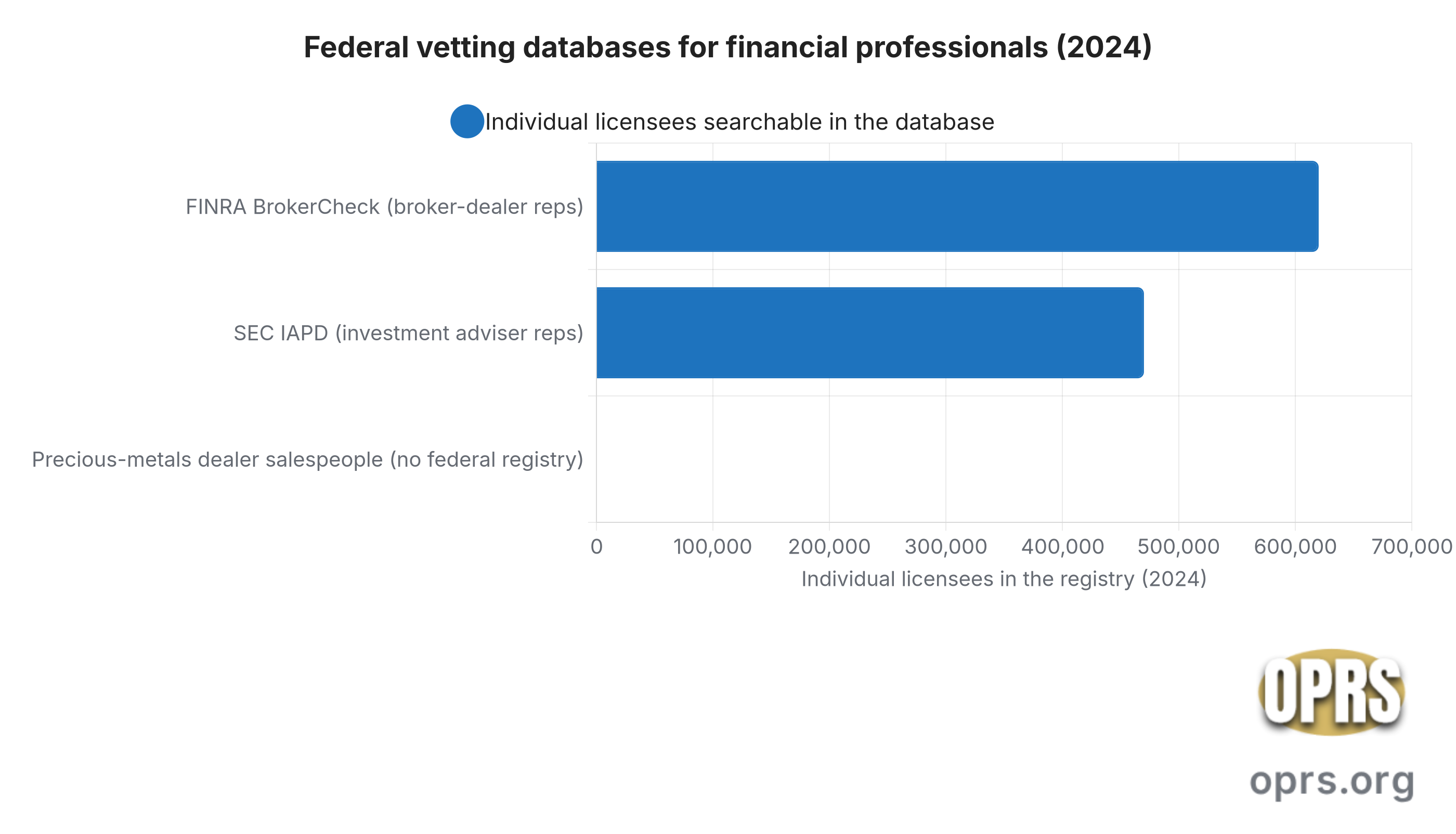
The FINRA 2024 Industry Snapshot reports around 3,300 broker-dealer firms and around 620,000 registered representatives in scope (source: FINRA statistics page). Every one of those people and firms can be searched in BrokerCheck. The tool also surfaces FINRA-administered arbitration awards and Letters of Acceptance, Waiver, and Consent (AWCs) when applicable.
Who is in BrokerCheck, and who is not
The coverage rule is mechanical. If a person sells or recommends securities for compensation in the US, they need a FINRA license tied to a broker-dealer, and they appear in BrokerCheck. That covers registered reps at full-service firms, online brokerages, and most institutions that distribute mutual funds, ETFs, variable annuities, and private placements.
Several categories of financial professional are NOT in BrokerCheck. Investment adviser representatives sit in the SEC Investment Adviser Public Disclosure database (IAPD) at adviserinfo.sec.gov. State-only insurance producers sit in NIPR and state insurance department registries. Mortgage loan originators sit in the NMLS Consumer Access system. None of those registries feeds BrokerCheck.
Precious-metals dealer salespeople are the category that matters here. Physical bullion sold to an IRS-approved depository for IRA inclusion is not a security. The transaction sits outside FINRA jurisdiction. The salesperson is, in the vast majority of cases, never registered with FINRA in the first place. They appear in no broker-dealer registry because they are not a broker-dealer rep.
Two narrow exceptions matter. A small subset of gold IRA dealer reps hold dual licensing: they are also registered as a broker-dealer rep or insurance producer in addition to selling metals. Those individuals WILL appear in BrokerCheck under their securities role. Some firms also have an affiliated registered broker-dealer that distributes self-directed IRA products structured as securities. Those entities appear too.
How to search FINRA BrokerCheck step by step
The search workflow takes about five minutes per individual. Run it on every person who pitches you a precious-metals IRA using titles like “financial advisor,” “investment specialist,” “wealth manager,” or “broker.” Those titles imply securities-licensed status. If BrokerCheck returns nothing under one of those titles, that is itself a flag worth investigating.
- Open brokercheck.finra.org directly. Do not search by Google. Phishing pages and SEO clones of BrokerCheck exist. Type the URL.
- Enter the individual or firm name in the search field. If you have the CRD number from a Form CRS or business card, use the number; it is unique. For individuals, add the state to narrow the result list if the name is common.
- Confirm the right record. Cross-check employment history against what the rep told you. A real broker-dealer rep can describe their last three employers verbally. The dates should line up with BrokerCheck.
- Open the full report (the PDF or expanded view). Scroll to the disclosure section first. A clean record shows “No disclosures.” Any disclosure entry will be categorized, dated, and described in plain language.
- Read each disclosure end to end. Customer disputes show alleged amounts, settlement values, and the firm’s response. Regulatory events show the regulator, the rule violated, and the sanction. Take notes; you may need them for a state Bureau of Securities cross-check.
The CRD number is the durable identifier. Names change with marriage, divorce, or transliteration. CRD numbers do not. If a rep refuses to share their CRD number when asked, that is a clean reason to walk away from the conversation. Legitimate broker-dealer reps quote the number from memory.
The seven BrokerCheck disclosure categories and how to read them
FINRA classifies disclosure events into seven categories on a rep’s CRD record. The categories come from the official BrokerCheck Disclosure Glossary. Each category has its own reading rules. A single old disclosure is not a verdict; a pattern across several is.
- Customer Dispute. A written complaint or arbitration filed by a retail customer. The entry shows the alleged amount, the date filed, the status (pending, settled, denied, awarded), and the firm’s response. Settlements over $15,000 are reportable. Read the firm’s response carefully; legitimate disputes are sometimes settled for cost-of-defense reasons.
- Regulatory Event. A finding by FINRA, the SEC, a state securities regulator, or a foreign financial regulator. These typically describe the rule violated, the sanction (suspension, fine, bar), and the underlying conduct. Regulatory events are the heaviest weight in a record.
- Employment Separation After Allegations. A firm filed a Form U5 saying the rep was terminated or resigned after alleged misconduct. The exact allegation is in the U5 disclosure section. This is often a leading indicator of later regulatory action.
- Criminal Disclosure. Felony charges (any) and certain investment-related misdemeanors. The rep self-reports these on Form U4. The disclosure stays on the record by category (most felonies are permanent, some misdemeanors fall off after 10 years).
- Financial Disclosure. Bankruptcy filings, unsatisfied judgments, and liens. These stay on the record for 10 years. For a rep selling retirement products, recent personal financial distress is contextually relevant.
- Civil Disclosure. Civil court actions related to investment business. Less common than customer disputes but more serious when present, because civil court has higher evidentiary thresholds than arbitration.
- Investigation. Notification that the rep is being formally investigated by a regulator. Open investigations are themselves disclosable. They may or may not become regulatory events.
FINRA reports that around 13 percent of registered representatives have at least one disclosure event on their record. The base rate matters: a single dated disclosure on a 25-year career record is contextually different from three disclosures clustered in the last three years on a five-year career record.
What “no record found” actually means for a gold IRA salesperson
For a registered broker-dealer rep, “no record found” usually means the name was misspelled or the search did not narrow to the right state. For a precious-metals dealer salesperson, “no record found” usually means the person was never FINRA-registered and never needed to be. Both readings are common; the meaning depends on what the rep claimed about their license.
A salesperson at a precious-metals dealer may legally sell physical gold and silver coins without any federal or state securities license. The activity is regulated under different bodies of law. State precious-metals dealer registration applies where it exists. FTC consumer-protection rules and CFTC retail-commodity rules apply if leverage is involved. IRS rules under 26 USC 408(m) govern which coin types qualify for IRA inclusion.
The screening question shifts. If a rep claimed a securities license they do not hold, that is a Form CRS issue. Form CRS is the SEC-mandated disclosure broker-dealers and investment advisers give retail clients at the start of the relationship. No CRS, no securities license, no BrokerCheck record: the rep is operating outside the FINRA/SEC regime entirely. Verify their state precious-metals dealer registration instead.
Layered checks beyond BrokerCheck for a gold IRA dealer
BrokerCheck handles one slice of the vetting work. Closing the coverage gap for a precious-metals dealer requires a layered set of public-record checks. None of them takes long individually, and the combined check is what filters the OPRS shortlist down to the few dealers we currently clear. See the 2026 OPRS list of operators we warn against for the applied output.
- SEC IAPD at adviserinfo.sec.gov for investment-adviser representatives, who are not in BrokerCheck.
- State Bureau of Securities records for the rep’s state of business; most state-level dealer enforcement appears here first.
- NASAA enforcement reports at nasaa.org aggregate state actions across all 50 states.
- CFTC press release archive and the CFTC RED List catch leveraged-metals and foreign-entity flags.
- FTC complaint reporting at reportfraud.ftc.gov covers deceptive-advertising and the 2024 fake-reviews rule under 16 CFR Part 465.
- State Attorney General press releases for the rep’s state and for the dealer’s headquartered state.
- BBB profile at bbb.org for the rating, the accreditation date, and the complaint-and-resolution pattern.
The 2011 joint SEC/NASAA/FINRA Investor Alert on self-directed IRA fraud sits inside this layered framework (source: SEC joint alert PDF). The alert names seven risk factors. BrokerCheck addresses the “unregistered or unlicensed sellers” factor for the rep population it actually covers. The other six factors need different sources.

Common mistakes retirees make using FINRA BrokerCheck
The same handful of misreadings come up repeatedly when retirees use BrokerCheck to evaluate a gold IRA pitch. Each one looks reasonable on the surface and produces the wrong decision in practice.
- Mistake 1: assuming BrokerCheck is universal. It covers about 620,000 securities-licensed individuals. Most precious-metals dealer salespeople sit outside that population entirely. A clean BrokerCheck miss can mean “never licensed” rather than “vetted clean.” Read it that way until you confirm the license status another way.
- Mistake 2: treating a clean record as approval. No disclosures is the baseline a rep needs to meet, not an endorsement. A rep with zero disclosures and a 30-year career still needs the dealer-level checks (BBB pattern, written fee schedule, IRS-approved depository confirmation) before any wire moves.
- Mistake 3: searching only the firm name. Disclosures attach to individuals more than firms in many cases. A firm record may look clean while the specific rep pitching the account has multiple customer disputes filed. Always search the individual.
- Mistake 4: dismissing one old disclosure without reading it. Read the entry. A customer dispute settled for $25,000 with the firm denying allegations reads differently than a regulatory event with FINRA finding the rep violated a specific suitability rule.
- Mistake 5: skipping the state cross-check. State Bureau of Securities and state AG releases often surface dealer-level enforcement that BrokerCheck does not show, because the action targeted the firm or the conduct rather than a registered individual.
FAQ on FINRA BrokerCheck for gold IRA vetting
Is FINRA BrokerCheck the same as the SEC’s IAPD database?
No. BrokerCheck covers FINRA-registered broker-dealer firms and reps. The SEC’s Investment Adviser Public Disclosure database (IAPD) at adviserinfo.sec.gov covers SEC and state-registered investment advisers. The two systems are linked at the back end; a search in either typically also returns the other if the person is dual-registered. Always check both for a self-described “financial professional.”
Can a gold IRA salesperson legally sell without a FINRA license?
Yes, in the vast majority of cases. Physical bullion delivered to an IRS-approved depository is not a security under federal law. The salesperson is selling a commodity, not a securities product. State precious-metals dealer registration may apply, plus CFTC and FTC consumer-protection law. FINRA registration applies only when the rep also distributes securities products on the side.
What if BrokerCheck shows a customer dispute settled for a small amount?
Read the entry in full. A single settled dispute on a long career record is contextually different from a pattern. The firm’s written response usually states whether the firm denied the allegations and settled for cost-of-defense reasons or accepted some responsibility. Pattern matters: three disclosures in three years signals more than one disclosure in twenty years.
How current is the BrokerCheck data?
Firms and reps update CRD records continuously through Form U4 (amendments to registration) and Form U5 (termination). FINRA publishes most updates to BrokerCheck within one business day. Older disclosures (some over 10 years) may fall off the public-facing report while remaining in the underlying CRD record accessible to regulators and prospective employers.
What does the absence of a rep from BrokerCheck tell me about a gold IRA dealer?
For most precious-metals dealers, the absence is expected and not a flag on its own. The flag comes from a mismatch: a rep using titles like “broker,” “advisor,” or “wealth manager” who does not appear in any securities registry. That mismatch is a Form CRS issue worth surfacing with the firm and a reason to apply the layered checks (state, NASAA, CFTC, BBB) before sending a wire.
Where this fits in a broader vetting framework
BrokerCheck is one screening layer among several. The related OPRS pages walk through the other layers in detail. The SEC Investor Alerts on gold IRA fraud page maps the seven risk factors the 2011 joint alert names. The regulator-by-regulator coverage map details which agency covers which slice of a gold IRA transaction. The dealer-vetting framework for non-finance retirees packages the full layered check into a sequence a non-specialist can run in an afternoon.
Some operators in the market lean on the educational side of the funnel. Augusta Precious Metals publishes a free buyer-beware checklist that walks through dealer-vetting questions a retiree should ask before opening an account. The firm operates an Education-First process built around learn, talk, and decide, with salaried, non-commissioned educators.
Augusta has been BBB A+ accredited since 2014. Money Magazine has named the firm Best Overall Gold IRA Company every year from 2022 through 2026. Investopedia has named Augusta Most Transparent Gold IRA Company across the same window. The firm’s industry-reported minimum sits around $50,000 for gold IRA accounts.
None of those signals exempts a reader from running the BrokerCheck and layered checks above. They illustrate what a clean public record and a transparent dealer-side process look like in 2026. See the OPRS shortlist for the alternative operators with lower thresholds we currently clear.
Pick one specific dealer or rep you are evaluating right now. Run the five-step BrokerCheck search above. If the rep appears, read every disclosure end to end and note the pattern. If the rep does not appear, confirm whether they ever claimed a securities-licensed title; if yes, that is a Form CRS issue worth raising directly. Layer the SEC IAPD, state Bureau of Securities, NASAA, CFTC, and BBB checks before any wire instruction leaves your bank.
Sources cited
- FINRA BrokerCheck public search tool
- FINRA BrokerCheck Disclosure Glossary (PDF)
- FINRA Industry Snapshot and statistics page
- Financial Industry Regulatory Authority (FINRA) home
- SEC Investment Adviser Public Disclosure (IAPD) database
- SEC Form CRS (Customer Relationship Summary)
- SEC, NASAA, FINRA joint Investor Alert: Self-Directed IRAs and the Risk of Fraud (2011)
- 26 USC 408(m), IRS rules on collectibles in retirement accounts
- CFTC RED List of unregistered foreign entities
- NASAA annual enforcement reports
- 16 CFR Part 465, the 2024 FTC fake reviews rule
- FTC consumer fraud reporting portal
- Better Business Bureau company search
Consult your tax advisor for your specific situation. Past performance is not a guarantee of future results.