

Updated: August 26, 2026
OPRS may receive compensation when readers open an account through partner links on this page. Our analysis is based on independent research, BBB data, and IRS publications.
30-second verdict
- A 401(a) plan is a qualified employer plan under IRC Section 401(a). For public school teachers, it is almost always a defined benefit pension (lifetime annuity formula), not a defined contribution account.
- The 401(a) pension is not directly rollable to a gold IRA while the teacher is receiving the annuity. The 403(b) tax-sheltered annuity contributed alongside it is rollable at separation under IRC Section 403(b)(8).
- The 401(a) pension already provides a guaranteed lifetime income floor. The portfolio decision shifts from “do I need more guaranteed income” to “do I need non-correlated assets to hedge inflation against a fixed pension payout.”
- Procedural sequence (4 steps): confirm 401(a) plan type (defined benefit vs money purchase) from the state retirement system summary plan description, price the pension annuity equivalent at the current rate environment to know the existing fixed-income exposure on the household balance sheet, size the residual portfolio decision on the rollable 403(b), then execute a trustee-to-trustee transfer of the 403(b) sleeve into a self-directed gold IRA at separation under IRC Section 408(d)(3).
A single, never-married public school teacher with 25 to 30 years of service, currently age 60 to 65, typically holds two distinct retirement assets. The first is a state 401(a) defined benefit pension: a lifetime annuity formula administered by the state retirement system. The second is a 403(b) tax-sheltered annuity: a contributory account in the teacher’s name held with a 403(b) provider.
The 401(a) and 403(b) live under different IRC sections, behave differently at separation, and interact differently with a gold IRA rollover decision. See the dealers OPRS clears and the operators we warn against before any 403(b)-to-gold-IRA conversation. A dealer that conflates the 401(a) pension with the 403(b) rollable sleeve in its pitch is the same dealer that quotes a transfer timeline it cannot meet on a single-retiree profile.
Element I is the structural distinction between a 401(a) defined benefit plan and a 403(b) tax-sheltered annuity for public school teachers, including how each is funded, who controls the asset, and what happens at separation.
Element II is how a fully-funded 401(a) pension changes the portfolio composition decision on the rollable 403(b) sleeve, because the household already holds a large implicit fixed-income position in the pension annuity.
Element III is the four-step procedural sequence to confirm the 401(a) plan type, price the pension annuity equivalent, size the rollable 403(b) decision, and execute the trustee-to-trustee transfer at separation. Element IV is where Augusta sits in this picture, and the cautionary frame on dealer screening for sub-$150,000 rollover profiles.
Element V is when the gold IRA decision should wait or be deferred entirely.
Screen the dealer before the 403(b) rollover paperwork
A teacher whose 401(a) pension already handles lifetime income has less room for error with a thin dealer than a teacher rolling for income generation. The dealer screen comes first, before the allocation decision and before any 403(b) transfer paperwork. A dealer that cannot quote a rollover timeline, a custodian process flow, and a transparent buy-back at the diligence stage is one to avoid. That is the same dealer that stalls when the 403(b) provider asks for a substantiation letter.
3 of 27+ gold IRA dealers reviewed by OPRS make the 2026 trusted list. Updated August 2026.
What a 401(a) plan actually is, and how it differs from a 403(b)
A 401(a) plan is any qualified employer-sponsored retirement plan organized under IRC Section 401(a). For private-sector employers, the most common 401(a) plan is a 401(k) cash or deferred arrangement. For public-sector employers, governments, and public school systems, the 401(a) is almost always the umbrella section under which the employer’s defined benefit pension or money purchase plan operates.
State teacher retirement systems are 401(a) qualified plans operating a defined benefit formula. Examples include the Tennessee Consolidated Retirement System, the Ohio State Teachers Retirement System, the California State Teachers Retirement System, and the New York State Teachers Retirement System. The formula is: annual benefit equals years of service multiplied by a benefit multiplier, multiplied by Final Average Salary.
The 403(b) tax-sheltered annuity sits under a different IRC section: IRC Section 403(b). A 403(b) is available to employees of public schools, certain tax-exempt organizations, and ministers, per IRS Publication 571 (Tax-Sheltered Annuity Plans for Employees of Public Schools).
The 403(b) is a defined contribution account in the teacher’s name. The teacher elects contributions through salary deferral, the asset belongs to the teacher, and the teacher controls the investment selection inside the contract or custodial account.
The operational consequence at separation: the 401(a) defined benefit pension becomes a lifetime annuity paid by the state retirement system. The teacher elects a payout option (single life, joint and survivor, period certain) but does not control the underlying asset.
A single never-married teacher typically elects single life because there is no spouse and no eligible joint-survivor beneficiary on most state plans. The 403(b) becomes a rollable account at separation. The teacher can leave it at the source 403(b) provider, transfer it trustee-to-trustee to a traditional IRA under IRC Section 403(b)(8), or roll it to a self-directed IRA with a precious metals option.
The 401(a) and 403(b) sit on the same household balance sheet but the rollover decision applies only to the 403(b).
How a 401(a) pension changes the gold IRA decision math
A retiree without a defined benefit pension typically holds a 403(b), 401(k), or IRA balance plus Social Security as the household income stack. The portfolio decision balances accumulation against decumulation: enough fixed income to fund near-term distributions, enough growth to outpace inflation over a 20-to-30-year horizon, enough liquidity to handle unplanned expenses.
A retiree with a 401(a) defined benefit pension layered on top of Social Security has already solved the lifetime-income problem. The pension pays a fixed (or inflation-linked, depending on the state plan) lifetime annuity. Social Security pays a separately inflation-linked lifetime annuity.
Consider a teacher with 30 years of service, a 2.0 percent multiplier, and a Final Average Salary of $75,000. The pension alone lands at approximately $45,000 per year. Adding approximately $30,000 from Social Security at Full Retirement Age produces a total of approximately $75,000 in guaranteed annual income before any 403(b) distribution.
The portfolio decision on the rollable 403(b) shifts in two ways. First, the pension annuity is the household’s existing fixed-income exposure.
A $45,000 annual pension, valued as an immediate annuity for a 65-year-old female in the current rate environment, corresponds to an annuity-equivalent capital value of approximately $675,000 to $750,000. That range uses a 6 percent to 7 percent payout rate for a single life immediate annuity, per the FINRA Investor Alert on Variable Annuity Fees rate guidance and standard mortality assumptions.
The household already holds the equivalent of $675,000 to $750,000 in fixed-income exposure through the pension alone, on a balance sheet before the 403(b) is even counted.
Second, the rollable 403(b) sleeve no longer needs to anchor the household with bond-heavy fixed-income allocations to support distributions. The pension and Social Security do that work.
The 403(b) sleeve is free to carry non-correlated assets such as gold, broad-market equities, and real assets that hedge inflation against the fixed pension payout. This matters especially in state plans where the pension cost-of-living adjustment is capped. The Tennessee Consolidated Retirement System caps the annual COLA at the lower of CPI or 3 percent, per the Tennessee Treasury Retirement Services TCRS Plan Overview. Many state plans cap or zero out COLAs in low-funded-ratio years.
The Tennessee teacher pension is fixed in nominal dollars during a high-inflation period, absent a discretionary COLA grant. The gold IRA inside the rollable 403(b) is one of the few asset classes that has historically held purchasing power across inflation regimes.
Sizing the gold IRA allocation inside the 403(b) sleeve
The conventional precious metals allocation guidance from the SEC investor.gov Asset Allocation Bulletin and the FINRA Investor Insights on Asset Allocation sits at 5 to 10 percent of a diversified portfolio for inflation-hedge purposes.
For a teacher with an $80,000 to $150,000 403(b) balance, the pension already fills the fixed-income role. Whether the 5 to 10 percent allocation guidance reads as aggressive or modest depends on the denominator: the 403(b) sleeve alone, or the total household balance sheet including the pension annuity-equivalent capital value.
The table below compares two denominator approaches for the calibrated Linda reference profile. Linda is a single never-married teacher, age 62, with 30 years of service, a Final Average Salary of $75,000, a 2.0 percent multiplier, and $115,000 in a 403(b) balance. Her 401(a) pension pays $45,000 per year, and her Social Security PIA is $2,500 per month at Full Retirement Age 67. Dollar values are calibrated examples for the denominator question only, not personalized recommendations.
| Item | Sleeve-only denominator | Household balance sheet denominator |
|---|---|---|
| 403(b) balance | $115,000 | $115,000 |
| 401(a) pension annuity-equivalent | Not counted | $675,000 (single life, 6.67% payout rate) |
| Total denominator | $115,000 | $790,000 |
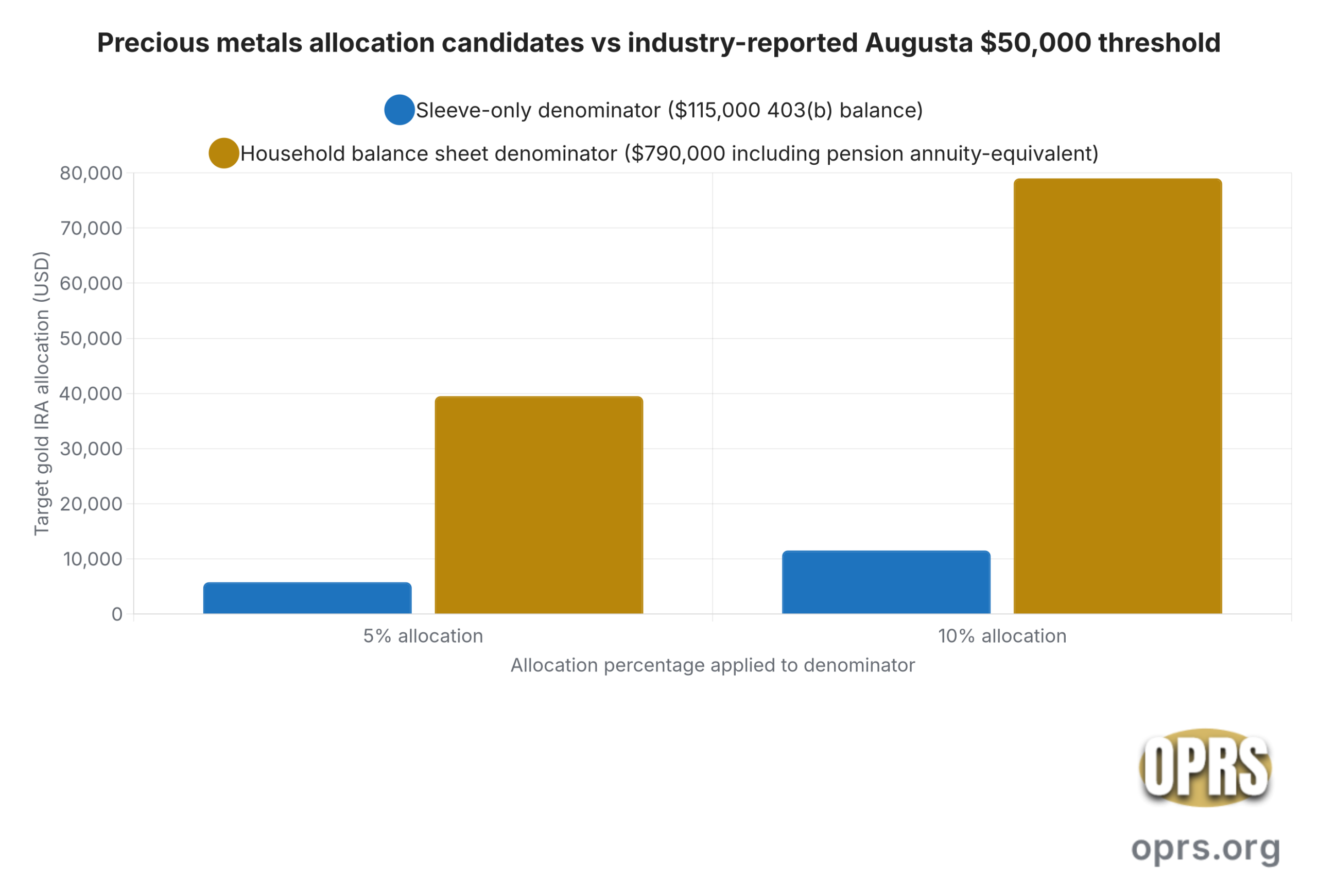
| 5% precious metals allocation | $5,750 | $39,500 |
| 10% precious metals allocation | $11,500 | $79,000 |
| Augusta industry-reported minimum threshold | industry-reported around $50,000 | industry-reported around $50,000 |
| Allocation clears Augusta threshold | No at 5%, No at 10% | No at 5%, Yes at 10% |
| Implication for the 403(b) rollover decision | Sub-threshold for Augusta on sleeve-only math | Above threshold for Augusta on household math, but requires liquidating a large fraction of the 403(b) |
Can you roll your account into a precious metals IRA? Eligibility checker
Most retirement money can move into a precious metals IRA once it qualifies as an eligible rollover distribution. Pick your account type and situation for a general answer. Always confirm specifics with your plan administrator or custodian.
General guidance only, not tax or financial advice. Eligibility depends on your specific plan document and IRS rules; confirm with your plan administrator and a tax advisor. A direct trustee-to-trustee transfer avoids the 60-day rule and 20% mandatory withholding.
The right dealer explains every fee up front. Get Augusta's free precious metals IRA company checklist.
The sleeve-only denominator is the conservative read: a teacher who treats the 403(b) as the portfolio that needs balancing on its own merits arrives at an allocation that does not clear the industry-reported Augusta minimum.
The household-balance-sheet denominator is the analytically more accurate read: it counts the pension annuity-equivalent as the existing fixed-income exposure and treats the 403(b) as the residual portfolio that carries the inflation-protection role.
The household denominator at 10 percent allocation clears the Augusta minimum but requires moving roughly two-thirds of the 403(b) into the gold IRA, which is concentrated relative to most diversification guidance.
A 5 percent household allocation lands at approximately $39,500, which falls below the industry-reported Augusta threshold. A teacher at that size either routes to a different dealer with a lower minimum, defers the rollover until the 403(b) balance grows, or accepts the threshold-driven dealer constraint.
The chart below puts the precious metals allocation candidates on the same footing against the industry-reported Augusta minimum threshold, on the calibrated Linda reference profile.
The four-step procedural sequence
The decision to roll a 403(b) into a self-directed gold IRA in the presence of a 401(a) defined benefit pension follows a four-step sequence. The sequence is identical for any state teacher pension system; the parameter values differ by plan.
Step 1: Confirm the 401(a) plan type from the summary plan description
Pull the most recent summary plan description (SPD) from the state retirement system.
The SPD declares whether the 401(a) plan is a defined benefit plan (a formula-based lifetime annuity), a money purchase plan (defined contribution with mandatory employer contributions and an account balance), or a hybrid plan. The Tennessee Consolidated Retirement System operates a Hybrid Plan for members hired after July 2014, combining a defined benefit component with a defined contribution component, per the Tennessee Treasury Retirement Services TCRS Plan Overview.
The distinction matters: a defined benefit component is not rollable while the teacher is receiving the annuity, a money purchase or defined contribution component is rollable at separation under IRC Section 401(a)(31).
Step 2: Price the pension annuity equivalent at the current rate environment
Calculate the capital value of the pension annuity at the current rate environment using a single-premium immediate annuity (SPIA) payout rate as the benchmark. For a 65-year-old female in the current environment, single life SPIA payout rates land approximately 6 to 7 percent per the FINRA Investor Alert on Variable Annuity Fees rate context.
A $45,000 annual pension corresponds to an annuity-equivalent capital value of approximately $643,000 to $750,000. This figure is the implicit fixed-income exposure already on the household balance sheet through the pension alone, and it anchors the allocation decision on the rollable 403(b) sleeve.
Step 3: Size the rollable 403(b) allocation decision against the residual portfolio
Treat the rollable 403(b) as the residual portfolio after the pension annuity-equivalent and the Social Security PIA-equivalent are counted as the household’s existing fixed-income exposure. Apply the SEC and FINRA 5 to 10 percent precious metals allocation guidance to the household-balance-sheet denominator, not the sleeve-only denominator, to arrive at the analytically accurate target gold IRA allocation.
Cross-check the target dollar amount against the dealer minimum thresholds (industry-reported around $50,000 at Augusta, industry-reported around $10,000 at Birch) to confirm which dealers the allocation clears. If the target falls below all dealer minimums, defer the rollover or wait for the 403(b) balance to grow.
Step 4: Execute the trustee-to-trustee transfer at separation
At separation from service, initiate a trustee-to-trustee transfer of the chosen 403(b) allocation amount into a self-directed IRA at a qualified IRA custodian under IRC Section 403(b)(8) and IRC Section 408(d)(3).
Leave the residual 403(b) balance at the source provider if the household allocation math points to a partial rollover, which most calibrated teacher profiles do. Move the full balance only if the sleeve is targeted entirely at inflation protection.
The 401(a) pension remains untouched at the state retirement system and continues to pay the lifetime annuity at the elected payout option. The gold IRA is funded after the rollover settles and the bullion purchase clears the dealer’s supply chain. On a clean operator, that runs approximately 5 to 10 business days from custodian receipt to depository segregation.

Where Augusta sits in the 401(a) plus 403(b) picture
Augusta Precious Metals sits on the OPRS three-dealer shortlist for the precious metals IRA category.
The dealer minimum is industry-reported around $50,000, which sits above a sub-$50,000 5 percent household allocation on the calibrated Linda profile and at or below a 10 percent household allocation.
For a teacher with a 401(a) pension in place, the dealer choice affects two operational variables. The first is whether the dealer can run the rollover on a defined timeline against a 403(b) provider’s substantiation paperwork. State-sponsored 403(b) providers tend to require letters of acceptance and signature workflows that a thin dealer mishandles, stalling the transfer for weeks.
The second variable is whether the dealer’s custodian network supports a rollover sized to the household-allocation math rather than the sleeve-only math. A dealer that ignores the denominator question is the same dealer that pushes a full-balance rollover into the gold IRA. That is concentration risk for a teacher whose 403(b) is the only liquid asset outside the pension annuity.
Augusta’s published process emphasizes Learn, Talk, Decide as a stepwise approach, with salaried, non-commissioned educators rather than commissioned salespeople.
The Company Comparison Checklist is published for retirees evaluating a rollover decision and a dealer choice before signing custodian paperwork. Use this checklist when household-allocation math points to a rollover above the industry-reported $50,000 threshold and the OPRS dealer screen has cleared the path. See Augusta’s Company Comparison Checklist before any 403(b)-to-gold-IRA rollover that sits alongside a 401(a) pension.
When the gold IRA decision should wait
Three scenarios where a teacher with a 401(a) pension should defer the gold IRA rollover rather than execute at separation:
- The 401(a) plan turns out to be a money purchase plan or a hybrid plan with a defined contribution component. Some state plans offer member-controlled defined contribution accounts inside the 401(a) umbrella that are themselves rollable, on top of the rollable 403(b). The total rollable balance changes, the allocation math changes, and the dealer threshold question changes. Re-run Step 2 and Step 3 with the corrected total before deciding.
- The 403(b) sits inside a variable annuity contract with a surrender charge schedule. The FINRA Investor Alert on Variable Annuity Fees documents surrender charge schedules that can extend 7 to 10 years from purchase. A teacher mid-schedule on a variable annuity contract may face a 5 to 7 percent surrender charge that erodes the rollover math; in that case, time the rollover to the surrender-charge expiration date even if separation came earlier.
- The household allocation math points to a target below all dealer minimums. A teacher with a sleeve-only 5 percent allocation of $5,750 (and a household-allocation 5 percent of $39,500) sits below the industry-reported Augusta minimum and the industry-reported Birch minimum. The choices are: defer the rollover until the 403(b) grows, route to a no-minimum dealer (which exposes the rollover to dealers OPRS has not cleared), or revise the allocation upward on the household math (which concentrates the rollable sleeve). Defer is typically the operationally safest choice on a single-retiree profile.
A teacher who falls into any of these three scenarios should still consult the dealer screen before the rollover happens later. The operators OPRS warns against do not change their pitch when the calendar moves. Check this dealer against the 2026 OPRS list when the rollover finally happens, regardless of how many years the pension and 403(b) have been sitting in place untouched.
Frequently asked questions
Can a teacher roll a 401(a) defined benefit pension into a gold IRA?
Not while receiving the lifetime annuity. A 401(a) defined benefit pension pays a formula-based annuity from the state retirement system trust. The underlying assets belong to the trust, not to the individual member, and there is no individual account balance to roll.
A teacher with a money purchase or defined contribution component inside the 401(a) umbrella can roll the defined contribution component at separation under IRC Section 401(a)(31). This applies to Tennessee Hybrid Plan members hired after July 2014 and certain newer state plan tiers.
A teacher with a defined benefit-only 401(a) elects a payout option (single life, joint and survivor, period certain) and receives the annuity for life; the pension is not the rollable asset, the 403(b) is.
How does the Social Security Fairness Act of 2024 affect a 401(a) pension recipient?
The Social Security Fairness Act of 2024 (Public Law 118-273) repealed the Windfall Elimination Provision (WEP) and the Government Pension Offset (GPO) for benefits payable after December 2023. Teachers in non-Social-Security-covered state pension systems who paid Social Security on separate non-teaching employment receive the full Primary Insurance Amount rather than the WEP-reduced amount.
The repeal increases the Social Security component of the household income stack. That strengthens the case that the 403(b) sleeve does not need to anchor the household with bond-heavy fixed income, because the lifetime-annuity income floor is now larger. The 401(a) pension itself is unaffected by the Fairness Act; the change is on the Social Security side.
What payout option should a single never-married teacher elect on the 401(a) pension?
For a single never-married teacher with no eligible joint-survivor beneficiary and no dependents, the single life payout option produces the highest monthly benefit because there is no reduction for a survivor annuity.
The teacher may also elect a period-certain option: 10 years, 15 years, or 20 years certain. Under this option, a designated beneficiary receives payments for the certain period if the teacher dies during it. The monthly benefit is reduced compared with single life.
The choice between single life and a period-certain option depends on whether you want to designate a beneficiary to receive guaranteed payments for a set period. That beneficiary might be a sibling, a niece or nephew, or a charitable organization. The cost is a lower monthly benefit for life.
Most calibrated single-teacher profiles elect single life because the household has no dependent income stream the pension needs to backstop.
Does the 401(a) pension count against the Required Minimum Distribution start date for the rolled gold IRA?
No. The 401(a) defined benefit pension pays a lifetime annuity that does not have an RMD start date the way an IRA or a 403(b) does. The annuity payment itself satisfies the RMD requirement for the pension at the elected payout option, per IRS Publication 575 (Pension and Annuity Income).
The rolled self-directed gold IRA has its own RMD start date at age 73 under SECURE 2.0. This applies to any IRA holder born between 1951 and 1959, per IRS Publication 590-B (Distributions from Individual Retirement Arrangements).
The two RMD streams operate independently. The pension annuity pays for life with no RMD calculation needed. The gold IRA RMD is calculated on the December 31 prior-year balance divided by the IRS Uniform Lifetime Table factor each year, starting at age 73.
Should a teacher take the 401(a) lump sum if offered instead of the lifetime annuity?
Most state teacher 401(a) defined benefit plans do not offer a lump sum option for the accrued pension benefit; the benefit must be taken as the lifetime annuity. Some plans offer a partial lump sum option (PLOP) for a portion of the accrued benefit in exchange for a reduced lifetime annuity.
For a single never-married teacher with a longer-than-average life expectancy, the lifetime annuity is typically the superior election. Single females have a life expectancy of approximately age 86 at age 65, per Social Security Administration mortality tables. The actuarial reduction for the partial lump sum (PLOP) assumes average longevity, which works against a long-lived retiree.
A teacher considering a partial lump sum to fund a gold IRA rollover should run the break-even analysis against the calibrated longevity assumption. For the Linda profile, the break-even age lands past 80 and the lifetime annuity wins on the calibration.
Sources cited
- IRC Section 401(a) Qualified Pension, Profit-Sharing, and Stock Bonus Plans, including 401(a)(31) Direct Rollover Provisions
- IRC Section 403(b) Tax-Sheltered Annuity Plans, including 403(b)(8) Rollover Eligibility
- IRC Section 408, including 408(d)(3) Rollover Rules and 408(m)(3) IRS-Approved Bullion
- IRS Publication 571 Tax-Sheltered Annuity Plans for Employees of Public Schools
- IRS Publication 575 Pension and Annuity Income (Including RMD Treatment of Annuity Payments)
- IRS Publication 590-B Distributions from Individual Retirement Arrangements (SECURE 2.0 RMD Age 73)
- Social Security Fairness Act of 2024 (Public Law 118-273) Repealing WEP and GPO
- FINRA Investor Alert on Variable Annuity Fees and Surrender Charges
- FINRA Investor Insights on Asset Allocation and the 5-to-10 Percent Precious Metals Guidance
- SEC investor.gov, Asset Allocation Investor Bulletin
- Tennessee Treasury Retirement Services TCRS Plan Overview (Hybrid Plan Defined Benefit Plus Defined Contribution Structure)
More on OPRS
- 403(b) annuity vs gold IRA fee comparison for teachers
- 457(b) vs 403(b) vs 401(k) rollover rules compared
- Tennessee TCRS pension and gold IRA coordination
- Retire 65 vs 67 pension max + gold IRA timing
- Concurrent pension plus IRA RMD at age 73
- See the 2026 OPRS dealer list and the operators we warn against