

Updated: July 30, 2026
OPRS may receive compensation when readers open an account through partner links on this page. Our analysis is based on independent research, BBB data, and IRS publications.
A single account holder rolling a 403(b) or 401(k) into a gold IRA faces one structural gap a married account holder does not. There is no spouse on the paperwork to call the custodian, sign a distribution form, or carry the account through a period of cognitive or physical unavailability.
The answer is a three-instrument stack. It is drafted under IRC Section 408 for the beneficiary designation and the Uniform Power of Attorney Act for the durable financial POA recognized in 28 states. The state’s revocable trust statute governs the successor trustee on non-IRA assets. Updated July 30, 2026.
This guide targets the single never-married account holder in the age 60 to 65 band with an IRA balance in the 80,000 to 150,000 dollar range. Your reader is typically a former teacher, nurse, librarian, or state employee approaching the rollover decision without a spouse. She wants procedural durability, not emotional reassurance.
The framework below produces three signed documents, a custodian acceptance letter on file, and an annual review cadence that keeps all three instruments current as the account holder ages.
Inline note on dealer vetting before custodian selection: see our 2026 reality check on the gold IRA dealers we warn single filers against before any custodian or POA-acceptance conversation begins. Element I of the OPRS dealer rubric, the BBB Business Profile, is the first filter we apply on every operator a single-filer account holder is likely to encounter.
Why the three-instrument stack is the documented answer for a single filer
A married account holder has a structural fallback the custodian recognizes automatically. A surviving spouse can sign the IRA beneficiary form, file a treat-as-own election under IRC Section 408(d)(3)(C), and continue the account without probate involvement. The custodian processes spousal continuity routinely, because the federal framework gives the surviving spouse procedural priority no other beneficiary class receives.
A single filer has none of these defaults. Every access point the spouse covers automatically must be covered by an explicit instrument signed in advance.
Three distinct access scenarios arise for a single-filer gold IRA over a 20-to-30-year horizon. The durable POA covers lifetime access during cognitive or physical unavailability. The successor trustee covers continuity of non-IRA estate administration. The beneficiary designation form covers post-death IRA transfer to a named beneficiary.
Each instrument addresses one scenario and none substitutes for the others.
Each instrument addresses one scenario; none substitutes for the others. A POA does not survive the death of the account holder. A successor trustee does not reach IRA assets the trust does not own. A beneficiary form does not authorize lifetime access. The single-filer rollover paperwork is incomplete until all three are signed.
Instrument 1. Durable financial power of attorney
The durable financial power of attorney reaches the gold IRA custodian during your lifetime. Most states base it on the Uniform Power of Attorney Act, enacted in 28 states and the District of Columbia. States that have not enacted the Uniform Act, including Florida, Texas, and New York, operate under their own POA statutes. Each carries state-specific drafting requirements the gold IRA custodian’s compliance team reviews before honoring the document.
Explicit retirement-account authority. The Uniform Act treats retirement-plan authority as a “hot power” at Section 211, meaning it must be granted expressly, not inherited from a general grant of financial authority. A POA that grants “all financial matters” without explicitly granting retirement-account authority will be rejected by most custodians on the face of the document.
Durability language under state statute. A POA terminates automatically at the principal’s incapacity unless the document contains express durability language. The Uniform Act’s Section 104 supplies a statutory durability presumption if the document includes “this power of attorney is not affected by the subsequent disability or incapacity of the principal” or substantially similar language. Non-Uniform states require state-specific phrasing.
Acceptance affidavit and refusal protection. The Uniform Act’s Section 119 protects a third party that accepts a POA in good faith from later liability, provided the third party requests an acceptance affidavit and the agent signs it. Custodians typically require the agent to sign an acceptance affidavit before processing any transaction. Custodians without an acceptance-affidavit clause in their POA policy often refuse out-of-state or older POA documents on that basis alone.
The pre-signing procedure: before the attorney appointment, the account holder requests the prospective custodian’s written POA acceptance policy. The policy typically states which state’s statute the custodian recognizes, whether out-of-state POAs require legal review (often three to four weeks), and whether a specific acceptance-affidavit form is required. The attorney drafts the POA against the custodian’s policy, not against a generic state form. The custodian’s compliance review is then a confirmation, not a discovery process.
Instrument 2. Successor trustee on a revocable living trust
The revocable living trust does not own the IRA. Under IRC Section 408(a) and Treasury Regulation 1.408-2, a traditional IRA must be held in the name of an individual or a qualified trust. In practice, virtually every custodian holds the IRA in the individual account holder’s name, with the trust named as a beneficiary if the account holder chooses that.
The successor trustee’s role is not to manage the IRA during your lifetime; that authority belongs to the POA agent. The successor trustee manages non-IRA assets the trust funds. Those assets include a bank checking account covering six to twelve months of fixed expenses, a brokerage holding cash equivalents, the title to a primary residence, and any pension-survivor lump-sum payouts.
These are the assets that pay property tax, homeowner’s insurance, and household running costs during any period the principal is unable to direct her own affairs.
Primary and contingent named. A trust with one named successor and no contingent fails if that person predeceases or declines to serve. Name a primary, often a sibling, niece, nephew, or trusted long-time friend in the same age cohort or younger. Also name at least one contingent, typically a corporate trustee at a bank or trust company as the legal default.
Trustee compensation framework. Most state trust statutes default to “reasonable compensation” for a non-settlor trustee. The trust should specify whether the named individual will serve without compensation (typical when the named successor is also a beneficiary) or at a published trust-company rate. Specifying the framework up front prevents a settlement dispute years later when the successor presents an invoice the residual beneficiaries dispute.
Investment standard and powers. The trust should specify whether the trustee operates under the state’s Uniform Prudent Investor Act default rules or under a modified investment standard. For conservative non-IRA assets (bank, money market, short Treasury), the default is usually adequate. For concentrated positions the holder wishes to preserve (a primary residence, a partial equity position), the trust should grant explicit power to hold the position without violating the diversification duty.
Instrument 3. IRA beneficiary designation form filed with the custodian
The IRA beneficiary designation form is the most consequential document in the stack: the beneficiary form overrides the will under IRC Section 408 and state probate law. A will that names a residuary beneficiary does not control the IRA; the beneficiary form on file with the custodian controls. The custodian processes the post-death transfer using the form on file at the date of death, regardless of what the will or any later-drafted document states.
The SECURE Act (December 2019) and SECURE 2.0 (December 2022) materially changed the post-death distribution framework for non-spouse beneficiaries. Under IRS Publication 590-B, a non-spouse designated beneficiary who is not an eligible designated beneficiary must empty the inherited IRA by the end of the tenth calendar year. That deadline runs from the year of your death.
A single filer choosing a sibling or niece as IRA beneficiary should be aware the niece will trigger the 10-year rule, which compresses the post-death tax timing on a six-figure balance.
Primary and contingent classes named. Per stirpes versus per capita language matters: per stirpes routes a deceased primary’s share to the deceased primary’s descendants, while per capita splits the share among surviving primaries equally. The single filer typically prefers per stirpes for blood-relation primaries (sibling’s share passes to the sibling’s children) and per capita for non-blood relations (a longtime friend’s share lapses if the friend predeceases).
Charitable beneficiary as a 10-year tax planning lever. A single filer with no descendants and a charitable inclination may name a qualifying public charity as the IRA beneficiary, in whole or in part.
The charity receives the IRA outside the SECURE 10-year rule because the charity is a tax-exempt organization under IRC Section 501(c)(3) and pays no income tax on the distributed funds.
The estate plan can route the IRA to the charity (no income tax cost) and route the taxable-account assets to the individual beneficiaries (full step-up in basis at death under IRC Section 1014).
Trust as beneficiary only with see-through qualification. A trust named as IRA beneficiary must qualify as a “see-through trust” under Treasury Regulation 1.401(a)(9)-4 (Q&A 5) to allow the trust beneficiaries to use their own 10-year framework.
Non-qualifying trusts collapse to a 5-year rule (if the decedent died before the required beginning date) or a continuation of the decedent’s life-expectancy distribution schedule, both of which are typically less favorable.
The cleaner path for most single filers is to name individual beneficiaries (or the charity) directly on the IRA form and leave the trust out of the beneficiary chain.
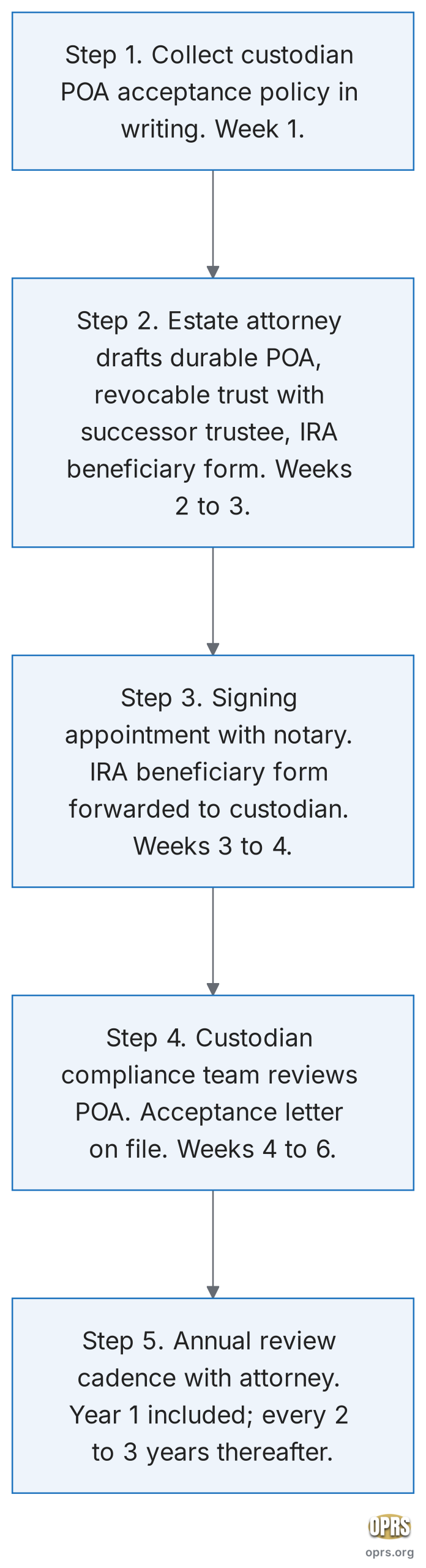
The five-step procedural workflow that produces the three signed documents
The three instruments are signed at one attorney appointment, in a specific order, with one prior step (custodian POA-policy collection) and one follow-up step (custodian acceptance filing).
Precious metals IRA fee-drag calculator
Precious metals IRAs charge mostly flat dollar fees (setup, annual custodian, storage). Flat fees take a much bigger bite out of a small account than a large one. Enter your numbers to see the drag.
Estimate only. Fee amounts vary by provider and are often not published; enter figures you confirm in writing. This tool ignores metal price changes and the dealer spread, which also affect returns. Not financial advice.
The right dealer explains every fee up front. Get Augusta's free precious metals IRA company checklist.
Step 1. Custodian POA-acceptance policy collection (week 1). Before the attorney appointment, the account holder calls the prospective gold IRA custodian and requests the written POA acceptance policy. The policy typically arrives by email within three to five business days. The account holder forwards it to the estate attorney before the drafting appointment.
Step 2. Estate attorney drafting appointment (week 2 to 3). The attorney drafts all three instruments at one appointment, against the custodian’s POA policy, the state’s revocable trust statute, and the SECURE Act post-death framework. The attorney typically charges a flat fee for the three-instrument single-filer package; the range observed in the persona profile is 1,800 to 3,500 dollars depending on state and complexity.
Step 3. Signing appointment (week 3 to 4). All three instruments are signed at one appointment, with the notary on site. The attorney’s office forwards the IRA beneficiary form original to the custodian. The account holder keeps the durable POA original, with notarized copies provided to the named agent and the custodian. The account holder holds the revocable trust original, and the successor trustee is notified by certified letter.
Step 4. Custodian acceptance filing (week 4 to 6). The custodian’s compliance team reviews the POA and the beneficiary form. A standard-form POA aligned with the custodian’s published policy clears review in three to five business days. An out-of-state or non-standard POA can take three to four weeks. The custodian sends written acceptance to the account holder confirming the POA is on file and the agent is recognized.
Step 5. Annual review cadence (year 1 forward). The attorney’s standard package typically includes an annual review touchpoint at no additional cost in year 1 and a flat-fee review every two to three years after that. Material life events (death of a named agent or beneficiary, change of state of residence, change of custodian) trigger an out-of-cycle review.
Custodian POA acceptance policy: four data points to collect before signing
The custodian’s POA acceptance policy drives the attorney’s drafting choices for the durable POA. Collecting it before the drafting appointment, rather than after, saves one drafting revision cycle and the corresponding attorney fee.
Custodian review time varies significantly by document quality. A standard-form POA aligned to the custodian’s published policy clears in three to five business days. A standard-form POA citing an out-of-state Uniform Act jurisdiction clears in ten to fifteen business days. A non-standard or older POA requiring full legal review takes fifteen to twenty-five business days.

Statutory framework recognized. The policy states which state’s POA statute the custodian’s compliance team is trained to review. Most national custodians recognize the Uniform Act and the major non-Uniform statutes (California, Florida, Texas, New York). The attorney confirms the custodian recognizes the state of the account holder’s residence before drafting.
Acceptance affidavit form. The policy states whether the custodian provides its own affidavit form or accepts the Uniform Act’s statutory affidavit. If the custodian provides its own form, the form is in the attorney’s drafting file before signing so the agent can sign both at the same notary appointment.
Re-execution requirement. Some custodians require a POA to be re-executed every three to five years to confirm currency. The policy should state the interval so the account holder can plan the attorney-appointment cadence accordingly.
Successor agent acceptance procedure. The policy should state how the custodian processes a successor agent’s claim when the primary is unavailable. Most policies require the successor to file an acceptance affidavit and evidence of the primary’s unavailability (death certificate, resignation letter, or physician’s certification).
A single filer considering custodians without published POA acceptance policies should treat the absence as a red flag. The published policy is the operational signal that the custodian handles POA cases routinely. Check this dealer against the 2026 OPRS list before settling on a custodian whose POA acceptance practice is unverified.
Common mistakes single filers make on the three-instrument stack
Mistake 1. Relying on the will as the IRA beneficiary instrument. The will does not control the IRA. If your IRA beneficiary form still lists “estate” (the default when no form is filed), the IRA routes through probate and triggers the less favorable 5-year rule under SECURE. A named residuary beneficiary in the will does not change that outcome.
Mistake 2. Naming the revocable trust as IRA beneficiary without see-through qualification. A trust that fails the Treasury Regulation 1.401(a)(9)-4 (Q&A 5) test is treated as if the estate is the beneficiary. Either name individual beneficiaries directly on the IRA form, or have the attorney confirm in writing the trust qualifies as see-through.
Mistake 3. Drafting the POA without explicit retirement-account authority. A POA that grants “general financial authority” without an explicit hot-power clause under the Uniform Act’s Section 211 will be rejected by most gold IRA custodians.
Mistake 4. Naming a single individual agent with no contingent. A POA with one named agent and no contingent fails if the primary predeceases, resigns, or is unable to serve at the moment the principal needs the agent. Name a primary, at least one contingent individual, and a corporate fiduciary as the legal default.
Mistake 5. Not collecting the custodian’s POA acceptance policy before drafting. An attorney drafting a generic state-form POA without seeing the custodian’s policy may produce a document the compliance team rejects on review. The policy comes first, the drafting comes second.
Mistake 6. Skipping the annual review. A POA signed at age 62, with a named agent who was 55 at signing, may have a different named-agent answer at age 75 when the agent is 68 or has predeceased. A calendar reminder for the annual review touchpoint, with the attorney’s office, every January.
Sub-Augusta-threshold context for sub-150,000 dollar accounts
The single-filer profile this guide targets typically holds a 403(b) or pension lump-sum balance in the 80,000 to 150,000 dollar range. Augusta Precious Metals’ industry-reported minimum sits around 50,000 dollars for gold IRA accounts, which puts the persona profile above the threshold but below the high-net-worth band most marketing materials target.
The procedural framework above applies identically at any balance level. The one adjustment for the sub-150,000 dollar account is the dealer-vetting filter. A small-balance account on a percentage-fee custodian structure can carry a fee drag you may not have priced into the rollover decision. the OPRS 2026 gold IRA trust list before any sub-threshold sleeve-sizing conversation moves to a destination custodian.
FAQ
Can a durable POA be used to roll over a 403(b) into a gold IRA on the account holder’s behalf?
Yes, provided the POA expressly grants retirement-account authority under the state’s POA statute and the receiving custodian accepts the document. Most national gold IRA custodians accept a POA with the explicit retirement-plan authority clause from the Uniform Act’s Section 211. The agent files the rollover paperwork in the agent’s capacity, with notarized acceptance affidavit. The custodian’s typical review window for a non-standard or out-of-state POA is three to four weeks.
Does a single filer need a revocable trust if the IRA beneficiary form covers the IRA transfer at death?
The trust is not for the IRA; the trust is for the non-IRA assets that fund estate administration. A single filer with no real estate may not need a trust if a transfer-on-death registration covers the non-IRA estate transfer.
A single filer in three situations typically benefits from the trust plus successor trustee combination. Those situations are owning a primary residence, expecting a pension survivor lump-sum payout, or holding a brokerage account she wants managed during a period of unavailability. The alternative is a probate court appointment of a guardian and an estate executor, which is materially slower and more expensive.
What happens to the gold IRA if the account holder dies before naming a beneficiary?
The custodian’s default is to treat the estate as the beneficiary when no form is on file.
The estate is not a “designated beneficiary” under the SECURE Act. That means the post-death distribution defaults to the 5-year rule if you died before the required beginning date, or to a continuation of your life-expectancy distribution schedule if you died after it.
Either outcome is materially less favorable than naming a designated beneficiary directly on the IRA form.
Can a sibling, niece, or longtime friend act as both the POA agent and the IRA beneficiary?
Yes, the named POA agent and the named IRA beneficiary can be the same individual. The legal frameworks are separate (POA reaches the IRA during the account holder’s lifetime; the beneficiary form reaches the IRA after death), so the same person can hold both roles without conflict. The estate attorney typically asks the account holder to confirm the choice in writing because the dual role gives the named individual significant authority before and after death.
How often should a single filer review the three-instrument stack after signing?
The documented cadence is an annual touchpoint review with the attorney in year 1 (typically included in the flat-fee package) and a flat-fee review every two to three years after that. Material life events trigger an out-of-cycle review: death of a named agent or beneficiary, change of state of residence, change of custodian, or material change in account balance.
Sources cited
- IRC Section 408 (Cornell Legal Information Institute)
- IRS Publication 590-B, Distributions from Individual Retirement Arrangements
- Treasury Regulation 1.401(a)(9)-4 (Cornell Legal Information Institute)
- Uniform Power of Attorney Act (Uniform Law Commission)
- Treasury Regulation 1.408-2 (Cornell Legal Information Institute)
- FINRA Investor Insights on Concentration Risk
- IRC Section 1014, Basis of Property Acquired from a Decedent (Cornell)